
SLIDE 1
Elementary Functions
Part 5, Trigonometry Lecture 5.4a, The Law of Cosines
- Dr. Ken W. Smith
Sam Houston State University
2013
Smith (SHSU) Elementary Functions 2013 1 / 22
Solving Triangles and the Law of Cosines
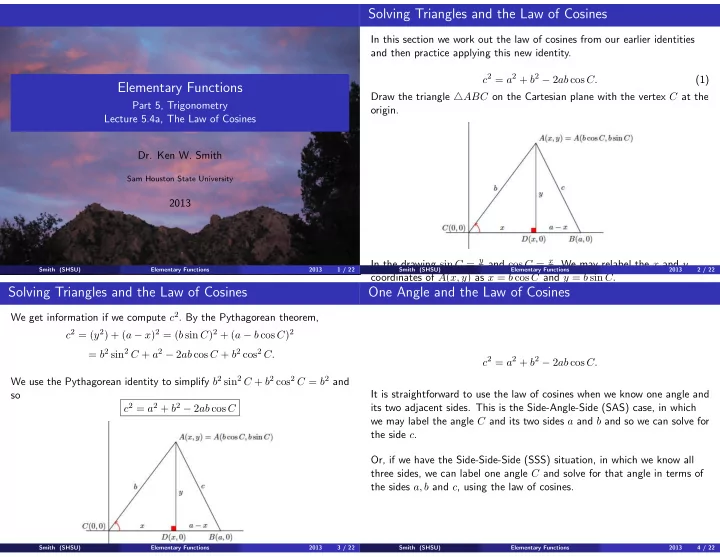
In this section we work out the law of cosines from our earlier identities and then practice applying this new identity. c2 = a2 + b2 − 2ab cos C. (1) Draw the triangle △ABC on the Cartesian plane with the vertex C at the
- rigin.
In the drawing sin C = y
b and cos C = x b . We may relabel the x and y
coordinates of A(x, y) as x = b cos C and y = b sin C.
Smith (SHSU) Elementary Functions 2013 2 / 22
Solving Triangles and the Law of Cosines
We get information if we compute c2. By the Pythagorean theorem, c2 = (y2) + (a − x)2 = (b sin C)2 + (a − b cos C)2 = b2 sin2 C + a2 − 2ab cos C + b2 cos2 C. We use the Pythagorean identity to simplify b2 sin2 C + b2 cos2 C = b2 and so c2 = a2 + b2 − 2ab cos C
Smith (SHSU) Elementary Functions 2013 3 / 22
One Angle and the Law of Cosines
c2 = a2 + b2 − 2ab cos C. It is straightforward to use the law of cosines when we know one angle and its two adjacent sides. This is the Side-Angle-Side (SAS) case, in which we may label the angle C and its two sides a and b and so we can solve for the side c. Or, if we have the Side-Side-Side (SSS) situation, in which we know all three sides, we can label one angle C and solve for that angle in terms of the sides a, b and c, using the law of cosines.
Smith (SHSU) Elementary Functions 2013 4 / 22