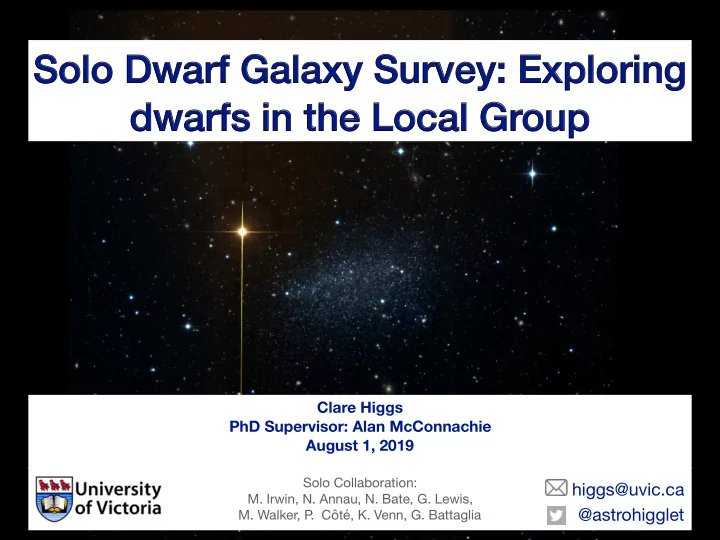
Solo Dwarf Galaxy Survey: Exploring dwarfs in the Local Group Clare - - PowerPoint PPT Presentation

solo dwarf galaxy survey exploring dwarfs in the local
SMART_READER_LITE
LIVE PREVIEW

Solo Dwarf Galaxy Survey: Exploring dwarfs in the Local Group Clare - - PowerPoint PPT Presentation

Solo Dwarf Galaxy Survey: Exploring dwarfs in the Local Group Clare Higgs PhD Supervisor: Alan McConnachie August 1, 2019 Solo Collaboration: higgs@uvic.ca M. Irwin, N. Annau, N. Bate, G. Lewis, @astrohigglet M. Walker, P . Ct, K. Venn,


slide-1
SLIDE 1

Solo Dwarf Galaxy Survey: Exploring dwarfs in the Local Group

Clare Higgs PhD Supervisor: Alan McConnachie August 1, 2019

higgs@uvic.ca @astrohigglet

Solo Collaboration:

  • M. Irwin, N. Annau, N. Bate, G. Lewis,
  • M. Walker, P

. Côté, K. Venn, G. Battaglia

slide-2
SLIDE 2

DWARF GALAXIES

Local Group and a little beyond. ➡ Inside 3 Mpc. Not within the virial radius of a large galaxy ➡ More than 300 kpc from M31 and the Milky Way Low mass. MV >-18

NEARBY ISOLATED

slide-3
SLIDE 3

Why … NEARBY ISOLATED

  • Sensitive probes of galaxy formation and evolution
  • Resolved stellar populations
  • Intrinsic properties of low mass galaxies

Solitary Local (Solo) Dwarf Galaxy Survey

DWARF GALAXIES Why … Why …

slide-4
SLIDE 4

▸ Nearby (<3 Mpc) ▸ Isolated (>300 kpc from MW/M31) ▸ Wide field imaging (u), g & i ▸ CFHT MegaCam, Magellan Megacam

and Magellan IMACS

Solo Observations

Name

  • Alt. Name

RA Dec. Distance E(B − V ) Tel. Filt. [kpc] [Mags.] WLM DDO221 00h01m58.2s −15o27039” 933 ± 34 0.030 M gi C gi AndXVIII 00h02m14.5s +45o05020” 1355 ± 81 0.102 C gi ESO410-G005 KK98 00h15m31.6s −32o10048” 1923 ± 35 0.013 M ugi Cetus 00h26m11.0s −11o02040” 755 ± 24 0.038 M gi C g ESO294-G010 00h26m33.4s −41o51019” 2032 ± 37 0.013 M g i IC1613 DDO8 01h04m47.8s +02o07004” 755 ± 42 0.030 M ugi C gi KKs3 02h24m44.4s −73o30051” 2120 ± 70 0.045 M gi Perseus 03h01m22.8s +40o59017” 785 ± 65 0.062 C Eridanus II 03h44m21.1s −43o32000” 785 ± 65 M UGCA86 03h59m48.3s +67o08019” 2960 ± 232 0.918 C gi HIZSS3A(B) 07h00m29.3s −04o12030” 1675 ± 108 0.046 M ugi C g UGC4879 09h16m02.2s +52o50024” 1361 ± 25 0.215 C gi LeoT 09h34m53.4s +17o03005” 417 ± 19 0.037 C gi Antlia B 09h48m56.1s −25o59024” 1294 ± 99 C g LeoA 09h59m26.5s +30o44047” 798 ± 44 0.055 C gi SextansB 10h00m00.1s +05o19056” 1426 ± 20 0.034 C gi NGC3109 DDO236 10h03m06.9s −26o09035” 1300 ± 48 0.013 M ugi Antlia 10h04m04.1s −27o19052” 1349 ± 62 0.011 M gi SextansA DDO75 10h11m00.8s −04o41034” 1432 ± 53 0.046 M ugi LeoP 10h21m45.1s +18o05017” 1620 ± 150 0.090 C gi DDO99 11h50m53.0s +38o52049” 2590 ± 167 0.053 C ig NGC4163 12h12m09.1s +36o10009” 2860 ± 39 0.050 C gi IC3104 12h18m46.0s −79o43034” 2270 ± 188 0.065 M ugi DDO113 12h14m57.9s +36o13008” 2950 ± 82 0.049 C gi DDO125 12h27m40.9s +43o29044” 2580 ± 59 0.091 C gi GR8 DDO155 12h58m40.4s +14o13003” 2178 ± 120 0.066 M gi UGC8508 13h30m44.4s +54o54036” 2580 ± 36 0.227 C gi KKH86 13h54m33.5s +04o14035” 2590 ± 190 0.053 M ugi KKR3 14h07m10.5s +35o03037” 2188 ± 121 0.047 C gi UGC9128 14h15m56.5s +23o03019” 2291 ± 42 0.038 C g DDO190 14h24m43.4s +44o31033” 2790 ± 93 0.100 C gi KKR25 16h13m48.0s +54o22016” 1905 ± 61 0.345 C gi IC4662 17h47m08.8s −64o38030” 2440 ± 191 0.020 M gi SagDIG 19h29m59.0s −17o40051” 1067 ± 88 0.019 C ugi NGC6822 DDO209 19h44m56.6s −14o47021” 459 ± 17 0.018 C ugi Phoenix 19h44m56.6s −14o47021” 415 ± 19 0.010 M ugi DDO210 Aquarius 20h46m51.8s −12o50053” 1072 ± 39 0.026 M ugi C ugi IC5152 22h02m41.5s −51o17047” 1950 ± 45 0.016 M ugi AndXXVIII 22h32m41.2s +31o12058” 661+152

61

0.051 C ugi KK258 22h40m43.9s −30o47059” 2230 ± 50 0.011 M gi Tucana 22h41m49.6s −64o25010” 887 ± 49 0.024 M ugi UKS2323-326 UGCA438 23h26m27.5s −32o23020” 2208 ± 92 0.021 M ugi PegDIG DDO216 23h28m36.3s +14o44035” 920 ± 30 0.061 C ugi KKH98 23h45m34.0s +38o43004” 2523 ± 105 0.053 C ugi

slide-5
SLIDE 5

Why … NEARBY ISOLATED

  • Sensitive probes of galaxy formation and evolution
  • Resolved stellar populations
  • Intrinsic properties of low mass galaxies

DWARF GALAXIES Why … Why …

  • Need to minimize systematics

HOMOGENEOUS Why …

slide-6
SLIDE 6

Local Group Subsample

distance to M31

WLM = DDO 221 UGC 4879 = VV 124 IC 1613 = DDO 8 DDO 210 = Aquarius NGC 6822 = DDO 209 Peg DIG =DDO 216

  • Alt. Names:

McConnachie 2012

slide-7
SLIDE 7

Solo Dwarfs

0.5°

IC 1613 Leo T Leo A WLM Perseus Sag DIG

slide-8
SLIDE 8

Full field of view

Solo Dwarfs

0.5°

IC 1613 Leo T Leo A WLM Perseus Sag DIG

slide-9
SLIDE 9

Analysis Techniques

Resolved Stars Integrated Light

Pros:

Describe the central regions well.

Colour profiles Cons:

Dominated by younger stellar populations.

Heavily contaminated by foreground and background sources.

Combine both!

Pros:

Reveals faint and extended stellar populations.

Mass weighted rather than luminosity weighted.

Can study the fainter old RGB population.

Kinematic tracers often RGB stars. Cons:

Incompleteness due to Crowding in the central part

Radial profiles are not in “conventional” units.

slide-10
SLIDE 10

Resolved Stars in Nearby Dwarfs

slide-11
SLIDE 11

Resolved Stars in Nearby Dwarfs

slide-12
SLIDE 12

Extended Radial Profiles

Combine resolved stellar profiles with integrated light profiles in the i band.

The g band is used in dwarfs with no visible integrated i band.

Combine with parameter

  • .

γRGB

Surface Brightness Radius

slide-13
SLIDE 13

Extended Radial Profiles

Surface Brightness Radius Similar “wings” observed by Bellazzini et al. 2018.

slide-14
SLIDE 14

Comparisons with Literature Values

Comparisons to values compiled by McConnachie 2012

slide-15
SLIDE 15

Trends/Future Work

How does shape or size vary with distance?

Indicative of tidal effects

Trends with star formation histories?

Reshaping due to internal processes

Comparison to MW or M31 satellites, dwarfs in Fornax, M101 etc.

External environmental effects

Preliminary!

slide-16
SLIDE 16

Trends/Future Work

Martin et al. 2018

Martin et al. 2018 find ultra faint MW satellites are increasingly flatter with decreasing luminosity.

We find the brighter Solo dwarfs are more elliptical in general

Preliminary!

slide-17
SLIDE 17

Exploring γRGB

  • describes the fraction
  • f i band light resulting from

the RGB stars.

Dependent on spatially resolved star formation history, metallicity, age - metallicity relation, dust reddening…

γRGB

Larger fraction from RGB stars Redder

slide-18
SLIDE 18

Summary

Uniform and homogenous analysis of nearby isolated dwarf galaxies near the Local Group.

Generate extended radial profiles to faint surface brightness limits.

Study dwarfs collectively and individually.

Clare Higgs higgs@uvic.ca @astrohigglet