SLIDE 1
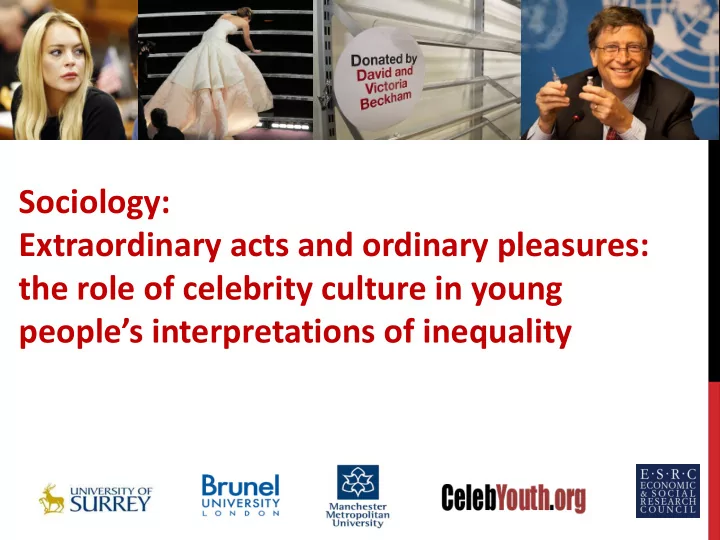
Sociology: Extraordinary acts and ordinary pleasures: the role of celebrity culture in young people’s interpretations of inequality
SLIDE 2
Forbes.com, 2013; 2014
SLIDE 3 Youth cultures and youth transitions
Youth cultures
- Youth culture, inequalities and
resistance (e.g. Hall & Jefferson, 2006; Willis et al., 1990, McRobbie, 1991)
- Post-subcultural work (e.g. Bennett
& Kahn-Harris, 2004; Muggleton & Weinzierl, 2003) Youth transitions
- Transitions into adulthood,
particularly from education to employment (e.g. Henderson et al., 2007; MacDonald & Shildrick, 2007)
Image from: http://chereefranco.wordpress.com/2010/04/19/teddy- girls-boys/
SLIDE 4
Challenging dominant narratives about youth and celebrity
SLIDE 5 Making sense of inequality
“In this double-declaiming, envy is kept at bay. The uncalculated calculations
common-sense’s double- declaiming can be used to compare ‘their’ misfortunes with ‘our’ gains … Speakers are to be heard depicting the pleasures
- f ‘ordinary life’ in general, and affirming, in a personal way,
the credits of their own particular lives.” (Billig, 1992, p.119) “As the columns of credits and debits are summed, so the accounts are settled to arrive at the conclusion that there is a ‘just-world’, at least so far as royals and commoners are concerned.” (Billig, 1992, p.124)
SLIDE 6 Celebrities do extraordinary things
Bob: It was on the News yesterday. He was like helping eradicate polio from like the
- world. So yeah. (South West, Year 10)
Herbert: Bill Gates as well. He’s, because he’s like, yeah, well he’s probably richer than anyone here but he gives away like 80% of all his money but he’s still like a billionaire [laughing slightly] so, whereas like those lot they just keep it all and live in huge mansions which they don’t need, but Bill Gates he just gives it all to charity which is yeah, that’s good. (South West, individual interview, Year 10)
SLIDE 7
The importance of charity
Heather: David Beckham, did you say he was the ideal celebrity? Bruno: Yeah. … You can't argue with him. … like he wasn’t born with talent, there are so many people that are born with something, he had to work for it, like every day, day in, day out. And he would be playing at the time when he would get like £10, and now, £10 a week, and now people get 100k a week. And since then, even now he’s giving, three like three, three million pounds to charity for five months, and he’s playing for a Paris club, but he’s not taking the money, he’s going to give it to charity straight away. I don't think he’s a wrong person, something you can tell like, he’s done nothing wrong. (London school, Year 12)
SLIDE 8 Macdonalds on the red carpet: celebrities as
- rdinary in extraordinary circumstances
SLIDE 9
Jennifer Lawrence: ‘she’s just like us’
Strawberry: Because she’s just normal. Like she was on the red carpet, and she was ordering McDonald’s, and I thought that was cool, coz like all the rest of them are like starving themselves, and she was giving out a positive message. And then she tripped, and just laughed at herself. (London, Year 12) Amelia: Jennifer Lawrence always seems like someone who’s just like us, like she always talks about how she’d never wanna get really skinny, because she likes food. [laughter] And she doesn’t like the pressure of having to be really skinny. (Manchester, Year 10)
SLIDE 10
Celebrity lives as disgusting and inauthentic
Mike: You could fit all the real parts of Nicki Minaj into … a drawer approximately that big. She’s just like the biggest fakest walking talking Barbie, and also she tries to be Lady Gaga which annoys me. Um. She’s just, she’s just, argh, if I saw her I would actually hit her. With a brick. [laughter] I would probably knock one of her facial features out. … I wonder if she does feel like rubber, it would be great, you can bounce her. [laughter] Roll her down a hill. Who wouldn’t want to do that? [laughter] (South West, Year 10, female) Kim: You use the word fake. What do you mean? Kirsty: Not their-selves. … Literally not themselves, like some of their body parts just aren’t real. [all laugh] (Manchester, Year 10)
SLIDE 11
Schadenfreude and celebrity hating
Laura: Why do you find her [Kim Kardashian] funny? Teresa: Because it’s like she doesn’t, her life isn’t really. She doesn’t do anything worthwhile apart from be a socialite, and I’m not even sure if that’s like a proper career, but it’s just- she’s quite funny to watch, because she’s so materialistic. So it’s amusing. (South West, year 10) Laura: So you’d rather meet someone you disliked? Shane: Probably. Rick: Just so I can abuse them. Shane: Yeah … You know, like it’s like when people say erm [pause] you know, it’s like they’ve got such a big ego, you just want to take them down a couple of pegs. That’s why … Just because they think so highly of themselves, and they haven’t really done anything so. (London, year 12)
SLIDE 12
Celebrity Schadenfreude and Inequality
Schadenfreude as a ‘trans-affective process of resentment’ Individuals have a ‘desire for equality but [are] unable to think of anything other than levelling through humiliation’ (Cross and Littler, 2010: 397)
SLIDE 13 Credits and debits
Forbes.com, billionaire list on 23/06/14
‘As the columns of credits and debits are summed, so the accounts are settled to arrive at the conclusion that there is a ‘just-world’, at least so far as [celebrities and the rest of us] are concerned’ (Billig, 1992)
SLIDE 14 Credits, debits and aspirations
Read the data extract In your group, discuss:
- Can our analysis of celebrity talk help us to make sense of the
stories these young people tell? How?
- How can youth cultural and youth transitions work be usefully
combined to help us to understand contemporary young people’s lives?
SLIDE 15
@CelebYouthUK #Celebyouth