So Social work with women and their co companion animals ls Me - - PowerPoint PPT Presentation

so social work with women and their co companion animals
SMART_READER_LITE
LIVE PREVIEW

So Social work with women and their co companion animals ls Me - - PowerPoint PPT Presentation

New Voices ANZSWWER 2019 symposium Activism & Social change Oct 3 & 4 2019, Edith Cowan University, Perth, Australia En Encounterin ing g Interspecie ies Homelessness: So Social work with women and their co companion animals


slide-1
SLIDE 1

New Voices ANZSWWER 2019 symposium – Activism & Social change – Oct 3 & 4 2019, Edith Cowan University, Perth, Australia

En Encounterin ing g Interspecie ies Homelessness:

So Social work with women and their co companion animals ls

Me Melis lissa Lain ing

PhD Candidate School of Global, Urban & Social Studies RMIT University melissa.laing@rmit.edu.au

@ylaingylaing

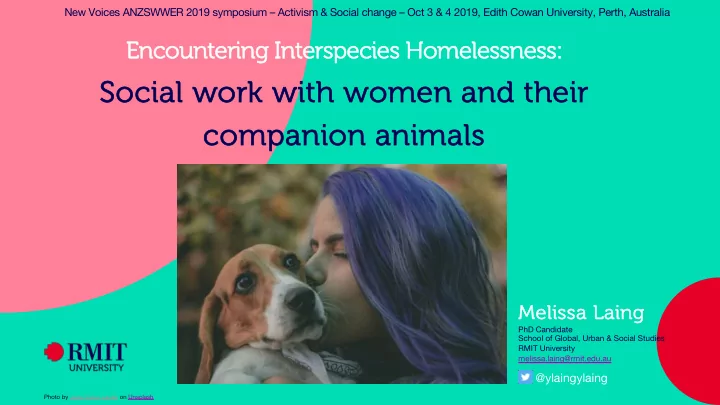
Photo by Joao Victor xavier on Unsplash

slide-2
SLIDE 2

Cr Critical social work in Family Violence & Homelessness/H /Housing sectors: Fr From all-to too-hu human to

  • mor
  • re-th

than-hu human?

“Why doesn’t she just give up her dog?”

Photo by April Walker on Unsplash

slide-3
SLIDE 3

Re Research questions

What is the nature of companion animal-inclusive practices

  • f resistance with interspecies families at risk of, or

experiencing homelessness?

How do social workers (and other practitioners) understand and frame care towards, and within interspecies families? What are factors that influence the care of interspecies families in social work and the broader human services? What further scope for companion animal-inclusive practice do social workers envisage for interspecies families at risk of, or experiencing homelessness?

Photo by Calum Lewis on Unsplash

slide-4
SLIDE 4

Re Research design

Co Conceptual framework: Critical posthumanism (Cudworth & Hobden, 2018) Critical ethics of care (Pease, Vreugdenhil & Stanford, 2018) & Ecofeminism (Adams & Gruen, 2014) Qualitatively-driven Mixed Methods (Creswell & Plano Clark, 2011;

Mertens, 2008)

Online survey (n=90 SW & non-SW) from Victorian Homelessness/Housing & Family Violence sectors Semi-structured in-depth interviews (n=17 SW) Reflexive thematic analysis (Braun, Clarke, Hayfield & Terry, 2019) inductive and deductive coding

Photo by Wendy Aros-Routman on Unsplash

slide-5
SLIDE 5

No Normative resista tance Cr Creative resistance Su Subversive resistance Op Open resistance

A A cri ritical po posthumanist so social work?

Photo by Ben Mater on Unsplash

RQ: What is the nature of companion animal-inclusive practices of resistance with interspecies families at risk of, or experiencing homelessness?

Resistance

Normative Creative Subversive Open

slide-6
SLIDE 6

No Normative resistance Su Subversive resistance

Companion animal friendly refuges Taking companion animals home (either temporarily or permanently with consent) Intake processes that specifically assess companion animals as part of the family system “Stealing animals” from violent homes Having relationships with veterinary clinics or hospitals for access to food, health care and emergency boarding for companion animals in situations where the family had to be separated Sneaking animals into crisis accommodation (motels, refuges) Brokerage money that is specifically for companion animals Linguistic sleight of hand - ‘turning a blind eye’, conversations that didn’t happen, saying things without saying things, ‘truth stretching’/lying by omission

slide-7
SLIDE 7

Adams, C., & Gruen, L. (Eds.). (2014). Ecofeminism: Feminist intersections with other animals and the earth. New York, NY: Bloomsbury Academic. Animal Medicines Australia. (2016). Pet ownership in Australia 2016. Retrieved from http://animalmedicinesaustralia.org.au/wp-content/uploads/2016/11/AMA_Pet-Ownership-in-Australia-2016- Report_sml.pdf Bozalek, V. (2018). Afterword. In B. Pease, A. Vreugdenhil, & S. Stanford (Eds.), Critical ethics of care in social work: Transforming the politics and practices of caring (pp. 241–245). London, England: Routledge. Braun, V., Clarke, V., Hayfield, N., & Terry, G. (2019). Thematic Analysis. In P. Liamputtong (Ed.), Handbook of Research Methods in Health Social Sciences (pp. 843–860). https://doi.org/10.1007/978-981-10-5251-4_103 Cudworth, E., & Hobden, S. (2018). Anarchism’s posthuman future. Anarchist Studies, 26(1), 79–104. Laing, M., & Maylea, C. (2018). A conceptual framework for taking subversive social work into the classroom. Advances in Social Work & Welfare Education, 20(2), 23–30. New Zealand Companion Animal Council, (2016). Companion animals in New Zealand. Retrieved from https://www.nzvna.org.nz/site/nzvna/files/Documents/Companion%20Animals_in_New_Zealand_2016_Report_we b.pdf Pease, B., Vreugdenhil, A., & Stanford, S. (Eds.). (2018). Critical ethics of care in social work: Transforming the politics and practices of caring. London, England: Routledge. Sanders, C. R. (1995). Killing with Kindness: Veterinary Euthanasia and the Social Construction of Personhood. Sociological Forum, 10(2), 195–214.

Re References