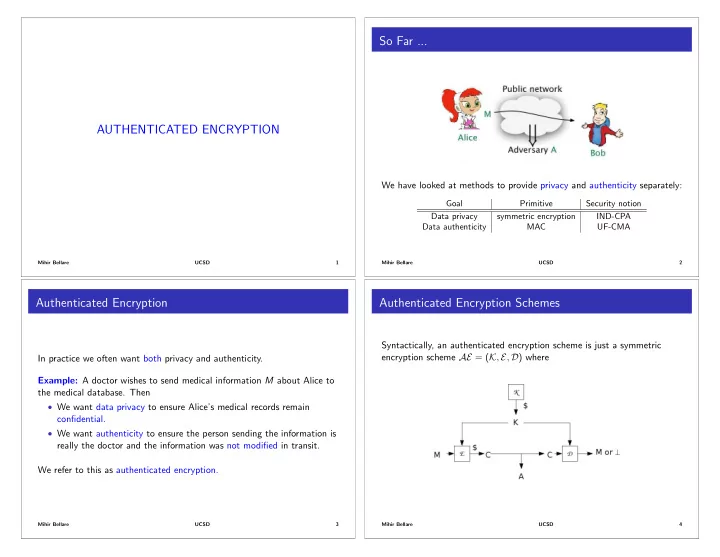
So Far ... AUTHENTICATED ENCRYPTION We have looked at methods to - - PowerPoint PPT Presentation

so far authenticated encryption
SMART_READER_LITE
LIVE PREVIEW

So Far ... AUTHENTICATED ENCRYPTION We have looked at methods to - - PowerPoint PPT Presentation

So Far ... AUTHENTICATED ENCRYPTION We have looked at methods to provide privacy and authenticity separately: Goal Primitive Security notion Data privacy symmetric encryption IND-CPA Data authenticity MAC UF-CMA Mihir Bellare UCSD 1


slide-1
SLIDE 1

AUTHENTICATED ENCRYPTION

Mihir Bellare UCSD 1

So Far ...

We have looked at methods to provide privacy and authenticity separately:

Goal Primitive Security notion Data privacy symmetric encryption IND-CPA Data authenticity MAC UF-CMA

Mihir Bellare UCSD 2

Authenticated Encryption

In practice we often want both privacy and authenticity. Example: A doctor wishes to send medical information M about Alice to the medical database. Then

  • We want data privacy to ensure Alice’s medical records remain

confidential.

  • We want authenticity to ensure the person sending the information is

really the doctor and the information was not modified in transit. We refer to this as authenticated encryption.

Mihir Bellare UCSD 3

Authenticated Encryption Schemes

Syntactically, an authenticated encryption scheme is just a symmetric encryption scheme AE = (K, E, D) where

Mihir Bellare UCSD 4

slide-2
SLIDE 2

Privacy of Authenticated Encryption Schemes

The notion of privacy for symmetric encryption carries over, namely we want IND-CPA.

Mihir Bellare UCSD 5

Integrity of Authenticated Encryption Schemes

Adversary’s goal is to get the receiver to accept a “non-authentic” ciphertext C. Integrity of ciphertexts: C is “non-authentic” if it was never transmitted by the sender.

Mihir Bellare UCSD 6

INT-CTXT

Let AE = (K, E, D) be a symmetric encryption scheme and A an adversary. Game INTCTXTAE procedure Initialize K

$

← K ; S ← ∅ procedure Enc(M) C

$

← EK(M) S ← S ∪ {C} Return C procedure Finalize(C) M ← DK(C) if (C ∈ S ∧ M = ⊥) then return true Else return false The int-ctxt advantage of A is Advint-ctxt

AE

(A) = Pr[INTCTXTA

AE ⇒ true]

Mihir Bellare UCSD 7

Integrity with privacy

The goal of authenticated encryption is to provide both integrity and

  • privacy. We will be interested in IND-CPA + INT-CTXT.

Mihir Bellare UCSD 8

slide-3
SLIDE 3

Plain Encryption Does Not Provide Integrity

Alg EK(M) C[0]

$

← {0, 1}n For i = 1, . . . , m do C[i] ← EK(C[i − 1] ⊕ M[i]) Return C Alg DK(C) For i = 1, . . . , m do M[i] ← E−1

K (C[i]) ⊕ C[i − 1]

Return M Question: Is CBC$ encryption INT-CTXT secure? Answer: No, because any string C[0]C[1] . . . C[m] has a valid decryption.

Plain Encryption Does Not Provide Integrity

Alg EK(M) C[0]

$

← {0, 1}n For i = 1, . . . , m do C[i] ← EK(C[i − 1] ⊕ M[i]) Return C Alg DK(C) For i = 1, . . . , m do M[i] ← E−1

K (C[i]) ⊕ C[i − 1]

Return M Question: Is CBC$ encryption INT-CTXT secure?

Plain Encryption Does Not Provide Integrity

Alg EK(M) C[0]

$

← {0, 1}n For i = 1, . . . , m do C[i] ← EK(C[i − 1] ⊕ M[i]) Return C Alg DK(C) For i = 1, . . . , m do M[i] ← E−1

K (C[i]) ⊕ C[i − 1]

Return M adversary A C[0]C[1]C[2]

$

← {0, 1}3n Return C[0]C[1]C[2] Then Advint-ctxt

SE

(A) = 1 This violates INT-CTXT. A scheme whose decryption algorithm never outputs ⊥ cannot provide integrity!

Mihir Bellare UCSD 11

Encryption with Redundancy

✐ ❄ ❄

EK M[1] C[1]

✐ ❄ ❄

EK M[m] C[m]

✐ ❄ ❄

EK C[2] M[2]

✐ ❄ ❄

EK h(M) C[m + 1] ... C[0] Here E: {0, 1}k × {0, 1}n → {0, 1}n is our block cipher and h: {0, 1}∗ → {0, 1}n is a “redundancy” function, for example

  • h(M[1] . . . M[m]) = 0n
  • h(M[1] . . . M[m]) = M[1] ⊕ · · · ⊕ M[m]
  • A CRC
  • h(M[1] . . . M[m]) is the first n bits of SHA1(M[1] . . . M[m]).

The redundancy is verified upon decryption.

Mihir Bellare UCSD 12

slide-4
SLIDE 4

Encryption with Redundancy

✐ ❄ ❄

EK M[1] C[1]

✐ ❄ ❄

EK M[m] C[m]

✐ ❄ ❄

EK C[2] M[2]

✐ ❄ ❄

EK h(M) C[m + 1] ... C[0] Let E: {0, 1}k × {0, 1}n → {0, 1}n be our block cipher and h: {0, 1}∗ → {0, 1}n a redundancy function. Let SE = (K, E′, D′) be CBC$ encryption and define the encryption with redundancy scheme AE = (K, E, D) via Alg EK(M) M[1] . . . M[m] ← M M[m + 1] ← h(M) C

$

← E′

K(M[1] . . . M[m]M[m + 1])

return C Alg DK(C) M[1] . . . M[m]M[m + 1] ← D′

K(C)

if (M[m + 1] = h(M)) then return M[1] . . . M[m] else return ⊥

Mihir Bellare UCSD 13

Arguments in Favor of Encryption with Redundancy

✐ ❄ ❄

EK M[1] C[1]

✐ ❄ ❄

EK M[m] C[m]

✐ ❄ ❄

EK C[2] M[2]

✐ ❄ ❄

EK h(M) C[m + 1] ... C[0] The adversary will have a hard time producing the last enciphered block of a new message.

Mihir Bellare UCSD 14

Encryption with Redundancy Fails

adversary A M[1]

$

← {0, 1}n ; M[2] ← h(M[1]) C[0]C[1]C[2]C[3]

$

← Enc(M[1]M[2]) Return C[0]C[1]C[2]

✐ ❄ ❄

EK M[1] C[1]

✐ ✐ ❄ ❄ ❄ ❄

C[0] EK C[2] EK C[3] h(M[1]M[2])

h(M[1])

  • M[2]

This attack succeeds for any (not secret-key dependent) redundancy function h.

Mihir Bellare UCSD 15

WEP Attack

A “real-life” rendition of this attack broke the 802.11 WEP protocol, which instantiated h as CRC and used a stream cipher for encryption [BGW]. What makes the attack easy to see is having a clear, strong and formal security model.

Mihir Bellare UCSD 16

slide-5
SLIDE 5

Generic Composition

Build an authenticated encryption scheme AE = (K, E, D) by combining

  • a given IND-CPA symmetric encryption scheme SE = (K′, E′, D′)
  • a given PRF F : {0, 1}k × {0, 1}∗ → {0, 1}n

CBC$-AES CTR$-AES . . . HMAC-SHA1 CMAC ECBC . . .

Mihir Bellare UCSD 17

Generic Composition

Build an authenticated encryption scheme AE = (K, E, D) by combining

  • a given IND-CPA symmetric encryption scheme SE = (K′, E′, D′)
  • a given PRF F : {0, 1}k × {0, 1}∗ → {0, 1}n

A key K = Ke||Km for AE always consists of a key Ke for SE and a key Km for F: Alg K Ke

$

← K′; Km

$

← {0, 1}k Return Ke||Km

Mihir Bellare UCSD 18

Generic Composition Methods

The order in which the primitives are applied is important. Can consider Method Usage Encrypt-and-MAC (E&M) SSH MAC-then-encrypt (MtE) SSL/TLS Encrypt-then-MAC (EtM) IPSec We study these following [BN].

Mihir Bellare UCSD 19

Encrypt-and-MAC

AE = (K, E, D) is defined by Alg EKe||Km(M) C ′

$

← E′

Ke(M)

T ← FKm(M) Return C ′||T Alg DKe||Km(C ′||T) M ← D′

Ke(C ′)

If (T = FKm(M)) then return M Else return ⊥ Security Achieved? IND-CPA INT-CTXT

Mihir Bellare UCSD 20

slide-6
SLIDE 6

Encrypt-and-MAC

AE = (K, E, D) is defined by Alg EKe||Km(M) C ′

$

← E′

Ke(M)

T ← FKm(M) Return C ′||T Alg DKe||Km(C ′||T) M ← D′

Ke(C ′)

If (T = FKm(M)) then return M Else return ⊥ Security Achieved? IND-CPA NO INT-CTXT Why? T = FKm(M) is a deterministic function of M and allows detection

  • f repeats.

Mihir Bellare UCSD 21

Encrypt-and-MAC

AE = (K, E, D) is defined by Alg EKe||Km(M) C ′

$

← E′

Ke(M)

T ← FKm(M) Return C ′||T Alg DKe||Km(C ′||T) M ← D′

Ke(C ′)

If (T = FKm(M)) then return M Else return ⊥ Security Achieved? IND-CPA NO INT-CTXT

Mihir Bellare UCSD 22

Encrypt-and-MAC

AE = (K, E, D) is defined by Alg EKe||Km(M) C ′

$

← E′

Ke(M)

T ← FKm(M) Return C ′||T Alg DKe||Km(C ′||T) M ← D′

Ke(C ′)

If (T = FKm(M)) then return M Else return ⊥ Security Achieved? IND-CPA NO INT-CTXT NO Why? May be able to modify C ′ in such a way that its decryption is unchanged.

Mihir Bellare UCSD 23

MAC-then-Encrypt

AE = (K, E, D) is defined by Alg EKe||Km(M) T ← FKm(M) C

$

← E′

Ke(M||T)

Return C Alg DKe||Km(C) M||T ← D′

Ke(C)

If (T = FKm(M)) then return M Else return ⊥ Security Achieved? IND-CPA INT-CTXT

Mihir Bellare UCSD 24

slide-7
SLIDE 7

MAC-then-Encrypt

AE = (K, E, D) is defined by Alg EKe||Km(M) T ← FKm(M) C

$

← E′

Ke(M||T)

Return C Alg DKe||Km(C) M||T ← D′

Ke(C)

If (T = FKm(M)) then return M Else return ⊥ Security Achieved? IND-CPA YES INT-CTXT Why? SE′ = (K′, E′, D′) is IND-CPA secure.

Mihir Bellare UCSD 25

MAC-then-Encrypt

AE = (K, E, D) is defined by Alg EKe||Km(M) T ← FKm(M) C

$

← E′

Ke(M||T)

Return C Alg DKe||Km(C) M||T ← D′

Ke(C)

If (T = FKm(M)) then return M Else return ⊥ Security Achieved? IND-CPA YES INT-CTXT

Mihir Bellare UCSD 26

MAC-then-Encrypt

AE = (K, E, D) is defined by Alg EKe||Km(M) T ← FKm(M) C

$

← E′

Ke(M||T)

Return C Alg DKe||Km(C) M||T ← D′

Ke(C)

If (T = FKm(M)) then return M Else return ⊥ Security Achieved? IND-CPA YES INT-CTXT NO Why? May be able to modify C in such a way that its decryption is unchanged.

Mihir Bellare UCSD 27

Encrypt-then-MAC

AE = (K, E, D) is defined by Alg EKe||Km(M) C ′

$

← E′

Ke(M)

T ← FKm(C ′) Return C ′||T Alg DKe||Km(C ′||T) M ← D′

Ke(C ′)

If (T = FKm(C ′)) then return M Else return ⊥ Security Achieved? IND-CPA INT-CTXT

Mihir Bellare UCSD 28

slide-8
SLIDE 8

Encrypt-then-MAC

AE = (K, E, D) is defined by Alg EKe||Km(M) C ′

$

← E′

Ke(M)

T ← FKm(C ′) Return C ′||T Alg DKe||Km(C ′||T) M ← D′

Ke(C ′)

If (T = FKm(C ′)) then return M Else return ⊥ Security Achieved? IND-CPA YES INT-CTXT Why? SE′ = (K′, E′, D′) is IND-CPA secure.

Mihir Bellare UCSD 29

Encrypt-then-MAC

AE = (K, E, D) is defined by Alg EKe||Km(M) C ′

$

← E′

Ke(M)

T ← FKm(C ′) Return C ′||T Alg DKe||Km(C ′||T) M ← D′

Ke(C ′)

If (T = FKm(C ′)) then return M Else return ⊥ Security Achieved? IND-CPA YES INT-CTXT

Mihir Bellare UCSD 30

Encrypt-then-MAC

AE = (K, E, D) is defined by Alg EKe||Km(M) C ′

$

← E′

Ke(M)

T ← FKm(C ′) Return C ′||T Alg DKe||Km(C ′||T) M ← D′

Ke(C ′)

If (T = FKm(C ′)) then return M Else return ⊥ Security Achieved? IND-CPA YES INT-CTXT YES Why? If C||T is new then T will be wrong.

Mihir Bellare UCSD 31

Two keys or one?

We have used separate keys Ke, Km for the encryption and message

  • authentication. However, these can be derived from a single key K via

Ke = FK(0) and Km = FK(1), where F is a PRF such as a block cipher, the CBC-MAC or HMAC. Trying to directly use the same key for the encryption and message authentication is error-prone, but works if done correctly.

Mihir Bellare UCSD 32

slide-9
SLIDE 9

Exercise

Let E = AES. Let K return a random 128-bit AES key K. Let SE = (K, E, D) where E, D are below. Here, X[i] denotes the i-th 128-bit block

  • f a string whose length is a multiple of 128.

Alg EK(M) if |M| = 512 then return ⊥ M[1] . . . M[4] ← M Ce[0]

$

← {0, 1}128Cm[0] ← 0128 for i = 1, . . . , 4 do Ce[i] ← EK(Ce[i − 1] ⊕ M[i]) Cm[i] ← EK(Cm[i − 1] ⊕ M[i]) Ce ← Ce[0]Ce[1]Ce[2]Ce[3]Ce[4] T ← Cm[4]; return (Ce, T) Alg DK((Ce, T)) if |Ce| = 640 then return ⊥ Cm[0] ← 0128 for i = 1, . . . , 4 do M[i] ← E −1

K (Ce[i]) ⊕ Ce[i − 1]

Cm[i] ← EK(Cm[i − 1] ⊕ M[i]) if Cm[4] = T then return ⊥ return M

Mihir Bellare UCSD 33

Exercise

1. Is SE IND-CPA-secure? Why or why not? 2. Is SE INT-CTXT-secure? Why or why not? 3. Is SE an Encrypt-and-MAC construction? Justify your answer.

Mihir Bellare UCSD 34

Generic Composition in Practice

AE in is based on which in general is and in this case is SSH E&M insecure secure SSL MtE insecure insecure SSL + RFC 4344 MtE insecure secure IPSec EtM secure secure WinZip EtM secure insecure Why?

  • Encodings
  • Specific “E” and “M” schemes
  • For WinZip, disparity between usage and security model

Mihir Bellare UCSD 35

Authenticated encryption today

  • Dedicated schemes: OCB, OCBx (x=1,2,3), GCM, CCM, EAX
  • TLS uses GCM
  • CAESAR competition to standardize new schemes:

http://competitions.cr.yp.to/caesar.html

Mihir Bellare UCSD 36