Smooth Assembled Mappings for Large-Scale Real Walking Zhi-Chao Dong - - PowerPoint PPT Presentation

smooth assembled mappings for large scale real walking
SMART_READER_LITE
LIVE PREVIEW

Smooth Assembled Mappings for Large-Scale Real Walking Zhi-Chao Dong - - PowerPoint PPT Presentation

Smooth Assembled Mappings for Large-Scale Real Walking Zhi-Chao Dong , Xiao-Ming Fu, Chi Zhang, Kang Wu, Ligang Liu University of Science and Technology of China Immersive virtual reality A perception of being physically present in a


slide-1
SLIDE 1

Smooth Assembled Mappings for Large-Scale Real Walking

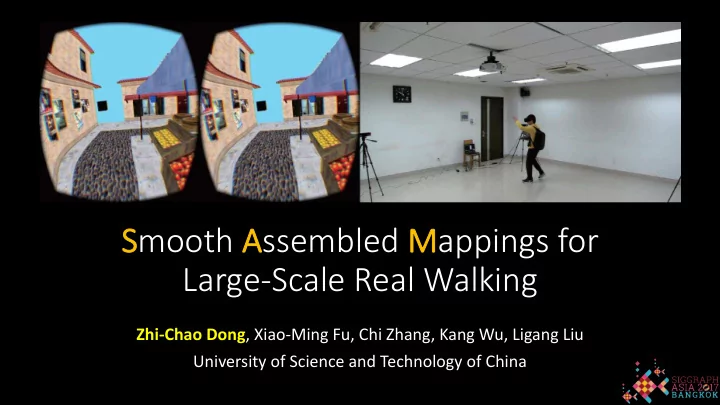
Zhi-Chao Dong, Xiao-Ming Fu, Chi Zhang, Kang Wu, Ligang Liu University of Science and Technology of China
slide-2
SLIDE 2

HTC Vive Oculus Rift Sony Play Station

Immersive virtual reality

  • A perception of being physically present in a non-physical world
  • VR systems provide an engrossing total environment
slide-3
SLIDE 3

Locomotion in immersive VR

  • Joystick
  • Walking-in-place
  • Real walking

stationary, unnatural

slide-4
SLIDE 4
  • Joystick
  • Walking-in-place
  • Real walking

simulated walking, less natural

Locomotion in immersive VR

slide-5
SLIDE 5
  • Joystick
  • Walking-in-place
  • Real walking

Locomotion in immersive VR

walk freely, natural

slide-6
SLIDE 6

Goal: mapping for real walking

  • Build a mapping between the virtual scene and the real workspace
  • Optimal: bijective and isometric mapping

Real workspace Virtual scene

slide-7
SLIDE 7

Challenge

  • Virtual scene and real workspace often differ significantly in sizes, shapes.
  • How to explore large virtual scene in smaller real workspace?

Virtual scene Real workspace

slide-8
SLIDE 8

Existing methods in real walking

  • Space manipulation
  • [Suma et al. 2011, 2012], [Vasylevska and Kaufmann 2017], [Vasylevska et al. 2013]

[Vasylevska et al. 2013]

slide-9
SLIDE 9
  • Redirected walking
  • [Razzaque et al. 2001, 2002], [Williams et al. 2007], [Steinicke et al. 2010],[Hodgson

and Bachmann 2013], [Azmandian et al. 2014], [Nescher et al. 2014] ···

[Nescher et al. 2014] [Steinicke et al. 2010]

Existing methods in real walking

slide-10
SLIDE 10

[Sun et al. 2016]

  • Space mapping method
  • [Sun et al. 2016] : computing a global mapping between virtual and real scenes

Existing methods in real walking

slide-11
SLIDE 11

Problem: severe distortion

  • Mapping the large-scale virtual scene globally may result in severe distortions

and artifacts. The greater size ratio, the larger distortions

extremely large distortion

slide-12
SLIDE 12

Our idea

  • Smooth Assembled Mappings (SAM):
  • A divide-and-conquer strategy
  • Benefits:

map substantially large virtual scenes into smaller real workspaces with low isometric distortion achieve better walking experience

slide-13
SLIDE 13

Our Method

  • 1. Decomposition
  • Decompose the virtual scene into small super-patches
  • 2. Mapping assembly
  • Each super-patch is mapped into real workspace
  • 3. Global refinement
  • Reduce the distortion globally
  • Key challenges:
  • How to achieve low distortion mappings for large-scale virtual

scene?

  • How to keep smoothness between local mappings?
slide-14
SLIDE 14

Decomposition

Input

Partition patches

slide-15
SLIDE 15

Decomposition

Input

Super-patches

slide-16
SLIDE 16

Mapping assembly

  • Compute mappings for all super-patches one by one in a width-first order.

The first super-patch Mapping result

slide-17
SLIDE 17

The second super-patch Mapping and assembly

Mapping assembly

  • Compute mappings for all super-patches one by one in a width-first order.
slide-18
SLIDE 18

The other super-patches Mapping and assembly

Mapping assembly

  • Compute mappings for all super-patches one by one in a width-first order.
slide-19
SLIDE 19

Mapping a local quad patch

  • Bézier patch as a map:

𝑔 𝑣, 𝑤 =

𝑗=0 𝑜 𝑘=0 𝑛

𝑑𝑗,𝑘𝐶𝑗

𝑜 𝑣 𝐶 𝑘 𝑛(𝑤)

 𝑑𝑗,𝑘: control points  𝐶𝑗

𝑜 𝑣 : Bernstein polynomial basis function

𝑔 One patch Real workspace

𝑄𝑙 𝑇𝑆

slide-20
SLIDE 20

Distortion cost: conforming low-distortion mapping

  • Distance-preserving cost:

𝐹𝑗𝑡𝑝(𝑞) =

𝑘=1 2

𝜏

𝑘 2 + 𝜏 𝑘 −2

 𝜏

𝑘: singular value of 𝐾(𝑞)

 When 𝜏1 = 𝜏2 = 1, the mapping is isometric, i.e., distance-preserving

𝜏2

𝜏1

1

slide-21
SLIDE 21

Boundary cost: avoiding colliding

  • Exterior boundary cost

𝐹𝑓𝑦𝑢 𝑞 =

𝑘=1 4

2 𝑒𝑘 + 𝑒𝑘

2 + 𝜗

  • Interior obstacle cost [Sun et al. 2016]

𝐹𝑗𝑜𝑢 𝑞 = exp − 1 2𝜏2 𝑣′2 𝑥2 + 𝑤′2 ℎ2

𝑣′ 𝑤′ = 𝑣 𝑤 cos 𝜄𝑑 sin 𝜄𝑑 − sin 𝜄𝑑 cos 𝜄𝑑 − 𝑣𝑑 𝑤𝑑

interior 𝑞 𝑒𝑘 > 0

slide-22
SLIDE 22

Constraints

1 2 𝑜 − 2 𝑜 − 1

𝑄𝑙 𝑄𝑚

  • Smoothness constraints:

𝒅𝑜,𝑘

𝑙

= 𝒅0,𝑘

𝑚

𝒅𝑜,𝑘

𝑙

− 𝒅𝑜−1,𝑘

𝑙

= 𝒅1,𝑘

𝑚

− 𝒅0,𝑘

𝑚

𝒅𝑜,𝑘

𝑙

− 2𝒅𝑜−1,𝑘

𝑙

+ 𝒅𝑜−2,𝑘

𝑙

= 𝒅2,𝑘

𝑚

− 2𝒅1,𝑘

𝑚

+ 𝒅0,𝑘

𝑚

  • Local bijection constraints:

det 𝐾(𝑞) > 0

𝐾(𝑞) is the Jacobian of the mapping at 𝑞

slide-23
SLIDE 23

Formulation and optimization

min distoriton cost + boundary cost

  • s. t. smoothness constraint

local bijection constraint

Optimization process

  • Super-patch based assembly
  • Newton’s method
slide-24
SLIDE 24

Global optimization

  • Perform a global optimization after all assemblies
slide-25
SLIDE 25

Recap: our SAM method

slide-26
SLIDE 26

Experiments

slide-27
SLIDE 27

3.6𝑛 × 3.6𝑛 sketch map real workspace

Setup

slide-28
SLIDE 28

User studies: various virtual scenes

slide-29
SLIDE 29

Interior obstacles

slide-30
SLIDE 30

Comparison to [Sun et al. 2016]: simulation

slide-31
SLIDE 31

Comparison to [Sun et al. 2016]: user study

slide-32
SLIDE 32

Comparisons with redirected walking

slide-33
SLIDE 33

Comparisons with redirected walking

slide-34
SLIDE 34

Comparisons with redirected walking

Square: user Circle: wolf

slide-35
SLIDE 35

Comparisons with redirected walking

Red: user Green: wolf

slide-36
SLIDE 36

Applications

slide-37
SLIDE 37

Conclusion

  • A novel divide-and-conquer method for mapping large-scale virtual

scene into small real workspace

  • Much less distortion
  • Better walking experience
  • Can work for any large virtual scenes
slide-38
SLIDE 38

Limitations

  • Pathways with large widths
  • Only pathway-type scene

Future work

  • Open scenes
  • Mapping scenes in AR

Conclusion

slide-39
SLIDE 39

Acknowledgements

  • All participants of user studies
  • Qi Sun ([Sun et al. 2016]), Stony Brook University
  • Mahdi Azmandian ([Azmandian et al. 2016]), University of

Southern California

  • Peng Song, Xuejin Chen, University of Science and Technology
  • f China
slide-40
SLIDE 40