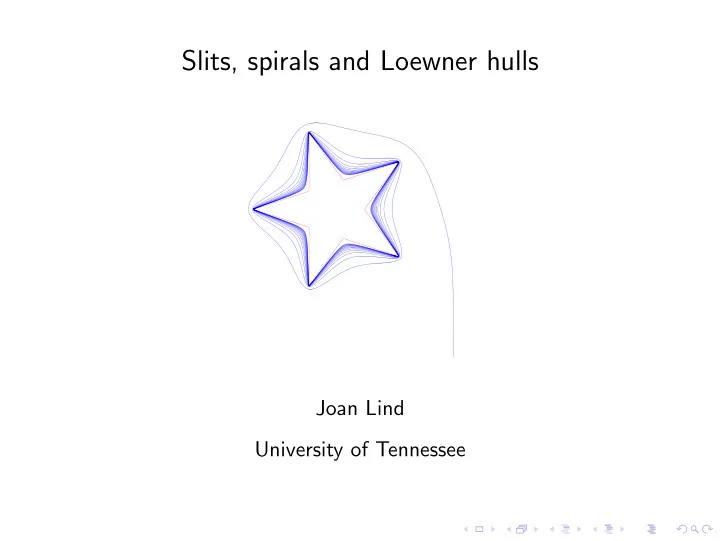
SLIDE 1
Slits, spirals and Loewner hulls
Joan Lind University of Tennessee
SLIDE 2
The story begins
Bieberbach conjecture (1916): For f (z) = z + a2z2 + a3z3 + · · · conformal on D, then |an| ≤ n.
SLIDE 3
The story begins
Bieberbach conjecture (1916): For f (z) = z + a2z2 + a3z3 + · · · conformal on D, then |an| ≤ n. Charles Loewner introduced the Loewner equation in 1923 to prove the n = 3 case.
SLIDE 4
The story begins
Bieberbach conjecture (1916): For f (z) = z + a2z2 + a3z3 + · · · conformal on D, then |an| ≤ n. Charles Loewner introduced the Loewner equation in 1923 to prove the n = 3 case. Louis des Branges again used the Loewner equation when he proved the conjecture in 1985.
SLIDE 5
The story continues
Simple Random Walk (SRW) in 2 dimensions – has a conformally invariant scaling limit: 2-d Brownian motion
SLIDE 6
The story continues
Schramm’s question: Do other 2-dimensional random walks (such as SAW, LERW, etc.) have conformally invariant scaling limits?
SLIDE 7
The story continues
In 2000, Oded Schramm introduced SLEκ, a family of random processes that contain the possible conformally invariant scaling limits.
SLIDE 8
The story continues
In 2000, Oded Schramm introduced SLEκ, a family of random processes that contain the possible conformally invariant scaling limits. Through the Loewner equation, SLEκ correspond to √κBt.
SLIDE 9
The Loewner equation
L Equ
← !
growing families of 2-d sets real-valued functions
SLIDE 10
From curves to functions
γ(t)
SLIDE 11
From curves to functions
γ(t)
SLIDE 12
From curves to functions
γ(t) gt λ(t)
SLIDE 13 From curves to functions
γ(t) gt λ(t)
gt(z) = z + ct z + O 1 z2
SLIDE 14 From curves to functions
γ(t) gt λ(t)
gt(z) = z + 2t z + O 1 z2
SLIDE 15
From curves to functions
γ(t) gt λ(t)
∂ ∂t gt(z) = 2 gt(z) − λ(t)
SLIDE 16
From functions to growing families of sets
For a continuous, real-valued function λ(t) and z ∈ H, consider ∂ ∂t gt(z) = 2 gt(z) − λ(t), g0(z) = z
SLIDE 17
From functions to growing families of sets
For a continuous, real-valued function λ(t) and z ∈ H, consider ∂ ∂t gt(z) = 2 gt(z) − λ(t), g0(z) = z Loewner hulls: Kt = {z ∈ H : gs(z) = λ(s) for some s ≤ t}.
SLIDE 18
From functions to growing families of sets
For a continuous, real-valued function λ(t) and z ∈ H, consider ∂ ∂t gt(z) = 2 gt(z) − λ(t), g0(z) = z Loewner hulls: Kt = {z ∈ H : gs(z) = λ(s) for some s ≤ t}. Theorem: gt is a conformal map from H \ Kt onto H.
SLIDE 19
Loewner flow
∂ ∂t gt(z) = 2 Re gt(z) − λ(t) |gt(z) − λ(t)|2 − 2i Im gt(z) |gt(z) − λ(t)|2
0.2 0.4 0.6 0.8 1 –1 –0.5 0.5 1
SLIDE 20
Example
Loewner hull generated by λ(t) ≡ 0.
SLIDE 21
Loewner equation
L Equ
← !
growing families of 2-d sets real-valued functions
SLIDE 22
The geometry of SLE curves
L Equ SLEκ ← → √κBt
SLIDE 23
The geometry of SLE curves
L Equ SLEκ ← → √κBt 0 ≤ κ ≤ 4 4 < κ < 8 8 ≤ κ
SLIDE 24
The geometry of SLE curves
SLE2 SLE6
SLIDE 25
Simple curve Loewner hulls
Question: When does the deterministic Loewner equation generate a simple curve?
SLIDE 26
Simple curve Loewner hulls
Question: When does the deterministic Loewner equation generate a simple curve? Lip(1/2) functions: |λ(t) − λ(s)| ≤ M |t − s|1/2 for all t, s is the domain of λ. The smallest such M is ||λ||1/2.
SLIDE 27
Simple curve Loewner hulls
Question: When does the deterministic Loewner equation generate a simple curve? Lip(1/2) functions: |λ(t) − λ(s)| ≤ M |t − s|1/2 for all t, s is the domain of λ. The smallest such M is ||λ||1/2. Answer: (Marshall, Rohde) There exists C0 > 0 so that for λ ∈ Lip(1/2) with ||λ||1/2 < C0, then the Loewner hull is a quasislit γ.
SLIDE 28
Simple curve Loewner hulls
Question: Do all Lip(1/2) driving functions generate simple curves?
SLIDE 29
Simple curve Loewner hulls
Question: Do all Lip(1/2) driving functions generate simple curves? Answer: (Marshall, Rohde) No. There is a non-simple example (a curve that spirals around a disc) that is generated by a Lip(1/2) driving function.
SLIDE 30
Simple curve Loewner hulls
Question: What is the optimal value of C0 for the Marshall-Rohde theorem?
SLIDE 31
Simple curve Loewner hulls
Question: What is the optimal value of C0 for the Marshall-Rohde theorem? Answer: (L) C0 = 4.
SLIDE 32
Simple curve Loewner hulls
Question: What is the optimal value of C0 for the Marshall-Rohde theorem? Answer: (L) C0 = 4. Key examples: λ(t) = −c√1 − t c = 3 c = 5
SLIDE 33
Loewner deformations
Omer Angel’s question: For r < 1, what can you say about Loewner hull driven by rλ?
SLIDE 34
Loewner deformations
Omer Angel’s question: For r < 1, what can you say about Loewner hull driven by rλ? Is it at least as nice as the hull driven by λ?
SLIDE 35
Loewner deformations
Omer Angel’s question: For r < 1, what can you say about Loewner hull driven by rλ? Is it at least as nice as the hull driven by λ? This is true for SLE. 0 ≤ κ ≤ 4 4 < κ < 8 8 ≤ κ
SLIDE 36
Loewner deformations
Omer Angel’s question: For r < 1, what can you say about Loewner hull driven by rλ? Is it at least as nice as the hull driven by λ? This is true for λ(t) = −c√1 − t. c = 3 c = 5
SLIDE 37
Loewner deformations
Omer Angel’s question: For r < 1, what can you say about Loewner hull driven by rλ? Is it at least as nice as the hull driven by λ? Is it always true?
SLIDE 38
Loewner deformations
Omer Angel’s question: For r < 1, what can you say about Loewner hull driven by rλ? Is it at least as nice as the hull driven by λ? Is it always true? Answer: N0.
SLIDE 39
Loewner deformations
Theorem (L, Marshall, Rohde)
Let λ be the driving function for the star spiral. When 0 < r < 1, then rλ generates a simple curve, and when r > 1, then rλ generates a “bubble” curve.
SLIDE 40
Spirals and collisions
Theorem (L, Marshall, Rohde)
If γ is a suffiently nice infinite spiral of half-plane capacity T, or if γ has a tangential self-intersection, then its driving term λ satisfies lim
t→T
|λ(T) − λ(t)| √ T − t = 4.
SLIDE 41
Spirals and collisions
Theorem (L, Marshall, Rohde)
If γ is a suffiently nice infinite spiral of half-plane capacity T, or if γ has a tangential self-intersection, then its driving term λ satisfies lim
t→T
|λ(T) − λ(t)| √ T − t = 4.
Theorem (L, Marshall, Rohde)
If λ : [0, T] → R is sufficiently regular on [0, T) and if lim
t→T
|λ(T) − λ(t)| √ T − t = κ > 4, then γ(T) = lim
t→T γ(t) exists, is real, and γ intersects R in the
same angle as the trace for κ√1 − t.
SLIDE 42
Spirals and collisions
Scaling Property:
◮ If λ generates hull Kt, then cλ(t/c2) generates cKt/c2.
SLIDE 43
Spirals and collisions
Scaling Property:
◮ If λ generates hull Kt, then cλ(t/c2) generates cKt/c2.
Example: λ(t) = c√t
SLIDE 44
Spirals and collisions
Concatenation Property:
◮ If λ generates hull Kt for t ∈ [0, T], then λ restricted to
[t0, T] generates hull gt0(KT \ Kt0).
SLIDE 45
Spirals and collisions
Concatenation Property:
◮ If λ generates hull Kt for t ∈ [0, T], then λ restricted to
[t0, T] generates hull gt0(KT \ Kt0). Kt0 λ(0) gt0 gt0(KT \ Kt0) λ(t0)
SLIDE 46
Spirals and collisions
Start with λ = −c√1 − t. For t0 ∈ (0, 1), map down by gt0. Rescale by 1/√1 − t0.
SLIDE 47
Spirals and collisions
Start with λ = −c√1 − t. For t0 ∈ (0, 1), map down by gt0. Rescale by 1/√1 − t0. What do we obtain? The same hull that we started with.
SLIDE 48
Spirals and collisions
Start with λ satisfying lim
t→1
|λ(1) − λ(t)| √1 − t = κ ≥ 4 Shift so that λ(1) = 0. For t0 ∈ (0, 1), map down by gt0. Rescale by 1/√1 − t0.
SLIDE 49
Spirals and collisions
Start with λ satisfying lim
t→1
|λ(1) − λ(t)| √1 − t = κ ≥ 4 Shift so that λ(1) = 0. For t0 ∈ (0, 1), map down by gt0. Rescale by 1/√1 − t0. What do we obtain? A hull that is getting closer and closer to the hull generated by ±κ√1 − t.
SLIDE 50
Spirals and collisions
What happens when κ = 4?
SLIDE 51
Spirals and collisions
What happens when κ = 4? 4√1 − t generates a hull that intersects the real line tangentially.
SLIDE 52
Spirals and collisions
What happens when κ = 4? 4√1 − t generates a hull that intersects the real line tangentially. The spiral behavior can be viewed as tangential behavior.
SLIDE 53
Recap: the Loewner equation question
L Equ
← !
growing families of 2-d sets real-valued functions Question: How do properties of the functions relate to geometric characteristics of the sets?
SLIDE 54
Sample of other Loewner explorations
SLIDE 55
Sample of other Loewner explorations
◮ Spacefilling curves (L, Rohde)
SLIDE 56
Sample of other Loewner explorations
◮ Spacefilling curves (L, Rohde) ◮ Driving functions with higher regularity (Wong, L, Tran)
SLIDE 57 Sample of other Loewner explorations
◮ Spacefilling curves (L, Rohde) ◮ Driving functions with higher regularity (Wong, L, Tran) ◮ H¨
SLIDE 58 Sample of other Loewner explorations
◮ Spacefilling curves (L, Rohde) ◮ Driving functions with higher regularity (Wong, L, Tran) ◮ H¨
◮ Complex-valued driving functions (Tran)
SLIDE 59 Sample of other Loewner explorations
◮ Spacefilling curves (L, Rohde) ◮ Driving functions with higher regularity (Wong, L, Tran) ◮ H¨
◮ Complex-valued driving functions (Tran) ◮ Multiple Loewner hulls (Roth, Schleissinger, Starnes)
SLIDE 60 Sample of other Loewner explorations
◮ Spacefilling curves (L, Rohde) ◮ Driving functions with higher regularity (Wong, L, Tran) ◮ H¨
◮ Complex-valued driving functions (Tran) ◮ Multiple Loewner hulls (Roth, Schleissinger, Starnes) ◮ Trees (Healey)
SLIDE 61 Sample of other Loewner explorations
◮ Spacefilling curves (L, Rohde) ◮ Driving functions with higher regularity (Wong, L, Tran) ◮ H¨
◮ Complex-valued driving functions (Tran) ◮ Multiple Loewner hulls (Roth, Schleissinger, Starnes) ◮ Trees (Healey) ◮ Trace existence (Zhang, Zinsmeister)
SLIDE 62
Thank you