Simulation of solid-liquid solar cells Solar Cell Domain - - PowerPoint PPT Presentation

simulation of solid liquid solar cells
SMART_READER_LITE
LIVE PREVIEW

Simulation of solid-liquid solar cells Solar Cell Domain - - PowerPoint PPT Presentation

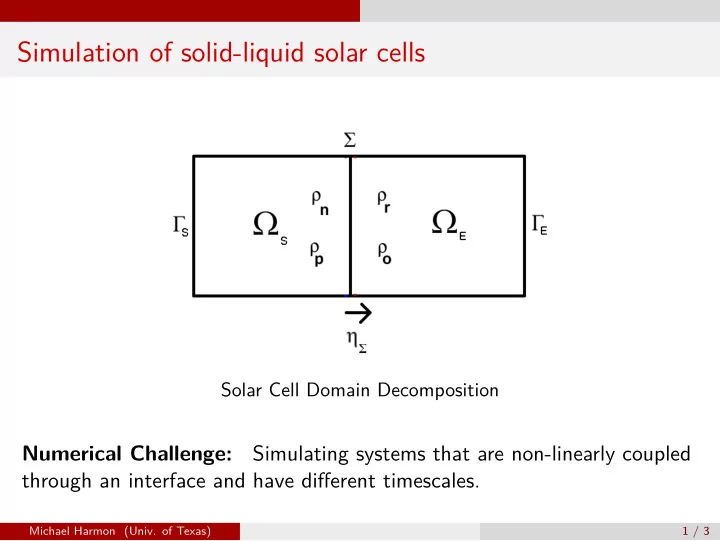
Simulation of solid-liquid solar cells Solar Cell Domain Decomposition Simulating systems that are non-linearly coupled Numerical Challenge: through an interface and have different timescales. Michael Harmon (Univ. of Texas) 1 / 3


slide-1
SLIDE 1

Simulation of solid-liquid solar cells

Solar Cell Domain Decomposition

Numerical Challenge: Simulating systems that are non-linearly coupled through an interface and have different timescales.

Michael Harmon (Univ. of Texas) 1 / 3
slide-2
SLIDE 2

Flow-transport with a non-linear reactive interface

Transport in subdomains: ΩS

  • ∂tρn + Jn ∇ · ( ∇Φ ρn − ∇ ρn ) = −R(ρn, ρp) + G(x)

∂tρp + Jp ∇ · (− ∇Φ ρp − ∇ ρp ) = −R(ρn, ρp) + G(x) ΩE

  • ∂tρr + Jr ∇ · ( ∇Φ ρr − ∇ ρr ) = 0

∂tρo + Jo ∇ · (− ∇Φ ρo − ∇ ρp ) = 0 Σ          Jn ( ∇Φ ρn − ∇ ρn ) · η = ket ( ρn − ρe

n ) ρo

Jp ( ∇Φ ρp − ∇ ρp ) · η = kht ( ρp − ρe

p ) ρr

Jr ( ∇Φ ρr − ∇ ρr ) · η = kht (ρp − ρe

p)ρr − ket (ρn − ρe n) ρo

Jo ( ∇Φ ρo − ∇ ρo ) · η = −kht (ρp − ρe

p) ρr + ket (ρn − ρe n) ρo

Flow in entire domain: −∇ · ( λ(x) ∇Φ) =

  • C(x) − (ρn − ρp)

in ΩS − (ρr − ρo) in ΩE

Michael Harmon (Univ. of Texas) 2 / 3

slide-3
SLIDE 3

Numerical methods and problems

Have: Flow-transport code that uses a mixed finite element method (MFEM) for flow equation and local discontinuous Galerkin (LDG) method for transport equations. Have: Code that solves diffusion equations which are non-linearly coupled through interface using LDG in space and time lagging (forward Euler) for linearization. Problem: Slow convergence to steady state solutions because linearization imposes severe constraint on time step. Need: Use big time steps. Need: Non-linear solver which is fast and easy to implement in deal.ii. (Newton-type method?) Need: Advice on best way to set up data structures.

Michael Harmon (Univ. of Texas) 3 / 3