SimSurvey - an R-based E-learning tool for geo- 2. Aim of the - - PowerPoint PPT Presentation

simsurvey an r based e learning tool for geo
SMART_READER_LITE
LIVE PREVIEW

SimSurvey - an R-based E-learning tool for geo- 2. Aim of the - - PowerPoint PPT Presentation

SimSurvey SimSurvey SimSurvey Outline SimSurvey Outline 1. Introduction SimSurvey - an R-based E-learning tool for geo- 2. Aim of the project statistical analyses 3. SimSurvey 3.1 Structure Mario Gellrich 1 , Rudolf Gubler 2 , Andreas


slide-1
SLIDE 1

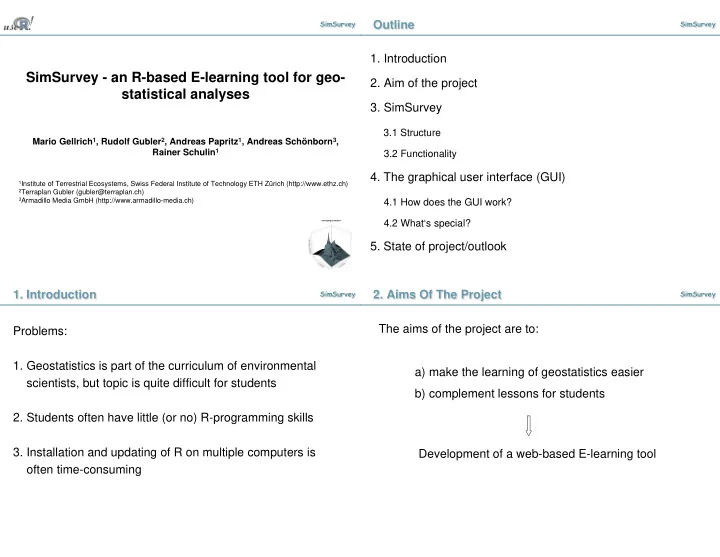
SimSurvey - an R-based E-learning tool for geo- statistical analyses

Mario Gellrich1, Rudolf Gubler2, Andreas Papritz1, Andreas Schönborn3, Rainer Schulin1

1Institute of Terrestrial Ecosystems, Swiss Federal Institute of Technology ETH Zürich (http://www.ethz.ch) 2Terraplan Gubler (gubler@terraplan.ch) 3Armadillo Media GmbH (http://www.armadillo-media.ch)

SimSurvey SimSurvey

  • 1. Introduction
  • 2. Aim of the project
  • 3. SimSurvey

3.1 Structure 3.2 Functionality

  • 4. The graphical user interface (GUI)

4.1 How does the GUI work? 4.2 What‘s special?

  • 5. State of project/outlook

Outline Outline

SimSurvey SimSurvey

  • 1. Introduction
  • 1. Introduction

Problems:

  • 1. Geostatistics is part of the curriculum of environmental

scientists, but topic is quite difficult for students

  • 2. Students often have little (or no) R-programming skills
  • 3. Installation and updating of R on multiple computers is
  • ften time-consuming

SimSurvey SimSurvey

  • 2. Aims Of The Project
  • 2. Aims Of The Project

The aims of the project are to: a) make the learning of geostatistics easier b) complement lessons for students Development of a web-based E-learning tool

SimSurvey SimSurvey

slide-2
SLIDE 2

3.1 SimSurvey – Structure 3.1 SimSurvey – Structure

Generator of spatial distribution of pollutants Spatial distribution of pollutants Hypotheses Definition of sampling approach Sampling Geostatistical analyses Task, financial recources Comparision predicted

  • bserved distribution of

pollutants Alternative sampling strategies? Evaluation of sampling strategies

Teacher‘s module Student‘s module

yes no SimSurvey SimSurvey

3.2 SimSurvey – Functionality 3.2 SimSurvey – Functionality

Teacher‘s module Student‘s module Statistics module Sampling environment

  • import/export data
  • edit data
  • graphics
  • regression
  • geostatistical analyses
  • R-console
  • take samples
  • view maps
  • manage resources
  • import maps
  • view maps
  • simulate spatially

referenced data

SimSurvey SimSurvey

3.2 SimSurvey – Functionality 3.2 SimSurvey – Functionality

SimSurvey is installed on a Linux-Server and runs in a browser The following software is required:

SimSurvey SimSurvey

  • Apache (web server)
  • Macromedia Flash Player 8 (visualisation)
  • PHP (interface between Flash, R and MySQL)
  • R (statistics, text-output, graphics-output)
  • MySQL (database to block ‘dangerous’ commands in the R-console)

The graphical user interface (GUI) The graphical user interface (GUI)

  • 4. Graphical user interface (GUI)
  • 4. Graphical user interface (GUI)

SimSurvey SimSurvey

slide-3
SLIDE 3
  • 4. Graphical user interface (GUI)
  • 4. Graphical user interface (GUI)

Screenshot menu

SimSurvey SimSurvey

Graphics-menu & histogram dialogbox

4.1 How does the GUI work? 4.1 How does the GUI work?

SimSurvey SimSurvey

4.1 How does the GUI work? 4.1 How does the GUI work?

  • 1. Flash uses an XML-file to create a dialogbox

Each Flash-item has a name and value

SimSurvey SimSurvey

1 2 4 3 1 2 3 4

label dropdown box textbox button Flash-items:

<outputField column="left" text="Bar color:" name="hisTxt003"/> <dropDown column="left" name="hisDdmCol"> <dropDownItem text="gray" value="gray"/> <dropDownItem text="green" value="green"/> <dropDownItem text="yellow" value="yellow"/> <dropDownItem text="blue" value=“blue"/> <dropDownItem text="red" value=“red"/> <dropDownItem text="wheat" value="wheat"/> </dropDown>

XML-code

  • 2. The value of the Flash-item hisDdmCol is “blue”

4.1 How does the GUI work? 4.1 How does the GUI work?

Macromedia Flash passes the value of hisDdmCol to PHP.

SimSurvey SimSurvey

slide-4
SLIDE 4

if ($_REQUEST["hisDdmV01"]) //graphics, histogram { $ausdruck=$_REQUEST["hisTinGrn"]; //title if (!$ausdruck) { $ausdruck="tmp"; } $variable1=$_REQUEST["hisDdmV01"]; //variable $eigenschaften1=$_REQUEST["hisTinCla"]; //number of classes $eigenschaften2=$_REQUEST["hisDdmCol"]; //barcolor $eigenschaften3=$_REQUEST["histTinXax"]; //label x $eigenschaften4=$_REQUEST["histTinYax"]; //label y $eigenschaften5=$_REQUEST["hisTinTit"]; //plot titel $arbeitsverzeichnis=$projektpfad; $maske="$pfad/include/graphics/histogram.R"; if (!file_exists("$projektpfad/$ausdruck/")) { mkdir("$projektpfad/$ausdruck/", 0777); chmod ("$projektpfad/$ausdruck/", 0777); } $grafikverzeichnis=$ausdruck; }

$eigenschaften2=$_REQUEST["hisDdmCol"]; //barcolor

  • 3. PHP takes the value of hisDdmCol and assigns it to a PHP-variable

$eigenschaften2

SimSurvey SimSurvey

4.1 How does the GUI work? 4.1 How does the GUI work?

PHP-code

setwd("**Arbeitsverzeichnis**/") load(".RData") library(grDevices) user.workspace <- "**Arbeitsverzeichnis**" ################## dynamic part 1 ####################################### start graphic.name <- "**Ausdruck**" ################## dynamic part 1 ####################################### end path.to.new.workspace <- paste(c(user.workspace, "/", graphic.name), collapse="") setwd(path.to.new.workspace) load(paste(c(user.workspace, "/", ".RData"), collapse="")) ################## dynamic part 2 ####################################### start sel.var <- "**variable1**" number.classes <- **eigenschaften1** bar.color <- "**eigenschaften2**" label.xaxis <- "**eigenschaften3**" label.yaxis <- "**eigenschaften4**" plot.title <- "**eigenschaften5**" ################## dynamic part 2 ####################################### end if(number.classes == "") { hist(dat[[sel.var]], nclass=nrow(dat[[sel.var]])/10, col=bar.color, xlab=label.xaxis, ylab=label.yaxis, main= plot.title, cex.main=1) } if(number.classes != ""){ hist(dat[[sel.var]], nclass=number.classes, col=bar.color, xlab=label.xaxis, ylab=label.yaxis , main= plot.title, cex.main=1) } save(list = ls(all=TRUE), file = ".RData") setwd(user.workspace) quit(save = "yes",status=0,runLast = FALSE)

bar.color <- "**eigenschaften2**"

  • 4. The PHP-variable "**eigenschaften2**" is part of a ‘dynamic’ R-script

SimSurvey SimSurvey

4.1 How does the GUI work? 4.1 How does the GUI work?

R-code

  • 5. PHP translates the ‘dynamic’ R-script into a standard R-script and runs it.

setwd("/home/mariog/public_html/simsurvey/tmp/ruedi/dornach_project/dornach/") load(".RData") library(grDevices) user.workspace <- "/home/mariog/public_html/simsurvey/tmp/ruedi/dornach_project/dornach" ################## dynamic part 1 ####################################### start graphic.name <- "histogram_001" ################## dynamic part 1 ####################################### end path.to.new.workspace <- paste(c(user.workspace, "/", graphic.name), collapse="") setwd(path.to.new.workspace) load(paste(c(user.workspace, "/", ".RData"), collapse="")) ################## dynamic part 2 ####################################### start sel.var <- "var4" number.classes <- 20 bar.color <- "blue" label.xaxis <- "cu" label.yaxis <- "Frequency" plot.title <- "Histogram (cu)" ################## dynamic part 2 ####################################### end if(number.classes == ""){ hist(dat[[sel.var]], nclass=nrow(dat[[sel.var]])/10, col=bar.color, xlab=label.xaxis, ylab=label.yaxis, main= plot.title, cex.main=1) } if(number.classes != ""){ hist(dat[[sel.var]], nclass=number.classes, col=bar.color, xlab=label.xaxis, ylab=label.yaxis , main= plot.title, cex.main=1) } save(list = ls(all=TRUE), file = ".RData") setwd(user.workspace) quit(save = "yes",status=0,runLast = FALSE)

bar.color <- "blue" col=bar.color

4.1 How does the GUI work? 4.1 How does the GUI work?

R-code

SimSurvey SimSurvey

  • 6. Flash takes the graphic produced by R and visualises it in the browser

4.1 How does the GUI work? 4.1 How does the GUI work?
slide-5
SLIDE 5

The R-GUI produces graphic output in separate windows.

SimSurvey SimSurvey

4.1 How does the GUI work? 4.1 How does the GUI work?

Text-output is displayed in a text-output window.

SimSurvey SimSurvey

4.1 How does the GUI work? 4.1 How does the GUI work?

What is special in R-GUI compared to other R-web interfaces*?

  • 1. R processes run via “socket connections” (faster than “batch mode”)
  • 2. Interface between R and Macromedia Flash
  • 3. GUI can easily be extended (modular construction system)
  • 5. Flash-R interface user-friendly (movable dialog-boxes and output-

windows in one browser-window)

*e.g. R-php (http://dssm.unipa.it/R-php) or Rweb (http://www.math.montana.edu/Rweb) SimSurvey SimSurvey

4.2 What’s special? 4.2 What’s special?

  • 5. State of project/outlook
  • 5. State of project/outlook

Done:

  • Project/Session management implemeted
  • R-GUI implemeted (graphics, regression, geo-statistics, R-console)

To do:

  • Sampling environment/handling of recources
  • Tests/bug-fixing
  • Outlook:
  • bug-fixed alpha-version available in Summer 2007
  • distribution of R-GUI/SimSurvey as open source software for teaching

SimSurvey SimSurvey

slide-6
SLIDE 6

Many thanks, questions/suggestions are welcome!!! Many thanks, questions/suggestions are welcome!!!

Mario Gellrich (mario.gellrich@env.ethz.ch) Mario Gellrich (mario.gellrich@env.ethz.ch) SimSurvey SimSurvey