Simple, Credible, and Approximately- Optimal auctions Constantinos - - PowerPoint PPT Presentation

simple credible and approximately optimal auctions
SMART_READER_LITE
LIVE PREVIEW

Simple, Credible, and Approximately- Optimal auctions Constantinos - - PowerPoint PPT Presentation

Simple, Credible, and Approximately- Optimal auctions Constantinos Daskalakis*, Brendan Lucier#, Maxwell Fishelson*, Vasilis Syrgkanis#, Santhoshini Velusamy^ Key results: First revenue guarantees for non-truthful multi-item auctions with


slide-1
SLIDE 1

Simple, Credible, and Approximately- Optimal auctions

Constantinos Daskalakis*, Brendan Lucier#, Maxwell Fishelson*, Vasilis Syrgkanis#, Santhoshini Velusamy^

* Massachusetts Institute of Technology, # Microsoft Research, New England, ^ Harvard University

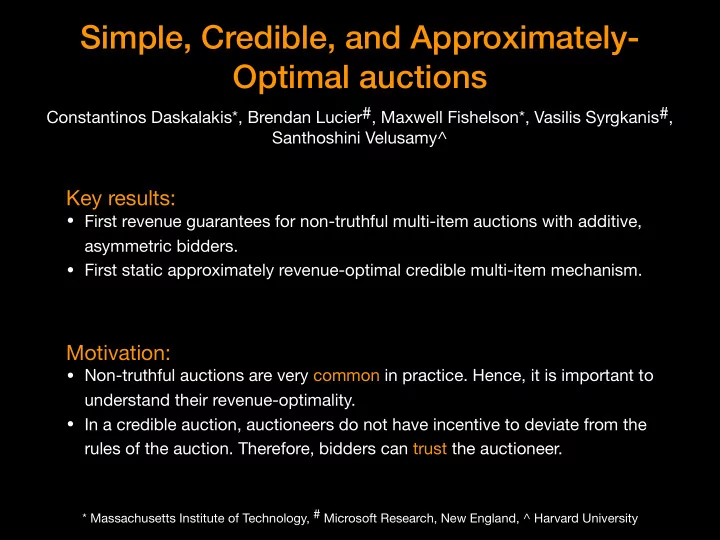
Key results:

  • First revenue guarantees for non-truthful multi-item auctions with additive,

asymmetric bidders.

  • First static approximately revenue-optimal credible multi-item mechanism.

Motivation:

  • Non-truthful auctions are very common in practice. Hence, it is important to

understand their revenue-optimality.

  • In a credible auction, auctioneers do not have incentive to deviate from the

rules of the auction. Therefore, bidders can trust the auctioneer.

slide-2
SLIDE 2

General Framework

Multi-item auction E(A):

The auctioneer

  • posts bidders-specific entry fees

upfront,

  • runs simultaneous single-item A

auctions on all items,

  • allocates items to those bidders

who paid entry fees.

Main theorem:

If every bidder in A auction does not

  • verbid and pays at most bid, then,

Separate First-price auctions with monopoly reserves

  • r

E(A) is approximately revenue-optimal. Non-truthful auction: E(First-Price), E(All-Pay) Credible auction: E(All-Pay)

slide-3
SLIDE 3

Proof of main theorem: E(First-Price)

[CDW16] Decomposition of type- space into “upward-closed” regions:

Optimal revenue ≤ Virtual welfare 
 Goal: Upper bound virtual welfare.

(t1, t2, t3, t4) → (t1, t2, ϕ(t3), t4)

Core problem:

Need to upper bound welfare-loss of first-price auctions.

Worst-case scenarios:

  • Welfare-loss is a constant fraction
  • f optimal welfare.
  • Optimal welfare is arbitrarily larger

than optimal revenue. Main idea: Both worst cases cannot co-exist!

[CDW16] - Yang Cai, Nikhil R. Devanur, and S. Matthew Weinberg. A duality-based unified approach to bayesian mechanism design, STOC 2016.

slide-4
SLIDE 4

Box-Lemma

1 bid

ti

Utility

ui(ti) max b−i bi

1

ti

Rev(PP)

max{ti}i∈[n]

lies above

max b−i max{ti}i∈[n]

CDF

𝖲𝖿𝗐(𝖰𝖰) + ui(ti) ≥ ti

1 bid 1 bid Welfare loss of first-price auctions ≤ 4•Rev(PP) CDF PP - Posted Price