Shortest Paths A priority queue will turn out to be useful for - - PDF document

shortest paths
SMART_READER_LITE
LIVE PREVIEW

Shortest Paths A priority queue will turn out to be useful for - - PDF document

2/21/2016 Dijkstras Algorithm The idea: reminiscent of BFS, but adapted to handle weights Grow the set of nodes whose shortest distance has been computed CSE373: Data Structures and Algorithms Nodes not in the set will have a


slide-1
SLIDE 1

2/21/2016 1

CSE373: Data Structures and Algorithms

Shortest Paths and Dijkstra's Algorithm

Steve Tanimoto Winter 2016

This lecture material represents the work of multiple instructors at the University of Washington. Thank you to all who have contributed!

Dijkstra’s Algorithm

  • The idea: reminiscent of BFS, but adapted to handle weights

– Grow the set of nodes whose shortest distance has been computed – Nodes not in the set will have a “best distance so far” – A priority queue will turn out to be useful for efficiency

  • An example of a greedy algorithm

– A series of steps – At each one the locally optimal choice is made

2 CSE 373: Data Structures & Algorithms Winter 2016

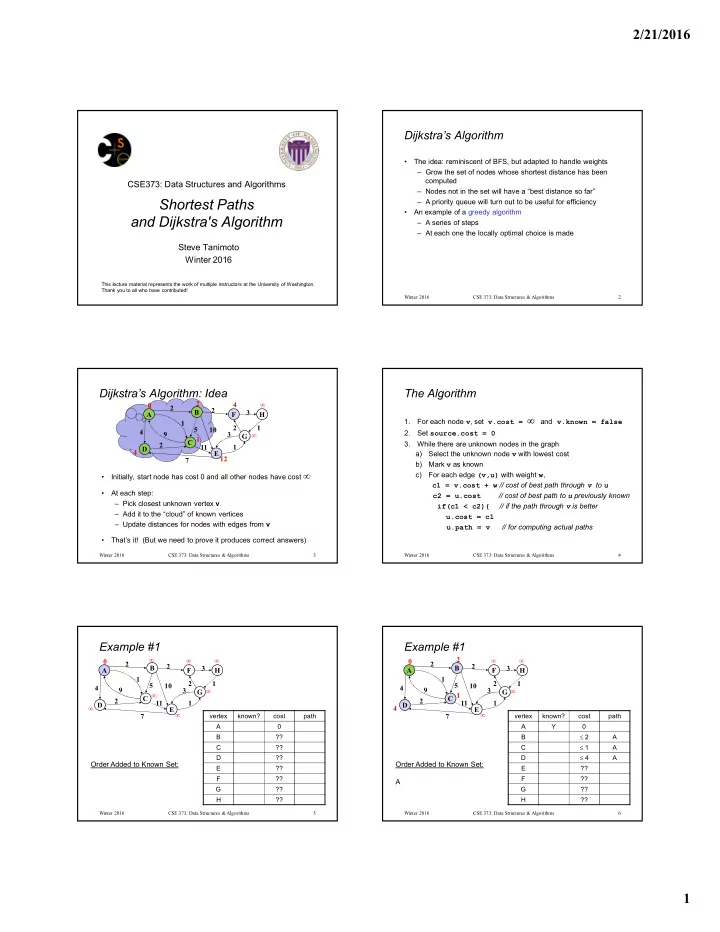
Dijkstra’s Algorithm: Idea

3 CSE 373: Data Structures & Algorithms

  • Initially, start node has cost 0 and all other nodes have cost 
  • At each step:

– Pick closest unknown vertex v – Add it to the “cloud” of known vertices – Update distances for nodes with edges from v

  • That’s it! (But we need to prove it produces correct answers)

A B D C F H E G 2 4 ∞ 4 1 12 ∞ 2 2 3 1 10 2 3 1 11 7 1 9 2 4 5

Winter 2016

The Algorithm

1. For each node v, set v.cost =  and v.known = false 2. Set source.cost = 0 3. While there are unknown nodes in the graph a) Select the unknown node v with lowest cost b) Mark v as known c) For each edge (v,u) with weight w, c1 = v.cost + w // cost of best path through v to u c2 = u.cost // cost of best path to u previously known if(c1 < c2){ // if the path through v is better u.cost = c1 u.path = v // for computing actual paths

4 CSE 373: Data Structures & Algorithms Winter 2016

Example #1

5 CSE 373: Data Structures & Algorithms

A B D C F H E G ∞ ∞ ∞ ∞ ∞ ∞ ∞ 2 2 3 1 10 2 3 1 11 7 1 9 2 4

vertex known? cost path A B ?? C ?? D ?? E ?? F ?? G ?? H ??

5 Order Added to Known Set:

Winter 2016

Example #1

6 CSE 373: Data Structures & Algorithms

A B D C F H E G 2 ∞ ∞ 4 1 ∞ ∞ 2 2 3 1 10 2 3 1 11 7 1 9 2 4

vertex known? cost path A Y B  2 A C  1 A D  4 A E ?? F ?? G ?? H ??

5 Order Added to Known Set: A

Winter 2016

slide-2
SLIDE 2

2/21/2016 2

Example #1

7 CSE 373: Data Structures & Algorithms

A B D C F H E G 2 ∞ ∞ 4 1 12 ∞ 2 2 3 1 10 2 3 1 11 7 1 9 2 4

vertex known? cost path A Y B  2 A C Y 1 A D  4 A E  12 C F ?? G ?? H ??

5 Order Added to Known Set: A, C

Winter 2016

Example #1

8 CSE 373: Data Structures & Algorithms

A B D C F H E G 2 4 ∞ 4 1 12 ∞ 2 2 3 1 10 2 3 1 11 7 1 9 2 4

vertex known? cost path A Y B Y 2 A C Y 1 A D  4 A E  12 C F  4 B G ?? H ??

5 Order Added to Known Set: A, C, B

Winter 2016

Example #1

9 CSE 373: Data Structures & Algorithms

A B D C F H E G 2 4 ∞ 4 1 12 ∞ 2 2 3 1 10 2 3 1 11 7 1 9 2 4

vertex known? cost path A Y B Y 2 A C Y 1 A D Y 4 A E  12 C F  4 B G ?? H ??

5 Order Added to Known Set: A, C, B, D

Winter 2016

Example #1

10 CSE 373: Data Structures & Algorithms

A B D C F H E G 2 4 7 4 1 12 ∞ 2 2 3 1 10 2 3 1 11 7 1 9 2 4

vertex known? cost path A Y B Y 2 A C Y 1 A D Y 4 A E  12 C F Y 4 B G ?? H  7 F

5 Order Added to Known Set: A, C, B, D, F

Winter 2016

Example #1

11 CSE 373: Data Structures & Algorithms

A B D C F H E G 2 4 7 4 1 12 8 2 2 3 1 10 2 3 1 11 7 1 9 2 4

vertex known? cost path A Y B Y 2 A C Y 1 A D Y 4 A E  12 C F Y 4 B G  8 H H Y 7 F

5 Order Added to Known Set: A, C, B, D, F, H

Winter 2016

Example #1

12 CSE 373: Data Structures & Algorithms

A B D C F H E G 2 4 7 4 1 11 8 2 2 3 1 10 2 3 1 11 7 1 9 2 4

vertex known? cost path A Y B Y 2 A C Y 1 A D Y 4 A E  11 G F Y 4 B G Y 8 H H Y 7 F

5 Order Added to Known Set: A, C, B, D, F, H, G

Winter 2016

slide-3
SLIDE 3

2/21/2016 3

Example #1

13 CSE 373: Data Structures & Algorithms

A B D C F H E G 2 4 7 4 1 11 8 2 2 3 1 10 2 3 1 11 7 1 9 2 4

vertex known? cost path A Y B Y 2 A C Y 1 A D Y 4 A E Y 11 G F Y 4 B G Y 8 H H Y 7 F

5 Order Added to Known Set: A, C, B, D, F, H, G, E

Winter 2016

Features

  • When a vertex is marked known,

the cost of the shortest path to that node is known – The path is also known by following back-pointers

  • While a vertex is still not known,

another shorter path to it might still be found Note: The “Order Added to Known Set” is not important – A detail about how the algorithm works (client doesn’t care) – Not used by the algorithm (implementation doesn’t care) – It is sorted by path-cost, resolving ties in some way

  • Helps give intuition of why the algorithm works

CSE 373: Data Structures & Algorithms 14 Winter 2016

Interpreting the Results

  • Now that we’re done, how do we get the path from, say, A to E?

A B D C F H E G 2 4 7 4 1 11 8 2 2 3 1 10 2 3 1 11 7 1 9 2 4 5

vertex known? cost path A Y B Y 2 A C Y 1 A D Y 4 A E Y 11 G F Y 4 B G Y 8 H H Y 7 F

Order Added to Known Set: A, C, B, D, F, H, G, E

CSE 373: Data Structures & Algorithms 15 Winter 2016

Stopping Short

  • How would this have worked differently if we were only interested in:

– The path from A to G? – The path from A to E? A B D C F H E G 2 4 7 4 1 11 8 2 2 3 1 10 2 3 1 11 7 1 9 2 4 5

vertex known? cost path A Y B Y 2 A C Y 1 A D Y 4 A E Y 11 G F Y 4 B G Y 8 H H Y 7 F

Order Added to Known Set: A, C, B, D, F, H, G, E

CSE 373: Data Structures & Algorithms 16 Winter 2016

Example #2

17 CSE 373: Data Structures & Algorithms

A B C D F E G ∞ ∞ ∞ ∞ ∞ ∞ 2 1 2

vertex known? cost path A B ?? C ?? D ?? E ?? F ?? G ??

5 1 1 1 2 6 5 3 10 Order Added to Known Set:

Winter 2016

Example #2

18 CSE 373: Data Structures & Algorithms

A B C D F E G ∞ ∞ 2 1 ∞ ∞ 2 1 2

vertex known? cost path A Y B ?? C  2 A D  1 A E ?? F ?? G ??

5 1 1 1 2 6 5 3 10 Order Added to Known Set: A

Winter 2016

slide-4
SLIDE 4

2/21/2016 4

Example #2

19 CSE 373: Data Structures & Algorithms

A B C D F E G 6 7 2 1 2 6 2 1 2

vertex known? cost path A Y B  6 D C  2 A D Y 1 A E  2 D F  7 D G  6 D

5 1 1 1 2 6 5 3 10 Order Added to Known Set: A, D

Winter 2016

Example #2

20 CSE 373: Data Structures & Algorithms

A B C D F E G 6 4 2 1 2 6 2 1 2

vertex known? cost path A Y B  6 D C Y 2 A D Y 1 A E  2 D F  4 C G  6 D

5 1 1 1 2 6 5 3 10 Order Added to Known Set: A, D, C

Winter 2016

Example #2

21 CSE 373: Data Structures & Algorithms

A B C D F E G 3 4 2 1 2 6 2 1 2

vertex known? cost path A Y B  3 E C Y 2 A D Y 1 A E Y 2 D F  4 C G  6 D

5 1 1 1 2 6 5 3 10 Order Added to Known Set: A, D, C, E

Winter 2016

Example #2

22 CSE 373: Data Structures & Algorithms

A B C D F E G 3 4 2 1 2 6 2 1 2

vertex known? cost path A Y B Y 3 E C Y 2 A D Y 1 A E Y 2 D F  4 C G  6 D

5 1 1 1 2 6 5 3 10 Order Added to Known Set: A, D, C, E, B

Winter 2016

Example #2

23 CSE 373: Data Structures & Algorithms

A B C D F E G 3 4 2 1 2 6 2 1 2

vertex known? cost path A Y B Y 3 E C Y 2 A D Y 1 A E Y 2 D F Y 4 C G  6 D

5 1 1 1 2 6 5 3 10 Order Added to Known Set: A, D, C, E, B, F

Winter 2016

Example #2

24 CSE 373: Data Structures & Algorithms

A B C D F E G 3 4 2 1 2 6 2 1 2

vertex known? cost path A Y B Y 3 E C Y 2 A D Y 1 A E Y 2 D F Y 4 C G Y 6 D

5 1 1 1 2 6 5 3 10 Order Added to Known Set: A, D, C, E, B, F, G

Winter 2016

slide-5
SLIDE 5

2/21/2016 5

Example #3

25 CSE 373: Data Structures & Algorithms

Y X 1 1 1 1 90 80 70 60 50 How will the best-cost-so-far for Y proceed? Is this expensive? …

Winter 2016

Example #3

26 CSE 373: Data Structures & Algorithms

Y X 1 1 1 1 90 80 70 60 50 How will the best-cost-so-far for Y proceed? 90, 81, 72, 63, 54, … Is this expensive? …

Winter 2016

Example #3

27 CSE 373: Data Structures & Algorithms

Y X 1 1 1 1 90 80 70 60 50 How will the best-cost-so-far for Y proceed? 90, 81, 72, 63, 54, … Is this expensive? No, each edge is processed only once …

Winter 2016

A Greedy Algorithm

  • Dijkstra’s algorithm

– For single-source shortest paths in a weighted graph (directed

  • r undirected) with no negative-weight edges
  • An example of a greedy algorithm:

– At each step, always does what seems best at that step

  • A locally optimal step, not necessarily globally optimal

– Once a vertex is known, it is not revisited

  • Turns out to be globally optimal

28 CSE 373: Data Structures & Algorithms Winter 2016

Where are We?

  • Had a problem: Compute shortest paths in a weighted graph with

no negative weights

  • Learned an algorithm: Dijkstra’s algorithm
  • What should we do after learning an algorithm?

– Prove it is correct

  • Not obvious!
  • We will sketch the key ideas

– Analyze its efficiency

  • Will do better by using a data structure we learned earlier!

29 CSE 373: Data Structures & Algorithms Winter 2016

Correctness: Intuition

Rough intuition: All the “known” vertices have the correct shortest path – True initially: shortest path to start node has cost 0 – If it stays true every time we mark a node “known”, then by induction this holds and eventually everything is “known” Key fact we need: When we mark a vertex “known” we won’t discover a shorter path later! – This holds only because Dijkstra’s algorithm picks the node with the next shortest path-so-far – The proof is by contradiction…

30 CSE 373: Data Structures & Algorithms Winter 2016

slide-6
SLIDE 6

2/21/2016 6

Correctness: The Cloud (Rough Sketch)

31 CSE 373: Data Structures & Algorithms

The Known Cloud v Next shortest path from inside the known cloud w Better path to v? No! Source

Suppose v is the next node to be marked known (“added to the cloud”)

  • The best-known path to v must have only nodes “in the cloud”

– Else we would have picked a node closer to the cloud than v

  • Suppose the actual shortest path to v is different

– It won’t use only cloud nodes, or we would know about it – So it must use non-cloud nodes. Let w be the first non-cloud node

  • n this path. The part of the path up to w is already known and

must be shorter than the best-known path to v. So v would not have been picked. Contradiction.

Winter 2016

Efficiency, first approach

Use pseudocode to determine asymptotic run-time – Notice each edge is processed only once

32 CSE 373: Data Structures & Algorithms

Dijkstra(V, E, vStart): for v in V: v.cost=infinity; v.known=False vStart.cost = 0 while not all nodes are known: b = find unknown node with smallest cost b.known = True for edge = (b,a) in E: if not a.known: if b.cost + weight((b,a)) < a.cost: a.cost = b.cost + weight((b,a)) a.path = b

Winter 2016

Dijkstra(V, E, vStart): for v in V: v.cost=infinity; v.known=False vStart.cost = 0 while not all nodes are known: b = find unknown node with smallest cost b.known = True for edge = (b,a) in E: if not a.known: if b.cost + weight((b,a)) < a.cost: a.cost = b.cost + weight((b,a)) a.path = b

Efficiency, first approach

Use pseudocode to determine asymptotic run-time – Notice each edge is processed only once

33 CSE 373: Data Structures & Algorithms

O(|V|)

Winter 2016

Dijkstra(V, E, vStart): for v in V: v.cost=infinity; v.known=False vStart.cost = 0 while not all nodes are known: b = find unknown node with smallest cost b.known = True for edge = (b,a) in E: if not a.known: if b.cost + weight((b,a)) < a.cost: a.cost = b.cost + weight((b,a)) a.path = b

Efficiency, first approach

Use pseudocode to determine asymptotic run-time – Notice each edge is processed only once

34 CSE 373: Data Structures & Algorithms

O(|V|) O(|V|2)

Winter 2016

Dijkstra(V, E, vStart): for v in V: v.cost=infinity; v.known=False vStart.cost = 0 while not all nodes are known: b = find unknown node with smallest cost b.known = True for edge = (b,a) in E: if not a.known: if b.cost + weight((b,a)) < a.cost: a.cost = b.cost + weight((b,a)) a.path = b

Efficiency, first approach

Use pseudocode to determine asymptotic run-time – Notice each edge is processed only once

35 CSE 373: Data Structures & Algorithms

O(|V|) O(|V|2) O(|E|)

Winter 2016

Dijkstra(V, E, vStart): for v in V: v.cost=infinity; v.known=False vStart.cost = 0 while not all nodes are known: b = find unknown node with smallest cost b.known = True for edge = (b,a) in E: if not a.known: if b.cost + weight((b,a)) < a.cost: a.cost = b.cost + weight((b,a)) a.path = b

Efficiency, first approach

Use pseudocode to determine asymptotic run-time – Notice each edge is processed only once

36 CSE 373: Data Structures & Algorithms

O(|V|) O(|V|2) O(|E|) O(|V|2)

Winter 2016

slide-7
SLIDE 7

2/21/2016 7

Improving asymptotic running time

  • So far: O(|V|2)
  • We had a similar “problem” with topological sort being O(|V|2)

due to each iteration looking for the node to process next – We solved it with a queue of zero-degree nodes – But here we need the lowest-cost node and costs can change as we process edges

  • Solution?

37 CSE 373: Data Structures & Algorithms Winter 2016

Improving (?) asymptotic running time

  • So far: O(|V|2)
  • We had a similar “problem” with topological sort being O(|V|2)

due to each iteration looking for the node to process next – We solved it with a queue of zero-degree nodes – But here we need the lowest-cost node and costs can change as we process edges

  • Solution?

– A priority queue holding all unknown nodes, sorted by cost – But must support decreaseKey operation

  • Must maintain a reference from each node to its current

position in the priority queue

  • Conceptually simple, but can be a pain to code up

38 CSE 373: Data Structures & Algorithms Winter 2016

Efficiency, second approach

Use pseudocode to determine asymptotic run-time

39 CSE 373: Data Structures & Algorithms

Dijkstra(V, E, vStart): for v in V: v.cost=infinity; v.known=False vStart.cost = 0 build-heap with all vertices while heap is not empty: b = deleteMin() b.known = True for edge = (b,a) in E: if not a.known: if b.cost + weight((b,a)) < a.cost: decreaseKey(a,”new cost – old cost”) a.path = b

Winter 2016

Efficiency, second approach

Use pseudocode to determine asymptotic run-time

40 CSE 373: Data Structures & Algorithms

O(|V|) Dijkstra(V, E, vStart): for v in V: v.cost=infinity; v.known=False vStart.cost = 0 build-heap with all vertices while heap is not empty: b = deleteMin() b.known = True for edge = (b,a) in E: if not a.known: if b.cost + weight((b,a)) < a.cost: decreaseKey(a,”new cost – old cost”) a.path = b

Winter 2016

Efficiency, second approach

Use pseudocode to determine asymptotic run-time

41 CSE 373: Data Structures & Algorithms

O(|V|) O(|V|log|V|) Dijkstra(V, E, vStart): for v in V: v.cost=infinity; v.known=False vStart.cost = 0 build-heap with all vertices while heap is not empty: b = deleteMin() b.known = True for edge = (b,a) in E: if not a.known: if b.cost + weight((b,a)) < a.cost: decreaseKey(a,”new cost – old cost”) a.path = b

Winter 2016

Efficiency, second approach

Use pseudocode to determine asymptotic run-time

42 CSE 373: Data Structures & Algorithms

O(|V|) O(|V|log|V|) O(|E|log|V|) Dijkstra(V, E, vStart): for v in V: v.cost=infinity; v.known=False vStart.cost = 0 build-heap with all vertices while heap is not empty: b = deleteMin() b.known = True for edge = (b,a) in E: if not a.known: if b.cost + weight((b,a)) < a.cost: decreaseKey(a,”new cost – old cost”) a.path = b

Winter 2016

slide-8
SLIDE 8

2/21/2016 8

Dijkstra(V, E, vStart): for v in V: v.cost=infinity; v.known=False vStart.cost = 0 build-heap with all vertices while heap is not empty: b = deleteMin() b.known = True for edge = (b,a) in E: if not a.known: if b.cost + weight((b,a)) < a.cost: decreaseKey(a,”new cost – old cost”) a.path = b

Efficiency, second approach

Use pseudocode to determine asymptotic run-time

43 CSE 373: Data Structures & Algorithms

O(|V|) O(|V|log|V|) O(|E|log|V|) O(|V|log|V|+|E|log|V|)

Winter 2016

Dense vs. sparse again

  • First approach: O(|V|2)
  • Second approach: O(|V|log|V|+|E|log|V|)
  • So which is better?

– Sparse: O(|V|log|V|+|E|log|V|) (if |E| > |V|, then O(|E|log|V|)) – Dense: O(|V|2)

  • But, remember these are worst-case and asymptotic

– Priority queue might have slightly worse constant factors – On the other hand, for “normal graphs”, we might call decreaseKey rarely (or not percolate far), making |E|log|V| more like |E|

44 CSE 373: Data Structures & Algorithms Winter 2016