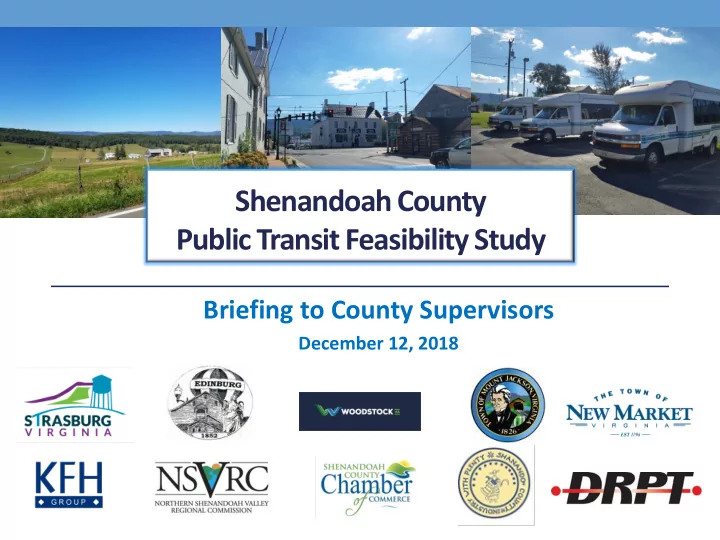
Shenandoah County Public Transit Feasibility Study Briefing to - - PowerPoint PPT Presentation

shenandoah county public transit feasibility study
SMART_READER_LITE
LIVE PREVIEW

Shenandoah County Public Transit Feasibility Study Briefing to - - PowerPoint PPT Presentation

Shenandoah County Public Transit Feasibility Study Briefing to County Supervisors December 12, 2018 Background Area non-profit agencies identified that the lack of transportation is a barrier for people to access services, jobs, medical


slide-1
SLIDE 1

Shenandoah County Public Transit Feasibility Study

Briefing to County Supervisors

December 12, 2018

slide-2
SLIDE 2

Background

  • Area non-profit agencies identified that the lack of

transportation is a barrier for people to access services, jobs, medical appointments, and educational

  • pportunities.
  • Major employers have indicated that hiring and

retaining entry level employees is a challenge due to limited transportation resources.

  • Shenandoah County Chamber reached out to the

Northern Shenandoah Valley Regional Commission (NSVRC) for technical assistance.

2

slide-3
SLIDE 3

Background

  • NSVRC applied for and was awarded a grant from the

Virginia Department of Rail and Public Transportation (DRPT) to study the feasibility of initiating a public transportation service.

  • Through an RFP process, KFH Group was hired to lead

the study.

  • The study was initiated in September, 2018.

3

slide-4
SLIDE 4

Study Tasks

Outreach to Stakeholder Groups and the Public Review of Socioeconomic Data and Local Planning

Documents

  • System and Service Development
  • Budget and Performance Development
  • System Governance and Management
  • Draft and Final Reports

4

slide-5
SLIDE 5

Stakeholder Input : Sept.– Nov. 2018

Human Service Agencies

  • Public transit is needed to help residents access jobs, medical

appointments, school, training, shopping, and other life activities.

  • Primary focus should be for job access and for seniors and people

with disabilities to access daily life activities.

  • Highest priority is the U.S. Route 11 Corridor, M-F.
  • A mobility management component should be included.
  • Public transit seen as an important economic development resource.
  • There are implementation concerns with regard to garnering public

support, the institutional structure, and effective marketing.

5

slide-6
SLIDE 6

Stakeholder Input: Sept.– Nov. 2018

Employers

  • Employer survey – 26 employers responded, representing 3,305

employees.

  • Nine reported that their employees have said transportation to work

is a problem for them.

  • Nine reported that transportation to work is an issue in hiring and

retaining employees.

  • Employees’ transportation problems are typically a result of carpool

arrangements that fall through, affecting more than one employee (20% mode share for carpooling).

  • Seven employers offered specific suggestions, with three suggesting

service along U.S. Route 11.

6

slide-7
SLIDE 7

Stakeholder Input: Sept.– Nov. 2018

Public Survey

  • 1,100 responses
  • Majority drive themselves (91%) and do not face transportation

barriers.

  • 65% of the total indicated that there is a need to start a public transit

program, with a focus on work trips and local service geared to appointments and daily life activities.

  • 342 people said they would use it.
  • Favored Service:
  • U.S. Route 11 Corridor
  • M-F, between 6:00 a.m. and 9:00 p.m.
  • Fixed route
  • Between $1.00 and $2.00 fare

7

slide-8
SLIDE 8

Stakeholder Input: Sept.– Nov. 2018

8

Public Survey

  • 270 Comments
  • 195 positive (72%)
  • 54 negative (20%)
  • 21 neutral
slide-9
SLIDE 9

Stakeholder Input: Sept.– Nov. 2018

Public Survey – Comments (Sample)

“I have a disability and this would make a world of difference in my quality of life” “I would definitely use this form of transportation to get back and forth to work. Yes this town does have a local taxi service, which is a great and friendly business, but for five days a week to go to and from work the taxi costs me $80 a week and I live just over 2 miles from my work. That gets extremely expensive… Please help bring public transportation to

  • Woodstock. This would help my family put food on the table and save to get a car of my
  • wn.”

“I think this would be a fantastic resource – to alleviate the stressors of the working poor, to meet the needs of the elderly, and to provide young people with a safe alternative to driving. I would be very willing for my tax dollars to go to such a program.” “There is no need for public transportation in Shenandoah County. A waste of money.” “Shenandoah County is too spread out for public transportation. The tax payer dollars that this would require are better used in other areas.” 9

slide-10
SLIDE 10

Demographics and Land Use Analysis

10

slide-11
SLIDE 11

Demographics and Land Use Analysis

11

slide-12
SLIDE 12

Demographics and Land Use Analysis

12

slide-13
SLIDE 13

Demographics and Land Use Analysis

13

slide-14
SLIDE 14

Demographics and Land Use Analysis

14

  • High need areas, as well as

population and major origins and destinations are generally clustered along U.S. Route 11 Corridor.

  • Local planning documents support

the investigation of initiating a public transportation program, as a collaborative effort among county, town, and regional partner.

slide-15
SLIDE 15

Next Steps: What is Feasible?

System and Service Development

  • Research Rural Systems in Virginia with Corridor

Services

  • Virginia Regional Transit
  • Front Royal Trolley and Corridor Connector (Warren County)
  • Culpeper – Orange Connector
  • BRITE (Staunton-Augusta-Waynesboro)
  • STAR Transit (Eastern Shore)
  • Farmville Area Bus
  • Blackstone Area Bus
  • Research Local Private Non-Profits with

Transportation Programs

15

slide-16
SLIDE 16

Next Steps: What is Feasible?

Focus of Research

  • Organizational Structure
  • County
  • Regional Body
  • Town
  • Private Non-Profit
  • Contracted vs In-house
  • Operating and Capital Costs and Funding

Partners

  • Operating Characteristics

16

slide-17
SLIDE 17

Next Steps: What is Feasible?

Develop Service Plan

  • Tentative Service Design for Budget

Development

  • Capital Needs

Budget and Performance Estimates

  • Cost estimates
  • Ridership estimates
  • Estimate fare revenue, grant options, local match

requirements and potential partners

  • There is the possibility of applying for a demonstration grant

from DRPT to initiate service.

17

slide-18
SLIDE 18

Next Steps: What is Feasible?

  • Recommendation for System

Governance and Management

  • County?
  • NSVRC?
  • Local private non-profit?
  • Contractor or in-house?

*Transit programs need a local champion*

18

slide-19
SLIDE 19

Questions and Contact Information

Project Deliverables

http://www.kfhgroup.com/nsvrcfeasibilitystudy/

NSVRC

Karen Taylor ktaylor@nsvregion.org (540) 636-8800

KFH Group

Elisabeth (Lib) Rood, AICP Senior Transportation Planner erood@kfhgroup.com 301-951-8660

19