Session 5: Dealing with Unmet Medical Needs and Support to - - PowerPoint PPT Presentation

session 5 dealing with unmet medical needs and support to
SMART_READER_LITE
LIVE PREVIEW

Session 5: Dealing with Unmet Medical Needs and Support to - - PowerPoint PPT Presentation

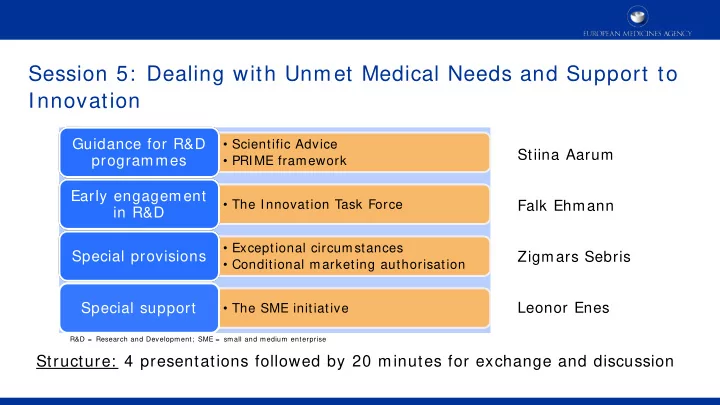
Session 5: Dealing with Unmet Medical Needs and Support to Innovation Guidance for R&D Scientific Advice Stiina Aarum programmes PRIME framework Early engagement The Innovation Task Force Falk Ehmann in R&D


slide-1
SLIDE 1

Session 5: Dealing with Unmet Medical Needs and Support to Innovation

  • Scientific Advice
  • PRIME framework

Guidance for R&D programmes

  • The Innovation Task Force

Early engagement in R&D

  • Exceptional circumstances
  • Conditional marketing authorisation

Special provisions

  • The SME initiative

Special support Stiina Aarum Falk Ehmann Zigmars Sebris Leonor Enes

Structure: 4 presentations followed by 20 minutes for exchange and discussion

R&D = Research and Development; SME = small and medium enterprise

slide-2
SLIDE 2

An agency of the European Union

Guidance to R&D programmes: Scientific Advice and the PRIME network

The EU medicines regulatory system and the European Medicines Agency: an introduction for international regulators and non-governmental organisations 18 September 2017

Presented by Stiina Aarum Product Development Scientific Support Department

slide-3
SLIDE 3

This session:

Scientific advice and protocol assistance – Scope, value and current developments

  • Parallel EMA/ HTA scientific consultation
  • Qualification of novel methodologies and biomarkers
  • Modelling and simulation
  • PRIME-Legal basis, value and experience so far

18 September 2017 Guidance to R&D programmes: Scientific Advice and the PRIME network

slide-4
SLIDE 4

The typical long road of bringing medicines to patients

Pharmaceutical + nonclinical (4 – 6 y) Phase I and II (2 – 4 y) Confirmatory phase III (2 - 5 y) Regulatory Assessment and approval (1 – 2 y) Reimburse- ment and launch (0 – 2 y)

  • Scientific advice
  • Support to small/ medium-sized enterprises
  • PRI ority MEdicines schem e ( PRI ME)
  • Conditional marketing authorisation
  • Accelerated Assessment
  • Compassionate Use

Patient access

18 September 2017

Regulatory provisions targeting the risk of development failure and the time to access:

Guidance to R&D programmes: Scientific Advice and the PRIME network

slide-5
SLIDE 5

Scientific Advice

  • Legal basis: According to Article 57-1 (n) of Regulation (EC) No 726/ 2004 of

the European Parliament and of the Council of 31 March 2004

  • One of the tasks of the Agency is "advising undertakings on the conduct of the

various tests and trials necessary to demonstrate the quality, safety and efficacy of medicinal products".

  • Advising Applicants on the scientific requirements for marketing authorisation

(MA):

– Before the first MA: companies ask questions on manufacturing, non-clinical and clinical trials, risk-management plans, ways to develop generics, hybrids and biosimilars; significant benefit for orphan medicines; development in children etc. – Post-MA: extension of indication to different age groups and stages of the disease; different conditions; & safety aspects. Line extensions etc.

18 September 2017 Guidance to R&D programmes: Scientific Advice and the PRIME network

slide-6
SLIDE 6

Scientific Advice

For human medicines, SA and protocol assistance are given by the Committee for Medicinal Products for Human Use (CHMP) on the recommendation of the Scientific Advice Working Party (SAWP). Prospective in nature- focusing on development strategies rather than pre- evaluation of data to support a MAA.

18 September 2017 Guidance to R&D programmes: Scientific Advice and the PRIME network

slide-7
SLIDE 7

Scientific Advice Network

18 September 2017

Patient Organisations , HTA bodies CHMP/ W Ps/ Other Com m ittees External Experts/ Clini cians Scientific Secretaria t SAW P Multidisci

  • pl. expert

group

Guidance to R&D programmes: Scientific Advice and the PRIME network

slide-8
SLIDE 8

Scientific Advice Working Party (SAWP)

  • Experts from national authorities, universities and hospitals selected for

expertise: e.g. oncology, cardiology, psychiatry, neurology, immunotherapy, gene and cell therapy, advanced therapies, pediatrics, geriatrics; quality, non—clinical and statistical methodologies.

  • Joint members across Committees not only CHMP, but also Paediatrics,

Orphan, Advanced Medicinal Products, PRAC

  • Scientific and logistic support from EMA secretariat: medical doctors

/ pharmacists and assistants

18 September 2017 Guidance to R&D programmes: Scientific Advice and the PRIME network

slide-9
SLIDE 9

SA can help to guide changes in the pivotal clinical development…

18 September 2017

SA/ PA submitted in 2008–2012, Hofer et al. Nat Rev Drug Discov. 2015

Guidance to R&D programmes: Scientific Advice and the PRIME network

slide-10
SLIDE 10

SA can help to guide changes in the pivotal clinical development towards improved regulatory acceptability

18 September 2017

  • Obtaining and complying SA is strongly associated with a positive outcome of a

MAA: almost 90% of those who obtain and follow SA receive a positive opinion compared to 40% for those who do not follow SA; Hofer et al. 2015

Guidance to R&D programmes: Scientific Advice and the PRIME network

slide-11
SLIDE 11

Scientific Advice main activity so far: scientific advice and protocol assistance

18 September 2017 Guidance to R&D programmes: Scientific Advice and the PRIME network

slide-12
SLIDE 12

Parallel EMA/ HTA scientific consultation

Starting point: Newly licensed medicines do not reach all patients in need Regulators and HTAs – answer different questions – have different requirements in terms of evidence Aim: decision makers come together early to discuss – the planned development including populations / comparators / design of trial / endpoints – the requirements for post-licensing evidence generation Expectation: Optimised development plan  Improve access for patients

18 September 2017 Guidance to R&D programmes: Scientific Advice and the PRIME network

slide-13
SLIDE 13

Reality check: from EU regulatory approval to national HTA/ P&R decisions for oncology products

Drug I ndication EU MA Approval Time for HTA/ P&R after MA (month) bosutinib ( Bosulif) chronic myeloid leukaemia 03/ 2013 7 7 11 18 vism odegib ( Erivedge) * basal cell carcinoma 07/ 2013 n/ a 7 5 20 cabozantinib ( Com etriq) * medullary thyroid cancer 03/ 2014 n/ a 10 8 n/ a

Martinalbo et al., Early access to cancer drugs in the

  • EU. Ann Oncol 27:

96–105, 2016

18 September 2017 Guidance to R&D programmes: Scientific Advice and the PRIME network

slide-14
SLIDE 14

Align regulatory and HTA thinking; what constitutes success?

Tripartite understanding of roles, remits and standards Common language Common understanding of methodology Common understanding of science and methodology; different application? Evidence generation without undue delay: avoid sequential thinking Alignment of the perspectives of EU regulators and HTA bodies published: Tafuri et al, Br J Clin Pharmacol (2016): Studied population, comparator, endpoints, overall package for E and S, other study design characteristics

18 September 2017 Guidance to R&D programmes: Scientific Advice and the PRIME network

slide-15
SLIDE 15

Qualification of novel methodologies and biomarkers

Vision: Speed up/ optimise drug development and utilisation, improve public health Procedure to guide the development of new more efficient ways to develop drugs, e.g. development of new endpoints for clinical trials Exam ples:

  • Methods to predict toxicity; IC to enrich a patient population for a clinical trial:

Volume of certain brain structures and level of certain biochemicals in the cerebrospinal fluid for trials in Alzheimer's disease

  • Surrogate clinical endpoints: new sensitive scales to measure efficacy of a new

drug instead of hard clinical endpoints

  • Patient and caregiver reported outcomes

18 September 2017 Guidance to R&D programmes: Scientific Advice and the PRIME network

slide-16
SLIDE 16

Qualification of Novel Methodologies for drug development

CHMP Qualification Advice on future protocols and methods for further method development towards qualification. CHMP Qualification Opinion on the acceptability of a specific use of the proposed method (e.g. use of a biomarker) in a research and development (R&D) context (non-clinical or clinical studies), based on the assessment of submitted data. W ho can apply? Consortia, Networks, Public / Private partnerships, Learned societies, Pharmaceutical industry. 1 1 7 procedures since start in 2 0 0 8

18 September 2017 Guidance to R&D programmes: Scientific Advice and the PRIME network

slide-17
SLIDE 17

Modelling and simulation- regulatory value

Early: Enable early informed discussion with sponsors regarding study designs, endpoints, dose regimens, paediatric questions, data needed to support benefit risk decisions At MAA: Support benefit risk decisions by investigating uncertainties & untested scenarios, and their clinical consequences Translate benefit risk from the population to individual Inform SmPC especially for special populations Support Subgroup analysis Post Marketing: Inform the contents of the RMP Lifecycle management of products

18 September 2017 Guidance to R&D programmes: Scientific Advice and the PRIME network

slide-18
SLIDE 18

Eligibility to PRIority Medicines (PRIME) scheme

Legal base-accelerated assessment (Recital 33 and Article 14(9) of Regulation (EC) No 726/ 2004) Medicinal products of major public health interest and in particular from the viewpoint

  • f therapeutic innovation.
  • Potential

to address to a significant extent an unm et m edical need

  • Scientific justification, based on

data and evidence available from nonclinical and clinical development, to address the UMN

No satisfactory method or if method exists, bring a major therapeutic advantage Introducing new methods or improving existing ones Meaningful improvement of efficacy (impact on onset, duration, improving morbidity, mortality)

18 September 2017 Guidance to R&D programmes: Scientific Advice and the PRIME network

slide-19
SLIDE 19

Entry points PRIME eligibility and required evidence

18 September 2017

Proof of concept

  • Sound pharmacological

rationale

  • Clinical response efficacy and

safety data in patients (exploratory trials)

  • Substantial improvement
  • Magnitude, duration, relevance
  • f outcomes to be judged on a

case by case basis

Any sponsor

Proof of principle (For SMEs and academia only)

  • Sound pharmacological

rationale, convincing scientific concept

  • Relevant nonclinical effects of

sufficiently large magnitude and duration

  • Tolerability in first in man trials

SMEs

Academ ia

Confirm ation

Nonclinical Phase I Exploratory

Confirm atory

Guidance to R&D programmes: Scientific Advice and the PRIME network

slide-20
SLIDE 20

Features of the PRIME scheme

Early access tool, supporting patient access to innovative medicines.

  • W ritten confirm ation of PRI ME eligibility and potential

for accelerated assessm ent;

  • Early CHMP Rapporteur appointm ent during

development;

  • Kick off m eeting with multidisciplinary expertise from EU

network;

  • Enhanced scientific advice at key development

milestones/ decision points;

  • EMA dedicated contact point;
  • Fee incentives for SMEs and academics on Scientific

Advice requests.

18 September 2017 Guidance to R&D programmes: Scientific Advice and the PRIME network

slide-21
SLIDE 21

PRIME eligibility recommendations adopted by 20 July 2017

> 1 2 0 eligibility requests 2 8 granted* ~ 5 0 % SMEs ~ 5 0 % Advanced therapies

18 September 2017 Guidance to R&D programmes: Scientific Advice and the PRIME network

slide-22
SLIDE 22

Take home message- Scientific Advice and PRIME

  • Key tool to prom ote the collection of robust data on the benefits and

risks of m edicines

  • Benefits patients as it prom otes the generation of robust data and

protects them from participating in badly designed or irrelevant clinical trials

  • Key platform for our collaboration w ith health technology assessm ent

( HTA) bodies which aims to facilitate patients’ access to new medicines

  • Central activity to stim ulate innovation
  • Regulatory incentive via PRI ME is possible for m edicinal products of

m ajor public health interest and in particular from the viewpoint of therapeutic innovation

18 September 2017

slide-23
SLIDE 23

Thank you for your attention

Stiina.aarum@ema.europa.eu

European Medicines Agency

30 Churchill Place • Canary Wharf • London E14 5EU • United Kingdom

Telephone + 44 (0)20 3660 6000 Facsim ile + 44 (0)20 3660 5555 Send a question via our w ebsite www.ema.europa.eu/ contact

Further information

Follow us on @EMA_ New s

slide-24
SLIDE 24

Backup/ extra slides

18 September 2017 Guidance to R&D programmes: Scientific Advice and the PRIME network

slide-25
SLIDE 25

Transparency

Publication of monthly reports

  • Broad characteristics
  • Active substance (for eligible products only)
  • High-level statistics

18 September 2017

List of products granted eligibility to PRIME

Guidance to R&D programmes: Scientific Advice and the PRIME network

slide-26
SLIDE 26

PRIME webpage and supporting documents

18 September 2017

Factsheet in lay language Q&A, tem plates, application form for applicants

prime@ema.europa.eu

Guidance to R&D programmes: Scientific Advice and the PRIME network

slide-27
SLIDE 27

An agency of the European Union

Early engagement in R&D: The Innovation Task Force (ITF)

The EU medicines regulatory system and the European Medicines Agency: an introduction for international regulators and non-governmental organisations

Presented by: Falk Ehmann Science and Innovation Office; Human Medicines Research and Development Support Division; EMA

slide-28
SLIDE 28

Regulators became gatekeepers and enablers…

1 Clinical pharmacology & Therapeutics; Advance online publication 3 April 2013. doi: 10.1038/ clpt.2013.14 ; F Ehmann, M Papaluca Amati, T Salmonson, M Posch, S Vamvakas, R Hemmings, HG Eichler and CK Schneider

slide-29
SLIDE 29

I nnovation Task Force ( I TF)

Multidisciplinary platform for preparatory dialogue and orientation on innovative methods, technologies and medicines

2

slide-30
SLIDE 30

I TF objectives ( ASAP) :

  • Assist Know ledge exchange on innovative strategies involving

regulatory netw ork

  • Support drug developm ent via early dialogue on

– Scientific, legal and regulatory issues – Products, m ethodologies and technologies

  • Address the im pact of em erging therapies and technologies on

current regulatory system

  • Preparing for form al procedures

3

slide-31
SLIDE 31

Users of the I nnovation Task Force

4

Regulatory watch: Where do new medicines originate from in the EU? Nature Reviews Drug Discovery Volume: 13, Pages: 92–93; Published online 31 January 2014 )?

ITF users 2012-2015

Originator and the marketing authorization holder for 94 approved products evaluated, divided according to organization type

slide-32
SLIDE 32

5

I TF Secretariat SME Office Orphan Safety & Efficacy ( 5 therapeutic areas) Quality Risk Managem ent I nspection Regulatory Affairs Legal Biostatistics Paediatrics GCP I T Veterinary Medicines Gene- Cell- Tissue MP Scientific Advice Clinical Pharm acology / Non-Clinical Stakeholder

  • incl. Academ ia,

I ndustry

Multidisciplinary ITF (internal) resources from across the Agency:

slide-33
SLIDE 33

6

I TF ( external) I TF resources from EU and beyond:

  • EU regulatory netw ork including Com m ittees, W Ps and experts
  • Research and other EU Public I nstitutions (Karolinska, Italian Nano

Centre, Max-Planck, Frauenhofer)

  • EU I nstitutions e.g. Joint Research Centre, EFSA, ECHA, EDQM, DG

Research, -Sante, -Growth

  • Expertise from International Regulators, e.g. FDA, PMDA/ MHLW, HC,

Swissmedic, TGA

  • International Institutions (US-Nano Characterisation Laboratory, Mayo Clinic)
  • Other bodies within the EU (ECDC, Medical device authorities)
slide-34
SLIDE 34

Main tasks of the I nnovation Task Force ( I TF)

  • Coordination of ITF briefing meetings
  • ATMP classification review
  • Art. 57 Scientific Opinion

 With focus on: Emerging therapies and technologies

e.g. Nanomedicines, Synthetic Biology, Epigenetics, Biomaterial, Health technologies (e- and m-health)

Borderline and combination products

e.g. devices, cosmetics, food

slide-35
SLIDE 35

I nvolvem ent in I TF Briefing Meetings ( internal and external) :

8

Year of m eetings 2 0 1 3 2 0 1 4 2 0 1 5 2 0 1 6 Number of meetings 23 27 33 41 ITF attendees 51 66 54 116 EMA attendees (non ITF) 25 32 74 106 WP experts from EU Regulatory Network 70 71 65 123 Industry attendees 109 90 98 147 Total 255 259 291 492

50 100 150 200 250 300 350 400 450 500 2013 2014 2015 2016

slide-36
SLIDE 36

I m pact of I nnovation Task Force on other EMA procedures:

9 2 I TF Briefing m eetings organised between 2014 – 2016, of which 8 0 % were submitted by academ ia, SMEs and consortia (ITF support focus)

  • 15% are Advanced Therapies (Gene, Cell, Tissue engineered products)
  • 14% consider seeking EU Orphan Drug designation (rare diseases)
  • 20% consider interaction with the EMA Paediatric Committee (PDCO)
  • 30% of applicants consider applying a formal scientific advice request
  • 11% consider Qualification of methodology (e.g. Biomarker qualification)
  • 10% consider Marketing Authorisation Application within foreseeable future
slide-37
SLIDE 37

I TF Outcom es: I ntel gathering and dissem ination

10

ITF Briefing meetings and minutes ATMP classifications Art. 57 opinions

  • Monthly briefing and feed-back provided to CHMP and other Com m ittees
  • Trainings organised ( internal and external)
  • Aw areness sessions broadcasted via EU-NTC
  • Recommendations for the organisation of w orkshops, expert m eetings
  • Recommendations for Drafting guidance
  • I nput in Horizon Scanning and EU I nnovation Netw ork
  • ITF-BM Tracking database as constant tracking and intel gathering tool
  • Annual intelligence gathering including stakeholder consultation
slide-38
SLIDE 38

Further information

Take home messages

Regulators became gatekeepers and enablers The EMA is open to discuss scientific, regulatory and technical aspects of innovative developments The ITF is the Regulator’s tool for informal early engagement and feed-back See: http: / / www.ema.europa.eu/ ema/ index.jsp?curl= pages/ regulation/ general/ general_content_000334.jsp&mid= WC0b01ac05800ba1d9 Contact us at: ITFsecretariat@ema.europa.eu

slide-39
SLIDE 39

An agency of the European Union

Dealing with Unmet Medical Needs and Support to Innovation

Marketing authorisation under exceptional circumstances, Conditional Marketing Authorisation and Adaptive pathways The EU medicines regulatory system and the European Medicines Agency: an introduction for international regulators and non-governmental

  • rganisations

Presented by Zigmars Sebris on 18 September 2017 Regulatory Affairs Office, Human Medicines Evaluation Division

slide-40
SLIDE 40

Regulatory tools and initiatives aimed at unmet medical needs

  • Based on less comprehensive data and with
  • bligation to generate these data post-

authorisation Conditional Marketing authorisation

  • When comprehensive data can not be general

at all, subject to specific obligations Marketing authorisation under exceptional circum stances

  • Reduced assessment time for products of major

public health interest Accelerated assessment

  • Products made available to patients prior

granting of marketing authorisation Compassionate use

  • Support scheme with early and enhanced

scientific dialogue PRIME

  • Scientific concept of medicines development and

data generation Adaptive pathw ays

  • Forum for informal early dialogue

Innovation task force

  • Other tools and initiatives

Etc.

Dealing with Unmet Medical Needs - CMA, MA under exceptional circumstances, Adaptive Pathways 1

To o l s i n l e g i sl a t i o n Ot h e r t o o l s a n d i n i t i a t i v e s

slide-41
SLIDE 41

Tools in the Legislation

Dealing with Unmet Medical Needs - CMA, MA under exceptional circumstances, Adaptive Pathways 2

Quality + nonclinical Phase I and II Confirmatory phase III Assessm ent and approval Reimburse- ment and launch

Access

Quality + nonclinical Phase I and II Confirmatory phase III Assessm ent and approval Reimburse- ment and launch

Access

Quality + nonclinical Phase I and II Confirmatory phase III Assessm ent and approval Reimburse- ment and launch

Access Access

slide-42
SLIDE 42

Conditional Marketing authorisation

Dealing with Unmet Medical Needs - CMA, MA under exceptional circumstances, Adaptive Pathways 3

Scope (at least 1)

Seriously debilitating or life-threatening diseases Emergency situations Orphan products

Criteria (all)

Positive benefit-risk balance Comprehensive data can be provided after authorisation Unmet medical needs will be addressed Benefits of immediate availability outweigh the risks

Commission Regulation (EC) No 507/ 2006 ‘unm et m edical needs’ means a condition for which there exists no satisfactory method of diagnosis, prevention or treatment authorised in the Community or, even if such a method exists, in relation to which the medicinal product concerned will be of major therapeutic advantage to those affected

Com prehensive data not yet available

slide-43
SLIDE 43

Marketing Authorisation Under Exceptional Circumstances

I m possible to provide com prehensive data on the efficacy and safety of the medicinal product under normal conditions of use, for objective, verifiable reasons

Dealing with Unmet Medical Needs - CMA, MA under exceptional circumstances, Adaptive Pathways 4

Criteria (at least 1) the indications are encountered so rarely that it be expected to obtain comprehensive evidence, or in the present state of scientific knowledge, comprehensive information cannot be provided, or it would be contrary to generally accepted principles of medical ethics to collect such information

slide-44
SLIDE 44

Comparison

Dealing with Unmet Medical Needs - CMA, MA under exceptional circumstances, Adaptive Pathways 5

Conditional MA MA under exceptional circum stances Comprehensive data after authorisation Comprehensive data not possible To later sw itch to ‘standard’ MA To remain such indefinitely Valid for 1 year only (annual renewals) Valid for 5 years (renewable) + annual re-assessment Possible in centralised procedure only Possible in all registration procedures Specific Obligations + may have conditions Specific obligations + may have conditions

slide-45
SLIDE 45

Last 10 years in numbers

Dealing with Unmet Medical Needs - CMA, MA under exceptional circumstances, Adaptive Pathways 6

Data updated w ith DLP 3 1 Dec 2 0 1 6

slide-46
SLIDE 46

Therapeutic areas

Dealing with Unmet Medical Needs - CMA, MA under exceptional circumstances, Adaptive Pathways 7

DLP 3 0 Jun 2 0 1 6

Oncology Infectious diseases

slide-47
SLIDE 47

Conversion of Conditional MA to standard MA

Dealing with Unmet Medical Needs - CMA, MA under exceptional circumstances, Adaptive Pathways 8

On average w ithin 4 years a conditional MA is converted into a standard MA

Data updated w ith DLP 3 1 Dec 2 0 1 6

slide-48
SLIDE 48

Conditional MA – everolimus

Votubia

For subependymal giant cell astrocytoma (SEGA) associated with tuberous sclerosis complex In patients not amenable to surgery Unmet need: lack of non-invasive pharmacological treatments (no satisfactory method)

Initial evidence

Phase II single arm study (28 pts) Ongoing phase III double blind placebo controlled randomised study (117 patients) Reduction in SEGA volume demonstrated Safety database: 143 pts

Dealing with Unmet Medical Needs - CMA, MA under exceptional circumstances, Adaptive Pathways 9

Specific

  • bligations

Final results from main part of the pivotal phase III study Long-term follow up from both pivotal studies No changes in scope or deadlines

slide-49
SLIDE 49

Conditional MA – raltegravir

Isentress

For treatment of HIV-1 infection In case of HIV-1 replication despite

  • ngoing anti-retroviral

therapy Unmet need: activity against HIV that is resistant to many other antiretroviral agents Approved following accelerated assessment

Initial evidence

16 and 24 week results from two ongoing phase III studies (350 + 349 pts.) + supportive studies Results showed that addition of raltegravir can provide suppression of HIV replication that is sustained to 24 weeks Safety database: 1214 pts.

Dealing with Unmet Medical Needs - CMA, MA under exceptional circumstances, Adaptive Pathways 10

Specific

  • bligations

48 week data from pivotal studies Implementation of a plan to monitor resistance and of observational safety data collection Due date for one obligation extended by 10 months to duet o need to revise proposal based

  • n CHMP comments
slide-50
SLIDE 50

MA under Exceptional Circumstances – lomitapide

Lojuxta

For patients with homozygous familial hypercholesterolaem ia Rare, life-threatening autosomal dominant genetic disease characterised by marked elevations in low density lipoprotein cholesterol Criterion: rarity of the indication (comprehensive data cannot reasonably to be expected)

Initial evidence

Unblinded single arm study (29 patients in primary analysis) Complemented by short term supportive studies Consistent lipid lowering efficacy shown Total safety database: 845 patients

Dealing with Unmet Medical Needs - CMA, MA under exceptional circumstances, Adaptive Pathways 11

Specific

  • bligations

Long term prospective observational study to systematically collect information on the safety and effectiveness outcomes

  • Annual reports provided each year
  • No completion date for the activity
slide-51
SLIDE 51

Information on EMA’s website

Dealing with Unmet Medical Needs - CMA, MA under exceptional circumstances, Adaptive Pathways 12

slide-52
SLIDE 52

Any questions?

Zigmars.sebris@ema.europa.eu

European Medicines Agency

30 Churchill Place • Canary Wharf • London E14 5EU • United Kingdom

Telephone + 44 (0)20 3660 6000 Facsim ile + 44 (0)20 3660 5555 Send a question via our w ebsite www.ema.europa.eu/ contact

Further information

Follow us on @EMA_ New s

slide-53
SLIDE 53

An agency of the European Union

Special Support: The Small and Medium enterprise (SME) initiative

The EU medicines regulatory system and the European Medicines Agency: an introduction for international regulators and non-governmental organisations

Presented by: Leonor Enes SME Office; Stakeholders & Communication Division; European Medicines Agency

slide-54
SLIDE 54

SME Regulation What the SME Office does Support to innovation – stats Marketing authorisations

1 2 3

1

4

slide-55
SLIDE 55

Assistance to SMEs

Regulatory, administrative and procedural support

Facilitates communication

With SMEs in veterinary and human pharma sector

SME Office launch in December 2005 Coordinating & networking

Working closely with EU, SME partners and stakeholders

A single contact point

COMMISSION REGULATION (EC) No 2049/ 2005 of 15 December 2005

Aim : to promote innovation and the development of new medicines for

human and veterinary use by SMEs

2

SME Regulation

1

slide-56
SLIDE 56

Assignment of SME status Regulatory Assistance & SME briefing meetings Fee Incentives Translation Assistance Training and Awareness Partnering & Networking SME Register

3

Reporting and Planning

SME Office annual report 2016 SME action plan (2017-2020)

What the SME Office does

2

slide-57
SLIDE 57

Assignment of SME status: SME definition

Commission Recommendation 2003/ 361/ EC defines micro, small and medium-sized enterprises

4

Enterprise category Enterprise category Medium- sized Small Annual balance sheet total Annual turnover Headcount: annual work units (AWU) ≤ EUR 50 million < 250 Micro ≤ EUR 43 million ≤ EUR 2 million ≤ EUR 2 million < 10 ≤ EUR 10 million ≤ EUR 10 million < 50

  • r
  • r
  • r
  • r

To qualify for SME status companies must: 1) be established in the EEA 2) meet the following thresholds:

slide-58
SLIDE 58

Registered SMEs

  • From 28 countries across EU
  • Top 3 countries : UK,

Germany and France

  • 41% micro, 34% small,

25% medium

  • Majority human (78% ), 4%

vet, 5% human/ vet & 13% service providers

  • Information on registered

companies available in the SME public register

5

108 246 372 460 507 679 1098 1258 1301 1619 1810 2006 2007 2008 2009 2010 2011 2012 2013 2014 2015 2016

slide-59
SLIDE 59

Regulatory assistance to SMEs

Tailored to SMEs

6

2007 2008 2009 2010 2011 2012 2013 2014 2015 2006 Direct administrative and procedural assistance 90 82 93 102 165 135 130 163 20 141 2016 174 128 Reg. Ass.

cut off date 19/ 07/ 2017

slide-60
SLIDE 60

SME fee incentives

Fee reductions and exemptions for scientific advice, scientific services, inspections & establishment of maximum residue limits Deferrals of the fee payable for an application for marketing authorisation or related inspection Conditional fee exemption Fee reductions and exemptions for post-authorisation procedures and pharmacovigilance activities Waiver of the MedDRA licensing fee for micro and small companies

7

Full details on all fees and fee reductions are available in: Explanatory note on general fees payable to the European Medicines Agency and Explanatory note on pharmacovigilance fees payable to the European Medicines Agency

slide-61
SLIDE 61

Training & awareness for SMEs

Provide training

&

ease the access to regulatory information

Announcements

Information sent by email to SMEs and stakeholders

Newsletters

Circulated quarterly; published

  • n the EMA Website.

Info days

Annual or Biannual regulatory training course tailored for SMEs

SME User Guide

Updated regularly

8

Supporting innovative medicines' development and early access; 17/ 11/ 2017

slide-62
SLIDE 62

Support to innovation – SME briefing meetings

provides a platform for early dialogue with SME to discuss regulatory strategy of medicinal product development and navigate the range of procedures and incentives available multidisciplinary group, co-operation with other EMA offices (scientific advice, paediatrics, orphans, regulatory affairs, etc)

  • pen to medicinal products for human and veterinary use

free of charge

9

2005 - 2015: 6 5 2016: 1 3 2017 (Jan - July): 9

3

slide-63
SLIDE 63

ITF briefing meetings (2016)

Academia SMEs Mid-cap Other

10

8 1 9 %

2 0 4 9 %

6 1 5 % 7 1 7 %

20 out of 41 ITF meetings in 2016 were for SMEs applicants

Support to innovation - Innovation Task Force & ATMPs

ATMPs

6

FINALISED ISED (ti (till en end 2016) 2016)

ATMP certifications

Certification of quality and non-clinical data for ATMPs intended for human use: for SMEs only

slide-64
SLIDE 64

Human medicines

11

2 6 % of all SA by SMEs 4 6 % of all PA by SMEs

177 SA and PA submitted by SMEs

Support to innovation - Scientific Advice & Protocol Assistance

6

Parallel HTA Advice by SMEs

6 8 2 3 % 8 3 2 8 % 1 4 3 4 9 %

Scope of scientific advice - hum an products - SMEs ( 2 0 1 1 -2 0 1 6 ) Quality Non-clinical Clinical In 2016, 5 4 % of clinical questions in SA were related to confirmatory trials

2 0 1 6

slide-65
SLIDE 65

Support to innovation - PRIME (PRIority MEdicines)

Key figures (2016-July 2017)

12

121 applications received up to July 2017 (half by SMEs) 28 medicines granted PRIME of which 1 2 are SMEs 1 SME early entrance (SMEs can apply earlier on the basis of compelling non- clinical data and tolerability data from initial clinical trials) additional SME fee reductions for scientific advice

6 5 0 % 2 1 7 % 4 3 3 % Hum an products SMEs ( 2 0 1 6 – July 2 0 1 7 )

ATMP Biological Chemical

  • Oncology
  • Immunology
  • Haematology
  • Gastroenterology
  • Neurology
  • Infections diseases

Therapeutic areas:

slide-66
SLIDE 66

Marketing authorisations

9 1 %

13

1 5 8 4 8 5 1 0 6 8 4 1 2 1 1 3 1 1 1 1 4 6 6 1 3 3 4 3 1 5 2 4 6 8 10 12 14 16 18

2006 2007 2008 2009 2010 2011 2012 2013 2014 2015 2016

1 1 2 1 2 4 1 2 2 5 1 2 1 1 2 4 6 8

2006 2007 2008 2009 2010 2011 2012 2013 2014 2015 2016

Human medicines

SME Applicants – MAA outcom e by year ( 2 0 0 6 -2 0 1 6 )

Veterinary medicines

27 MAA submitted by SMEs in 2016 9 MAA submitted by SMEs in 2016

4

slide-67
SLIDE 67

Further information

Take home messages

SMEs are a source of pharmaceutical innovation The EMA remains committed to fostering an environment which provides incentives to SMEs: awareness of the EMA SME initiative, training and education, supporting innovative medicines’ developments, and further engaging with SMEs, partners and stakeholders See: supporting SMEs Contact us at: sme@ema.europa.eu