SESSION 3: NUCLEAR SCIENCE AND TECHNOLOGY APPLICATIONS: SUSTAINING, - - PowerPoint PPT Presentation

session 3 nuclear science and technology applications
SMART_READER_LITE
LIVE PREVIEW

SESSION 3: NUCLEAR SCIENCE AND TECHNOLOGY APPLICATIONS: SUSTAINING, - - PowerPoint PPT Presentation

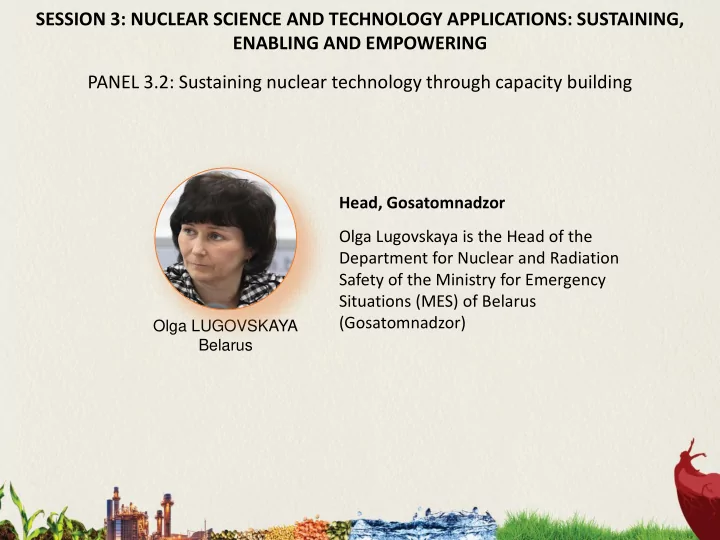
SESSION 3: NUCLEAR SCIENCE AND TECHNOLOGY APPLICATIONS: SUSTAINING, ENABLING AND EMPOWERING PANEL 3.2: Sustaining nuclear technology through capacity building Head, Gosatomnadzor Olga Lugovskaya is the Head of the Department for Nuclear and


slide-1
SLIDE 1

PANEL 3.2: Sustaining nuclear technology through capacity building SESSION 3: NUCLEAR SCIENCE AND TECHNOLOGY APPLICATIONS: SUSTAINING, ENABLING AND EMPOWERING

Olga LUGOVSKAYA Belarus

Head, Gosatomnadzor Olga Lugovskaya is the Head of the Department for Nuclear and Radiation Safety of the Ministry for Emergency Situations (MES) of Belarus (Gosatomnadzor)

slide-2
SLIDE 2

From Post-Chernobyl to Nuclear Country: Belarus Experience and Importance of Radiation Safety in All Things Nuclear

Olga LUGOVSKAYA Head of the Department for Nuclear and Radiation Safety of the Ministry for Emergency Situations of the Republic of Belarus (Gosatomnadzor)

slide-3
SLIDE 3

> 2 200 000 people affected 23% of the territory сcontaminated by cesium-137 higher than 37 kBq/m2 46 500 km2

Chernobyl consequences for Belarus. General information

479 settlements abandoned New institutions &

  • rganisations

Scientific Educational Equipment manufactures Administrative State systems created for:

radioecological monitoring control of radioactive contamination in food and products creation of network of radiological equipment manufactures medical surveillance and treatment

  • f the affected population

dose monitoring (including State Dose Registry) management of economical activities

  • n the affected territories and its

scientific support radwaste management management of abandoned zones scientific support of Chernobyl consequences overcoming training of specialists with necessary competences (with ISEU as basic

  • rganization not only Belarus but for

CIS) informing people on safety aspects of living in contaminated areas emergency preparedness and response for radiological accidents (as a part of EPR for all emergency situations)

slide-4
SLIDE 4

Radiation & Nuclear Applications in Belarus

IRS Use: 1,4 thousand organizations 23 thousands IRS:

industrial gamma installations gamma diagnostic and therapy devices gamma flaw detectors radioisotope devices, including radioisotope fire smoke detectors X-ray diagnostic and therapy devices X-ray flaw detectors neutron generators electron accelerators, etc.

Nuclear applications:

Research done by the Joint Institute of Power and Nuclear Research “Sosny” of the National Academy of Science of Belarus.

Radwaste facilities:

“Ekores” for medical and industrial waste “Sosny” Institute facility for liquid radioactive waste processing Chernobyl decontamination waste disposal facilities

slide-5
SLIDE 5

Key Aspects of Sustainability and Safety

In-time implementation of modern safety standards into national legislation and regulatory documents as well as into regulatory practice Strong supervision focused not only on identification of violations and punishment, but consistent preventive work with operators Wide use of peer review services for getting recommendations for safety improvements from competent international experts Use and unite of all existing resources for radiation safety provision

slide-6
SLIDE 6

Capacity building for nuclear power program

2012 –

Resolution of Council of Ministers #33: Joint Institute of Power and Nuclear Research SOSNY is empowered to provide scientific and technical support to NRA

2016 –

  • Resolution of Government

#991 of 02 Dec. 2016 issued “On provision of scientific and technical support to Ministry for Emergency Situations”. 16

  • rganizations-participants of

TSO system

2017 –

Creation of Scientific and Technical Center of Nuclear and Radiation Center started in the system of MES (Presidential Decree

  • n this issue adopted in

October 2017)

The main tasks of the Center:

  • provide scientific and technical support to the NRA
  • coordinate TSO system
  • conduct scientific research
  • participate in safety review, etc.

1986

Chernobyl accident

2007

Decision to enter nuclear power Creation of Gosatomnadzor

2018

> 30 years Chernobyl consequences overcoming > 10 years nuclear infrastructure development State programs for scientific support & training TSO system development:

2013

Gosatomnadzor enhansement (with staff increase more than twice)

since 1960-s

Scientific nuclear research by Institute of Nuclear Energy in SOSNY, including development of mobile NPP “Pamir”
slide-7
SLIDE 7

Competence development is organized for all areas of GAN activities using Resources

* CNS CRR, Area of Good Performance 1: “81 regulatory employees have studied abroad in the framework of IAEA and EU international cooperation projects and bilateral basis” initially proposed by USA

Internal

  • State training program up to 2020
  • Sharing of experience
  • Information bases
  • Library creation
  • Internships/tutoring

External *

  • EC technical cooperation projects
  • IAEA (national/regional projects)
  • Bilateral cooperation (9+2 agreements)
  • RCF (since 2012), Forum WWER (since

2015), WENRA(since 2015)

slide-8
SLIDE 8

Gosatomnadzor Policy Statement Regulatory Strategy Gosatomnadzor Development Strategy (updated) Information and Communication Strategy of Gosatomnadzor (updated)

Strategic Plan for 2016-2020

Gosatomnadzor Strategic Planning

Strategy of Supervision Development Strategy of Knowledge Management Strategy of HR Management

slide-9
SLIDE 9

THANK YOU FOR THE ATTENTION

Olga LUGOVSKAYA Head of the Department for Nuclear and Radiation Safety of the Ministry for Emergency Situations of the Republic of Belarus (Gosatomnadzor)