Service Encounter NKFUST Role of Technology Service Organization - - PDF document

service encounter
SMART_READER_LITE
LIVE PREVIEW

Service Encounter NKFUST Role of Technology Service Organization - - PDF document

Shin Ming Guo Service Encounter NKFUST Role of Technology Service Organization and Culture Managing Variability Managing Difficult Interactions Case Questions A customer just arrived and insisted that he has made a


slide-1
SLIDE 1

1

Service Encounter

Role of Technology

Service Organization and Culture

Managing Variability

Managing Difficult Interactions Shin‐Ming Guo NKFUST

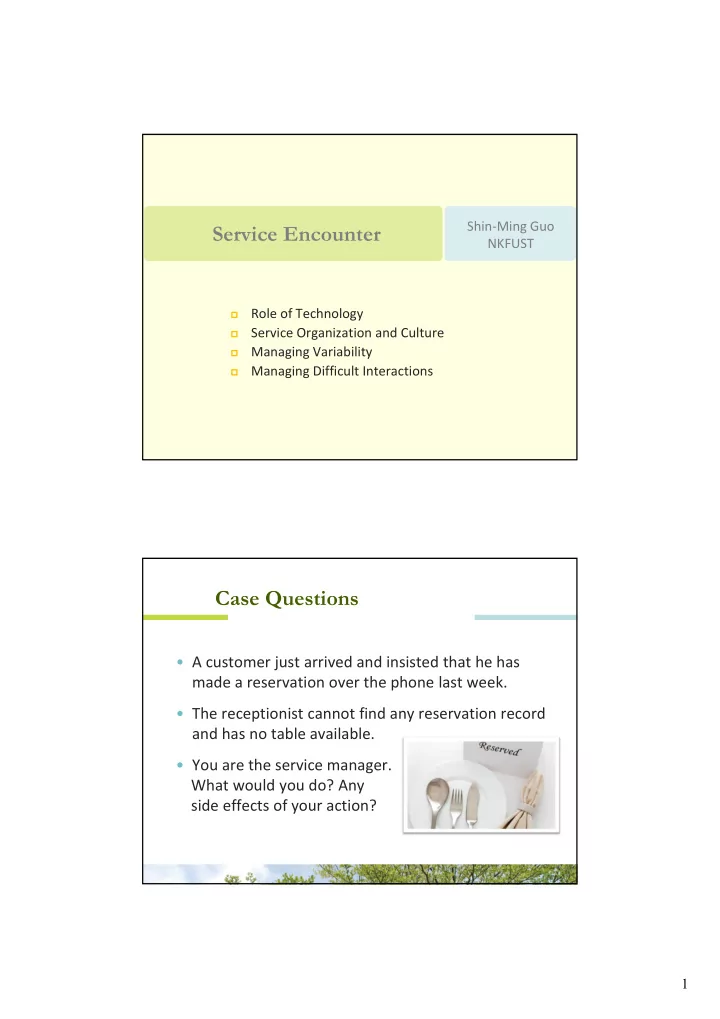
Case Questions

  • A customer just arrived and insisted that he has

made a reservation over the phone last week.

  • The receptionist cannot find any reservation record

and has no table available.

  • You are the service manager.

What would you do? Any side effects of your action?

slide-2
SLIDE 2

2

Technology in Service Encounter

3

Technology Technology Technology Technology Technology Customer Customer Server Server Server Server Server Customer Customer Customer

  • D. Technology‐Mediated

Service Encounter

  • E. Technology‐Generated

Service Encounter

  • A. Technology‐Free

Service Encounter

  • B. Technology‐Assisted

Service Encounter

  • C. Technology‐Facilitated

Service Encounter

Evolution of Service Encounter

4

Service Industry Human Contact Machine Assisted Internet Facilitated Banking Teller ATM Online banking Grocery Checkout clerk Self‐checkout station Online order/ pickup Airlines Ticket agent Check‐in kiosk Print boarding pass Restaurants Wait person Vending machine Online order/ delivery Movie theater Ticket sale Kiosk ticketing Pay‐for‐view Book store Information clerk Stock‐availability terminal Online shopping Education Teacher Computer tutorial Distance learning Gambling Poker dealer Computer poker Online poker

slide-3
SLIDE 3

3

Who Controls Service Encounter?

  • Service Organization‐Dominated

McDonald’s

  • Service Personnel‐Dominated

Physician and Patient

  • Customer‐Dominated

Self‐Service

5

The Service Encounter Triad

6

Service Organization Efficiency versus satisfaction Efficiency versus autonomy Customers Contact Personnel Perceived control

slide-4
SLIDE 4

4

  • I. Service Organization

7

Employee Selection  Training Control + Empowerment Strategy + Culture The service encounter occurs within the context of an

  • rganization’s culture as well as its physical surroundings.

Ritz-Carlton Hotel- The Seven Day Countdown

  • Day One: Staff Orientation

– Warm welcome, Philosophy, Gold Standards,…

  • Day Two: Departmental Vision Sessions

– Group work, understand working purpose,…

  • Day Three through Seven: Skills Training

– Daily line‐up, uniform fittings, handling guest

difficulties, technical training,…

slide-5
SLIDE 5

5

Definitions of Corporate Culture

  • Culture is a pattern of beliefs and

expectations shared by the

  • rganization’s members.
  • Culture is the traditions and beliefs of an
  • rganization that distinguish it from others.
  • Culture is shared orientations that hold the

unit together and give a distinctive identity.

  • II. Contact Personnel

10

 Selection

  • 1. Abstract Questioning
  • 2. Situational Vignette
  • 3. Role Playing

 Training

Unrealistic customer expectations Unexpected service failure

slide-6
SLIDE 6

6

Example: Amy’s Ice Cream

11

 What was your most rewarding past

experience and why?

 What are you looking for in your next job?  What have you done in the past to irritate a

customer?

 What flavor of ice cream best describes your

personality?

Empowerment and Training

12

Train and trust the inherent power within employees to evaluate choices and competently execute creative decisions.

  • 1. Invest in people as much as in machines.
  • 2. Use technology to support contact personnel rather than to

monitor or replace them.

  • 3. Consider the recruitment and training of contact personnel as

critical to the firm’s success.

  • 4. Link compensation to performance for employees at all levels.
slide-7
SLIDE 7

7

Unethical Behaviors of Employees

13

Misrepresenting the Nature of the Service Customer Manipulation General Honesty and Integrity

  • Promising a

nonsmoking room when none is available

  • Using bait‐and‐switch

tactics

  • Creating a false need for

service

  • Misrepresenting the

credentials of the service provider

  • Exaggerating the

benefits of a specific service offering

  • Giving away a

guaranteed reservation

  • Performing

unnecessary services

  • Padding a bill with

hidden charges

  • Hiding damage to

customer possessions

  • Making it difficult to

invoke a service guarantee

  • Treating customers

unfairly or rudely

  • Being unresponsive to

customer requests

  • Failing to follow stated

company policies

  • Stealing customer

credit card information

  • Sharing customer

information with third parties

  • III. The Customer

Classification of shopping goods customers

  • Economizing customer: want to maximize the value
  • btained from the service
  • Ethical customer: support socially responsible firms
  • Personalizing customer: prefer personal

relationships

  • Convenience customer: will pay extra for

convenience

14

slide-8
SLIDE 8

8

Managing Customer-Introduced Variability

15

A trade‐off between cost and service quality (customer satisfaction)

Managing Customer-Introduced Variability

16

slide-9
SLIDE 9

9

Expectations and Attitudes

Unrealistic customer expectations

  • 1. Unreasonable demands
  • 2. Demands against policies
  • 3. Unacceptable treatment of employees
  • 4. Drunkenness
  • 5. Breaking of societal norms
  • 6. Special‐needs customers

Unexpected service failure

  • 1. Unavailable service
  • 2. Slow performance
  • 3. Unacceptable service

17

The Customer is Not Always Right

 Southwest managers tell employees they are

Southwest's No. 1 customer, that the paying customer is not always right. Thinking the paying customer is right all the time, Southwest executives say, only undermines the trust between management and employees.

 "The theory goes that if we treat our employees well,

they'll treat the customer well," a Southwest executive

  • said. And that translates, most of the time anyway, into

profits.

18

Washington Post April 08, 2003

slide-10
SLIDE 10

10

'Too Fat To Fly' Passenger Sues Southwest

  • A passenger checked in at the terminal was

told by a Southwest Airlines gate agent that she was too fat to fly and she needed to buy a second seat.

  • Southwest Airlines has announced they will

be installing a ‘Check‐Your‐Comfort chair at the gate. Similar to the carry‐on size check, the new chair will allow customers to see if they will fit in a single seat before they get

  • nto the plane.

Southwest Tops All Airlines in Customer Service

American Customer Satisfaction Index (ACSI)—an annual customer service study—Southwest Airlines had the best score among all airlines for the 16th consecutive year. “Southwest appears well prepared for today’s economic conditions with its no‐frills approach, low fares, and reliable service,” said ACSI. “The airline has a record of being able to deliver the basics well—getting both passengers and their luggage to the same destination on time.”

20

slide-11
SLIDE 11

11

Service Encounter Success Factors

21

Service Provider Human Machine Human Employee selection

Interpersonal skills Support technology Engender trust Intuitive interface Verification Security Easy to access

Machine

Easy to access Fast response Verification Remote monitoring Compatibility Tracking Verification Security Failsafe

Customer

Satisfaction Duality

Higher Customer Satisfaction More Familiarity with Customer Needs and Ways of Meeting Them Greater Opportunity for Recovery from Errors Higher Employee Satisfaction Higher Productivity Improved Quality

  • f Service

More Repeat Purchases Stronger Tendency to Complain about Service Errors Lower Costs Better Results

slide-12
SLIDE 12

12

Summary

 Service encounter is viewed as a triad.  Select and empower the contact personnel.  Training to anticipate possible situations.  The Customer is Not Always Right.  New area: machines serving human customers

23