
SLIDE 1
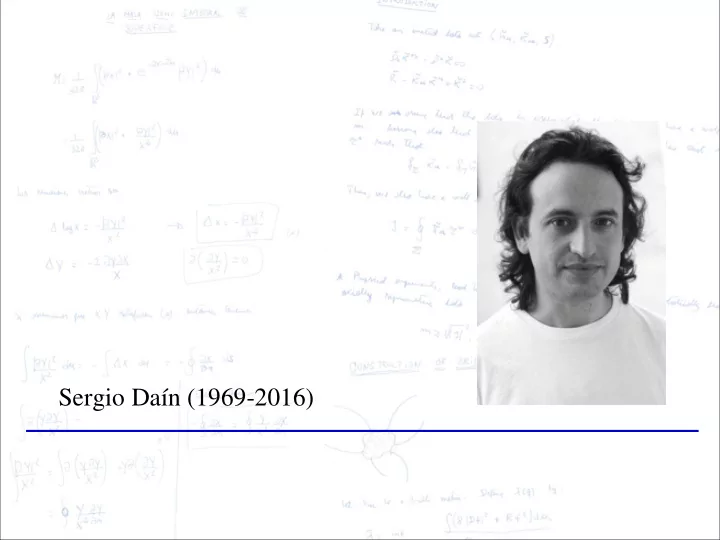
Sergio Dan (1969-2016) Understanding isolated system dynamics in - - PowerPoint PPT Presentation
Sergio Dan (1969-2016) Understanding isolated system dynamics in General Relativity A perspective on Sergio Dains contribution to General Relativity Jos e Luis Jaramillo Institut de Math ematiques de Bourgogne (IMB) Universit e
A perspective on Sergio Dain’s contribution to General Relativity Jos´ e Luis Jaramillo
Institut de Math´ ematiques de Bourgogne (IMB) Universit´ e de Bourgogne Franche-Comt´ e Jose-Juis.Jaramillo@u-bourgogne.fr
VIII International Meeting on Lorentzian Geometry, GeLoMa 2016 M´ alaga, 21 September 2016
Jos´ e Luis Jaramillo Understanding isolated system dynamics in GR M´ alaga, 21 September 2016 1 / 35
1
Gravitational collapse in General Relativity: the general framework
2
Aspects of the Cauchy problem in General Relativity Elliptic problems in General Relativity Einstein equations: physical content
3
Geometric inequalities: the role of angular momentum Global inequalities: |J| ≤ m2 Local inequalities: A ≥ 8π|J|
4
Perspective
Jos´ e Luis Jaramillo Understanding isolated system dynamics in GR M´ alaga, 21 September 2016 2 / 35
Gravitational collapse in General Relativity: the general framework
1
Gravitational collapse in General Relativity: the general framework
2
Aspects of the Cauchy problem in General Relativity Elliptic problems in General Relativity Einstein equations: physical content
3
Geometric inequalities: the role of angular momentum Global inequalities: |J| ≤ m2 Local inequalities: A ≥ 8π|J|
4
Perspective
Jos´ e Luis Jaramillo Understanding isolated system dynamics in GR M´ alaga, 21 September 2016 3 / 35
Gravitational collapse in General Relativity: the general framework
Understanding Einstein equations: interplay of Geometry, Analysis and Physics Rµν − 1 2R gµν = 8πG c4 Tµν
Jos´ e Luis Jaramillo Understanding isolated system dynamics in GR M´ alaga, 21 September 2016 4 / 35
Gravitational collapse in General Relativity: the general framework
Understanding Einstein equations: interplay of Geometry, Analysis and Physics Rµν − 1 2R gµν = 8π Tµν
Jos´ e Luis Jaramillo Understanding isolated system dynamics in GR M´ alaga, 21 September 2016 4 / 35
Gravitational collapse in General Relativity: the general framework
Understanding Einstein equations: interplay of Geometry, Analysis and Physics Rµν − 1 2R gµν = 8π Tµν Classical gravitational collapse picture
1
Singularity Theorems: incomplete inextendible causal geodesic, given “strong gravitational field” data on ˜ S Trapped surfaces [Penrose, Hawking, 65, 67, 70, 73...]. Non-simply connected data [Gannon, Lee 75, 76...].
2
(Weak) Cosmic Censorship conjecture [Penrose 69]: Complete I + and Black Hole region and Horizon.
3
Spacetime settles down to a stationary final state: Positivity mass theorems [Schoen & Yau 79, 80, Witten 81].
4
BH uniqueness “theorems” [e.g. Chru´
sciel et al. 12]:
Final state given by Kerr spacetime, (m, J). Initial value problem: 3+1 approach.
Jos´ e Luis Jaramillo Understanding isolated system dynamics in GR M´ alaga, 21 September 2016 4 / 35
Aspects of the Cauchy problem in General Relativity
1
Gravitational collapse in General Relativity: the general framework
2
Aspects of the Cauchy problem in General Relativity Elliptic problems in General Relativity Einstein equations: physical content
3
Geometric inequalities: the role of angular momentum Global inequalities: |J| ≤ m2 Local inequalities: A ≥ 8π|J|
4
Perspective
Jos´ e Luis Jaramillo Understanding isolated system dynamics in GR M´ alaga, 21 September 2016 5 / 35
Aspects of the Cauchy problem in General Relativity Elliptic problems in General Relativity
1
Gravitational collapse in General Relativity: the general framework
2
Aspects of the Cauchy problem in General Relativity Elliptic problems in General Relativity Einstein equations: physical content
3
Geometric inequalities: the role of angular momentum Global inequalities: |J| ≤ m2 Local inequalities: A ≥ 8π|J|
4
Perspective
Jos´ e Luis Jaramillo Understanding isolated system dynamics in GR M´ alaga, 21 September 2016 6 / 35
Aspects of the Cauchy problem in General Relativity Elliptic problems in General Relativity
A physical formulation “Suppose we want to describe an isolated self-gravitating system. For example a star, a binary system, a black hole or colliding black holes. Typically these astrophysical systems are located far away from the Earth, so that we can receive from them only electromagnetic and gravitational radiation. How is this radiation? For example one can ask how much energy is radiated, or which are the typical frequencies for some systems. This is the general problem we want to study.”
[S. Dain, Lecture Notes in Physics 604, 161-182 (2002)]
A first step in the mathematical study: elliptic systems “Elliptic problems appear naturally in physics mainly in two situations: as equations which describe equilibrium (for example, stationary solutions in General Relativity) and as constraints for the evolution equations (for example, constraint equations in Electromagnetism and General Relativity). In addition, in General Relativity they appear often as gauge conditions for the evolution equations.”
[S. Dain, Lecture Notes in Physics 692, 117-139 (2006)]
Jos´ e Luis Jaramillo Understanding isolated system dynamics in GR M´ alaga, 21 September 2016 7 / 35
Aspects of the Cauchy problem in General Relativity Elliptic problems in General Relativity
Initial data set for Einstein equations ( ˜ S, ˜ hij, ˜ Kij, µ, ji) ˜ S: connected three-dimensional manifold. ˜ hij: Riemannian metric. ˜ Kij: symmetric tensor field. µ: scalar field. ji: vector field on S. Constraint equations ˜ R − ˜ Kij ˜ Kij + ˜ K2 = 16πµ (Hamiltonian constraint) ˜ Dj ˜ Kij − ˜ Di ˜ K = −8πji (Momentum constraint)
Jos´ e Luis Jaramillo Understanding isolated system dynamics in GR M´ alaga, 21 September 2016 8 / 35
Aspects of the Cauchy problem in General Relativity Elliptic problems in General Relativity
Asymptotically Euclidean initial data Data on ˜ S are asymptotically flat with N asymptotic ends, if for some compact set Ω we have ˜ S \ Ω = N
k=1 ˜
S(k) where ˜ S(k) are open sets that can be mapped by a coordinate system ˜ xj diffeomorphically onto the complement of a closed ball in R3 such that ˜ hij =
˜ r
r−2) , ∂k˜ hij = O(˜ r−2), ∂l∂k˜ hij = O(˜ r−3) ˜ Kij = O(˜ r−2) , ∂k ˜ Kij = O(˜ r−3) as ˜ r = 3
j=1(˜
x)2 1
2 → ∞ in each “asymptotic end” ˜
S(k).
Jos´ e Luis Jaramillo Understanding isolated system dynamics in GR M´ alaga, 21 September 2016 9 / 35
Aspects of the Cauchy problem in General Relativity Elliptic problems in General Relativity
Conserved quantities at spatial infinity ADM mass m: m = 1 16π lim
˜ r→∞
hij − ∂i˜ hjj
νidA ADM momentum Pi: Pi = 1 8π lim
˜ r→∞
Kjk − ˜ K˜ hij
νkdA Angular momentum Ji at spatial infinity: Ji = 1 8π lim
˜ r→∞
Kjk − ˜ K˜ hjk
νkdA , with φi = ǫijk˜ xj∂k
Jos´ e Luis Jaramillo Understanding isolated system dynamics in GR M´ alaga, 21 September 2016 10 / 35
Aspects of the Cauchy problem in General Relativity Elliptic problems in General Relativity
Conformal compactification of the data Focus on vacuum data: µ = 0, ji = 0. Conformally compactified data: (S, hij, Kij) with ˜ S = S \ {i} (i point at infinity) and ˜ hij = ψ4hij , ˜ Kij = ψ−2Kij + 1 3 ˜ hij ˜ K Constraint equations
8R
= −1 8KijKijψ−7 + 1 12 ˜ K2ψ5 (Lichnerowicz equation) DjKij = 2 3ψ6Di ˜ K
Jos´ e Luis Jaramillo Understanding isolated system dynamics in GR M´ alaga, 21 September 2016 11 / 35
Aspects of the Cauchy problem in General Relativity Elliptic problems in General Relativity
Conformal compactification of the data Focus on vacuum data: µ = 0, ji = 0. Conformally compactified data: (S, hij, Kij) with ˜ S = S \ {i} (i point at infinity) and ˜ hij = ψ4hij , ˜ Kij = ψ−2Kij + 1 3 ˜ hij ˜ K Constraint equations: maximal slicing ˜ K = 0
8R
= −1 8KijKijψ−7 (Lichnerowicz equation) DjKij =
Jos´ e Luis Jaramillo Understanding isolated system dynamics in GR M´ alaga, 21 September 2016 11 / 35
Aspects of the Cauchy problem in General Relativity Elliptic problems in General Relativity
Resolution on the compact S: technical advantages
Simpler to prove existence of solutions for elliptic equations. Simpler to analyze fields in terms of local differentiability in a neighborhood of i. With [York 73]: Kij = Qij − (Lw)ij, with (Lw)ij = Diwj + Djwi − 2
3hijDkwk
8R
= −1 8KijKijψ−7 , ψ > 0 Di(Lw)ij ≡ ∆wi + 1 3DiDjwj + Ri
jwj = DjQji
Boundary conditions (xj: h-normal coordinates centered at i, i.e. r = 3
i=1(xj)2 1
2 )
Kij = O(r−4), (as r → 0) lim
r→0 rψ
= 1 (at compactified i) Free data: (hij, Qij, ˜ K). Constrained data: (ψ, wi)
Jos´ e Luis Jaramillo Understanding isolated system dynamics in GR M´ alaga, 21 September 2016 12 / 35
Aspects of the Cauchy problem in General Relativity Elliptic problems in General Relativity
Two asymptotic ends data Brill-Lindquist data Misner wormhole data Misner data (“images” method) Non-time symmetric generalizations Bowen-York, (generalized) punctures...
Jos´ e Luis Jaramillo Understanding isolated system dynamics in GR M´ alaga, 21 September 2016 13 / 35
Aspects of the Cauchy problem in General Relativity Elliptic problems in General Relativity
Article: [S.Dain, H. Friedrich, Commun. Math. Phys. 222, 569 - 609 (2001)] (Initial) Objectives
Construction of data satisfying “multipole expansion”: ˜ hij ∼
˜ r
˜ hk
ij
˜ rk , ˜ Kij ∼
˜ Kk
ij
˜ rk Problem of evolving asymptotically flat Initial Data near space-like and null infinity with Friedrich’s conformal field equations [Friedrich 98; cf. T-T. Paetz’s talk]. Implications of “regular finite initial value problem near space-like infinity” in numerical relativity.
Results A series of (hard) theorems giving sufficient conditions for the existence of solutions with prescribed regularity to the elliptic system. Explicit constructions.
Keywords/Elements: Sobolev imbedding, Rellich-Kondrakov, Schauder fixed point, Lp regularity, Schauder elliptic regularity, Fredholm alternative, Weak and Strong Maximum Principle...
Jos´ e Luis Jaramillo Understanding isolated system dynamics in GR M´ alaga, 21 September 2016 14 / 35
Aspects of the Cauchy problem in General Relativity Elliptic problems in General Relativity
Article: [S.Dain, H. Friedrich, Commun. Math. Phys. 222, 569 - 609 (2001)]
Theorem 1 (Hamiltonian constraint). Let hij be a smooth metric on S with positive Ricci scalar R. Assume that Kij is smooth in ˜ S and satisfies in a convex normal neighborhood Ba r8KijKij ∈ E∞(Ba) . Then there exists on ˜ S a unique solution ψ of the Hamiltonian constraint, which is positive, satisfies the boundary conditions, and has in Ba the form ψ =
ˆ ψ r
, ˆ ψ ∈ E∞(Ba) , ˆ ψ(i) = 1.
(f ∈ C∞( ˜ S) is in Em(Ba) if on Ba we can write f = f1 + rf2 with f1, f2 ∈ Cm(Ba)).
Theorem 2 (Momentum constraint). Let hij be a smooth metric in S. There exist trace-free tensor fields Kij ∈ C∞(S \ i) satisfying Kij ∼
k≥−4 Kk ijrk (with
Kk
ij ∈ C∞(S2) ) with the following properties:
i) Kij = KAJ
ij
+ ˆ Kij, with ˆ Kij = O(r−2) and KAJ
ij
= A
r3 (3ninj − δij) + 3 r3
iii) r8KijKij ∈ E∞(Ba)
Jos´ e Luis Jaramillo Understanding isolated system dynamics in GR M´ alaga, 21 September 2016 14 / 35
Aspects of the Cauchy problem in General Relativity Elliptic problems in General Relativity
General Comments Rigorous construction of a large class of solutions to the constraint equations, providing regular initial data aiming at smooth asymptotic structure at null infinity from the evolution of Friedrich’s conformal equations. Regularity condition kills linear momentum P i: generic logarithmic terms in the expansion if P i = 0 (no multipole expansion of the prescribed form). Explicit solutions of the momentum constraint (with angular momentum).
Euclidean space. Axisymmetric solutions. (!)
Foundational article in Sergio’s career: “Train in the right trail” [H. Friedrich] Very solid piece of work, technically and conceptually, but smoothness I + turned out to be more complicated [Valiente-Kroon 04,05; cf. T-T. Paetz’s talk]. Difficult to overstimate the formative character of this article (“this elliptic problem played a chord in the mathematical sensitivity of Sergio”, [H. Friedrich]) (A plausible interpretation as a “Wittgenstein ladder”).
Jos´ e Luis Jaramillo Understanding isolated system dynamics in GR M´ alaga, 21 September 2016 15 / 35
Aspects of the Cauchy problem in General Relativity Elliptic problems in General Relativity
Article: [S. Dain, Class. Quantum Grav. 21, 555-573 (2004)] Not yet BBHs!!!
[Pretorius 05]
BH initial data: excision technique
Given C closed surface, expansion null (geodesics), with ˜ H = ˜ Di˜ νi: θ± = ∇i(ti ∓ ˜ νi) = ˜ K ∓ ˜ H − ˜ Kij ˜ νi˜ νj Under the proprer global and energy conditions future (marginally) trapped surfaces [cf. Galloway’s course] θ+ ≤ 0 , θ− ≤ 0 lay in the Black Hole region.
Elliptic reduction, conformal method: θ∓ = ψ−3 ±4νiDiψ ± Hψ − ψ−3Kijνiνj
[cf. L´
8R
= −1 8KijKijψ−7 , ψ > 0 , on ˜ Ω
= ∓
, on ∂Ω lim
r→0 rψ
= 1 , (at compactified i)
Jos´ e Luis Jaramillo Understanding isolated system dynamics in GR M´ alaga, 21 September 2016 16 / 35
Aspects of the Cauchy problem in General Relativity Elliptic problems in General Relativity
Ω) ∩ C2(¯ Ω) and ∂Ω smooth. Assume R ≥ 0 in ˜ Ω and H ≥ 0 on ∂Ω (either R or H not identically zero). Let us prescribe at ∂Ω θ− ≤ 0 , |θ−| ≤ ψ1 Kijνiνj Then there exists a unique, positive, solution ψ and θ+ ≤ θ− ≤ 0 .
Complementary results and extensions
Marginally trapped surfaces: θ+ = 0 [D. Maxwell, Commun. Math. Phys. 253, 561 (2004)]: Assumptions: R = 0, H < 0, H ≤ −Kijνiνj ≤ 0 and λh,Ω > 0, where λh,Ω generalizes the Yamabe invariant (note θ− ≤ 0): λh,Ω = inf
ϕ∈C∞
c (M),ϕ=0
+ 2
||ϕ||2
L6
Stationary apparent horizons (isolated horizons): θ+ = σij
+ = 0. [S. Dain, J. L.
Jaramillo, B. Krishnan, PRD, 71 064003 (2005)]. Well-posed problem with mixed
Neumann-Dirichlet conditions for the momentum constraint (Lopatinski-Schapiro ellipticity conditions). ID for black hole in instantaneous equilibrium.
Jos´ e Luis Jaramillo Understanding isolated system dynamics in GR M´ alaga, 21 September 2016 17 / 35
Aspects of the Cauchy problem in General Relativity Einstein equations: physical content
1
Gravitational collapse in General Relativity: the general framework
2
Aspects of the Cauchy problem in General Relativity Elliptic problems in General Relativity Einstein equations: physical content
3
Geometric inequalities: the role of angular momentum Global inequalities: |J| ≤ m2 Local inequalities: A ≥ 8π|J|
4
Perspective
Jos´ e Luis Jaramillo Understanding isolated system dynamics in GR M´ alaga, 21 September 2016 18 / 35
Aspects of the Cauchy problem in General Relativity Einstein equations: physical content
Understanding regularity of stationary initial data
[S. Dain, Class. Quantum Grav. 18, 4329-4338 (2001)]
Characterization of the fall-off behaviour of the intrinsic metric and the extrinsic curvature of Cauchy initial data for asymptotically flat, stationary vacuum spacetimes near spacelike infinity. It fills gap in the proof of analytic compactification at null infinity of asymptotically flat, vacuum stationary spacetimes [ Beig & Simon 81; Damour & Schmidt 90]. Understanding of regularity conditions to be imposed at infinity for stationary data: key for constructing data containing Kerr. Understanding content of initial data: Initial Data for Two Kerr-like Black Holes Known families of binary data do not contained Kerr (stationary solutions): difficulty to assess their physical meaning, namely the gravitational waves content.
[ S. Dain, Phys. Rev. Lett., 87, 121102 (2001)]:
Family of data containing two Kerr as individual limit. Key property: hij ∈ W 4,p(S3), p < 3
[S. Dain. Phys. Rev. D64, 124002 (2001)]:
Improved family of binary Kerr in head-collision and in the close limit.
Jos´ e Luis Jaramillo Understanding isolated system dynamics in GR M´ alaga, 21 September 2016 19 / 35
Aspects of the Cauchy problem in General Relativity Einstein equations: physical content
Characterization of absence of “gravitational wave content” Geometric invariant characterizing staticity [S. Dain, Phys.Rev.Lett 93, 231101 (2004)] 2nd-order operator P from “constrained map”. Obtain α by solving 4-order elliptic equation PP∗η = 0 on (S, hij). λ(k) = − 1 8π
niDiα(k) . Thm.:(S, hij) is static iff λ(k) = 0 at come end ik. Conserved quantities Brill-Lindquist-type data, with two “internal” asymptotic ends i1, i2 and a third “external” one, with respective masses m1, m2, m3. Black hole interaction energy [S. Dain, Phys. Rev. D 66, 084019 (2002)].
E ≡ m3 − m1 − m2 = −m1m2 r12 + −J1 · J2 + 3(J1 · ˆ n)(J2 · ˆ n) r3
12
+ higher order terms Conserved quantities in a black hole collision [S. Dain, J.A. Valiente-Kroon, Class. Quantum
G0 = − 127
√ 5π 4
r2
12m1m2
Constant along I +: information about the late time evolution of the collision.
Jos´ e Luis Jaramillo Understanding isolated system dynamics in GR M´ alaga, 21 September 2016 20 / 35
Aspects of the Cauchy problem in General Relativity Einstein equations: physical content
Axisymmetric (maximal) initial data parametrized by two functions: (q, ω)
Axial Killing vector ηi of (S, ˜ hij, ˜ Kij) (with ˜ K = 0): Lη˜ hij = 0 , Lη ˜ Kij = 0 . Conformal decomposition: ˜ hij = ψ4hij, ˜ Kij = ψ−2Kij, and η = ηiηjhij. Then, with hij = e−2q dρ2 + dz2 + 1 ρ2 ηiηj
[D. Brill, Ann. Phys. 7 466-83 (1959)]
Kij = 2S(i ηj) η , Si = 1 2η ǫijkηjDkω , Lηω = 0 so that constraints become DjKji = 0 ,
8 R
8 DiωDiω 2η2 ψ−7
Komar angular momentum of a closed surface S
J(S) = 1 16π
ǫµνλγ∇ληγ = 1 8π
KijηiνjdA = Remark: in vacuum, if S′ contains S, it holds: J(S′) = J(S) .
Jos´ e Luis Jaramillo Understanding isolated system dynamics in GR M´ alaga, 21 September 2016 21 / 35
Aspects of the Cauchy problem in General Relativity Einstein equations: physical content
New axisymmetric data: exploring extremality
Axisymmetric data with: q = 0 and ω = ωKerr.
[S. Dain, C. Lousto , R. Takahashi. Phys. Rev. D65, 104038 (2002)]
εJ ≡
J m2 ,
εJ ≤ 1 εA ≡
A 8π
m4−J2 ,
εA ≤ 1
Constructing binary black hole with maximum “kick” velocity: cylindrical ends in extremal data
vrecoil = 3290 ± 47 km · s−1: maximum with numerics!
[S. Dain, C. O. Lousto y Y. Zlochower, Phys. Rev. D, 78, 024039 (2008)]
Based on existence theorem for extremal Bowen-York data:
[S. Dain y M. E. Gabach-Cl´ ement, “Extreme Bowen-York initial data”, Class. Quantum Grav. 26, 035020 (2009)].
Numerical exploration of geometric inequalities [Jaramillo, Vasset, Ansorg, Novak 08, 09]
εA ≡ A 8π
√ m4 − J2 coined as Dain’s number: RIGIDITY!!!.
Jos´ e Luis Jaramillo Understanding isolated system dynamics in GR M´ alaga, 21 September 2016 22 / 35
Aspects of the Cauchy problem in General Relativity Einstein equations: physical content
New axisymmetric data: exploring extremality
Axisymmetric data with: q = 0 and ω = ωKerr.
[S. Dain, C. Lousto , R. Takahashi. Phys. Rev. D65, 104038 (2002)]
εJ ≡
J m2 ,
εJ ≤ 1 εA ≡
A 8π
m4−J2 ,
εA ≤ 1
Constructing binary black hole with maximum “kick” velocity: cylindrical ends in extremal data
vrecoil = 3290 ± 47 km · s−1: maximum with numerics!
[S. Dain, C. O. Lousto y Y. Zlochower, Phys. Rev. D, 78, 024039 (2008)]
Based on existence theorem for extremal Bowen-York data:
[S. Dain y M. E. Gabach-Cl´ ement, “Extreme Bowen-York initial data”, Class. Quantum Grav. 26, 035020 (2009)].
Numerical exploration of geometric inequalities [Jaramillo, Vasset, Ansorg, Novak 08, 09]
εA ≡ A 8π
√ m4 − J2 coined as Dain’s number: RIGIDITY!!!.
Jos´ e Luis Jaramillo Understanding isolated system dynamics in GR M´ alaga, 21 September 2016 22 / 35
Aspects of the Cauchy problem in General Relativity Einstein equations: physical content
New axisymmetric data: exploring extremality
Axisymmetric data with: q = 0 and ω = ωKerr.
[S. Dain, C. Lousto , R. Takahashi. Phys. Rev. D65, 104038 (2002)]
εJ ≡
J m2 ,
εJ ≤ 1 εA ≡
A 8π
m4−J2 ,
εA ≤ 1
Constructing binary black hole with maximum “kick” velocity: cylindrical ends in extremal data
vrecoil = 3290 ± 47 km · s−1: maximum with numerics!
[S. Dain, C. O. Lousto y Y. Zlochower, Phys. Rev. D, 78, 024039 (2008)]
Based on existence theorem for extremal Bowen-York data:
[S. Dain y M. E. Gabach-Cl´ ement, “Extreme Bowen-York initial data”, Class. Quantum Grav. 26, 035020 (2009)].
Numerical exploration of geometric inequalities [Jaramillo, Vasset, Ansorg, Novak 08, 09]
εA ≡ A 8π
√ m4 − J2 coined as Dain’s number: RIGIDITY!!!.
Jos´ e Luis Jaramillo Understanding isolated system dynamics in GR M´ alaga, 21 September 2016 22 / 35
Aspects of the Cauchy problem in General Relativity Einstein equations: physical content
To retain: Mastery of elliptic theory. Axisymmetry. Sharp geometric bounds: angular momentum. Equality: rigidity (and cylindrical ends).
Jos´ e Luis Jaramillo Understanding isolated system dynamics in GR M´ alaga, 21 September 2016 22 / 35
Geometric inequalities: the role of angular momentum
1
Gravitational collapse in General Relativity: the general framework
2
Aspects of the Cauchy problem in General Relativity Elliptic problems in General Relativity Einstein equations: physical content
3
Geometric inequalities: the role of angular momentum Global inequalities: |J| ≤ m2 Local inequalities: A ≥ 8π|J|
4
Perspective
Jos´ e Luis Jaramillo Understanding isolated system dynamics in GR M´ alaga, 21 September 2016 23 / 35
Geometric inequalities: the role of angular momentum
Prototype: Isoperimetric inequality
L2 ≥ 4πA (= circle) Geometry
“General Relativity is a geometric theory, hence it is not surprising that geometric inequalities appear naturally in it. Many of these inequalities are similar in spirit as the isoperimetric
an object of “optimal shape”. This object, like the circle, can be described by few parameters and it has also a variational characterization.”
Physics
“[...] General Relativity is also a physical theory. It is often the case that the quantities involved have a clear physical interpretation and the expected behavior of the gravitational and matter fields often suggests geometric inequalities which can be highly non-trivial from the mathematical point of view. The interplay between physics and geometry gives to geometric inequalities in General Relativity their distinguished character.”
Jos´ e Luis Jaramillo Understanding isolated system dynamics in GR M´ alaga, 21 September 2016 24 / 35
Geometric inequalities: the role of angular momentum
BH uniqueness “theorem” [e.g. Chru´
sciel et al. 12]
Stationary black holes in vacuum are characterized by sub-extremal Kerr solution:
Kerr family parametrized by (m, J): solutions for all values of the parameters. Relation (A, m, J) in BH case Horizon Area (A), mass (m), angular momentum (J): A = 8π
A ≤ 16πm2 (= Schwarzschild) J ≤ m2 (= Extreme Kerr) 8π|J| ≤ A (= Extreme Kerr)
Jos´ e Luis Jaramillo Understanding isolated system dynamics in GR M´ alaga, 21 September 2016 25 / 35
Geometric inequalities: the role of angular momentum
Relation (A, m, J) in BH case Horizon Area (A), mass (m), angular momentum (J): A = 8π
A ≤ 16πm2 (= Schwarzschild) J ≤ m2 (= Extreme Kerr) 8π|J| ≤ A (= Extreme Kerr)
Jos´ e Luis Jaramillo Understanding isolated system dynamics in GR M´ alaga, 21 September 2016 25 / 35
Geometric inequalities: the role of angular momentum
Relation (A, m, J) in BH case Horizon Area (A), mass (m), angular momentum (J): A = 8π
A ≤ 16πm2 (= Schwarzschild) J ≤ m2 (= Extreme Kerr) 8π|J| ≤ A (= Extreme Kerr) Question: J ≤ m2 and 8π|J| ≤ A in the Dynamical case?
Jos´ e Luis Jaramillo Understanding isolated system dynamics in GR M´ alaga, 21 September 2016 25 / 35
Geometric inequalities: the role of angular momentum Global inequalities: |J| ≤ m2
1
Gravitational collapse in General Relativity: the general framework
2
Aspects of the Cauchy problem in General Relativity Elliptic problems in General Relativity Einstein equations: physical content
3
Geometric inequalities: the role of angular momentum Global inequalities: |J| ≤ m2 Local inequalities: A ≥ 8π|J|
4
Perspective
Jos´ e Luis Jaramillo Understanding isolated system dynamics in GR M´ alaga, 21 September 2016 26 / 35
Geometric inequalities: the role of angular momentum Global inequalities: |J| ≤ m2
Penrose inequality: A ≤ 16πm2 [Penrose 69]
Global version: BH horizon section HS, with area A, in a slice S with ADM mass m. Area grows along BH horizon [Hawking 73]. Spacetime settles to a stationary state. BH uniqueness: final state is Kerr (mo, Ao) with A ≤ Ao ≤ 16πm2
GWs take energy away, Trautman-Bondi mass at
I + is decreasing: mo ≤ m [cf. Nurowski’s talk].
On S we have: A ≤ 16πm2 . Local in time: Initial Data (S): apparent horizon Σ. Weak cosmic censorship: BH event horizon H. Minimal surface enclosing Σ: Amin(Σ) ≤ A(HS). Amin(Σ) ≤ 16πm2 Remark: refinement of mass possitivity theorem m ≥ 0.
Jos´ e Luis Jaramillo Understanding isolated system dynamics in GR M´ alaga, 21 September 2016 27 / 35
Geometric inequalities: the role of angular momentum Global inequalities: |J| ≤ m2
Dain’s inequality: |J| ≤ m2 [Friedman & Mayer 82]
BH Initial Data on S with (m, J). Weak Cosmic censorship: Gravitational collapse results in a Black Hole. Axial symmetry: angular momentum cannot be radiated away, J constant along the evolution. Spacetime settles to a stationary state. BH uniqueness, final state is Kerr (mo, Jo) with J = Jo ≤ m2
GWs take energy away, Trautman-Bondi mass at
I + is decreasing: mo ≤ m [cf. Nurowski’s talk].
On S we have: J ≤ m2 .
Jos´ e Luis Jaramillo Understanding isolated system dynamics in GR M´ alaga, 21 September 2016 27 / 35
Geometric inequalities: the role of angular momentum Global inequalities: |J| ≤ m2
Dain’s inequality: |J| ≤ m2 [Friedman & Mayer 82]
BH Initial Data on S with (m, J). Weak Cosmic censorship: Gravitational collapse results in a Black Hole. Axial symmetry: angular momentum cannot be radiated away, J constant along the evolution. Spacetime settles to a stationary state. BH uniqueness, final state is Kerr (mo, Jo) with J = Jo ≤ m2
GWs take energy away, Trautman-Bondi mass at
I + is decreasing: mo ≤ m [cf. Nurowski’s talk].
On S we have: J ≤ m2 .
“Weak Cosmic Censorship” and “settlement to stationarity”
“[...] a counter example will imply that the standard picture of the gravitational collapse is not
understand why this highly nontrivial inequality should hold unless [WCC and final stationary] can be thought of as providing the underlying physical reason behind it.”
Jos´ e Luis Jaramillo Understanding isolated system dynamics in GR M´ alaga, 21 September 2016 27 / 35
Geometric inequalities: the role of angular momentum Global inequalities: |J| ≤ m2
initial data set with two asymptotics ends. Let m and J denote the total mass and angular momentum at one of the ends. Then, the following inequality holds
Steps of the proof: lower bound + variational analysis Variational principle [S. Dain, Class. Quantum. Grav., 23, 6857-6871 (2006)] Brill’s expression for the total mass, bounded below by mass functional M(σ, ω): m ≥ M(σ, ω) =
1 32
dV Positivity of mass “as a tool”. Local version [S. Dain, CQG 23, 6845-6855 (2006); Phys.Rev.Lett. 96, 101101(2006)] Proof that extreme Kerr is a local minimum of M(σ, ω), with M(σ, ω) ≥
Global version [S. Dain, J. Differential Geometry, 79 (1) 33-67 (2008)] M(σ, ω) ∼ M′
Ω(η, ω) = 1 32π
η2
Unique absolute minimum through harmonic maps argument [Hildebrandt et al. 77] Generalizations and improvements Simplification, charge, improvement of rigidity [Chru´
sciel, Weinstein, Costa, Schoen, Zhou...]
Numerical exploration of multiple ik [S. Dain, O. Ortiz, Phys. Rev. D, 80, 024045 (2009)]
Jos´ e Luis Jaramillo Understanding isolated system dynamics in GR M´ alaga, 21 September 2016 28 / 35
Geometric inequalities: the role of angular momentum Local inequalities: A ≥ 8π|J|
1
Gravitational collapse in General Relativity: the general framework
2
Aspects of the Cauchy problem in General Relativity Elliptic problems in General Relativity Einstein equations: physical content
3
Geometric inequalities: the role of angular momentum Global inequalities: |J| ≤ m2 Local inequalities: A ≥ 8π|J|
4
Perspective
Jos´ e Luis Jaramillo Understanding isolated system dynamics in GR M´ alaga, 21 September 2016 29 / 35
Geometric inequalities: the role of angular momentum Local inequalities: A ≥ 8π|J|
Assessing Christodolou mass as BH quasi-local mass candidate mChris =
16π + 4πJ2 A
Mass not growing in the generic case: “Penrose procress/superradiance”, extraction
In vacuum and axisymmetry, no loss of J is possible δJ = 0. Mass expected to grow on physical grounds: δmChris =
κ 8π δA + ΩHδJ = κ 8π δA ≥ 0
Then, since δA ≥ 0 [Hawking 73], we have δmChris ≥ 0 iff: κ = 1 4mChris
A2
A ≥ 8π|J| Research context Conjectured in the stationary case with surrounding matter [Ansorg, Petroff 05,06]. Proof (including equality case and charge) [Ansorg, Pfister, Hennig, Cederbaum 08,11] Extremality conditions [Booth & Fairhurst 08]. 1st law of Thermodynamics in Dynamical Horizons: [Ashtekar & Krishnan 02,03]
Jos´ e Luis Jaramillo Understanding isolated system dynamics in GR M´ alaga, 21 September 2016 30 / 35
Geometric inequalities: the role of angular momentum Local inequalities: A ≥ 8π|J|
non-vacuum spacetime with Λ ≥ 0 and with matter fulfilling the dominant energy condition, it holds the inequality (with A and J the area and angular momentum of S) A ≥ 8π|J| (= Extreme Kerr throat) Steps of the proof: stability condition + variational analysis Variational functional [S. Dain, Phys. Rev. D 8,104010 (2010)] Definition of an extreme throat geometry, with J. Identification of MS MS =
1 2π
η2
Proof of e(MS−8)/8 ≥ 2|J| [A. Ace˜
na, S. Dain, M.E. Gabach-Cl´ ement, CQG 28, 105014 (2011)]
Proof for vacuum, maximal ( ˜ K = 0), globally axisym. data [S. Dain, M. Reiris, PRL
107, 051101 (2011)]: Stability minimal surfaces: A ≥ 4πe(MS−8)/8. Rigidity proof.
Quasilocal spacetime proof [J.L. Jaramillo, M. Reiris, S. Dain, PRD 84, 121503(R) (2011)] Essential ingredients: Lorentzian spacetime structure + stability of marginally outer trapped surfaces [Andersson, Mars, Simon 05; Galloway, Schoen 06] [cf. Galloway’s course]. Generalizations Charges, higher dimensions, Einstein-Maxwell dilaton, Λ, mass [Dain, Gabach-Cl´
ement, Jaramillo, Reiris, Hollands, Paetz, Simon, Yazadjiev, Fajman, Khuri, Weinstein, Yamada...]
Jos´ e Luis Jaramillo Understanding isolated system dynamics in GR M´ alaga, 21 September 2016 31 / 35
Geometric inequalities: the role of angular momentum Local inequalities: A ≥ 8π|J|
Conjecture: R2(U) G
c3 |J(U)|
For a rotating body U with J(U) and R(U) “size measure”: The speed of light c is the maximum speed (Lorentzian str.). Trapped surface conjecture [Seifert 79]: R(U) G
c2 m(U).
It holds for black holes: A ≥ 8π G
c3 |J|.
Theorem [S. Dain, Phys. Rev. Lett. 112, 041101 (2014)]. Consider a maximal, axially symmetric, initial data set that satisfy the dominant energy condition. Let U be an open set on the
R2(U) ≥ 24
π3 G c3 |J(U)|
where, for a Killing vector ηi with norm λ, we define R(U) as R(U) ≡ 2
π
(
1/2
RSY(U) .
Further (ongoing...) steps in inequalities for bodies Charge, angular momentum, energy, size [S. Dain, PRL 112, 041101 (2014)]:
Q4 4R2 + c2J2 R2 ≤ E2
(motivated by Bekenstein bounds) Sharp lower bounds charge-radius [P. Anglada, S. Dain, O. Ortiz, PRD 93, 044055 (2016)]. Theorem, physical discussion, numerical exploration (published: 23 February 2016)
Jos´ e Luis Jaramillo Understanding isolated system dynamics in GR M´ alaga, 21 September 2016 32 / 35
Perspective
1
Gravitational collapse in General Relativity: the general framework
2
Aspects of the Cauchy problem in General Relativity Elliptic problems in General Relativity Einstein equations: physical content
3
Geometric inequalities: the role of angular momentum Global inequalities: |J| ≤ m2 Local inequalities: A ≥ 8π|J|
4
Perspective
Jos´ e Luis Jaramillo Understanding isolated system dynamics in GR M´ alaga, 21 September 2016 33 / 35
Perspective
Back to the classical gravitational collapse picture
1
Singularity Theorems.
2
(Weak) Cosmic Censorship conjecture.
3
Spacetime settles down to a stationary final state.
4
BH uniqueness “theorems”.
Jos´ e Luis Jaramillo Understanding isolated system dynamics in GR M´ alaga, 21 September 2016 34 / 35
Perspective
Back to the classical gravitational collapse picture
1
Singularity Theorems.
2
(Weak) Cosmic Censorship conjecture.
3
Spacetime settles down to a stationary final state.
4
BH uniqueness “theorems”. An ongoing research program... 1st stage, elliptic systems: initial data and stationarity. 2nd stage, variational analysis: geometric inequalities. 3rd stage, hyperbolic problems: well-posedness of (axisymmetric) evolutions systems, wave equations/linear stability and extremality... [1) S. Dain, “Axisymmetric
evolution of Einstein equations and mass conservation”, CQG 25, 145021 (2008); 2) S. Dain, O. Ortiz, “On well-posedness, linear perturbations and mass conservation for axisymmetric Einstein equation”, PRD81, (4), 044040 (2009); 3) S. Dain, M. Reiris, “Linear perturbations and mass conservation for axisymmetric Einstein equations”, Ann. Henri Poincar´ e, 12, 49-65 (2011); 4) S. Dain, Gustavo Dotti, “The wave equation on the extreme Reissner-Nordstr¨
Dain, I. Gentile de Austria, ”On the linear stability of the extreme Kerr black hole under axially symmetric perturbations”, CQG 31 195009 (2014); 6) S. Dain, I. Gentile de Austria, “Bounds for axially symmetric linear perturbations for the extreme Kerr black hole”, CQG 32 135010 (2015).]
Jos´ e Luis Jaramillo Understanding isolated system dynamics in GR M´ alaga, 21 September 2016 34 / 35
Perspective
Research: Mathematical answers for Physical questions, Physical intuitions for Mathematical queries Richness, soundness, astonishing inner consistency. Results he highlighted: A stability result in black holes: |J| ≤ m2 . Relation between size and angular momentum: A ≥ 8π|J| . Teaching and mentoring: a source of satisfaction (“bringing ideas...”) Crucial role in the GR community: a gift for distillating the finest ideas of the previous generation and transmitting them (enriched!) to the younger one. A gift for pedagogy: his articles as optimal places to get started in a domain. A gift to light up enthusiasm in his many “students”. A gift to express important ideas in simple, elegant... and few words.
Jos´ e Luis Jaramillo Understanding isolated system dynamics in GR M´ alaga, 21 September 2016 35 / 35
Perspective
Research: Mathematical answers for Physical questions, Physical intuitions for Mathematical queries Richness, soundness, astonishing inner consistency. Results he highlighted: A stability result in black holes: |J| ≤ m2 . Relation between size and angular momentum: A ≥ 8π|J| . Teaching and mentoring: a source of satisfaction (“bringing ideas...”) Crucial role in the GR community: a gift for distillating the finest ideas of the previous generation and transmitting them (enriched!) to the younger one. A gift for pedagogy: his articles as optimal places to get started in a domain. A gift to light up enthusiasm in his many “students”. A gift to express important ideas in simple, elegant... and few words. Gracias Sergio
Jos´ e Luis Jaramillo Understanding isolated system dynamics in GR M´ alaga, 21 September 2016 35 / 35