SLIDE 1
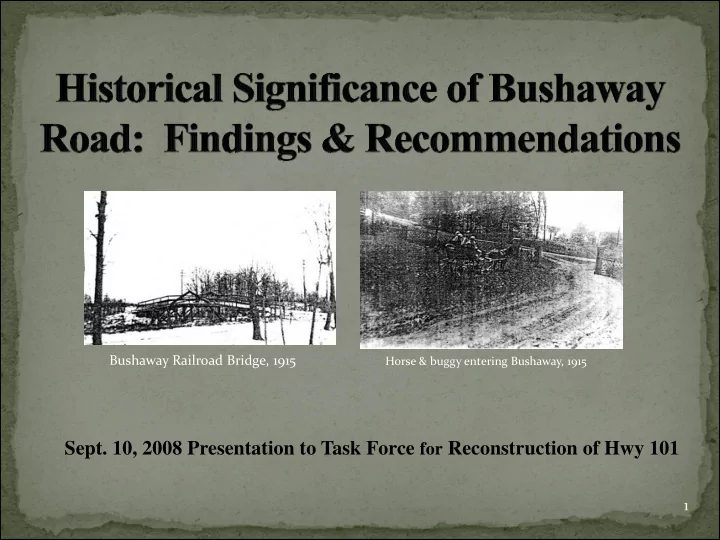
- Sept. 10, 2008 Presentation to Task Force for Reconstruction of Hwy 101
Bushaway Railroad Bridge, 1915
Horse & buggy entering Bushaway, 1915
1
SLIDE 2 Intangible impacts overview (scenic, historic, cultural) Historical Findings
Irene Stemmer’s summary of early history Revelations from County maps Photographs of historic houses View from professional historians, Bob Frame, Mead & Hunt
Threat of current County proposal Reconstruction can be viewed as opportunity to revisit history Recommendations for Bushaway reconstruction Recommendations for Bushaway Sesquicentennial (150 yrs) Overall recommendation on Bushaway: be proud, don’t plunder
2
SLIDE 3
Scenic features
Bushaway is known as
the most beautiful road in Wayzata
Beauty of the heavily
treed roadway
Quality of estate gates,
fences, walls, homes
3
SLIDE 4
Historical features
Road Residences Historic District
Cultural features
Bushaway as a neighborhood or community should be
encouraged
Relatives of Bushaway pioneers should be encouraged to
remain in area
4
SLIDE 5 Brief summary of Irene Stemmer’s report
Native American Trails Trappers (cabin remains at 324 Bushaway) Early landowning pioneers
Shaver Carpenter
Later large, notable farms
Dodge Decker
Early lakeside estates
Field, Sweatt, Brooks, Piper, etc.
Origins and significance of the road
Bushaway, the hub (with railroad depot) on the Dayton to Shakopee
(Miss. River to Minn. River)
Irene’s preliminary draft report can be found under “historical subgroup” in the Bushaway website: http://bushaway.wetpaint.com
5
SLIDE 6 Revelations from early County maps
Bushaway Rd (part of road from Dayton to Shakopee) was one
- f the first, if not the first road, road surveyed under the
Minnesota State Legislature exactly 150 years ago.
1858, First road survey (Shaver’s era)
1896 Survey map (Carpenter’s era)
6
SLIDE 7
Revelations from early County maps Discovery of 92 ft circular City Park at McGinty’s
dead-end at Bushaway, from 1893 County Rd Map.
Note new angle and location of railroad crossing.
7
SLIDE 8
Photographs: Historic House
1919 View of wall and bridge from Brooks estate during
construction & house in 2008 (Stielow residence)
8
SLIDE 9 Photographs: Historical Houses
1918 Brooks Carriage house & house today on Stielow’s House could be threatened by planned roadway shoulder Note traditional hand-placed rock walls on both sides of the
9
SLIDE 10
Photographs
Brooks caretakers house 1925 & now 620 Bushaway (Morris’)
10
SLIDE 11
Photographs
1918 Brooks servants house & house today on 581
Bushaway property (Mast’s)
It is scheduled for demolition next month.
11
SLIDE 12
Historically designated house built by Piper in 1926: Zita Hawley residence, 555 Bushaway Perfect example of “lake cottage” architecture
12
SLIDE 13
Photographs of houses with historical interest:
House built in 1910 by H. C. Piper Residence of Gregg Anderson at 421 Bushaway
13
SLIDE 14
Photographs of houses with historical interest:
Eide House built about 1930 321 Bushaway
14
SLIDE 15
Photographs
Field estate; third house built by Fields, in 1937; Now Westlund residence at 324 Bushaway Half of front yard to be lost by possible roundabout
Adjacent to house is this trappers cabin dating back to the 1700s. 15
SLIDE 16
Photographs of houses with historical interest:
Yasmineh House built in 1928 271 Bushaway at corner with La Salle
16
SLIDE 17
Photographs of houses with historical interest:
Residence of Zev & Kristina Oman at 250 Bushaway House built in 1952 by Hill Family (of Janney, Semple & Hill) House is attached to original 1912 Decker estate service
house, Purcell & Elmslie, architects (on right)
17
SLIDE 18
Photographs of houses with historical interest:
Residence of Jon Salveson at 218 Bushaway House built to resemble old Dodge house of early 1900s
18
SLIDE 19
Photographs of houses with historical interest:
Residence of Robert Keith at 100 Bushaway House built in 1936 or before on old Dodge farm
19
SLIDE 20
Additional Bushaway houses over 50 years old and
potentially eligible for historical recognition:
121 Bushaway, built in 1935 217 Bushaway, built in 1946 433 Bushaway, built in 1930 (Nash/Berman house) 623 Bushaway, built in 1915 (Piper/Pflaum house)
Pflaum house is another good example of historic “lake cottage”
architecture.
20
SLIDE 21
Locust Hills Estate horse barn (1940) and equipment
building at 500 Bushaway are preserved and already determined to be eligible for National Register
21
SLIDE 22 In the early 1980s, MN/DOT developed plans for a new causeway
through lower Wayzata Bay, and another to fill 2-4 acres of Gray’s Bay for park parking. The Wayzata City Council negotiated a plan for a much smaller amount of fill, and no change to the causeway.
In the early 1980s, MN/DOT also developed several alternative
plans for radically rebuilding the railroad bridge and the intersection of Bushaway with McGinty, including tunneling McGinty under Bushaway. The City Council accepted the plan for a “Bushaway BeBo,” a tunnel underneath the tracks. The railroad opposed all these plans. The State threw up its hands and gave the road to the County.
- If history didn’t repeat itself, this would be a really funny story.
SLIDE 23
Methods of report by Bob Frame, Mead & Hunt
Using 3 main eligibility criteria of the National Registry
Association with events/activities contributing to historical trends Association with historically important people Representative of distinctive period, type of construction, artistic
character, or architecture
Preliminary evaluation of the extent to which Bushaway
might meet these criteria as
A road corridor Residential properties Historic district
23
SLIDE 24 BUSHAWAY Events/Activities People Architecture
Road
Very significant role played in State transportation system and in facilitating the development around Lake Minnetonka Because alignment of road changed in late 1800s, it probably does not have
roads qualify because roadway materials change.)
Houses/ Properties
Many associated with important lakefront residential development
- trends. Several associated
with farm development Architecture representative
- f Period Revival and high‐
style architectural styles used in lakeshore cottages and estates.
District
Several properties played significant role in agriculture and lakeside estates may have shaped residential development trends. Area associated with Henry Carpenter, who platted much of the land. Significance architecture as a collection of lakeshore estates.
24
SLIDE 25 BUSHAWAY
Overall Conclusions
Road
Very significant role played in early State transportation, but not likely to be meet eligibility criteria.
Houses/ Properties
A number of residences almost certainly would meet eligibility standards of National Register if additional historical work done.
District
District played significant role in lake related development and important estates remain. Might well meet eligibility for National Register if additional historical work done.
25
SLIDE 26 Loss of historic gates and fences
All would go under the Proposed County plan
Brooks/Stielow gate
Field/Westlund fence
26
SLIDE 27 Loss of potential for
railroad bridge reconstruction with historic character
Loss of historic character
neighborhood
Field Meeting with Country 27
SLIDE 28 Loss of thousands of trees with scenic and
environmental importance
Greg Brown, URS standing under one of the Locust Hills Willow trees his plan would remove
28
SLIDE 29
Bridge redesign Encouraging residents
to preserve historic buildings build fences and gates with historic hand-placed stone wall designs
Addition of a walkway (shoulder or narrow trail) so that
Bushaway residents can visit neighbors Wayzata residents can enjoy Bushaway’s beauty
Placing utilities underground so that trees are not damaged for
power lines
Taking these steps plus getting historical recognition for
Bushaway would implement Wayzata Comprehensive Plan
To preserve environments, and To strengthen community
29
SLIDE 30 See Bushaway Neighborhood Vision Statement It is critical to retain 2-lane, traditional roadway without
- 3rd lane
- 8” high concrete curbing
- 8 ft shoulders
- 10 ft boulevards
- 8 ft asphalt trail (alternative walkway feasible)
Intersection should be retained in present location If necessary, the railroad bridge should be reconstructed in current location but
with historic character and minuscule intrusion on local properties.
- Raising the bridge (3 ft as proposed) should be avoided, if at all possible, because of the
high retaining walls needed to support the entrances.
A temporary moratorium (by City Council) against cutting down trees adjacent
to Bushaway is needed because during periods of reconstruction planning, trees may be cut down without proper authorization.
30
SLIDE 31
This is the 150th year (Sesquicentennial) of Bushaway as
a road officially designated by the 1st State Legislature.
The State is also celebrating Minnesota’s 150th birthday. It is not too late to gain a lot of publicity and interest in
Wayzata by celebrating the Sesquicentennial of Wayzata’s road, Bushaway.
The City should work with the Wayzata Historical
Society and the Bushaway Community in this effort.
After December it will be too late.
31
SLIDE 32
BUSHAWAY
Overall Recommendations
Road
Minimize the scenic, historical, cultural, and environment damage possible from radical reconstruction
Houses/ Properties
Encourage and assist residents: To apply for National Register status. To preserve historic & environmental features
District
Encourage City of Wayzata To insist on minimal changes to historic road To start process of National Register application To celebrate Bushaway’s 150th birthday 32