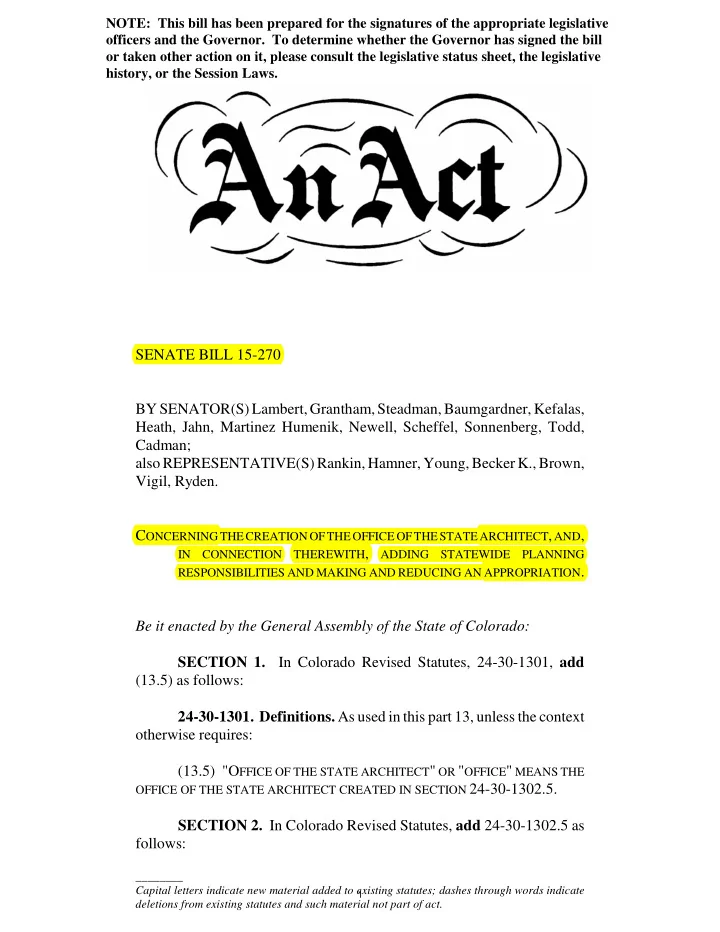
SLIDE 1 SENATE BILL 15-270 BY SENATOR(S) Lambert, Grantham, Steadman, Baumgardner, Kefalas, Heath, Jahn, Martinez Humenik, Newell, Scheffel, Sonnenberg, Todd, Cadman; also REPRESENTATIVE(S) Rankin, Hamner, Young, Becker K., Brown, Vigil, Ryden. CONCERNING THE CREATION OF THE OFFICE OF THE STATE ARCHITECT, AND,
IN CONNECTION THEREWITH, ADDING STATEWIDE PLANNING RESPONSIBILITIES AND MAKING AND REDUCING AN APPROPRIATION.
Be it enacted by the General Assembly of the State of Colorado: SECTION 1. In Colorado Revised Statutes, 24-30-1301, add (13.5) as follows: 24-30-1301. Definitions. As used in this part 13, unless the context
(13.5) "OFFICE OF THE STATE ARCHITECT" OR "OFFICE" MEANS THE
OFFICE OF THE STATE ARCHITECT CREATED IN SECTION 24-30-1302.5.
SECTION 2. In Colorado Revised Statutes, add 24-30-1302.5 as follows:
NOTE: This bill has been prepared for the signatures of the appropriate legislative
- fficers and the Governor. To determine whether the Governor has signed the bill
- r taken other action on it, please consult the legislative status sheet, the legislative
history, or the Session Laws.
________ Capital letters indicate new material added to existing statutes; dashes through words indicate deletions from existing statutes and such material not part of act.
1
SLIDE 2 24-30-1307. Legislative declaration. The purpose of this part 13 is to allow the department of personnel OFFICE OF THE STATE ARCHITECT to develop the policies and standards for state agencies and state institutions
- f higher education to follow for the major renovation or new construction
- f real property and to allow the department of personnel OFFICE to
delegate the authority to implement such policies and standards to the individual state agencies or state institutions of higher education. It is not the purpose of this part 13 to require state agencies or state institutions of higher education to add FTEs or incur additional expenditures to implement the provisions of this part 13. SECTION 9. In Colorado Revised Statutes, add 24-30-1311 as follows: 24-30-1311. Statewide planning function - responsibilities. (1) (a) COMMENCING WITH THE 2017-18 FISCAL YEAR, AND EACH FISCAL
YEAR THEREAFTER, AND IN ACCORDANCE WITH THE OFFICE OF STATE PLANNING AND BUDGETING'S BUDGET INSTRUCTIONS, A STATE AGENCY SHALL ANNUALLY SUBMIT ALL CAPITAL CONSTRUCTION BUDGET REQUESTS, INCLUDING ANY AMENDED REQUESTS, TO THE OFFICE FOR REVIEW.
(b) COMMENCING WITH THE 2016-17 FISCAL YEAR, AND EACH
FISCAL YEAR THEREAFTER, AND PRIOR TO THE SUBMISSION OF A SUPPLEMENTAL APPROPRIATIONS REQUEST TO THE OFFICE OF STATE PLANNING AND BUDGETING, EVERY STATE AGENCY SHALL SUBMIT SUPPLEMENTAL APPROPRIATIONS REQUESTS FOR CAPITAL CONSTRUCTION TO THE OFFICE FOR REVIEW.
(2) THE OFFICE SHALL REVIEW ALL THE SUBMISSIONS IT RECEIVES
PURSUANT TO SUBSECTION (1) OF THIS SECTION AND MAKE THE RECOMMENDATIONS REQUIRED IN SECTION 24-30-1303 (1) (t) (I) IN A TIMELY MANNER TO ALLOW THE OFFICE OF STATE PLANNING AND BUDGETING TO MEET THE DEADLINES SPECIFIED IN SECTION 24-37-304 (1)
(c.3). (3) (a) EACH STATE AGENCY SHALL FORWARD OPERATIONAL
MASTER PLANS, FACILITIES MASTER PLANS, FACILITIES PROGRAM PLANS, AND FIVE-YEAR PLANS TO THE OFFICE. THE OFFICE SHALL REVIEW OPERATIONAL MASTER PLANS AND APPROVE THE FACILITIES MASTER PLANS, FACILITIES PROGRAM PLANS, AND FIVE-YEAR PLANS DESCRIBED IN SECTION
PAGE 11-SENATE BILL 15-270
2
SLIDE 3
24-1-136.5. (b) THE OFFICE SHALL ANNUALLY PROVIDE THE CAPITAL
DEVELOPMENT COMMITTEE WITH A REPORT ON APPROVED FACILITY MANAGEMENT PLANS AND FACILITY PROGRAM PLANS, AND SHALL ALSO PROVIDE THE COMMITTEE WITH COPIES OF APPROVED FIVE-YEAR PLANS FOR EACH STATE AGENCY.
(4) THE OFFICE SHALL DEVELOP, OR CAUSE TO BE DEVELOPED, AFTER
CONSULTATION WITH THE OFFICE OF STATE PLANNING AND BUDGETING PURSUANT TO SECTION 24-37-201, STANDARDS FOR THE PREPARATION OF CURRENT FACILITIES MASTER PLANS COORDINATED WITH OPERATIONAL MASTER PLANS, AND FACILITY PROGRAM PLANS COORDINATED WITH OPERATIONAL PROGRAM PLANS FOR EACH STATE AGENCY, EXCEPT STATE INSTITUTIONS OF HIGHER EDUCATION AS PROVIDED IN SECTION 23-1-106,
C.R.S. (5) THE OFFICE SHALL COORDINATE THE PREPARATION AND
MAINTENANCE OF LONG-RANGE MASTER PLANS PURSUANT TO SECTION
24-1-136.5 THAT RECOMMEND EXECUTIVE AND LEGISLATIVE ACTIONS FOR
ACHIEVING DESIRED STATE OBJECTIVES AND THAT INCLUDE RECOMMENDED METHODS FOR EVALUATION.
(6) THE OFFICE IS AUTHORIZED TO ACCEPT AND RECEIVE GRANTS
AND SERVICES RELEVANT TO STATE PLANNING FROM THE FEDERAL GOVERNMENT, OTHER STATE AGENCIES, LOCAL GOVERNMENTS, AND PRIVATE AND CIVIC SOURCES.
(7) IT IS THE GENERAL ASSEMBLY'S INTENT THAT THE OFFICE
CONSULT WITH ALL STAKEHOLDERS IN ESTABLISHING NEW PROCEDURES RELATED TO ITS STATEWIDE PLANNING FUNCTIONS AND THAT THE CURRENT PROCESS FOR REVIEW OF ANY CAPITAL CONSTRUCTION OR CAPITAL RENEWAL REQUEST FOR STATE INSTITUTIONS OF HIGHER EDUCATION, ASIDE FROM THE CHANGES SET FORTH IN SENATE BILL 15-270, REMAIN THE SAME.
SECTION 10. In Colorado Revised Statutes, 2-3-1304, amend (1) (a.3) (I) and (2); and repeal (1) (e) as follows: 2-3-1304. Powers and duties of capital development committee. (1) The capital development committee has the following powers and PAGE 12-SENATE BILL 15-270
3
SLIDE 4 maintained by the department of personnel OFFICE OF THE STATE
ARCHITECT pursuant to section 24-30-1303.5, C.R.S., and that has
demonstrable capital construction costs receives an amount equal to one hundred dollars multiplied by the qualified charter school's average daily membership for the applicable budget year. SECTION 15. In Colorado Revised Statutes, 23-1-106, amend (3), (7) (a), (11) (b), and (12) as follows: 23-1-106. Duties and powers of the commission with respect to capital construction and long-range planning - legislative declaration
- definitions. (3) The commission shall review and approve facility master
plans for all state institutions of higher education on land owned or controlled by the state or an institution and capital construction or capital renewal program plans for projects other than those projects described in subsection (9) or (10) of this section. THE COMMISSION SHALL FORWARD
THE APPROVED FACILITY MASTER PLANS TO THE OFFICE OF THE STATE
- ARCHITECT. Except for those projects described in subsection (9) or (10) of
this section, no capital construction or capital renewal shall commence except in accordance with an approved facility master plan and program plan. (7) (a) The commission annually shall prepare a unified, five-year capital improvements report of projects to be constructed, but not including those capital construction or capital renewal projects to be undertaken pursuant to subsection (9) or (10) of this section, coordinated with education plans. The commission shall transmit the report to the office of state planning and budgeting, the governor OFFICE OF THE STATE
ARCHITECT, the capital development committee, and the joint budget
committee, consistent with the executive budget timetable, together with a recommended priority of funding of capital construction or capital renewal projects for the system of public higher education. The commission shall annually transmit the recommended priority of funding of capital construction or capital renewal projects to the capital development committee no later than November 1 of each year. (11) (b) The commission shall submit a compilation of the projects to THE OFFICE OF THE STATE ARCHITECT AND the capital development committee on or before December 1 of each year. PAGE 16-SENATE BILL 15-270
4
SLIDE 5 Page i June 2015 Principal Representatives State Buildings Programs Delegates Physical Plant Directors Construction Managers Re: Controlled Maintenance Budget Request Instructions for FY 2016/2017 On April 24, 2015 the Governor signed Long Bill SB15-234 for fiscal year 2015/2016 which included general fund appropriations for Controlled Maintenance (CM) Projects recommended by OSA for funding in the amount of $19,195,021. Previously in December of 2014, House Bill 14-1342 provided for funding
- f $21,480,980 for additional CM projects also recommended by OSA for fiscal year 2015/2016 that were
- riginally recommended in fiscal year 2014/2015 but not funded in the previous Long Bill SB14-230. The
total amount funded was $40,670,011 and included the funding for all CM projects listed in Level I and various projects listed in Level II and Level III of the Office of the State Architect’s annual report presented to the Capital Development Committee (CDC) in December 2014. In addition, the Capital Development Committee recommended to the Joint Budget committee that if revenues were available at the end of calendar year 2015 the remainder of Level II ($31,692,939) should be funded. OSA will monitor. Although the amount funded and potentially to be funded is below the recommended amount of $91,401,202 for fiscal year 2015/2016 CM (approximately 0.66% of the Current Replacement Value (CRV) of the State’s general funded inventory), it demonstrates the Administration’s and the Capital Development Committee’s continued commitment to funding CM on an annual basis as funding becomes available. Senate Bill SB15-270 Concerning the Creation of the Office of the State Architect, and, in Connection therewith, Adding Statewide Planning Responsibilities; formally changed the name of State Buildings Division to the Office of the State Architect in statute and added oversight responsibilities for state agency planning and capital construction recommendations. Starting in fiscal year 2016/2017 OSA in consultation with OSPB will establish policies and procedures for the submission, review and approval
- f state agency Operational Master Plans, Facility Program Plans, Facility Master Plans and Capital
Construction Project requests. Additionally, starting in fiscal year 2017/2018 OSA will review, approve and recommend state agency Capital Construction Project requests along with Controlled Maintenance Project requests to the OSPB and the CDC. The Colorado Department of Higher Education (CDHE) will continue to approve planning documents for all institutions of higher education as well as recommend the prioritized list of Capital Construction project requests directly to the OSPB and the CDC. OSA will also receive the prioritized list and approved planning documents from CDHE for review starting in fiscal year 2017/2018. Because of the added responsibility to review and approve planning documents and capital construction requests from all state agencies, OSA will be required to coordinate controlled maintenance requests along with capital construction requests. Therefore, starting with fiscal year 2017/2018 Controlled Maintenance Budget Request submittals (including controlled Maintenance Project requests) from all state agencies and institutions of higher education will be due at the Office
- f the State Architect on the same date in July as Capital Construction Project requests are
due per OSPB instructions. As in previous years OSA will conduct an on-site tour of each agency during the summer to review CM needs and status of on-going CM and CC projects. Prior to the scheduled on-site visit, OSA will send each agency a checklist of topics to be discussed and each agency will be required to provide at or before the on-site visit preliminary Five Year Controlled Maintenance and Capital Construction Project Request Plans including anticipated Capital Renewal projects and the Controlled Maintenance and Capital Construction updated Status Reports.
5
SLIDE 6 Page ii As is in previous instructions, major modifications, updates, deletions, and additions are in RED font. NOTES: □ Agency CM Submittal due Date: The due date for electronic submittals to OSA via e-mail is Friday, September 4, 2015. □ Capital Renewal Requests due Date: Capital Renewal Requests for all State Agencies and Institutions of Higher Education are to be submitted directly to OSA by July 15, 2015
- n SBP’s CM-3 form and OSPB’s CC-C form. OSA will review and approve project
requests for conformity to Section 2.5 of these instructions and forward to OSPB and
- CDHE. (Note that additional information and supporting documentation are required for
Capital Renewal Requests as compared to standard Controlled Maintenance Requests). Agencies and institutions should prioritize all Capital Renewal Requests in their in-house Capital Construction Prioritized Project List to be submitted directly to the Governor’s Office of State Planning and Budgeting (OSPB) and the Colorado Department of Higher Education (CDHE). □ Six Month Encumbrance/Three Year Project Expiration Deadlines: The six-month encumbrance deadline for hiring an architectural/engineering/consulting firm and having a fully signed and executed contract in place is October 23, 2015 for each appropriated Capital Construction and Controlled Maintenance project listed in Long Bill SB15-234 and June 30, 2015 for projects listed in HB14-1342. The Project Expiration Date for projects listed in both SB15-234 and HB14-1342 is June 30, 2018. □ CM Funding Eligibility Guidelines: HB12-1318 directed the Office of the State Architect to develop guidelines in order to establish when a state-owned, general-funded building
- r other physical facility would be eligible for controlled maintenance funding. The Fifteen
Year Eligibility guidelines established in FY 2002/2003 and published within these instructions has been updated and approved by Capital Development Committee and were effective for the FY 2014/2015 cycle. □ Detailed Cost Estimate: A detailed cost estimate is required for all project requests regardless of size, complexity or cost. All existing and new project requests (previously funded, current request, and all future phase requests) shall be provided with a detailed cost estimate as described in Section 2.5 (D) and as indicated on the CM Project Request form (SBP CM-3). Estimates shall be reviewed and revised annually. Rough estimates, lump sum estimates or order of magnitude estimates will not be accepted and the project request will be sent back to the agency for revisions. □ Code Compliance submittal (EXHIBIT L-1) and Final SC-4.1 submittal (EXHIBIT L- 2): As in past years, in order to improve timely verification that state agencies and institutions of higher education have complied with the Building Code Compliance Policy for CM and CC projects as established by OSA, the submission of EXHIBIT L-1 and all required code documentation shall be submitted directly after execution of the final Notice of Occupancy/Use form SBP-01. As a separate submission, the Final SC-4.1 and all associated contingency use documentation EXHIBIT L-2 shall be submitted after the project has officially been Closed-out and all funds have been expended, transferred and
- r reverted. (Refer to Sections 2.6 and 2.7).
□ OIT: The Governor’s Office of Information Technology/Joint Technology Committee shall review project requests involving information technology (voice, data, and video) system, (Refer to OSPB/CDHE instructions). □ Inflationary Adjustments: OSPB will establish the inflationary adjustments for Capital Construction and Controlled Maintenance requests for FY 2016/2017 in the Capital Construction Budget Instructions. □ Capital Outlay: OSPB has previously maintained that projects that fall below Capital Outlay limits (under $50,000) are not to be requested; however, Capital Outlay requests that are above the limit will be considered by OSPB on a case-by-case basis.
6
SLIDE 7
STATE OF COLORADO OFFICE OF THE STATE ARCHITECT STATE BUILDINGS PROGRAMS CONTRACTOR'S DESIGN/BID/BUILD (D/B/B) AGREEMENT (STATE FORM SC-6.21)
CONTRACT ID NUMBER: AGENCY IDENTIFICATION NUMBER: PROJECT NUMBER: PROJECT NAME:
7
SLIDE 8
SC-6.23
STATE OF COLORADO OFFICE OF THE STATE ARCHITECT STATE BUILDINGS PROGRAMS THE GENERAL CONDITIONS OF THE CONTRACTOR’S DESIGN/BID/BUILD (D/B/B) AGREEMENT (STATE FORM SC-6.23)
8
SLIDE 9
STATE OF COLORADO OFFICE OF THE STATE ARCHITECT STATE BUILDINGS PROGRAMS DESIGN/BUILD LUMP SUM (LS) AGREEMENT (STATE FORM SC-8.0)
CONTRACT ID NUMBER: AGENCY IDENTIFICATION NUMBER: PROJECT NUMBER: PROJECT NAME:
9
SLIDE 10
SC-8.1 i
STATE OF COLORADO OFFICE OF THE STATE ARCHITECT STATE BUILDINGS PROGRAMS THE GENERAL CONDITIONS OF THE DESIGN/BUILD LUMP SUM (LS) AGREEMENT (STATE FORM SC-8.1)
10
SLIDE 11
7/2013 SC-9.0
STATE OF COLORADO OFFICE OF THE STATE ARCHITECT STATE BUILDINGS PROGRAMS DESIGN/BUILD GUARANTEED MAXIMUM PRICE (GMP) AGREEMENT (STATE FORM SC-9.0)
CONTRACT ID NUMBER: AGENCY IDENTIFICATION NUMBER: PROJECT NUMBER: PROJECT NAME:
11
SLIDE 12
SC-9.1 i
STATE OF COLORADO OFFICE OF THE STATE ARCHITECT STATE BUILDINGS PROGRAMS THE GENERAL CONDITIONS OF THE DESIGN/BUILD GUARANTEED MAXIMUM PRICE (GMP) AGREEMENT
(STATE FORM SC-9.1)
12
SLIDE 13 Page 1 of 4
OFFICE OF THE STATE ARCHITECT DRAFT STATE BUILDINGS PROGRAMS POLICIES AND PROCEDURES BEST PRACTICES Selection of Professional and Construction Services utilizing REQUEST FOR PROPOSALS FOR INTEGRATED PROJECT DELIVERY and REQUEST FOR QUALIFICATIONS FOR PROFESSIONAL SERVICES
This policy is intended to instruct all state agency/institution personnel in the process of selecting professional design and construction services for state funded construction projects in order to conduct fair, open and consistent selection processes throughout the state.
The Office of the State Architect has participated over the past year in a task force with representatives from the design and construction community whose goal was to review the state’s construction procurement process and make industry best practice recommendations. Those recommendations have been accepted and incorporated into this policy. It is intended that the task force will meet from time to time to review the process. REQUEST FOR PROPOSALS FOR INTEGRATED PROJECT DELIVERY (CM/GC, D/B/LS & D/B/GMP Agreements)
- 1. Develop Project Specific Selection Criteria
Standard RFP evaluation forms (Appendix A and A1) contain the following general categories: 1). QUALIFICATIONS OF THE FIRM 2).QUALIFICATIONS OF THE MANAGEMENT TEAM MEMBERS 3).PROJECT MANAGEMENT APPROACH 4).PRIOR PROJECT EXPERIENCE/SUCCESS 5).MISCELLANEOUS Each category is required and the general selection criteria for qualifications within each category are typically applicable to most projects. However, some projects have unique characteristics for services and expertise and justify modifying the criteria accordingly and agency/institutions are encouraged to do so. A few examples justifying specialized selection criteria might include: unique building types and construction methodologies, advanced technological requirements, complex phasing and scheduling, energy conservation and environmental constraints and historic restoration. (Consult with OSA before solicitation).
- 2. Selection Criteria Weighting for Qualifications and Cost
The RFP’s have been modified to use a standard 70-30 numerical split between qualifications and cost. The highest score for qualifications on the evaluation form is to receive 70 points and the other team scores are to be determined as a percentage of the 70 points. Agency/institutions should carefully assign weights using whole numbers to all criteria on evaluation forms for inclusion into the RFP solicitation and prior to evaluations. It is beneficial to the process if competing firms know the importance of each selection criteria by numerical weight prior to preparing prequalification submittals and for oral interviews. (An 80-20 split between qualifications and cost could be considered for highly complex or unique projects. (Consult with OSA before solicitation).
- 3. Selection Committee Expertise and Representation
Selection committees should include a balance of skills and expertise related specifically to the project. Each committee should include and be chaired by the Office of the State Architect/State Buildings Delegate or their designee, technical state personnel experienced in design and construction, program end users and possibly
13
SLIDE 14 Page 2 of 4
representation from experienced individuals from outside the state system. Committee size should typically be between three to seven individuals with the majority being experienced in design and construction. (Some projects may require greater numbers of individuals depending on the number of programs impacted). All committee member names should remain confidential and an identification number should be assigned to use on all evaluation forms.
- 4. Determine Competitive Range for Oral Interview
The agency/institution shall determine prior to and include in the RFP solicitation the competitive range (number)
- f firms to be invited to the oral interview (typically 3 to 5). Methodology to determine the number may be based
- n an established passing score or determined from the spread of overall scores.
- 5. Selection Committee Evaluations
Committee members are to evaluate and score the strength of each firm’s prequalification submittal (Step I) and qualifications during the oral interview (Step II) and assign by criteria a numerical rating of 1 to 5 with 5 being the highest rating using whole numbers. Committee member’s scores should be consistent whether or not they score high or low across all firms.
- 6. Conduct Roundtable Discussion after the Oral Interview for Clarifications and Consensus
After the last oral interview for scoring qualifications (Step II) the agency/institution should conduct a roundtable discussion with all selection committee members to compare rankings in each selection criteria and adjusted if
- appropriate. The total scores from each committee member will then be divided by the number of committee
members to determine the average score for each firm’s qualifications.
- 7. Keep Cost Proposals Confidential until the Oral Interview Scoring is Complete
The "Cost Proposals" are to be submitted at the oral interview and shall not be opened until all scoring for all oral interviews have been completed. The oral interview total score or average score for each firm should not be changed after the Cost Proposals are opened. The average score is to be combined with each firms cost proposal to determine the highest scoring firm being ranked the most qualified.
- 8. Analyze all Cost Proposal Numbers
a). The agency/institution should analyze the cost proposals and note if there are wide variations and or if one firm is significantly lower than the rest. A significantly lower cost proposal could mean the firm will be providing significantly fewer hours to design and manage the project. (This assumes equally qualified firms have somewhat the same personnel cost structure and "like" firms are competing for the same talent in the market place). Consider requesting quantifiable backup such as man hours and hourly rates to understand what is driving significant differences. b). The agency/institution should verify that all firms used the advertised construction schedule for the pricing of the "Cost Proposal." Be aware of the consequences associated with changing the advertised assumptions. Allowing respondents to use a shorter schedule may be unrealistic, since the design, building systems, bid package requirements, phasing, and other project unique factors have not been finalized for the project. A firm’s use of an accelerated short schedule could negatively affect the architect/engineer and their services. Agency/institutions may consider firms that alter the construction schedule Non-responsive. c). For Design/Build Guaranteed Maximum Price (GMP) Services proposals the Design/Build Entity's Architect/ Engineers' Fee should include all Architect/Engineers' design services and fees for all Design Service Phases, Construction Administration Phase, Post Construction Phase (if applicable) and the Not- To- Exceed reimbursable expenses of the Architect/ Engineers. None of these Architect/Engineer Fees nor any portion of these fees are to be included in the Cost of Construction Work. This would provide compliance with State Contract form SC-9.0 and assure the proposals are evaluated (apples to apples) and scored correctly. The Exhibit A - Designated Services and Method of Payment should indicate all design services to be included in the Architect/ Engineer Basic Services Fee rather than in the cost of construction work.
14
SLIDE 15 Page 3 of 4
d). If after reviewing all requested information the agency/institution determines that a prospective firm has not demonstrated the ability to meet the Standards of Responsibility (Procurement Code R-24-103-401-02) necessary to indicate the capability to meet all contractual requirements, the contract shall not be awarded and a written determination of Non-responsibility shall be issued. (Consult with OSA before issuing determination).
- 9. Provide Transparent Feedback
After award of the project any firm having submitted qualifications and or cost proposals will be provided a debrief meeting upon request by the agency/institution and access to all submittals and scoring and ranking documentation used in the determination of the most qualified firm. REQUEST FOR QUALIFICATIONS FOR PROFESSIONAL SERVICES (D/B/B & CM/GC Agreements)
- 1. Develop Project Specific Selection Criteria
Standard RFQ evaluation forms (Appendix A and A1) contain the following general categories: 1). PROJECT TEAM 2).TEAM CAPABILITIES 3).PRIOR EXPERIENCE 4).PROJECT APPROACH 5).WORK LOCATION Each category is required and the general selection criteria for qualifications within each category are typically applicable to most projects. However, some projects have unique characteristics for services and expertise and justify modifying the criteria accordingly and agency/institutions are encouraged to do so. A few examples justifying specialized selection criteria might include: unique building types and construction methodologies, advanced technological requirements, complex phasing and scheduling, energy conservation and environmental constraints and historic restoration. (Consult with OSA before solicitation).
- 2. Selection Criteria Weighting for Qualifications
Agency/institutions should carefully assign weights to all criteria on evaluation forms for inclusion into the RFQ solicitation and prior to evaluations. It is beneficial to the process if competing firms know the importance of each selection criteria by numerical weight prior to preparing prequalification submittals and for oral interviews.
- 3. Selection Committee Expertise and Representation
Selection committees should include a balance of skills and expertise related specifically to the project. Each committee should include and be chaired by the Office of the State Architect/State Buildings Delegate, technical state personnel experienced in design and construction, program end users and possibly representation from experienced individuals from outside the state system. Committee size should typically be between three to seven individuals with the majority being experienced in design and construction. (Some projects may require greater numbers of individuals depending on the number of programs impacted).
- 4. Determine Competitive Range for Oral Interview
The agency/institution shall determine prior to and include in the RFQ solicitation the competitive range (number)
- f firms to be invited to the oral interview (typically 3 to 5). Methodology to determine the number may be based
- n an established passing score or determined from the spread of overall scores.
- 5. Selection Committee Evaluations
Committee members are to evaluate and score the strength of each firm’s prequalification submittal (Step I) and qualifications during the oral interview (Step II) and assign by criteria a numerical rating of 1 to 5 with 5 being the highest rating.
15
SLIDE 16 Page 4 of 4
- 6. Conduct Roundtable Discussion after the Oral Interview for Clarifications and Consensus
After the last oral interview for scoring qualifications (Step II) the agency/institution should conduct a roundtable discussion with all selection committee members to compare rankings in each selection criteria and adjusted if
- appropriate. The total scores from each committee member will then be divided by the number of committee
members to determine the average score for each firm’s qualifications. Rank all firms with the highest scoring firm being the most qualified.
- 9. Provide Transparent Feedback
After award of the project, any firm having submitted qualifications will be provided a debrief meeting upon request by the agency/institution and access to all submittals and scoring and ranking documentation used in the determination of the most qualified firm.
End of Policy SBP/BP 7/2015 16