Semigroups of hyperbolic isometries CAFT 2018 2 nd July 2018 - - PowerPoint PPT Presentation

semigroups of hyperbolic isometries
SMART_READER_LITE
LIVE PREVIEW

Semigroups of hyperbolic isometries CAFT 2018 2 nd July 2018 - - PowerPoint PPT Presentation

Semigroups of hyperbolic isometries CAFT 2018 2 nd July 2018 Matthew Jacques (The Open University) 0 / 14 M obius semigroups M obius transformations and hyperbolic geometry


slide-1
SLIDE 1

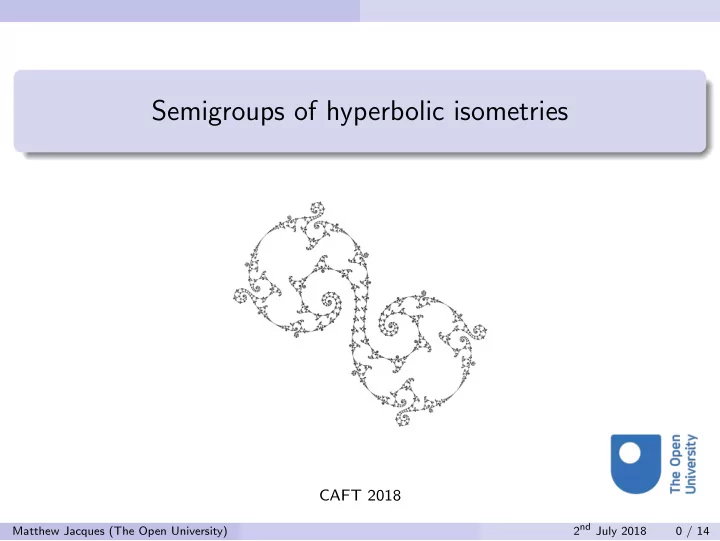
Semigroups of hyperbolic isometries

CAFT 2018

Matthew Jacques (The Open University) 2nd July 2018 0 / 14
slide-2
SLIDE 2

  • bius semigroups

  • bius transformations and hyperbolic geometry
  • We consider the group ▼3 of M¨
  • bius transformations acting as the

conformal automorphisms of ❜ ❈, which we identify with the Riemann sphere. ❇ ❇ ✚ ▼ ❇❀ ✚

❈ ▼ ✚ ▼ ❉ ❉

Matthew Jacques (The Open University) 2nd July 2018 1 / 14

slide-3
SLIDE 3

  • bius semigroups

  • bius transformations and hyperbolic geometry
  • We consider the group ▼3 of M¨
  • bius transformations acting as the

conformal automorphisms of ❜ ❈, which we identify with the Riemann sphere.

  • The action of each M¨
  • bius transformation can be extended from the

Riemann sphere to a conformal action on the unit ball ❇. ❇ ✚ ▼ ❇❀ ✚

❈ ▼ ✚ ▼ ❉ ❉

Matthew Jacques (The Open University) 2nd July 2018 1 / 14

slide-4
SLIDE 4

  • bius semigroups

  • bius transformations and hyperbolic geometry
  • We consider the group ▼3 of M¨
  • bius transformations acting as the

conformal automorphisms of ❜ ❈, which we identify with the Riemann sphere.

  • The action of each M¨
  • bius transformation can be extended from the

Riemann sphere to a conformal action on the unit ball ❇.

  • When ❇ is equipped with the hyperbolic metric ✚, the group ▼3 is

exactly the group of orientation preserving isometries of (❇❀ ✚), and ❜ ❈ is its ideal boundary. ▼ ✚ ▼ ❉ ❉

Matthew Jacques (The Open University) 2nd July 2018 1 / 14

slide-5
SLIDE 5

  • bius semigroups

  • bius transformations and hyperbolic geometry
  • We consider the group ▼3 of M¨
  • bius transformations acting as the

conformal automorphisms of ❜ ❈, which we identify with the Riemann sphere.

  • The action of each M¨
  • bius transformation can be extended from the

Riemann sphere to a conformal action on the unit ball ❇.

  • When ❇ is equipped with the hyperbolic metric ✚, the group ▼3 is

exactly the group of orientation preserving isometries of (❇❀ ✚), and ❜ ❈ is its ideal boundary.

  • We shall also consider the subgroup ▼2 ✚ ▼3 that fixes ❉ set-wise

and preserves orientation on ❉.

Matthew Jacques (The Open University) 2nd July 2018 1 / 14

slide-6
SLIDE 6

  • bius semigroups

  • bius semigroups

We are interested in semigroups of M¨

  • bius transformations.

Matthew Jacques (The Open University) 2nd July 2018 2 / 14

slide-7
SLIDE 7

  • bius semigroups

  • bius semigroups

We are interested in semigroups of M¨

  • bius transformations.

Throughout we shall restrict our attention to finitely-generated M¨

  • bius

semigroups, and refer to these simply as semigroups.

Matthew Jacques (The Open University) 2nd July 2018 2 / 14

slide-8
SLIDE 8

  • bius semigroups

Limit sets

If S is a semigroup, we define its forward limit set, denoted Λ+(S) to be the accumulation points of S(0) on ❜ ❈.

✼✦ ❀ ✼✦

Matthew Jacques (The Open University) 2nd July 2018 3 / 14

slide-9
SLIDE 9

  • bius semigroups

Limit sets

If S is a semigroup, we define its forward limit set, denoted Λ+(S) to be the accumulation points of S(0) on ❜ ❈. We define S1 =

✟g1 ❥ g ✷ S ✠.

✼✦ ❀ ✼✦

Matthew Jacques (The Open University) 2nd July 2018 3 / 14

slide-10
SLIDE 10

  • bius semigroups

Limit sets

If S is a semigroup, we define its forward limit set, denoted Λ+(S) to be the accumulation points of S(0) on ❜ ❈. We define S1 =

✟g1 ❥ g ✷ S ✠.

The backward limit set of S, denoted Λ(S) is the set of accumulation points of S1(0) on ❜ ❈.

✼✦ ❀ ✼✦

Matthew Jacques (The Open University) 2nd July 2018 3 / 14

slide-11
SLIDE 11

  • bius semigroups

Limit sets

If S is a semigroup, we define its forward limit set, denoted Λ+(S) to be the accumulation points of S(0) on ❜ ❈. We define S1 =

✟g1 ❥ g ✷ S ✠.

The backward limit set of S, denoted Λ(S) is the set of accumulation points of S1(0) on ❜ ❈. Examples: Kleinian groups,

✼✦ ❀ ✼✦

Matthew Jacques (The Open University) 2nd July 2018 3 / 14

slide-12
SLIDE 12

  • bius semigroups

Limit sets

If S is a semigroup, we define its forward limit set, denoted Λ+(S) to be the accumulation points of S(0) on ❜ ❈. We define S1 =

✟g1 ❥ g ✷ S ✠.

The backward limit set of S, denoted Λ(S) is the set of accumulation points of S1(0) on ❜ ❈. Examples: Kleinian groups, S =

z ✼✦ 1

3z❀ z ✼✦ 1 3z + 2 3

.

Matthew Jacques (The Open University) 2nd July 2018 3 / 14

slide-13
SLIDE 13

  • bius semigroups

Λ+(S) and Λ(S) where S =

z ✼✦

a 1+z ❀ z ✼✦ a1+2ia1❂2 1+z

❀ z ✼✦

1 4(1+z)

❀ a = 0✿1 + 0✿7i✿

Matthew Jacques (The Open University) 2nd July 2018 4 / 14

slide-14
SLIDE 14

  • bius semigroups

Definition

We say a semigroup S is semidiscrete if the identity element is not an accumulation point of S. ✒ ▼ ✒

  • ✒ ▼
  • ✒ ▼

Matthew Jacques (The Open University) 2nd July 2018 5 / 14

slide-15
SLIDE 15

  • bius semigroups

Definition

We say a semigroup S is semidiscrete if the identity element is not an accumulation point of S.

Theorem 1 (J, Short 2016)

Suppose that S ✒ ▼2 is a nonelementary, semidiscrete semigroup. If Λ+(S) ✒ Λ(S), then S is a group. ✒ ▼

  • ✒ ▼

Matthew Jacques (The Open University) 2nd July 2018 5 / 14

slide-16
SLIDE 16

  • bius semigroups

Definition

We say a semigroup S is semidiscrete if the identity element is not an accumulation point of S.

Theorem 1 (J, Short 2016)

Suppose that S ✒ ▼2 is a nonelementary, semidiscrete semigroup. If Λ+(S) ✒ Λ(S), then S is a group.

Theorem 2 (J. 2016)

Suppose that S ✒ ▼3 is a nonelementary, semidiscrete semigroup. If Λ+(S) = Λ(S) and this set is not connected, then S is a group. ✒ ▼

Matthew Jacques (The Open University) 2nd July 2018 5 / 14

slide-17
SLIDE 17

  • bius semigroups

Definition

We say a semigroup S is semidiscrete if the identity element is not an accumulation point of S.

Theorem 1 (J, Short 2016)

Suppose that S ✒ ▼2 is a nonelementary, semidiscrete semigroup. If Λ+(S) ✒ Λ(S), then S is a group.

Theorem 2 (J. 2016)

Suppose that S ✒ ▼3 is a nonelementary, semidiscrete semigroup. If Λ+(S) = Λ(S) and this set is not connected, then S is a group.

Conjecture

Suppose that S ✒ ▼3 is a nonelementary semidiscrete semigroup. If Λ+(S) = Λ(S) ✻= ❜ ❈, then S is a group.

Matthew Jacques (The Open University) 2nd July 2018 5 / 14

slide-18
SLIDE 18

If the forward and backward limit sets are equal, then the following Lemma tells us the semigroup is contained in a Kleinian group.

Lemma

Suppose S is a nonelementary semidiscrete semigroup, and that Λ+(S) = Λ(S) = Λ, where Λ is not a circle nor ❜ ❈. Then the elements of ▼3 that fix Λ setwise form a discrete group.

Matthew Jacques (The Open University) 2nd July 2018 6 / 14

slide-19
SLIDE 19

Let G denote the group generated by S.

❈ ♥ ✶ ✶ ✣ ❉ ✦ ✣

Matthew Jacques (The Open University) 2nd July 2018 7 / 14

slide-20
SLIDE 20

Let G denote the group generated by S. The limit set of G is equal to Λ.

❈ ♥ ✶ ✶ ✣ ❉ ✦ ✣

Matthew Jacques (The Open University) 2nd July 2018 7 / 14

slide-21
SLIDE 21

Let G denote the group generated by S. The limit set of G is equal to Λ. Since Λ is not equal to ❜ ❈, then ❜ ❈ ♥ Λ has 1, 2 or ✶-many components. ✶ ✣ ❉ ✦ ✣

Matthew Jacques (The Open University) 2nd July 2018 7 / 14

slide-22
SLIDE 22

Let G denote the group generated by S. The limit set of G is equal to Λ. Since Λ is not equal to ❜ ❈, then ❜ ❈ ♥ Λ has 1, 2 or ✶-many components.

  • The case where Λ has ✶-many complementary components is open.

✣ ❉ ✦ ✣

Matthew Jacques (The Open University) 2nd July 2018 7 / 14

slide-23
SLIDE 23

Let G denote the group generated by S. The limit set of G is equal to Λ. Since Λ is not equal to ❜ ❈, then ❜ ❈ ♥ Λ has 1, 2 or ✶-many components.

  • The case where Λ has ✶-many complementary components is open.
  • If Λ has 2 complementary components then G is quasi-Fuchsian (or

contains an index 2 quasi-Fuchsian subgroup) and Λ is a quasi-circle. ✣ ❉ ✦ ✣

Matthew Jacques (The Open University) 2nd July 2018 7 / 14

slide-24
SLIDE 24

Let G denote the group generated by S. The limit set of G is equal to Λ. Since Λ is not equal to ❜ ❈, then ❜ ❈ ♥ Λ has 1, 2 or ✶-many components.

  • The case where Λ has ✶-many complementary components is open.
  • If Λ has 2 complementary components then G is quasi-Fuchsian (or

contains an index 2 quasi-Fuchsian subgroup) and Λ is a quasi-circle. In both cases the conjecture is true. ✣ ❉ ✦ ✣

Matthew Jacques (The Open University) 2nd July 2018 7 / 14

slide-25
SLIDE 25

Let G denote the group generated by S. The limit set of G is equal to Λ. Since Λ is not equal to ❜ ❈, then ❜ ❈ ♥ Λ has 1, 2 or ✶-many components.

  • The case where Λ has ✶-many complementary components is open.
  • If Λ has 2 complementary components then G is quasi-Fuchsian (or

contains an index 2 quasi-Fuchsian subgroup) and Λ is a quasi-circle. In both cases the conjecture is true.

  • The rest of this talk will concentrate on the case where Λ has 1

complementary component, Ω, in which case we show that the conjecture is true. ✣ ❉ ✦ ✣

Matthew Jacques (The Open University) 2nd July 2018 7 / 14

slide-26
SLIDE 26

Let G denote the group generated by S. The limit set of G is equal to Λ. Since Λ is not equal to ❜ ❈, then ❜ ❈ ♥ Λ has 1, 2 or ✶-many components.

  • The case where Λ has ✶-many complementary components is open.
  • If Λ has 2 complementary components then G is quasi-Fuchsian (or

contains an index 2 quasi-Fuchsian subgroup) and Λ is a quasi-circle. In both cases the conjecture is true.

  • The rest of this talk will concentrate on the case where Λ has 1

complementary component, Ω, in which case we show that the conjecture is true. Let us take a conformal map ✣ : ❉ ✦ Ω. ✣

Matthew Jacques (The Open University) 2nd July 2018 7 / 14

slide-27
SLIDE 27

Let G denote the group generated by S. The limit set of G is equal to Λ. Since Λ is not equal to ❜ ❈, then ❜ ❈ ♥ Λ has 1, 2 or ✶-many components.

  • The case where Λ has ✶-many complementary components is open.
  • If Λ has 2 complementary components then G is quasi-Fuchsian (or

contains an index 2 quasi-Fuchsian subgroup) and Λ is a quasi-circle. In both cases the conjecture is true.

  • The rest of this talk will concentrate on the case where Λ has 1

complementary component, Ω, in which case we show that the conjecture is true. Let us take a conformal map ✣ : ❉ ✦ Ω. Again, we denote the conjugate of G and S by ✣ as Γ and Σ respectively.

Matthew Jacques (The Open University) 2nd July 2018 7 / 14

slide-28
SLIDE 28

Let G denote the group generated by S. The limit set of G is equal to Λ. Since Λ is not equal to ❜ ❈, then ❜ ❈ ♥ Λ has 1, 2 or ✶-many components.

  • The case where Λ has ✶-many complementary components is open.
  • If Λ has 2 complementary components then G is quasi-Fuchsian (or

contains an index 2 quasi-Fuchsian subgroup) and Λ is a quasi-circle. In both cases the conjecture is true.

  • The rest of this talk will concentrate on the case where Λ has 1

complementary component, Ω, in which case we show that the conjecture is true. Let us take a conformal map ✣ : ❉ ✦ Ω. Again, we denote the conjugate of G and S by ✣ as Γ and Σ respectively. Then Γ is a Fuchsian group of the first kind.

Matthew Jacques (The Open University) 2nd July 2018 7 / 14

slide-29
SLIDE 29

Ω has one component, Λ decomposable

The case where Λ is a decomposable continuum

A continuum Λ is decomposable if there exist subcontinua ✕1 and ✕2, neither empty nor Λ itself, such that Λ = ✕1 ❬ ✕2. Otherwise Λ is indecomposable. ✣ ✣ ❉ ❙ ❅ ✷ ❅ ✒ ❙

✣ ✣ ❉ ✦ ✣ ✣ ✒ ❙ ❙ ✩

Matthew Jacques (The Open University) 2nd July 2018 8 / 14

slide-30
SLIDE 30

Ω has one component, Λ decomposable

The case where Λ is a decomposable continuum

A continuum Λ is decomposable if there exist subcontinua ✕1 and ✕2, neither empty nor Λ itself, such that Λ = ✕1 ❬ ✕2. Otherwise Λ is indecomposable. Let ✣ be the Carath´ eodory extension of ✣ to ❉, that maps ❙1 to the Carath´ eodory boundary ❅Ω of Ω. ✷ ❅ ✒ ❙

✣ ✣ ❉ ✦ ✣ ✣ ✒ ❙ ❙ ✩

Matthew Jacques (The Open University) 2nd July 2018 8 / 14

slide-31
SLIDE 31

Ω has one component, Λ decomposable

The case where Λ is a decomposable continuum

A continuum Λ is decomposable if there exist subcontinua ✕1 and ✕2, neither empty nor Λ itself, such that Λ = ✕1 ❬ ✕2. Otherwise Λ is indecomposable. Let ✣ be the Carath´ eodory extension of ✣ to ❉, that maps ❙1 to the Carath´ eodory boundary ❅Ω of Ω. For prime end e ✷ ❅Ω, let I(e) denote its impression. ✒ ❙

✣ ✣ ❉ ✦ ✣ ✣ ✒ ❙ ❙ ✩

Matthew Jacques (The Open University) 2nd July 2018 8 / 14

slide-32
SLIDE 32

Ω has one component, Λ decomposable

The case where Λ is a decomposable continuum

A continuum Λ is decomposable if there exist subcontinua ✕1 and ✕2, neither empty nor Λ itself, such that Λ = ✕1 ❬ ✕2. Otherwise Λ is indecomposable. Let ✣ be the Carath´ eodory extension of ✣ to ❉, that maps ❙1 to the Carath´ eodory boundary ❅Ω of Ω. For prime end e ✷ ❅Ω, let I(e) denote its impression. For E ✒ ❙1 let us define I(E) = ❙

w✷E I(✣(w)).

✣ ❉ ✦ ✣ ✣ ✒ ❙ ❙ ✩

Matthew Jacques (The Open University) 2nd July 2018 8 / 14

slide-33
SLIDE 33

Ω has one component, Λ decomposable

The case where Λ is a decomposable continuum

A continuum Λ is decomposable if there exist subcontinua ✕1 and ✕2, neither empty nor Λ itself, such that Λ = ✕1 ❬ ✕2. Otherwise Λ is indecomposable. Let ✣ be the Carath´ eodory extension of ✣ to ❉, that maps ❙1 to the Carath´ eodory boundary ❅Ω of Ω. For prime end e ✷ ❅Ω, let I(e) denote its impression. For E ✒ ❙1 let us define I(E) = ❙

w✷E I(✣(w)).

Theorem (Matsuzaki 2004)

Let G be a Kleinian group such that Ω(G) has one component and Λ(G) is a decomposable continuum. Let ✣ : ❉ ✦ Ω(G) be a Riemann map, and suppose ✣1G✣ = Γ is a Fuchsian group of the 1st kind. If E ✒ ❙1 is not dense in ❙1 then I(E) ✩ Λ.

Matthew Jacques (The Open University) 2nd July 2018 8 / 14

slide-34
SLIDE 34

Ω has one component, Λ decomposable

The case where Λ is a decomposable continuum

Proposition (J. 2018)

Let S be a semidiscrete semigroup such that Λ+(S) = Λ(S) is a decomposable continuum whose complement has one component. Then S is a group. ❙ ✻ ❙ ❙ ✩ ✷ ♥ ✷ ✣ ✣ ✷ ✷ ✣ ✒

Matthew Jacques (The Open University) 2nd July 2018 9 / 14

slide-35
SLIDE 35

Ω has one component, Λ decomposable

The case where Λ is a decomposable continuum

Proposition (J. 2018)

Let S be a semidiscrete semigroup such that Λ+(S) = Λ(S) is a decomposable continuum whose complement has one component. Then S is a group.

Proof.

By Theorem 1 it is enough to show that Λ+(Σ) = ❙1. ✻ ❙ ❙ ✩ ✷ ♥ ✷ ✣ ✣ ✷ ✷ ✣ ✒

Matthew Jacques (The Open University) 2nd July 2018 9 / 14

slide-36
SLIDE 36

Ω has one component, Λ decomposable

The case where Λ is a decomposable continuum

Proposition (J. 2018)

Let S be a semidiscrete semigroup such that Λ+(S) = Λ(S) is a decomposable continuum whose complement has one component. Then S is a group.

Proof.

By Theorem 1 it is enough to show that Λ+(Σ) = ❙1. For suppose towards contradiction that Λ+(Σ) ✻= ❙1, then Λ+(Σ) is not dense in ❙1. ✩ ✷ ♥ ✷ ✣ ✣ ✷ ✷ ✣ ✒

Matthew Jacques (The Open University) 2nd July 2018 9 / 14

slide-37
SLIDE 37

Ω has one component, Λ decomposable

The case where Λ is a decomposable continuum

Proposition (J. 2018)

Let S be a semidiscrete semigroup such that Λ+(S) = Λ(S) is a decomposable continuum whose complement has one component. Then S is a group.

Proof.

By Theorem 1 it is enough to show that Λ+(Σ) = ❙1. For suppose towards contradiction that Λ+(Σ) ✻= ❙1, then Λ+(Σ) is not dense in ❙1. Hence by Matsuzaki’s theorem, I(Λ+(Σ)) ✩ Λ. ✷ ♥ ✷ ✣ ✣ ✷ ✷ ✣ ✒

Matthew Jacques (The Open University) 2nd July 2018 9 / 14

slide-38
SLIDE 38

Ω has one component, Λ decomposable

The case where Λ is a decomposable continuum

Proposition (J. 2018)

Let S be a semidiscrete semigroup such that Λ+(S) = Λ(S) is a decomposable continuum whose complement has one component. Then S is a group.

Proof.

By Theorem 1 it is enough to show that Λ+(Σ) = ❙1. For suppose towards contradiction that Λ+(Σ) ✻= ❙1, then Λ+(Σ) is not dense in ❙1. Hence by Matsuzaki’s theorem, I(Λ+(Σ)) ✩ Λ. Now let us choose z ✷ Λ ♥ I(Λ+(Σ)), and sequence fn ✷ S such that fn converges ideally to z. ✣ ✣ ✷ ✷ ✣ ✒

Matthew Jacques (The Open University) 2nd July 2018 9 / 14

slide-39
SLIDE 39

Ω has one component, Λ decomposable

The case where Λ is a decomposable continuum

Proposition (J. 2018)

Let S be a semidiscrete semigroup such that Λ+(S) = Λ(S) is a decomposable continuum whose complement has one component. Then S is a group.

Proof.

By Theorem 1 it is enough to show that Λ+(Σ) = ❙1. For suppose towards contradiction that Λ+(Σ) ✻= ❙1, then Λ+(Σ) is not dense in ❙1. Hence by Matsuzaki’s theorem, I(Λ+(Σ)) ✩ Λ. Now let us choose z ✷ Λ ♥ I(Λ+(Σ)), and sequence fn ✷ S such that fn converges ideally to z. By passing to a subsequence if necessary, ✣1fn✣ converges ideally to some point w ✷ Λ+(Σ). ✷ ✣ ✒

Matthew Jacques (The Open University) 2nd July 2018 9 / 14

slide-40
SLIDE 40

Ω has one component, Λ decomposable

The case where Λ is a decomposable continuum

Proposition (J. 2018)

Let S be a semidiscrete semigroup such that Λ+(S) = Λ(S) is a decomposable continuum whose complement has one component. Then S is a group.

Proof.

By Theorem 1 it is enough to show that Λ+(Σ) = ❙1. For suppose towards contradiction that Λ+(Σ) ✻= ❙1, then Λ+(Σ) is not dense in ❙1. Hence by Matsuzaki’s theorem, I(Λ+(Σ)) ✩ Λ. Now let us choose z ✷ Λ ♥ I(Λ+(Σ)), and sequence fn ✷ S such that fn converges ideally to z. By passing to a subsequence if necessary, ✣1fn✣ converges ideally to some point w ✷ Λ+(Σ). Since z ✷ I(✣(w)) ✒ I(Λ+(Σ)) we have a contradiction.

Matthew Jacques (The Open University) 2nd July 2018 9 / 14

slide-41
SLIDE 41

Ω has one component, Λ indecomposable

The case where Λ is an indecomposable continuum

In the case where Λ has one complementary component, it remains to consider the subcase where Λ is an indecomposable continuum.

✣ ❉

❩❩

❥✣✵ ❥❥❙ ✣ ❥ ❥ ❥ ❁ ✶❀ ✣✵

✑ ✷ ❀ ❂

Matthew Jacques (The Open University) 2nd July 2018 10 / 14

slide-42
SLIDE 42

Ω has one component, Λ indecomposable

The case where Λ is an indecomposable continuum

In the case where Λ has one complementary component, it remains to consider the subcase where Λ is an indecomposable continuum.

Bishop–Jones H

1 2 ✑ Theorem (Bishop, Jones 1994)

Let ✣ be a conformal mapping from ❉ onto Ω. If

❩❩

❥✣✵(z)❥❥❙(✣)(z)❥2(1 ❥z❥2)3 dxdy ❁ +✶❀ then ✣✵ belongs to the Hardy space H

1 2 ✑ for all ✑ ✷ (0❀ 1❂2). Matthew Jacques (The Open University) 2nd July 2018 10 / 14

slide-43
SLIDE 43

Ω has one component, Λ indecomposable

The case where Λ is an indecomposable continuum

In the case where Λ has one complementary component, it remains to consider the subcase where Λ is an indecomposable continuum.

Bishop–Jones H

1 2 ✑ Theorem (Bishop, Jones 1994)

Let ✣ be a conformal mapping from ❉ onto Ω. If

❩❩

❥✣✵(z)❥❥❙(✣)(z)❥2(1 ❥z❥2)3 dxdy ❁ +✶❀ then ✣✵ belongs to the Hardy space H

1 2 ✑ for all ✑ ✷ (0❀ 1❂2).

Theorem (Bishop, Jones 1994)

If a finitely-generated Kleinian group has a simply connected invariant component that is not a disc, then a.e. point on the boundary with respect to harmonic measure is a twist point.

Matthew Jacques (The Open University) 2nd July 2018 10 / 14

slide-44
SLIDE 44

Ω has one component, Λ indecomposable

Γ is cocompact

A parabolic map g ✷ G is called accidental if its conjugate ✌ ✷ Γ is loxodromic. ✷

Matthew Jacques (The Open University) 2nd July 2018 11 / 14

slide-45
SLIDE 45

Ω has one component, Λ indecomposable

Γ is cocompact

A parabolic map g ✷ G is called accidental if its conjugate ✌ ✷ Γ is loxodromic. There are no accidental parabolic maps in G. ✷

Matthew Jacques (The Open University) 2nd July 2018 11 / 14

slide-46
SLIDE 46

Ω has one component, Λ indecomposable

Γ is cocompact

A parabolic map g ✷ G is called accidental if its conjugate ✌ ✷ Γ is loxodromic. There are no accidental parabolic maps in G. On the other hand:

  • a parabolic element g ✷ G is accidental if and only if the fixed point
  • f g lies in the impression of two distinct prime ends of Ω; and
  • each prime end of Ω has impression Λ (Matsuzaki 2004).

Matthew Jacques (The Open University) 2nd July 2018 11 / 14

slide-47
SLIDE 47

Ω has one component, Λ indecomposable

Γ is cocompact

A parabolic map g ✷ G is called accidental if its conjugate ✌ ✷ Γ is loxodromic. There are no accidental parabolic maps in G. On the other hand:

  • a parabolic element g ✷ G is accidental if and only if the fixed point
  • f g lies in the impression of two distinct prime ends of Ω; and
  • each prime end of Ω has impression Λ (Matsuzaki 2004).

Hence every parabolic map in G is accidental.

Matthew Jacques (The Open University) 2nd July 2018 11 / 14

slide-48
SLIDE 48

Ω has one component, Λ indecomposable

Γ is cocompact

A parabolic map g ✷ G is called accidental if its conjugate ✌ ✷ Γ is loxodromic. There are no accidental parabolic maps in G. On the other hand:

  • a parabolic element g ✷ G is accidental if and only if the fixed point
  • f g lies in the impression of two distinct prime ends of Ω; and
  • each prime end of Ω has impression Λ (Matsuzaki 2004).

Hence every parabolic map in G is accidental. Hence G has no parabolic elements.

Matthew Jacques (The Open University) 2nd July 2018 11 / 14

slide-49
SLIDE 49

Ω has one component, Λ indecomposable

Γ is cocompact

A parabolic map g ✷ G is called accidental if its conjugate ✌ ✷ Γ is loxodromic. There are no accidental parabolic maps in G. On the other hand:

  • a parabolic element g ✷ G is accidental if and only if the fixed point
  • f g lies in the impression of two distinct prime ends of Ω; and
  • each prime end of Ω has impression Λ (Matsuzaki 2004).

Hence every parabolic map in G is accidental. Hence G has no parabolic elements. Hence Γ has no parabolic elements.

Matthew Jacques (The Open University) 2nd July 2018 11 / 14

slide-50
SLIDE 50

Ω has one component, Λ indecomposable

Γ is cocompact

A parabolic map g ✷ G is called accidental if its conjugate ✌ ✷ Γ is loxodromic. There are no accidental parabolic maps in G. On the other hand:

  • a parabolic element g ✷ G is accidental if and only if the fixed point
  • f g lies in the impression of two distinct prime ends of Ω; and
  • each prime end of Ω has impression Λ (Matsuzaki 2004).

Hence every parabolic map in G is accidental. Hence G has no parabolic elements. Hence Γ has no parabolic elements. Hence Γ is cocompact.

Matthew Jacques (The Open University) 2nd July 2018 11 / 14

slide-51
SLIDE 51

Ω has one component, Λ indecomposable

The Schwarzian of ✣ is Γ-invariant because ❙(✣✌) = ❙(g✣) = ❙(✣) whenever g ✷ G, ✌ ✷ Γ and g = ✣✌✣1. ❃ ✷ ❉ ❥❙ ✣ ❥ ✻ ❥ ❥ ❀ ❥✣✵ ❥ ✻ ❥ ❥ ✿

❩❩

❥✣✵ ❥❥❙ ✣ ❥ ❥ ❥ ❁ ✶✿

Matthew Jacques (The Open University) 2nd July 2018 12 / 14

slide-52
SLIDE 52

Ω has one component, Λ indecomposable

The Schwarzian of ✣ is Γ-invariant because ❙(✣✌) = ❙(g✣) = ❙(✣) whenever g ✷ G, ✌ ✷ Γ and g = ✣✌✣1. For some C ❃ 0 we have the following estimates for all z ✷ ❉: ❥❙(✣)(z)❥ ✻ C (1 ❥z❥2)2 ❀ ❥✣✵ ❥ ✻ ❥ ❥ ✿

❩❩

❥✣✵ ❥❥❙ ✣ ❥ ❥ ❥ ❁ ✶✿

Matthew Jacques (The Open University) 2nd July 2018 12 / 14

slide-53
SLIDE 53

Ω has one component, Λ indecomposable

The Schwarzian of ✣ is Γ-invariant because ❙(✣✌) = ❙(g✣) = ❙(✣) whenever g ✷ G, ✌ ✷ Γ and g = ✣✌✣1. For some C ❃ 0 we have the following estimates for all z ✷ ❉: ❥❙(✣)(z)❥ ✻ C (1 ❥z❥2)2 ❀ ❥✣✵(z)❥ ✻ C (1 ❥z❥)3 ✿

❩❩

❥✣✵ ❥❥❙ ✣ ❥ ❥ ❥ ❁ ✶✿

Matthew Jacques (The Open University) 2nd July 2018 12 / 14

slide-54
SLIDE 54

Ω has one component, Λ indecomposable

The Schwarzian of ✣ is Γ-invariant because ❙(✣✌) = ❙(g✣) = ❙(✣) whenever g ✷ G, ✌ ✷ Γ and g = ✣✌✣1. For some C ❃ 0 we have the following estimates for all z ✷ ❉: ❥❙(✣)(z)❥ ✻ C (1 ❥z❥2)2 ❀ ❥✣✵(z)❥ ✻ C (1 ❥z❥)3 ✿ Recall the Bishop–Jones integral

❩❩

❥✣✵(z)❥❥❙(✣)(z)❥2(1 ❥z❥2)3 dxdy ❁ +✶✿

Matthew Jacques (The Open University) 2nd July 2018 12 / 14

slide-55
SLIDE 55

Ω has one component, Λ indecomposable

Conjecture

Suppose that S ✒ ▼3 is a nonelementary semidiscrete semigroup. If Λ+(S) = Λ(S) ✻= ❜ ❈, then S is a group.

Proposition (J. 2018)

Suppose that S ✒ ▼3 is a nonelementary semidiscrete semigroup. If Λ+(S) = Λ(S) ✻= ❜ ❈ and is not a connected set with infinitely many complementary components, then S is a group.

Matthew Jacques (The Open University) 2nd July 2018 13 / 14

slide-56
SLIDE 56

Thank you for your attention!

Matthew Jacques (The Open University) 2nd July 2018 14 / 14