Self-Presentation and Person Self-presentation: process of - - PDF document

self presentation and person
SMART_READER_LITE
LIVE PREVIEW

Self-Presentation and Person Self-presentation: process of - - PDF document

Basking in reflected glory Downward social comparison Increasing self-esteem by associating with others who Comparing ourselves to people who are worse off are successful (BIRGing) than we are on a particular trait or ability. Cialdini et al.


slide-1
SLIDE 1

1

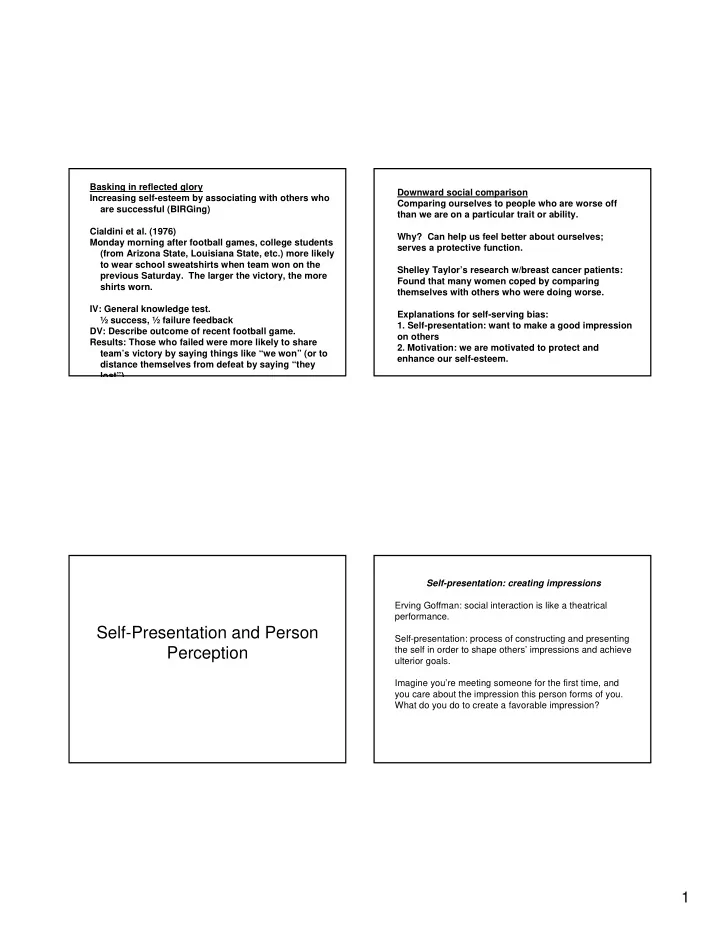
Basking in reflected glory Increasing self-esteem by associating with others who are successful (BIRGing) Cialdini et al. (1976) Monday morning after football games, college students (from Arizona State, Louisiana State, etc.) more likely to wear school sweatshirts when team won on the previous Saturday. The larger the victory, the more shirts worn. IV: General knowledge test. ½ success, ½ failure feedback DV: Describe outcome of recent football game. Results: Those who failed were more likely to share team’s victory by saying things like “we won” (or to distance themselves from defeat by saying “they lost”) Downward social comparison Comparing ourselves to people who are worse off than we are on a particular trait or ability. Why? Can help us feel better about ourselves; serves a protective function. Shelley Taylor’s research w/breast cancer patients: Found that many women coped by comparing themselves with others who were doing worse. Explanations for self-serving bias:

  • 1. Self-presentation: want to make a good impression
  • n others
  • 2. Motivation: we are motivated to protect and

enhance our self-esteem.

Self-Presentation and Person Perception

Self-presentation: creating impressions Erving Goffman: social interaction is like a theatrical performance. Self-presentation: process of constructing and presenting the self in order to shape others’ impressions and achieve ulterior goals. Imagine you’re meeting someone for the first time, and you care about the impression this person forms of you. What do you do to create a favorable impression?

slide-2
SLIDE 2

2

Self-presentational strategies Self-promotion Exemplification Modesty Intimidation Supplication Sandbagging Ingratiation Person perception: forming social judgments Person perception: Process by which we come to know about other people’s temporary states and enduring dispositions

  • Two parts: impression formation and attribution

Impression formation: rapid assessment of salient characteristics (from various sources) into an overall judgment

Integrating traits into a coherent impression Summation model: Valences are added up Averaging model: Valences are averaged Anderson (1968) Got ratings of desirability of hundreds of traits and categorized them: favorable, moderately favorable, moderately unfavorable, unfavorable Participants read descriptions of target individuals using different combinations of traits IV: Trait pairing (favorable only, favorable + moderately favorable). DV: Liking ratings Result: Adding moderately favorable = less likable (averaging model)

slide-3
SLIDE 3

3

Information integration theory

  • 1. Personal dispositions of perceiver

(personal chronic constructs, priming/accessibility, mood)

  • 2. Weighted average of target’s traits

(trait negativity bias)

Asch: Central and peripheral traits Kelley (1950) Introduced guest lecturer for psychology class IV: Trait descriptor used (warm or cold) DV: Student ratings, observed frequency of student participation Result: Ratings were more favorable and students participated more when speaker was introduced as “warm” Primacy effect: Earlier information carries more weight than later information Jones et al. (1968) Confederate is taking 30-item test of intellectual ability. Experimenter announced after each question whether right/wrong. Always 15 right, 15 wrong IV: Order of right/wrong questions. In one condition, most of the right answers are given in the first half of the “test.” Other condition opposite (most right answers in second half). DV: Intelligence rating, Likelihood of performing well on a retest. Result: Ratings were higher when correct answers came mainly from first half (earlier information) How do we make attributions about social behavior? Dispositional versus situational attributions Do people make attributions in a logical, rational way? Or, do we make some consistent errors? Fundamental attribution error Actor-observer bias Causal attributions: People’s explanations about the causes of their own or another person’s behavior. How do people explain another’s behavior? What kinds of errors do people typically make when explaining their own and others’ behavior, and what are the consequences of those errors?

slide-4
SLIDE 4

4

Fundamental attribution error: the tendency for people to underestimate the impact of situational causes and to overestimate the impact of dispositional causes in explaining another person’s behavior. Actor-observer difference: the tendency to attribute

  • ther people’s behavior to their disposition, but to

attribute one’s own behavior to the situation. Explanations for the actor-observer difference Perceptual salience (figure vs. ground) Availability of knowledge