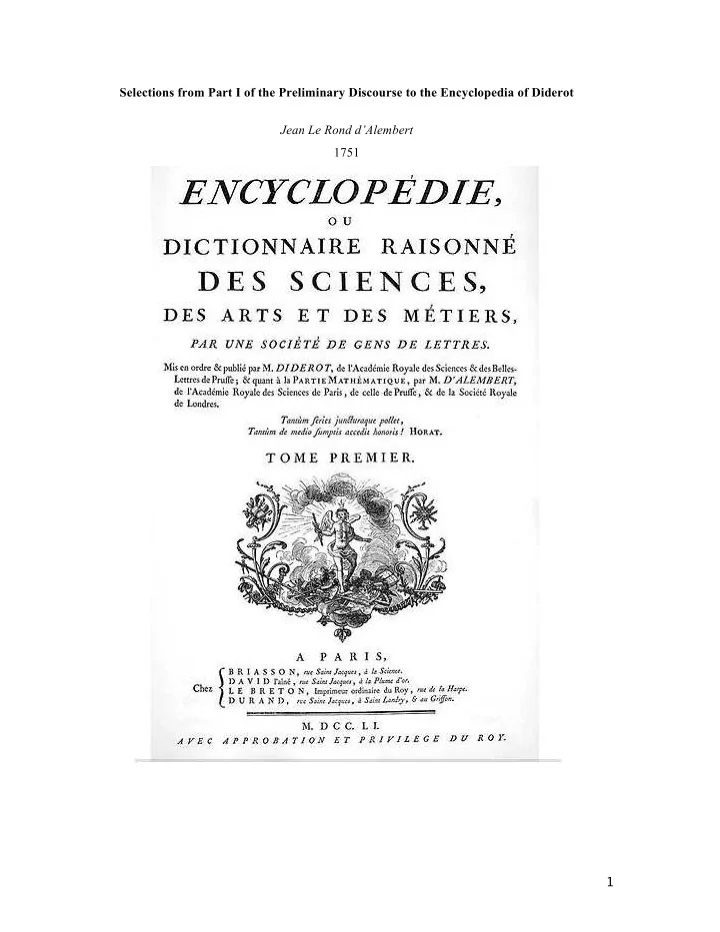
SLIDE 1
1 Selections from Part I of the Preliminary Discourse to the Encyclopedia of Diderot Jean Le Rond d’Alembert 1751
SLIDE 2
2 The Encyclopedia which we are presenting to the public is, as its title declares, the work of a society of men of letters. Were we not of their number, we might venture to affirm that they are all favorably known or worthy of being so. [1] But, without wishing to anticipate a judgment which should be made only by scholars, it is at least incumbent upon us, before all else, to remove the objection that could most easily prejudice the success of such a large undertaking as this. We declare, therefore, that we have not had the temerity to undertake unaided a task so superior to our capabilities, and that our function as editors consists principally in arranging materials which for the most part have been furnished in their entirety by others. We had explicitly made the same declaration in the body of the Prospectus, [2] but perhaps we should have put it at the beginning of that document…. The work whose first volume we are presenting today [4] has two aims. As an Encyclopedia, it is to set forth as well as possible the order and connection of the parts of human knowledge. As a Reasoned Dictionary of the Sciences, Arts, and Trades, it is to contain the general principles that form the basis of each science and each art, liberal or
SLIDE 3 3 mechanical, and the most essential facts that make up the body and substance of each. [5] These two points of view, the one of an Encyclopedia and the other of a Reasoned Dictionary, [6] will thus constitute the basis for the outline and division of our Preliminary
- Discourse. We are going to introduce them, deal with them one after another, and give an
account of the means by which we have tried to satisfy this double object. If one reflects somewhat upon the connection that discoveries have with one another, it is readily apparent that the sciences and the arts are mutually supporting, and that consequently there is a chain that binds them together. But, if it is often difficult to reduce each particular science or art to a small number of rules or general notions, it is no less difficult to encompass the infinitely varied branches of human knowledge in a truly unified system. [7] The first step which lies before us in our endeavor is to examine, if we may be permitted to use this term, the genealogy and the filiation of the parts of our knowledge, the causes that brought the various branches of our knowledge into being, and the characteristics that distinguish them. In short, we must go back to the origin and generation of our ideas. [8] Quite aside from the help this examination will give us for the encyclopedic enumeration of the sciences and the arts, it cannot be out of place at the head of a work such as this. *********
SLIDE 4
4 After reviewing the different parts of our knowledge and the characteristics that distinguish them, it remains for us only to make a genealogical or encyclopedic tree which will gather the various branches of knowledge together under a single point of view and will serve to indicate their origin and their relationships to one another. The general system of the sciences and the arts is a sort of labyrinth, a tortuous road which the intellect enters without quite knowing what direction to take. Impelled, first of all,
SLIDE 5 5 by its needs and by those of the body to which it is united, the intelligence studies the first objects that present themselves to it. It delves as far as it can into the knowledge
- f these objects, soon meets difficulties that obstruct it, and whether through hope or
even through despair of surmounting them, plunges on to a new route; now it retraces its footsteps, sometimes crosses the first barriers only to meet new ones; and passing rapidly from one object to another, it carries through a sequence of operations on each
- f them at different intervals, as if by jumps. The discontinuity of these operations is a
necessary effect of the very generation of ideas. However philosophic this disorder may be on the part of the soul, [57] an encyclopedic tree which attempted to portray it would be disfigured, indeed utterly destroyed. The system of our knowledge is composed of different branches, several of which have a common point of union. Since it is not possible, starting out from this point, to begin following all the routes simultaneously, it is the nature of the different minds that determines which route is chosen. Rarely does a single mind travel along a large number of these routes at the same time. In the study of Nature, men at first applied themselves, as if in concert, to satisfying the most pressing needs. But when they came to less absolutely necessary knowledge, they were obliged to divide it among themselves, and each one moved forward in almost equal step with the others. Thus several sciences have been contemporaneous, so to speak. But when tracing in historical order the progress of the mind, one can only embrace them successively. It is not the same with the encyclopedic arrangement of our knowledge. This consists
- f collecting knowledge into the smallest area possible and of placing the philosopher
at a vantage point, so to speak, high above this vast labyrinth, whence he can perceive the principal sciences and the arts simultaneously. From there he can see at a glance the objects of their speculations and the operations which can be made on these
- bjects; he can discern the general branches of human knowledge, the points that
separate or unite them; and sometimes he can even glimpse the secrets that relate them to one another. It is a kind of world map which is to show the principal countries, their position and their mutual dependence, the road that leads directly from one to the
- ther. This road is often cut by a thousand obstacles, which are known in each country
SLIDE 6 6
- nly to the inhabitants or to travelers, and which cannot be represented except in
individual, highly detailed maps. These individual maps will be the different articles
- f the Encyclopedia and the Tree or Systematic Chart will be its world map. [58]
But as, in the case of the general maps of the globe we inhabit, objects will be near or far and will have different appearances according to the vantage point at which the eye is placed by the geographer constructing the map, likewise the form of the encyclopedic tree will depend on the vantage point one assumes in viewing the universe of letters. Thus one can create as many different systems of human knowledge as there are world maps having different projections, and each one of these systems might even have some particular advantage possessed by none of the others. There are hardly any scholars who do not readily assume that their own science is at the center of all the rest, somewhat in the way that the first men placed themselves at the center of the world, persuaded that the universe was made for them. Viewed with a philosophical eye, the claim of several of these scholars could perhaps be justified by rather good reasons, quite aside from self-esteem.
SLIDE 7 7
Representation of Human Knowledge
In any case, of all the encyclopedic trees the one that offered the largest number of connections and relationships among the sciences would doubtless deserve preference. But can one flatter oneself into thinking it has been found? We cannot repeat too often that nature is composed merely of individual things which are the primary object of
- ur sensations and direct perceptions. To be sure, we note in these individual things
common properties by which we compare them and dissimilar properties by which we differentiate them. And these properties, designated by abstract names, have led us to form different classes in which these objects have been placed. But often such an
- bject, which because of one or several of its properties has been placed in one class,
belongs to another class by virtue of other properties and might have been placed
- accordingly. Thus, the general division remains of necessity somewhat arbitrary.
One could construct the tree of our knowledge by dividing it into natural and revealed knowledge, or useful and pleasing knowledge, or speculative and practical knowledge,
- r evident, certain, probable, and sensitive knowledge, or knowledge of things and
SLIDE 8 8 knowledge of signs, and so on into infinity. We have chosen a division which has appeared to us most nearly satisfactory for the encyclopedic arrangement of our knowledge and, at the same time, for its genealogical arrangement. We owe this division to a celebrated author [Bacon] of whom we will speak later in this preface. To be sure, we have thought it necessary to make some changes in his division, of which we will render an account; but we are too aware of the arbitrariness which will always prevail in such a division to believe that our system is the only one or the best. It will be sufficient for us if our work is not entirely disapproved of by men of
- intelligence. We do not wish to resemble that multitude of naturalists (censured with
such good reason by a modern philosopher) whose energies have been ceaselessly devoted to dividing the productions of Nature into genera and species, consuming an amount of time in this labor which would have been employed to much better purpose in the study of those productions themselves. What would be said of an architect, who, having to build an immense edifice, passed his whole life in drawing the plans for it? The objects to which our soul applies itself are either spiritual or material, and our souls are occupied with these objects either through direct ideas or through reflective
- ideas. The system of direct knowledge consists simply in the purely passive and
almost mechanical collection of this same knowledge; this is what we call memory. Reflection is of two kinds (as we have already observed): either it reasons on the
- bjects of direct ideas, or it imitates them. Thus memory, reason (strictly speaking),
and imagination are the three different manners in which our soul operates on the
- bjects of its thoughts. We do not take imagination here to be the ability to represent
- bjects to oneself, since that faculty is simply the memory itself of sensible objects, a
memory which would be continually in action if it were not assisted and relieved by the invention of signs. We take imagination in the more noble and precise sense, as the talent of creating by imitating. These three faculties form at the outset the three general divisions of our system of human knowledge: History, which is related to memory; Philosophy, which is the fruit
- f reason; and the Fine Arts, which are born of imagination. Placing reason ahead of
imagination appears to us to be a well-founded arrangement and one which is in
SLIDE 9 9 conformity with the natural progress of the operations of the mind. Imagination is a creative faculty, and the mind, before it considers creating, begins by reasoning upon what it sees and knows. Another motive which should decide us to place reason ahead
- f imagination is that in the latter faculty the other two are to some extent brought
- together. The mind creates and imagines objects only insofar as they are similar to
those which it has known by direct ideas and by sensations. The more it departs from these objects, the more bizarre and unpleasant are the beings which it forms. Thus, in the imitation of Nature, invention itself is subjected to certain rules. It is principally these rules which form the philosophical part of the Fine Arts, which is still rather imperfect because it can be the work only of genius, and genius prefers creation to discussion. Finally, if we examine the progress of reason in its successive operations, we will again agree that it ought to precede imagination in the arrangement of our faculties, because reason in a way leads to imagination by the last operations which it makes on
- bjects. These operations consist entirely in “creating” general beings, so to speak,
which no longer fall within the immediate competence of our senses since they are separated from their subject by abstraction. Thus of all the sciences that pertain to reason, Metaphysics and Geometry are those in which imagination plays the greatest
- part. I ask pardon of those superior wits who are detractors of Geometry; doubtless
they do not think [62] themselves so close to it, although all that separates them perhaps is Metaphysics. Imagination acts no less in a geometer who creates than in a poet who invents. It is true that they operate differently on their object. The first shears it down and analyzes it, the second puts it together and embellishes it. It is true, further, that these different ways of operating stem from different sorts of minds, and for this reason the talents of a great geometer and those of a great poet will perhaps never be found together. [63] But whether or not they are mutually exclusive, they have no right to hold one another in contempt. Of all the great men of antiquity, Archimedes is perhaps the one who most deserves to be placed beside Homer. I hope that this digression by a geometer who loves his art will be pardoned, and that he will not be accused of being an excessive enthusiast; and I return to my subject.
SLIDE 10 10 The general distribution of beings into spiritual and material provides a subdivision of the three general branches. History and Philosophy are occupied with each of these two kinds of beings, while imagination deals only with purely material beings, which is a new reason for placing it last in the arrangement of our faculties. At the head of the spiritual beings is God, who necessarily holds the first rank by virtue of His nature and of our need to know Him. Below that Supreme Being are the created spiritual beings whose existence is taught us by Revelation. Next comes man. Composed of two principles, he belongs by virtue of his soul to the spiritual beings and by virtue of his body to the material world. And finally comes that vast universe which we call the corporeal world, or Nature. We do not know why the celebrated author [Bacon] who serves as our guide in this arrangement has placed Nature before man in his system. It seems, on the contrary, that everything engages us to put man in the passageway that separates God and the spiritual beings from material bodies. Insofar as it is related to God, History includes either Revelation or tradition, and according to these two points of view, is divided into sacred history and ecclesiastical
- history. The history of man has for its object either his actions or his knowledge, and
consequently is civil or literary. In other words, it is divided between the great nations and the great geniuses, between the kings and the men of letters, between the conquerors and the philosophers. Finally, the history of Nature is the history of the innumerable productions that we observe therein, forming a quantity of branches almost equal in number to those diverse productions. Among these different branches, a distinguished place should be given to the history of the arts, which is simply the history of the use which men have made of the productions of Nature to satisfy their needs or their curiosity. Such are the principal objects of memory. Let us turn now to the faculty that reflects and reasons. Both the spiritual and the material beings on which that faculty acts have some general properties such as existence, possibility, and duration. The examination
- f these properties constitutes at the outset that branch of Philosophy from which all
- thers in part borrow their principles and which is called Ontology, or the science of
being, or general Metaphysics. We descend from there to the different particular
SLIDE 11 11 beings, and the science of these different beings is divided according to the same plan as that of History. The science of God, called Theology, has two branches: Natural Theology has only such knowledge of God as reason unaided produces, a knowledge which is not of very great extent. Revealed Theology draws a much more perfect knowledge of that Supreme Being from sacred history. From this same Revealed Theology results the science of created spiritual beings. Here again we have felt we ought to depart from
- ur author [Bacon]. It seems to us that science, considered as belonging to reason,
- ught not to be divided into Theology and Philosophy as it has been by him. For
Revealed Theology is simply reason applied to revealed facts. One can say that it belongs to History by virtue of the dogma that it teaches and to Philosophy by virtue
- f the consequences that it draws from these dogmas.
The first part of the science of man is that of the soul, and that science has for its aim either the speculative knowledge of the human soul or knowledge of its operations. Speculative knowledge of the soul derives in part from Natural Theology and in part from Revealed Theology, and is called Pneumatology or Particular Metaphysics. The knowledge of its operations is subdivided into two branches, these operations being capable of having either the discovery of truth or the practice of virtue for their object. The discovery of truth, which is the aim of Logic, produces the art of transmitting it to
- thers. Thus, the use that we make of Logic is partly for our own advantage, partly for
that of others of our species. The rules of Ethics are less related to isolated man and necessarily presume that he is in society with other men. The science of Nature is simply the science of bodies. But since bodies have general properties which are common to them, such as impenetrability, mobility, and extension, the science of Nature ought therefore to begin with the study of these
- properties. They have, so to speak, a purely intellectual side, by which they open an
immense scope to the speculations of the mind, and a material and sensible side by which we can measure them. Intellectual speculation is related to General Physics, which is, properly speaking, simply the metaphysics of bodies, and measurement is the object of Mathematics, whose divisions extend almost to infinity.
SLIDE 12 12 These two sciences lead to Particular Physics, which studies the bodies in themselves and whose sole object is individual things. Our own body ought to hold first rank among the bodies whose properties it is worthwhile for us to know, and it is immediately followed by those which we most need to know for self-preservation. Whence result Anatomy, Agriculture, Medicine, and their different branches. Finally, all the natural bodies submitted to our examination produce the innumerable other parts of reasoned Physics. Painting, Sculpture, Architecture, Poetry, Music, and their different divisions make up the third general distribution, which is born of imagination and whose parts are comprised under the name of Fine Arts. We can also include them under the general title of Painting [portrayal], because all the Fine Arts can be reduced to that and differ
- nly by the means which they use. Finally, we could relate them all to Poetry by
taking this word in its natural signification, which is simply invention or creation. Such are the principal parts of our encyclopedic tree. They will be found in more detail at the end of this Preliminary Discourse. We have made a sort of chart of them to which we have joined a much more extended explication than has just been given. This chart and this explication have already been published in the Prospectus in order to sound out the pleasure of the public. We have made some changes which will be easy to recognize. They are the fruit either of our reflections or of the counsels of a few philosophers who have been sufficiently public-spirited to take an interest in our
- work. If the enlightened public gives its approbation to these changes, it will be the
reward for our tractableness, and if it does not approve them, we will only be more strongly convinced of the impossibility of designing an encyclopedic tree that would please everyone. It remains for us to show how we have tried to reconcile the encyclopedic arrangement with the alphabetical arrangement in this Dictionary. To accomplish this task we have employed three means: the chart at the beginning of the work, the [designation of the] science to which each article is related, and the manner in which the article is treated. Ordinarily the name of the science to which the article belongs has been placed after the word that constitutes the subject of the article. Simply by referring to the chart one can see what rank this science
SLIDE 13 13
- ccupied and hence understand the place that the article is to have in the Encyclopedia. If it
happens that the name of the science is omitted, a reading of the article will suffice to make clear the science to which it is related, and even if we forget to point out, for example, that the word Bomb belongs to the military art, and the name of a city or country to geography, we have enough confidence in the intelligence of our readers to hope that they will not be shocked by such an omission. Moreover, through the arrangement of the contents of each article, especially in those of some length, it will hardly be possible to avoid seeing that such and such an article is related to another article, which belongs to a different science, and which in turn is related to a third article, and so forth. By means of the precision and frequency of the references to other articles [ les renvois ], we have tried to leave nothing to be desired on that score. For such references in this Dictionary are unusual in that they serve principally to indicate the connection of the materials, whereas in other works of this type, they are intended only to elucidate one article by another. Often, indeed, we have omitted the reference to another article because the terms of art or science which it would have designated are explained in individual articles which the reader will find by himself. Especially in the general articles on the sciences, we have tried to explain the aid which they give one another. Thus, three things make up the encyclopedic arrangement: the name of the science to which the article belongs, the position of that science in the tree, and the connection of the article with others in the same science or in a different science. This connection is indicated by the references to other articles or is easy to understand by means
- f the technical terms explained in their alphabetical place. We are not concerned here with
the reasons which have made us prefer the alphabetical arrangement in this work to all
- thers; these will be explained later when we speak of this collection as a Dictionary of
Sciences and Arts.