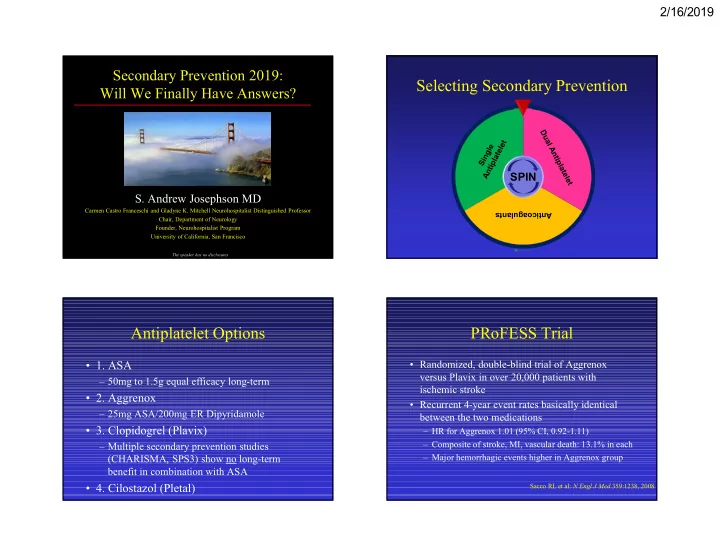
Selecting Secondary Prevention Will We Finally Have Answers? SPIN - - PowerPoint PPT Presentation

selecting secondary prevention
SMART_READER_LITE
LIVE PREVIEW

Selecting Secondary Prevention Will We Finally Have Answers? SPIN - - PowerPoint PPT Presentation

2/16/2019 Secondary Prevention 2019: Selecting Secondary Prevention Will We Finally Have Answers? SPIN S. Andrew Josephson MD Carmen Castro Franceschi and Gladyne K. Mitchell Neurohospitalist Distinguished Professor Anticoagulants Chair,


slide-1
SLIDE 1

2/16/2019 1

Secondary Prevention 2019: Will We Finally Have Answers?

  • S. Andrew Josephson MD

Carmen Castro Franceschi and Gladyne K. Mitchell Neurohospitalist Distinguished Professor Chair, Department of Neurology Founder, Neurohospitalist Program University of California, San Francisco

The speaker has no disclosures

tekhnologic

Anticoagulants

SPIN

Selecting Secondary Prevention Antiplatelet Options

  • 1. ASA

– 50mg to 1.5g equal efficacy long-term

  • 2. Aggrenox

– 25mg ASA/200mg ER Dipyridamole

  • 3. Clopidogrel (Plavix)

– Multiple secondary prevention studies (CHARISMA, SPS3) show no long-term benefit in combination with ASA

  • 4. Cilostazol (Pletal)

PRoFESS Trial

  • Randomized, double-blind trial of Aggrenox

versus Plavix in over 20,000 patients with ischemic stroke

  • Recurrent 4-year event rates basically identical

between the two medications

– HR for Aggrenox 1.01 (95% CI, 0.92-1.11) – Composite of stroke, MI, vascular death: 13.1% in each – Major hemorrhagic events higher in Aggrenox group

Sacco RL et al: N Engl J Med 359:1238, 2008

slide-2
SLIDE 2

2/16/2019 2

Law of Transitivity: Secondary Prevention

  • Aggrenox is better than ASA
  • Aggrenox and Clopidogrel are equal
  • Therefore, Clopidogrel is likely better

than ASA

Antiplatelet Options

  • If on no antiplatelet medication

– Plavix vs. Aggrenox (or ASA)

  • If already on ASA

– Switch to Plavix vs. Aggrenox

  • If already on Plavix or Aggrenox

– ???

Clopidogrel + ASA: Ever A Winning Combination?

  • POINT trial
  • Select those with only minor or no deficits

(NIHSS 3 or less or ABCD2 of 4 or more)

  • Nearly 5000 TIA or Minor Stroke patients

assigned to 90d of daily ASA + Placebo versus daily ASA + Clopidogrel following 600mg load

  • Modestly improved efficacy (1.5%)
  • Minimally (0.5%) more hemorrhage

Johnston SC et al: N Engl J Med 379:215, 2018

Dual Antiplatelets in TIA or Minor Stroke: How Long?

  • POINT was 90 days, CHANCE was 21 days
  • Most recurrent events in POINT were in the first

week and over 80% were in the first 30 days

  • Hemorrhagic risk was consistent and low

throughout and many were not ICH

  • Likely it is not necessary to expose patients to a

full 90 days of increased (small) hemorrhagic risk

Johnston SC et al: N Engl J Med 379:215, 2018

slide-3
SLIDE 3

2/16/2019 3

When we use Dual Antiplatelets

  • NOT all the time!
  • After minor stroke or TIA for only 21-30 days
  • After a fresh carotid or coronary stent
  • With severe intracranial atherosclerosis (>70%)

and stroke/TIA in that territory for only 90 days

  • Still completely unclear if there is a role for

platelet inhibition testing

Shrinking Indications for Anticoagulation in Stroke

  • 1. Atrial Fibrillation
  • 2. Some other cardioembolic sources

– Thrombus seen in heart – ?EF<35 – ?PFO with associated Atrial Septal Aneurysm

  • 3. Vertebral or Carotid dissection
  • 4. Rare hypercoagulable states: APLS

WARCEF 2012 CADISS 2015

Embolic Stroke of Undetermined Source (ESUS)

  • A useful construct for strokes that appear

embolic (allows us to stop saying “cryptogenic”)

  • 17 percent of all strokes

– More likely to be younger and minor symptoms

  • Recurrence 4.5% per year (mean f/u 2.7y) on

antiplatelet drugs

  • A nice target for studies of other secondary

prevention strategies

Hart RG et al: Stroke 48:867, 2017

Anticoagulate ESUS?

  • NAVIGATE-ESUS

– >7000 patients randomized to ASA or Rivaroxaban – No benefit in efficacy, increased bleeding with Xa

  • RE-SPECT ESUS

– >5000 patients randomized to ASA or dabigatran – No benefit in efficacy*, no increase in bleeding

  • ATTICUS

– Smaller trial with apixaban pending

Hart RG et al: N Engl J Med 378:2191, 2018

slide-4
SLIDE 4

2/16/2019 4

ESUS Subgroups that May Benefit?

  • Subclinical Afib

– Monitor, monitor and then monitor again

  • Atrial cardiopathy

– Afib does not generally occur in a healthy atrium – NAVIGATE ESUS subgroup – Trial pending

  • Unrecognized MI (ventricular cardiopathy)
  • PFO you don’t close

– NAVIGATE ESUS did not show a benefit but meta-analysis previously did

When Do We Use Anticoagulants?

  • Atrial Fibrillation/Flutter

– That’s about it (currently)!

  • Which anticoagulant to choose?

– Prefer DOACs but remember there are some contraindications (wt >100kg, CrCl<30) – Meta-analysis of DOAC trials

  • High dose rivaroxaban but not lower-dose or

apixaban had higher ICH risk than ASA

Huang W et al: JAMA Neurol 75:1511, 2018

What about Insulin Resistance?: IRIS Trial

Kernan WN et al: N Engl J Med 374:14, 2016

  • Nearly 4000 patients with recent TIA or

stroke were assigned to 15mg pioglitazone

  • r placebo for almost 5 years
  • Patients did not have diabetes but were

found to have insulin resistance

  • Primary outcome of stroke or MI

significantly reduced in the pioglitazone group (HR 0.71, P=0.007)

Insulin Resistance in 2017

  • The Problem: Nearly impossible to define

insulin resistance as they did in the trial

  • Take home:

– We don’t pay attention to insulin resistance – By modifying this risk factor we could make a reasonably big difference for our patients – We have no idea how to define this problem, but if we could, we now have guidance on how to help solve it

slide-5
SLIDE 5

2/16/2019 5

Insulin Resistance in 2019

  • Subgroup analysis of 2885 patients in IRIS

with “prediabetes” defined by ADA criteria

– HgbA1c 5.7-6.4% or fasting glucose 100-125 mg/dL

  • Primary outcomes were similar to entire

IRIS trial with hazard ratios of 0.57 (0.39- 0.84) for stroke/MI

  • Now we finally have a useful construct to

implement IRIS in daily practice

Spence JD et al: JAMA Neurol [Epub Ahead of Print], 2019