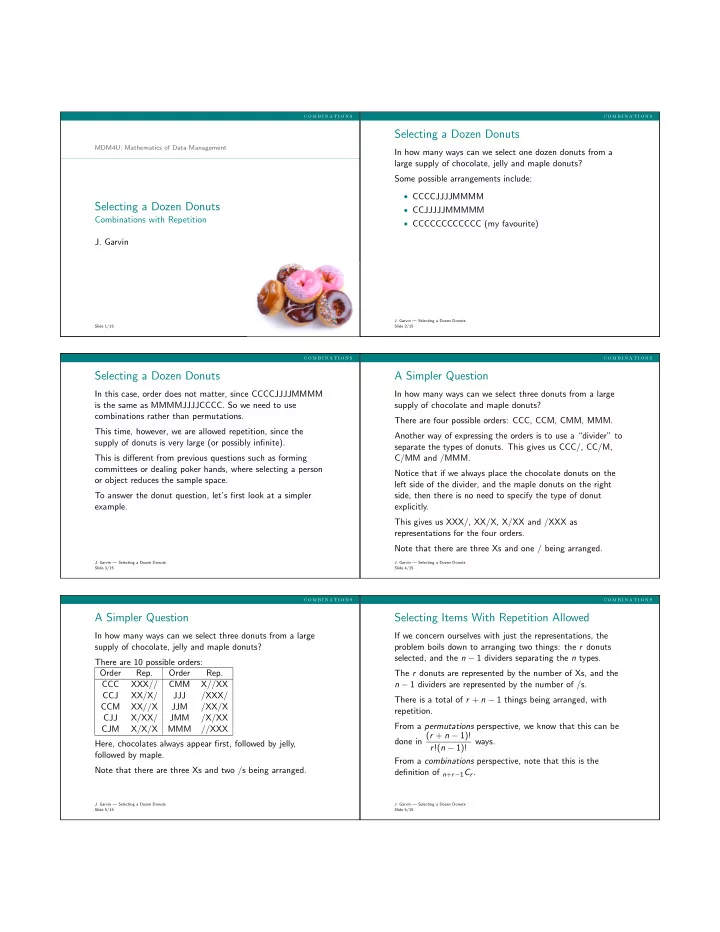

SLIDE 1
c o m b i n a t i o n s
MDM4U: Mathematics of Data Management
Selecting a Dozen Donuts
Combinations with Repetition
- J. Garvin
Slide 1/15
c o m b i n a t i o n s
Selecting a Dozen Donuts
In how many ways can we select one dozen donuts from a large supply of chocolate, jelly and maple donuts? Some possible arrangements include:
- CCCCJJJJMMMM
- CCJJJJJMMMMM
- CCCCCCCCCCCC (my favourite)
- J. Garvin — Selecting a Dozen Donuts
Slide 2/15
c o m b i n a t i o n s
Selecting a Dozen Donuts
In this case, order does not matter, since CCCCJJJJMMMM is the same as MMMMJJJJCCCC. So we need to use combinations rather than permutations. This time, however, we are allowed repetition, since the supply of donuts is very large (or possibly infinite). This is different from previous questions such as forming committees or dealing poker hands, where selecting a person
- r object reduces the sample space.
To answer the donut question, let’s first look at a simpler example.
- J. Garvin — Selecting a Dozen Donuts
Slide 3/15
c o m b i n a t i o n s
A Simpler Question
In how many ways can we select three donuts from a large supply of chocolate and maple donuts? There are four possible orders: CCC, CCM, CMM, MMM. Another way of expressing the orders is to use a “divider” to separate the types of donuts. This gives us CCC/, CC/M, C/MM and /MMM. Notice that if we always place the chocolate donuts on the left side of the divider, and the maple donuts on the right side, then there is no need to specify the type of donut explicitly. This gives us XXX/, XX/X, X/XX and /XXX as representations for the four orders. Note that there are three Xs and one / being arranged.
- J. Garvin — Selecting a Dozen Donuts
Slide 4/15
c o m b i n a t i o n s
A Simpler Question
In how many ways can we select three donuts from a large supply of chocolate, jelly and maple donuts? There are 10 possible orders: Order Rep. Order Rep. CCC XXX// CMM X//XX CCJ XX/X/ JJJ /XXX/ CCM XX//X JJM /XX/X CJJ X/XX/ JMM /X/XX CJM X/X/X MMM //XXX Here, chocolates always appear first, followed by jelly, followed by maple. Note that there are three Xs and two /s being arranged.
- J. Garvin — Selecting a Dozen Donuts
Slide 5/15
c o m b i n a t i o n s
Selecting Items With Repetition Allowed
If we concern ourselves with just the representations, the problem boils down to arranging two things: the r donuts selected, and the n − 1 dividers separating the n types. The r donuts are represented by the number of Xs, and the n − 1 dividers are represented by the number of /s. There is a total of r + n − 1 things being arranged, with repetition. From a permutations perspective, we know that this can be done in (r + n − 1)! r!(n − 1)! ways. From a combinations perspective, note that this is the definition of n+r−1Cr.
- J. Garvin — Selecting a Dozen Donuts
Slide 6/15