Secure Medicine Return & Pharmaceutical Stewardship Margaret - - PowerPoint PPT Presentation

secure medicine return amp pharmaceutical stewardship
SMART_READER_LITE
LIVE PREVIEW

Secure Medicine Return & Pharmaceutical Stewardship Margaret - - PowerPoint PPT Presentation

Secure Medicine Return & Pharmaceutical Stewardship Margaret Shield PhD Community Environmental Health Strategies About 1/3 of Medicines Sold to Households Go Unused For many reasons: Overprescribing. Overpurchasing. Patient


slide-1
SLIDE 1

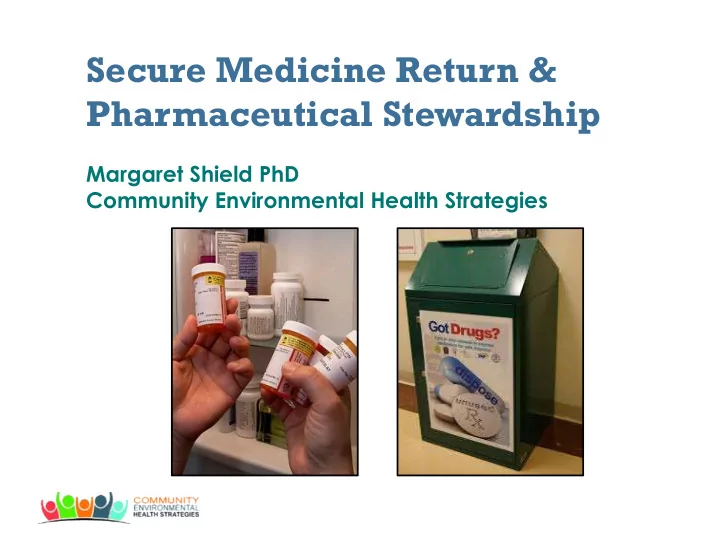
Secure Medicine Return & Pharmaceutical Stewardship

Margaret Shield PhD Community Environmental Health Strategies

slide-2
SLIDE 2

For many reasons:

  • Overprescribing.
  • Overpurchasing.
  • Patient doesn’t finish.
  • “Use As Needed” medicines

expire before used.

  • Changes in medications.
  • Lots of medicines during serious illness, and patient

recovers.

  • Lots of medicines, including strong pain relievers, for end-
  • f-life care.

About 1/3 of Medicines Sold to Households Go Unused

slide-3
SLIDE 3

Prevent Poisonings and Deaths

Leading cause of unintentional injury deaths Common cause of poisonings/ER visits, especially for kids and seniors

Secure Medicine Disposal Needed to Reduce Access to Medicines

Prevent Misuse & Addiction

73% of teens say it’s easy to get prescription drugs from parents’ medicine cabinets Many teens think prescription drugs are safer to use than street drugs

slide-4
SLIDE 4

National data: 45% of heroin users are also addicted to prescription

  • pioid painkillers.

Snohomish Health District WA data: Over half of people injecting heroin have also abused prescription drugs - Opioids or Amphetamines. 91% of those people abused the prescription drugs first.

Epidemic of Opioid & Heroin Abuse

Opioid Painkiller and Heroin Deaths; 1999-2013. Source: CDC

slide-5
SLIDE 5

 Educate health providers and the public  Expand prescription monitoring programs

  • Provide safe drug disposal – increase

return/take-back and disposal programs

 Focus on enforcement to address “pill mills”

and “doctor shopping”

Comprehensive Prevention Approach to Prescription Drug Abuse

from National Drug Control Strategy

slide-6
SLIDE 6

Secure Medicine Disposal Needed to Prevent Pollution

  • Improper disposal contributes to

pollution in waterways and water supplies.

  • Medicines are dangerous or

hazardous wastes.

  • No treatment by septic or

wastewater systems.

  • Trash cans are not secure.
  • FDA, DEA, EPA recommend

secure medicine take-back as better than trash disposal.

slide-7
SLIDE 7

FDA Drug Disposal Guidelines

  • Follow any specific disposal instructions on the
  • label. Do not flush medicines down the sink or

toilet unless this information specifically instructs you to do so.

  • Take advantage of programs that allow the

public to take unused drugs to a central location for proper disposal.

  • Transfer unused medicines to collectors registered

with the Drug Enforcement Administration (DEA). Authorized sites may be retail, hospital or clinic pharmacies, and law enforcement locations.

  • If no disposal instructions are given on the label

and no take-back program is available in your area, throw the drugs in the household trash following these steps:

1.Remove them from their original containers and mix them with an undesirable substance, such as used coffee grounds, dirt or kitty litter (this makes the drug less appealing to children and pets, and unrecognizable to people who may intentionally go through the trash seeking drugs). 2.Place the mixture in a sealable bag, empty can or

  • ther container to prevent the drug from leaking or

breaking out of a garbage bag.

FDA, DEA, EPA all recommend secure medicine take-back over trash disposal

slide-8
SLIDE 8

DEA Rule on Disposal of Controlled Substances, October 2014

And new options for transporting/shipping medicines to disposal facilities.

New Opportunities for More Convenient Take-Back

Allows Secure Collection Receptacles at:

Retail pharmacies

Hospitals with on-site pharmacies

Narcotic treatment centers

Long-term care facilities (partnered with a retail pharmacy)

and Law Enforcement Drop Boxes as previously allowed. Mail-back Programs Take-Back Events Run By Law Enforcement

slide-9
SLIDE 9

DEA Rule Defines Security Procedures & Authorized Entities

“Inner liner” boxes must have unique tracking number. Stored securely until transport. Boxes shipped or transported to final disposal via:

  • Reverse distributor.
  • Drug distributor.
  • Common carrier to a

Reverse Distributor or Distributor. DEA requires “non- retrievable” destruction, i.e. high temperature incineration. EPA recommended facilities. Secure collection receptacle bolted to countertop or floor. Two staff required to access medicines and seal “inner linter”.

slide-10
SLIDE 10

DEA Prescription Drug Take-back Events twice-a-year; spring/fall on Saturdays Ongoing Drop Boxes at Some Police/Sheriff Stations and Some Pharmacies

  • Not in all communities. Not coordinated system.
  • Law enforcement agencies still taking on most of burden.
  • More pharmacies becoming DEA authorized for take-back.
  • Walgreens drop boxes at 10 stores in WA (out of 134 stores).

Return Mailers

  • Limited availability.
  • Often sold for a fee.
  • Not all accept controlleds.

Current Medicine Take-back Options

slide-11
SLIDE 11

Convenient Pharmacies Collect More Medicines- San Francisco Pilot 2012-2015

slide-12
SLIDE 12

Voluntary medicine take-back programs are not adequate or sustainable.

  • nly capturing “tip of the iceberg”

No resources to expand collection sites to pharmacies and hospitals. No resources for program promotion. Staffing burden on law enforcement and local agencies. Unstable funding means programs have shut down. No capacity to collect more uncaptured drug waste.

12

slide-13
SLIDE 13

Drug manufacturers finance and operate medicine take-back programs in other countries. France since 1994. Canada in British Columbia since1998; now expanded to all provinces. Mexico launched in 2008. also Brazil, Columbia, Hungary, Spain.

Product Stewardship Approaches for Medicine Take-back

slide-14
SLIDE 14

Electronic Products Recycling (started 2009) Mercury Lights Recycling (started 2015)

Voluntary Rechargeable Battery Stewardship

WA Product Stewardship Laws

slide-15
SLIDE 15

15

Secure Medicine Return Regulations in 4 WA & 7 CA Counties

WA Ordinances enacted by local Boards of Health:  King County in 2013

  • Pop. ~ 2 million

 Snohomish County in 2016

  • Pop. ~ 800,000

 Kitsap County in 2016

  • Pop. ~ 258,000

 Pierce County in 2016

  • Pop. ~ 830,000

& several more counties beginning policy processes. WA Total Pop. ~ 7.2 million

slide-16
SLIDE 16

Every drug producer whose medicines are sold in or into the county must finance and provide a county-wide secure medicine return system.

  • Provide secure drop boxes in every pharmacy, hospital, and law

enforcement agency that volunteers to participate. Minimum number of drop boxes required in each city/town. Any gaps filled with collection events and prepaid return mailers. Also mailers available for homebound residents.

  • Accept prescription and over-the counter medicines from residential
  • sources. Not clinical or business wastes.
  • Promote program; annual reporting; public awareness surveys.
  • Utilize secure protocols for collection, handling, transportation of

drugs according to federal & state regulations and guidelines.

  • Dispose of drugs at hazardous waste facility. Or approval may be

granted for use of a WTE incinerator. Per EPA recommendation. Health District/Department provides oversight to ensure compliance and safety.

Overview of County Secure Medicine Return Regulations in WA

www.snohd.org/Waste/Medicine-Disposal/Pharmaceutical-Stewardship

slide-17
SLIDE 17

med-project.org

17

slide-18
SLIDE 18
  • Lawsuit slowed but did not

halt implementation.

  • Producers’ MED-Project

stewardship plan from ~ 370 manufacturers was accepted in March 2016.

  • Full program implementation,

January 2017.

  • Anticipate 90-100 drop-off

sites total.

kingcountysecuremedicinereturn.org MED-Project.org

slide-19
SLIDE 19

MED-Project Outreach to Potential Authorized Collectors in King County

See flyers for pharmacies, hospitals, clinics & law enforcement at kingcountysecuremedicinereturn.org

19

As of early Sept. 2016, contracts with 77 secure drop box sites: 38 retail pharmacies 22 hospitals/clinics 17 law enforcement 90-100 sites anticipated at

  • Jan. 2017 launch.
slide-20
SLIDE 20

County Pharmaceutical Stewardship Laws: Implementation Update

Timeline of Passage:

Delay Due to Unsuccessful Pharma Associations Lawsuit

DEA Rule Finalized

  • Oct. 2014
  • 3. San Francisco
  • 4. San Mateo
  • 5. Santa Clara
  • 6. Marin
  • 7. Santa Cruz
  • 8. Snohomish
  • 9. Santa

Barbara

2012 2013 2014 2015 2016

Producers’ Stewardship Plans accepted by Alameda, King, San Francisco, Santa Cruz, San Mateo counties. Alameda: > 20 collection events held; drop boxes being arranged. King: program to be fully launched January 17, 2017. Stewardship plans under review by Santa Clara. Stewardship plan due to Snohomish County in December 2016.

slide-21
SLIDE 21

~ 0.1% of annual medicine sales.

0.1% =1 penny for every $10 of medicine sales.

Or a few pennies per container of prescription or over- the-counter medicines sold.

Program costs estimates: ~ $1.2 million per year for Alameda County (pop. ~ 1.6 million) estimated by PhRMA and other trade associations in 2013. ~ $1 million per year for King County (pop. ~ 2 million) estimated by King County staff in 2013.

Estimated Cost to Medicine Producers for Pharmaceutical Stewardship

21

slide-22
SLIDE 22
  • Manufacturers are complying with county laws.
  • ~ 370 manufacturers have formed MED-Project stewardship
  • rganization.
  • Pharma Industry Associations are opposed to stewardship

legislation, saying:

– Patients should finish all their medicines. – Trash disposal (In-home disposal) is faster and easier. – Medicine take-back is not effective or is unworkable. – Financing take-back is not their responsibility.

  • Pharma Associations counterproposal = education about

trash disposal. MyOldMeds.com

Pharmaceutical Industry Response

slide-23
SLIDE 23

A WA State bill was first introduced in 2008. Coalition worked hard to pass from 2009 to 2012.

  • Rep. Strom Peterson (21st) plans to introduce new drug

take-back bill in 2017. Modeled on county laws.

WA State Pharmaceutical Stewardship Legislation: Not Passed, Yet

Drug companies should step up to disposal problems

  • Feb. 7, 2012
slide-24
SLIDE 24

Margaret Shield, PhD Community Environmental Health Strategies, LLC 206-499-5452 margaret.shield@CEHstrategies.com www.CEHstrategies.com

Secure Medicine Return & Pharmaceutical Stewardship

Questions?