Section 1.1: Percentages MATH 105: Contemporary Mathematics - - PDF document

section 1 1 percentages math 105 contemporary mathematics
SMART_READER_LITE
LIVE PREVIEW

Section 1.1: Percentages MATH 105: Contemporary Mathematics - - PDF document

Section 1.1: Percentages MATH 105: Contemporary Mathematics University of Louisville August 22, 2017 What are percentages? 2 / 24 Percentages in the everyday On a good day of encountering the world around you, percentages come up all the


slide-1
SLIDE 1

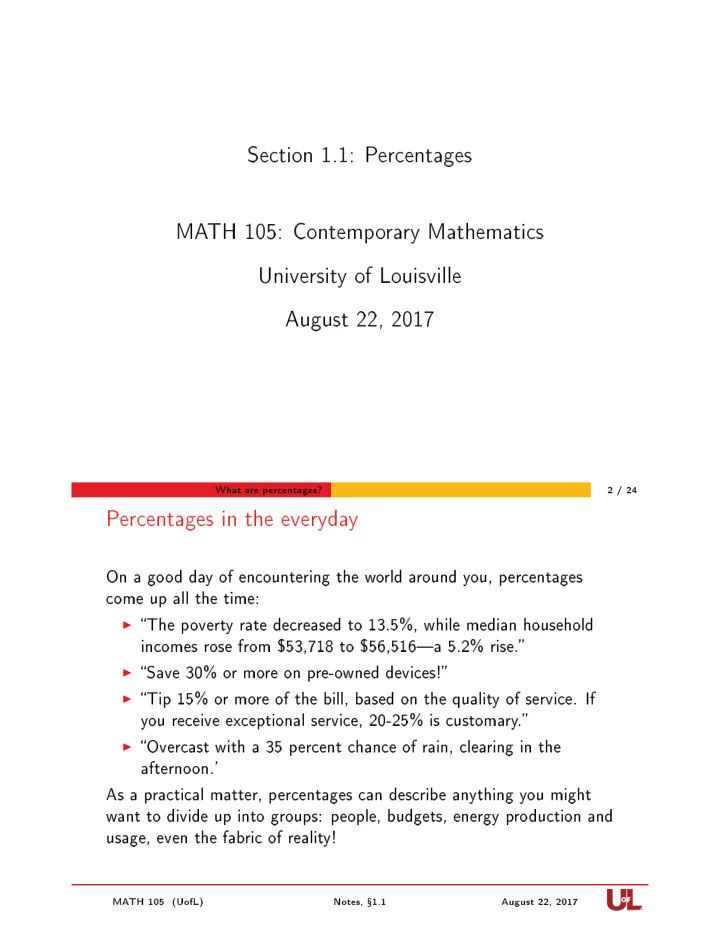
Section 1.1: Percentages MATH 105: Contemporary Mathematics University of Louisville August 22, 2017

What are percentages? 2 / 24

Percentages in the everyday

On a good day of encountering the world around you, percentages come up all the time:

▶ The poverty rate decreased to 13.5%, while median household

incomes rose from $53,718 to $56,516a 5.2% rise.

▶ Save 30% or more on pre-owned devices! ▶ Tip 15% or more of the bill, based on the quality of service. If

you receive exceptional service, 20-25% is customary.

▶ Overcast with a 35 percent chance of rain, clearing in the

afternoon.' As a practical matter, percentages can describe anything you might want to divide up into groups: people, budgets, energy production and usage, even the fabric of reality!

MATH 105 (UofL) Notes, 1.1 August 22, 2017

slide-2
SLIDE 2

What are percentages? 3 / 24

Three major types of percentages

▶ Parts of a whole

We use percentages to describe what portion of a whole belongs to a specic group.

  • How much of the US population is Native American? (1.2%)
  • What percentage of global power generation is nuclear? (10.6%)

▶ Quantity of a change

A percentage cen describe how something changes: either over time, or because of some adjustment.

  • Japan's population decreased by 0.8% from 2010 to 2015.
  • Brewing for 60 minutes, use an extra 20% water for evaporation.
  • Recently, the growth rate of the S&P 500 has been about 12%

per year.

▶ Likelihood of an event

A percentage can tell us how often something happens.

  • You roll 6 on a pair of dice about 14% of the time.
  • 30% of the numbers we encounter routinely start with a `1',

while only 5% start with a `9'.

MATH 105 (UofL) Notes, 1.1 August 22, 2017 Parts of a whole Calculating ratios 4 / 24

Parts as a percentage

The governing relationship between a part, a whole, and the ratio between them is ratio = part whole Using a calculator, the ratio is usually written as a decimal. Per cent literally means out of every hundred, so p% = p 100 Or in other words, if we have a decimal we want to write as a fraction, d = (100 × d)%

MATH 105 (UofL) Notes, 1.1 August 22, 2017

slide-3
SLIDE 3

Parts of a whole Calculating ratios 5 / 24

Calculating a part percentage: example

Kentucky demographics

As of the 2010 census, Kentucky had 4,339,367 people. 578,227 of them were 65 years old or older. What percentage is this? We calculate the ratio between the part of interest (age 65+) and the whole (entire population): 578227 4339367 ≈ 0.1332514627 Now, to get a percentage, we multiply by 100: 0.1332514627 × 100 ≈ 13.3 so about 13.3% of Kentucy's population is age 65 and up.

Time-saving tip

To multiply by 100, just shift the decimal point two places to the right.

MATH 105 (UofL) Notes, 1.1 August 22, 2017 Parts of a whole Other Calculations 6 / 24

Variations on part percentages

Recall that ratio = part whole. This relationship among three quantities could be written in other ways, to solve for dierent quantities: part = whole × ratio whole = part ratio These rephrasings allow you to solve dierent types of problems.

MATH 105 (UofL) Notes, 1.1 August 22, 2017

slide-4
SLIDE 4

Parts of a whole Other Calculations 7 / 24

Examples with ratios

Energy usage in the US

Total energy consumption in the US in 2016 was 28,500,000 GWh, of which 39% was electrical power. How much electrical power was consumed in the US? Note that here we know the whole (28.5 PWh total consumption) and the ratio (39%), but what we seek is the size of the part (electrical consumption). We calculate as follows: 39% = 39

100 = 0.39

28500000 × 0.39 = 11115000 so the US used about 11,115,000 GWh of electricity in 2016.

MATH 105 (UofL) Notes, 1.1 August 22, 2017 Parts of a whole Other Calculations 8 / 24

Examples with ratios, cont'd

Demographics of South Korea

A news story says that South Korea has about 12,000,000 Buddhists, making up 22.8% of the population. What is the approximate population of South Korea? In this case we know the part (12 million Buddhists) and the ratio (22.8%), and want to nd the whole (total population). We calculate as follows: 22.8% = 22.8

100 = 0.228

12000000 0.228 ≈ 52631579 so South Korea's population is about 52 million.

MATH 105 (UofL) Notes, 1.1 August 22, 2017

slide-5
SLIDE 5

Change as a Percentage 9 / 24

Describing Change

When we describe change, we can put it in either absolute or relative terms. For instance, the US population was 281,421,906 in 2000, and 308,745,538 in 2010. There are two dierent ways to describe what happened in those ten years: Absolute change The US population grew by 27,323,632 people. Relative change The US population grew by about 9.7%. Relative change is calculated when we treat the absolute change as a part of the original value: 27323632 281421906 ≈ 0.097 = 9.7%.

MATH 105 (UofL) Notes, 1.1 August 22, 2017 Change as a Percentage Calculating change percentages 10 / 24

Change calculations

How do we calculate relationships among absolute change, percentage change, original value, and modied value? absolute change = (modied value) − (original value) relative change = absolute change

  • riginal value

Or, to put it all in a single calcualation: relative change = (modied value) − (original value)

  • riginal value

MATH 105 (UofL) Notes, 1.1 August 22, 2017

slide-6
SLIDE 6

Change as a Percentage Calculating change percentages 11 / 24

Another way of looking at change

relative change = (modied value) − (original value)

  • riginal value

Using some arithmetic, we can rewrite this as: relative change = modied value

  • riginal value − 1

In other words, we can consider relative change to be theresult of thinking of the new value as a part of the original value's whole, and then subtracting 100%.

MATH 105 (UofL) Notes, 1.1 August 22, 2017 Change as a Percentage Calculating change percentages 12 / 24

Examples of change calculations

A year in the Dow Jones

The Dow Jones Industrial Average opened at 17,405 points in January 2016 and at 19,873 points in January 2017. What was its percentage change over 2016? absolute change = 19873 − 17405 = 2468 relative change = 2468 17405 ≈ 0.1418 so the DJIA grew 14.18% over 2016.

MATH 105 (UofL) Notes, 1.1 August 22, 2017

slide-7
SLIDE 7

Change as a Percentage Calculating change percentages 13 / 24

Same problem, dierent calculation

A year in the Dow Jones

The Dow Jones Industrial Average opened at 17,405 points in January 2016 and at 19,873 points in January 2017. What was its percentage change over 2016? ratio = 19873 17405 ≈ 1.1418 so over 2016, the DJIA grew to 114.18% of what it was. 100% of that was there to begin with, so 14.18% of that is how much it grew by.

MATH 105 (UofL) Notes, 1.1 August 22, 2017 Change as a Percentage Calculating change percentages 14 / 24

More change calculations

UofL enrollment number

UofL had 15,962 enrolled undergraduates in 201415, and 15,769 erolled undergraduates in 201516. What percentage change in enrollment occurred between these two years? absolute change = 15769 − 15962 = −193 relative change = −193 15962 ≈ −0.0121 so enrollment at UofL went down by 1.21%. Alternatively: 15769 15962 ≈ 0.9879 so enrollment became 98.79% of what it was, representing a decline of 1.21% (100%-98.79%).

MATH 105 (UofL) Notes, 1.1 August 22, 2017

slide-8
SLIDE 8

Change as a Percentage Calculating change percentages 15 / 24

Common changes to prices

Some specic terms are used to describe a change to the price of an item. Markup The relative increase in price between the wholesaleprice at which it is bought, and the retail price at which it is sold. Tax, tip, surcharge All of these are relative increases in cost, applied to the price. Markdown, discount Terminology for a relative decrease in price, due to a sale or repricing.

MATH 105 (UofL) Notes, 1.1 August 22, 2017 Change as a Percentage Calculating change percentages 16 / 24

Usage examples

Pricing of goods

A $140 smartphone is being sold, in a special deal, for $100. What is the discount rate? As before, we can perform either of two calculations: 100 − 140 140 ≈ −0.286 100 140 ≈ 0.714 The top gure directly tells us that the phone is discounted by 28.6%. The second instead tells us that the phone costs 71.4% of what it used to; note then that 100% − 71.4% = 28.6%.

MATH 105 (UofL) Notes, 1.1 August 22, 2017

slide-9
SLIDE 9

Change as a Percentage Calculating change percentages 17 / 24

Usage examples, continued

Pricing of goods

The bulk price of high-quality chocolate is about $3.50 per pound. The same chocolate is sold at retail for $12 per pound. What is the markup? We calculate either the markup directly or the ratio between the two prices: 12 − 3.50 3.50 ≈ 2.43 12 3.50 ≈ 3.43 The retail price is 343% of the wholesale price, but since 100% of that was already in the cost, the markup itself is only 243%.

MATH 105 (UofL) Notes, 1.1 August 22, 2017 Change as a Percentage Calculating other quantities from change percentage 18 / 24

Variant calculations

relative change = (modied value) − (original value)

  • riginal value

We can rearrange this formula to give ways to calculate the other quantities: modied value = original value + original value × relative change modied value = original value × (1 + relative change)

  • riginal value =

modied value 1 + relative change

MATH 105 (UofL) Notes, 1.1 August 22, 2017

slide-10
SLIDE 10

Change as a Percentage Calculating other quantities from change percentage 19 / 24

Examples of variant calculations

Applying tax

A garden ornament costs $13.50 and is subject to 6% tax. How much do you actually pay for it? We could calculate the tax separately, and add it in: $13.50 × 0.06 = $0.81 $13.50 + $0.81 = $14.31 Or, we could simply calculate the price-with-tax as 106% of the list price: $13.50 × 1.06 = $14.31 In either case, you will pay $14.31.

MATH 105 (UofL) Notes, 1.1 August 22, 2017 Change as a Percentage Calculating other quantities from change percentage 20 / 24

Examples of variant calculations, continued

Reversing a surcharge

You paid $47.24 in total for groceries which had a 8% delivery

  • surcharge. How much did the groceries themselves cost?

Here we know that $47.24 is 108% of the actual cost of the groceries, so we divide by 108% to get the original cost: $47.24 1.08 ≈ $43.74 So the groceries cost $43.74 (with a $3.50 delivery surcharge).

MATH 105 (UofL) Notes, 1.1 August 22, 2017

slide-11
SLIDE 11

Fun with Percentages A puzzle 21 / 24

A trick question

Markup and markdown

A shirt costs $5 to produce and is marked up by 20% for retail sale. It is then remaindered and discounted by 20%. What does it cost now? A typical and sensible answer is $5; this answer is incorrect! $5.00 × 1.20 = $6.00 (original retail price) $6.00 × 0.80 = $4.80 (discounted retail price) so the shirt is actually now being sold for $4.80.

MATH 105 (UofL) Notes, 1.1 August 22, 2017 Fun with Percentages Common statistical trickery 22 / 24

Two dierent looks at the same issue

A political scenario

The 2004 plan to partially privatize Social Security was variously described as reducing Social Security taxes by either 2% or 32%. Why the discrepancy? The proposal was going to reduce Social Security contribution from 6.2% of taxable income to 4.2%. This is clearly a dierence of 2 percentage points, i.e. how much the SS contribution is as a proportion of total income. On a hypothetical income of $50,000, the old proposal took $3,100; the new $2,100. $2,100 is about 67.7% of $3,100, so the new proposal would involve a 32.2% reduction in contribution size. In precise language: Social Security contribution was reduced by 32%,

  • r by 2 percentage points.

MATH 105 (UofL) Notes, 1.1 August 22, 2017

slide-12
SLIDE 12

Fun with Percentages Common statistical trickery 23 / 24

Percentages of a net change

Another political scenario

Women account for 92.3% of all jobs lost under Obama. Romney campaign, April 2012 That's an extraordinary claim! For each man who lost a job, did nearly 11 women really lose their job? Let's look at the job numbers.

  • Jan. '09
  • Mar. '12

Net loss Women only 66,122,000 65,439,000 683,000 Total 133,561,000 132,821,000 740,000 And 683000

740000 is in fact about 92.3%.

But is that the whole story?

MATH 105 (UofL) Notes, 1.1 August 22, 2017 Fun with Percentages Common statistical trickery 24 / 24

Percentages of a net change (continued)

Two factors explain that extraordinarily huge gender imbalance:

▶ Early, pre-2009 job loss hit male-dominated employment sectors. ▶ 20102012 job recovery also disproportionately occurred in

male-dominated sectors. To accentuate the absurdity, we could do the same calculation a mere month later, in February 2009:

  • Feb. '09
  • Mar. '12

Net loss Women only 65,923,000 65,439,000 484,000 Total 132,837,000 132,821,000 16,000 so in this time range, the share of job loss among women by the same calculation would be 484000

16000 = 3025%!

The Romney campaign didn't use that number, because instead of looking dramatic, it was merely absurd.

MATH 105 (UofL) Notes, 1.1 August 22, 2017