Secondary Corridor Empangeni Divisional Meeting of the ZCCI 22 - - PowerPoint PPT Presentation

secondary corridor
SMART_READER_LITE
LIVE PREVIEW

Secondary Corridor Empangeni Divisional Meeting of the ZCCI 22 - - PowerPoint PPT Presentation

Strategic Corridor Plan for the uMhlathuze-Ulundi-Vryheid Secondary Corridor Empangeni Divisional Meeting of the ZCCI 22 September 2016 Presented by Andrew Schultz The Spirit of the Emakhosini is a monument to the Zulu people. It comprises,


slide-1
SLIDE 1

Empangeni Divisional Meeting of the ZCCI – 22 September 2016

Presented by Andrew Schultz

Strategic Corridor Plan for the uMhlathuze-Ulundi-Vryheid Secondary Corridor

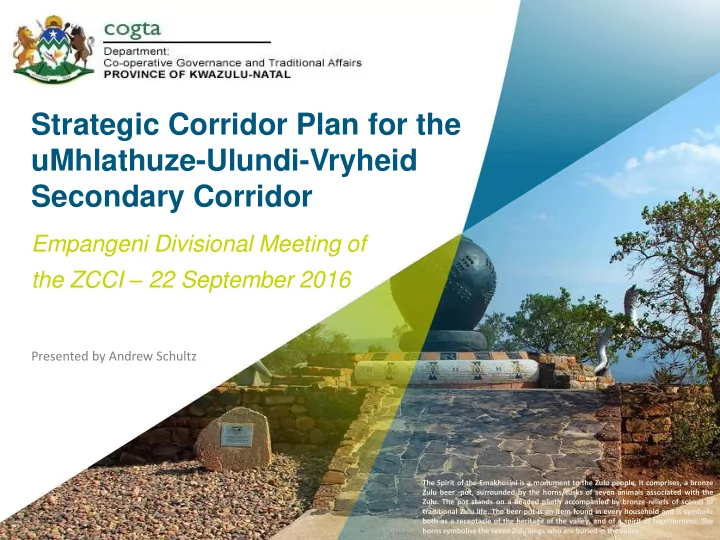
The Spirit of the Emakhosini is a monument to the Zulu people. It comprises, a bronze Zulu beer -pot, surrounded by the horns/tusks of seven animals associated with the

  • Zulu. The pot stands on a beaded plinth accompanied by bronze reliefs of scenes of

traditional Zulu life. The beer-pot is an item found in every household and is symbolic both as a receptacle of the heritage of the valley, and of a spirit of togetherness. The horns symbolise the seven Zulu kings who are buried in the valley.

slide-2
SLIDE 2

2

CONTENTS OF PRESENTATION

A. INTRODUCTION B. SITUATIONAL ANALYSIS & HIGH LEVEL STRATEGIC ASSESSMENT 1. POLICY CONTEXT AND VISION DIRECTIVES 2. SPATIAL CHALLENGES AND OPPORTUNITIES 3. SYNTHESIS C. SC1 REGIONAL SDF 1. VISION STATEMENT 2. SPATIAL CONCEPT 3. “PROTECT”, “CHANGE” AND “NEW” STRATEGIES

  • D. WAY FORWARD
slide-3
SLIDE 3
  • A. INTRODUCTION (1 OF 3)
  • 1. AIM & OBJECTIVES

3

The ‘SC1’ Regional SDF will establish a 25 year strategic framework The aim is to coordinate public sector resources to support the vision and create a framework for private investment that promotes economic growth and social well-being in an environmentally sustainable manner. The key objectives of the ‘SC1’ Regional SDF are to:

 Support value chain and logistics  Encourage investment growth and development  Coordinate infrastructure development  Guide land use and spatial planning.

slide-4
SLIDE 4
  • A. INTRODUCTION (2 OF 3)
  • 3. STUDY AREA AT COMMENCEMENT OF SITUATIONAL ANALYSIS

4

slide-5
SLIDE 5
  • A. INTRODUCTION (3 OF 3)
  • 2. PARTICIPATING MUNICIPLAITIES

5

uThungulu DM Zululand DM uMkhanyakhude DM uMhlathuze LM Ulundi LM Hlabisa LM uMlalazi LM Abaqulusi LM Mtubatuba LM Mthonjaneni LM Nongoma LM Ntambanana LM eDumbe LM uMfolozi LM

The SC1 Regional SDF extent, shaded in orange, will be the main focus of the study and focus for strategic planning interventions while the participating municipalities, shaded in grey, will be an influencer and be impacted upon by the SC1 Regional SDF.

slide-6
SLIDE 6

6

CONTENTS OF PRESENTATION

A. INTRODUCTION B. SITUATIONAL ANALYSIS & HIGH LEVEL STRATEGIC ASSESSMENT 1. POLICY CONTEXT AND VISION DIRECTIVES 2. SPATIAL CHALLENGES AND OPPORTUNITIES 3. SYNTHESIS C. SC1 REGIONAL SDF 1. VISION STATEMENT 2. SPATIAL CONCEPT 3. “PROTECT”, “CHANGE” AND “NEW” STRATEGIES

  • D. WAY FORWARD
slide-7
SLIDE 7
  • 1. POLICY CONTEXT & VISION DIRECTIVES (1 OF 12)

APPROACH

7

 Policy Context and Vision Directives  Theme based –

  • Biophysical
  • Socio-Economic
  • & Built Environment

 Scale for Legislative and Policy Framework –

  • International
  • National
  • Provincial
  • & Municipal
slide-8
SLIDE 8
  • 1. POLICY CONTEXT & VISION DIRECTIVES (2 OF 12)

PROCESS

8

Built Environment Analysis

Transport Spatial Planning Infrastructure

Biophysical Analysis Socio-Economic Analysis Key Policy Directives

slide-9
SLIDE 9

9

SPLUMA/NDP/NSDP/IUDF KZN PSEDS/PGDS/PGDP/PSDF Regional SDFs District GDPs, IDPs and SDFs Local IDPs and SDFs Local Area Plans and Precinct Plans Land Use Schemes

UUV SC1 Regional SDF

DRDLR Spatial Development Framework Guidelines KZN Provincial Human Settlements Master Spatial Plan SIP2 and N2 Strategic Corridor Plan District and Local Biodiversity Plans, LED Strategies, Transport Plans, etc. PRASA and Intersite Plans, Transnet Plans, DoT Plans, SANRAL Plans, etc.

  • 1. POLICY CONTEXT & VISION DIRECTIVES (3 OF 12)
slide-10
SLIDE 10
  • 1. POLICY CONTEXT & VISION DIRECTIVES (4 OF 12)

10

 Development Corridors:

  • Ermelo-Richards Bay Freight Corridor
  • Ermelo - Swaziland
  • Gauteng - Zimbabwe
  • Gauteng - Botswana
  • Mozambique - uMkhanyakhude

 NDP Schema

slide-11
SLIDE 11
  • 1. POLICY CONTEXT & VISION DIRECTIVES (5 OF 12)

11

slide-12
SLIDE 12
  • 1. POLICY CONTEXT & VISION DIRECTIVES (6 OF 12)

12

REGIONAL INDUSTRIAL DEVELOPMENT STRATEGY

slide-13
SLIDE 13
  • 1. POLICY CONTEXT & VISION DIRECTIVES (7 OF 12)

MPUMALANGA SDF

13

Ermelo N2 Bethal – N17 Standerton R23 Balfour Volksrust Piet Retief

slide-14
SLIDE 14
  • 1. POLICY CONTEXT & VISION DIRECTIVES (8 OF 12)

MPUMALANGA SDF

14

Ermelo N2 Bethal – N17

slide-15
SLIDE 15
  • 1. POLICY CONTEXT & VISION DIRECTIVES (9 OF 12)
  • 2. PROVINCIAL

15

KZN PGDS

Priority Intervention Areas

Nodes and Corridors

Primary (E)

Secondary (RB/E)

Tertiary (U, V, P, D)

Quaternary

RSC

Areas of Need

slide-16
SLIDE 16
  • 1. POLICY CONTEXT & VISION DIRECTIVES (10 OF 12)

MUNICIPAL – SPATIAL DEVELOPMENT FRAMEWORKS

16

Zululand District SDF uMkhanyakude SDF uThungulu District SDF

 Areas of need  Nodes and corridors  Urban and rural settlements  Economic activities and

  • pportunities

 Agricultural areas and land

potential

 Environmental areas

slide-17
SLIDE 17
  • 1. POLICY CONTEXT & VISION DIRECTIVES (11 OF 12)

R34

17

P700 R34 - Realignment R34 R66

slide-18
SLIDE 18

POLICY CONTEXT & VISION DIRECTIVES ( 12 OF 12)

ADJUSTED STUDY AREA

18

slide-19
SLIDE 19

19

CONTENTS OF PRESENTATION

A. INTRODUCTION B. SITUATIONAL ANALYSIS & HIGH LEVEL STRATEGIC ASSESSMENT 1. POLICY CONTEXT AND VISION DIRECTIVES 2. SPATIAL CHALLENGES AND OPPORTUNITIES 3. SYNTHESIS C. SC1 REGIONAL SDF 1. VISION STATEMENT 2. SPATIAL CONCEPT 3. “PROTECT”, “CHANGE” AND “NEW” STRATEGIES

  • D. WAY FORWARD
slide-20
SLIDE 20

20

  • 2. SPATIAL CHALLENGES AND OPPORTUNITIES (1 OF 10)

BIOPHYSICAL

Biophysical Key Challenges and Opportunities Short Term Issues (≤ 5 years)  Capacity is an issue throughout all the participating municipalities. There is a lack in human resources for environmental management and in turn, the municipality cannot address environmental issues faced by the municipality. Medium Term Issues (> 5 years and ≤ 15 years)  Water Management and water catchment management is a prevalent challenge, which refers to wetland degradation, surface and ground water contamination. This is mostly resultant from development in close vicinity to wetlands and water resources, over cultivation, communal grazing and poor agricultural practices.  Linked to the challenges around water management, is water provision. The country as a whole is facing drought conditions and water is scarce in the region. This results in numerous knock-on effects which will be most prominent in agriculture.  Soil erosion and degradation is also particularly problematic, arising from agricultural activities, no crop rotations, poor agricultural practices and communal grazing, as well as

  • ver utilization of soils.

 While urbanisation and urban sprawl is a recurring major challenge for the study area, as extracted from the relevant IDPs, it must be noted that the study area is predominantly

  • rural. Of greater relevance then, is rural sprawl or concentration in environmentally

sensitive areas. Where reference is made to urban sprawl, this is with regards to the few towns in Vryheid, and Ulundi, for example. The challenge here being that the increase in urbanisation is in many cases inadequately planned for, which in turn has a detrimental impact on the environment as there is a lack of land allocation, resulting in informal settlements near watercourses and wetlands.
slide-21
SLIDE 21
  • 2. POLICY CONTEXT & VISION DIRECTIVES ( 2 OF 10)

AGRICULTURAL LAND COVER

21

slide-22
SLIDE 22
  • 2. POLICY CONTEXT & VISION DIRECTIVES ( 3 OF 10)

EZEMVELO KZN WILDLIFE CORRIDORS

22

iSimangaliso Wetland Park W.H.S Ithala Um./Hl. Ophathe Ngoye Forest Reserve

slide-23
SLIDE 23
  • 2. POLICY CONTEXT & VISION DIRECTIVES ( 4 OF 10)

KEY SENSITIVITY AREAS

23

slide-24
SLIDE 24
  • 2. POLICY CONTEXT & VISION DIRECTIVES ( 5 OF 10)

TREAT WITH CAUTION AREAS

24

slide-25
SLIDE 25

25

  • 2. SPATIAL CHALLENGES AND OPPORTUNITIES (6 OF 10)

SOCIO-ECONOMIC

Socio-Economic Short Term Opportunities Short Term Challenges Short Term Issues (≤ 5 years)  P700 Road Linkage construction/upgrade  Agro-Processing incorporating Bio- Fuels  Industrial Regeneration  Small Town Regeneration  Hydo-Electricity (Jozini)  Climate change and prolonged periods

  • f drought

 Lack of adequate water supply  High levels of crime and risk  Poor supply of electricity in the District Medium Term Issues (> 5 years and ≤ 15 years)  Airport Development (Ulundi)  Eco, Battlefields and Cultural Heritage Tourism Routes  Makatini Flats Agriculture  Industrial Development Zone (IDZ)  Rural Waste Management Units  Infrastructure degradation and dilapidated state of roads  Low Levels of skills development and literacy  Poor spatial planning footprints showing two separate developments  Lack of coordination and working together of municipalities.

slide-26
SLIDE 26

26

  • 2. SPATIAL CHALLENGES AND OPPORTUNITIES (7 OF 10)

BUILT – SPATIAL PLANNING

Planning Key Challenges and Opportunities Challenges  Uncoordinated spatial development  Spatial fragmentation  Spatial structure and economic inequality  Programmatic service delivery approach and costs  Rapid and unmanaged urbanisation  Low densities and settlement sprawl  Weakly defined settlement hierarchy  Shortage of social and utility services  Integrated land use management challenges  Significant environmental resources  Constrained transport network  Limited infrastructure network capacity Opportunities  Improved co-ordination and alignment, including SC1 Regional SDF  Human settlement programmes and investments and potential to strengthen human settlement development  Rail and road infrastructure improvements, including P700  Improved connectivity and access to tourism facilities, urban services, agricultural distribution, etc.  Proposed Vryheid Airport and industrial development  Local agricultural production and small scale farmer opportunities

slide-27
SLIDE 27
  • 2. POLICY CONTEXT & VISION DIRECTIVES ( 8 OF 10)

LAND OWNERSHIP

27

slide-28
SLIDE 28

28

  • 2. SPATIAL CHALLENGES AND OPPORTUNITIES (9 OF 10)

BUILT – TRANSPORT

Transport Key Challenges and Opportunities Short Term Issues (≤ 5 years)  Updating of ITP’s in support of uMhlathuze-Ulundi-Vryheid Corridor  Upgrading of local public transport services  Municipal road maintenance, rehabilitation and upgrading  Development of new airport near Vryheid  Upgrading of the North Coast rail corridor and services between eThekwini and Richards Bay Medium Term Issues (> 5 years and ≤ 15 years)  Upgrading of R34 between Melmoth and Nkwalini  Development of the new Johannesburg to Durban High-Speed Rail Line,  Provision of regional rail lines – Richard’s Bay – Ulundi; Ulundi – Pongola; and Msunduzi – Ulundi  Upgrading of the Ermelo – Richards Bay line  Upgrading of the Swaziland line and development of new Swaziland line  Upgrading of Richard’s Bay port  Upgrading of Richards Bay Airport:  Upgrading of Ulundi Airport:  Upgrading of Mkuze Airport

slide-29
SLIDE 29

29

  • 2. SPATIAL CHALLENGES AND OPPORTUNITIES (10 OF 10)

BUILT – INFRASTRUCTURE

Infrastructure Key Challenges Key Opportunities Water and Sanitation  Severe drought conditions that result in depleted water sources.  Large disparities in levels of service and development between urban and rural areas.  Overall a few percentage of households have formal waste water disposal systems.  Lack of sufficient capacity to manage and operate water services infrastructure.  Operational and maintenance failures of the existing schemes.  Weaknesses in water conservation and demand management (WC/WDM).  High non-revenue water.  Extension of bulk water infrastructure

  • utwards from urban centres within the

SC1 Regional SDF corridor to provide sustainable support to social and economic growth in the corridor. Electricity  The population in the urban areas has access to household electricity, but few rural settlements have this service.  The electricity network in the southern portions of Zululand DM and some areas in uThungulu DM have very limited capacity.  The national energy crisis where inadequate power production led to nationwide load shedding, if it continues, has cost implications whereby capital and operating costs have to be incurred for standby generators.  The urban centres of Paulpietersburg, Vryheid, Ulundi, Melmoth and Empangeni have access to unconstrained bulk electricity supply.  Upgrading networks in areas identified as having constrained power supply. Solid Waste  Almost all the landfill sites within Zululand need upgrading in

  • rder to comply with the relevant legal requirements.

 There are a significantly high numbers of households in Zululand DM that use own refuse dumps (more than 50%).  Only 20% have access to a formal solid waste disposal system (urban areas).  Future investment in new and upgraded solid waste facilities.

slide-30
SLIDE 30

30

CONTENTS OF PRESENTATION

A. INTRODUCTION B. SITUATIONAL ANALYSIS & HIGH LEVEL STRATEGIC ASSESSMENT 1. POLICY CONTEXT AND VISION DIRECTIVES 2. SPATIAL CHALLENGES AND OPPORTUNITIES 3. SYNTHESIS C. SC1 REGIONAL SDF 1. VISION STATEMENT 2. SPATIAL CONCEPT 3. “PROTECT”, “CHANGE” AND “NEW” STRATEGIES

  • D. WAY FORWARD
slide-31
SLIDE 31
  • 3. SYNTHESIS (1 OF 4)

SPATIAL CONCEPTS

31

Develop Accessibility Framework

Define and Strengthen Settlement Hierarchy

Reinforce and Develop Activity Nodes and Corridors

Address Housing and Social Needs and Develop Integrated Human Settlements

Contain Urban and Rural Sprawl

Promote Quality Settlement Design

Protect Tourism, Agricultural, Heritage and Natural Assets

Develop Local Economic Opportunities

slide-32
SLIDE 32
  • 3. SYNTHESIS (2 OF 4)

CAPITAL INVESTMENT FRAMEWORK – DEVELOPMENT NODES

32

Hierarchy Definition Relationship to other classifications Nodes Identified Metro Node Significant urban centre with high existing economic growth and the potential for expansion thereof. Provides services to the provincial and regional economy and community needs. Second order nodes in KZN PSEDS/PGDS. Proposed metro node in uThungulu SDF. Richards Bay/ Empangeni Primary Node Urban centre with good economic development and the potential for growth. Provides services to the sub-regional and district economy and community needs. Third order nodes in KZN PSEDS/PGDS. First order nodes in district SDFs. Vryheid Ulundi Mtubatuba Secondary Node Centre with important service delivery and commercial functions within the district and local economies of their respective municipalities. Fourth order nodes in KZN PSEDS/PGDS. Second order nodes in district SDFs

  • r first order nodes in local SDFs.

Eshowe Melmoth Ntambanana Heatonville KwaMbonambi Nongoma Paulpietersburg/ eDumbe Hlabisa Tertiary Node Centre that provides basic government service delivery to the surrounding communities with limited commercial activities and little to no services sector. Not specifically identified in KZN PSEDS/PGDS. Third order nodes in district SDFs and/or secondary nodes in local SDFs. Identified in district and local SDFs. Quaternary Nodes Small rural centres that provide lower

  • rder services to surrounding rural

settlements. Not specifically identified in KZN PSEDS/PGDS or district SDFs. Third order nodes in local SDFs. Identified in local SDFs.

slide-33
SLIDE 33
  • 3. SYNTHESIS (3 OF 4)

SPATIAL CONCEPT DIAGRAM

33

slide-34
SLIDE 34
  • 3. SYNTHESIS (4 OF 4)

PILLARS OF THE VISION AND DRAFT VISION STATEMENT

34

To develop a sustainable regional corridor that reflects the people, heritage and landscape connected by the corridor and which supports an economically viable and diverse region and an improved quality of life for local communities through economic growth, job creation, urban and rural development, improved service delivery and the protection of the environment.

Diverse and Growing Economy Equitable Access to Services, Facilities and Amenities Sustainable Natural Environment Liveable Built Environment

slide-35
SLIDE 35

35

CONTENTS OF PRESENTATION

A. INTRODUCTION B. SITUATIONAL ANALYSIS & HIGH LEVEL STRATEGIC ASSESSMENT 1. POLICY CONTEXT AND VISION DIRECTIVES 2. SPATIAL CHALLENGES AND OPPORTUNITIES 3. SYNTHESIS C. SC1 REGIONAL SDF 1. VISION STATEMENT 2. SPATIAL CONCEPT 3. “PROTECT”, “CHANGE” AND “NEW” STRATEGIES

  • D. WAY FORWARD
slide-36
SLIDE 36
  • 3. SC1 REGIONAL SDF (1 OF 7)

VISION STATEMENT

36

Incorporating -

Feasible alternative access to Port from Gauteng with road improvements

Tourism: iSimangaliso Wetland Park (W.H.S.), Hluhluwe–Imfolozi Park, The eMakhosini - Ophathe Heritage Park and Ithala Game Reserve

Cultural Heritage: Zulu, Afrikaner and German, and Anglo-Zulu and Anglo- Boer War

National Strategic Water Resources, Pongola, Mfolozi, Mhlathuze Headwaters and Coastal Wetlands

Agriculture incl. Forestry

slide-37
SLIDE 37
  • 3. SC1 REGIONAL SDF (2 OF 7)

SPATIAL CONCEPT

37

slide-38
SLIDE 38
  • 3. SC1 REGIONAL SDF (3 OF 7)

“PROTECT”, “CHANGE” AND “NEW” STRATEGIES: ENVIRONMENT

38

slide-39
SLIDE 39
  • 3. SC1 REGIONAL SDF (4 OF 7)

“PROTECT”, “CHANGE” AND “NEW” STRATEGIES: SOCIO-ECON.

39

slide-40
SLIDE 40
  • 3. SC1 REGIONAL SDF (5 OF 7)

“PROTECT”, “CHANGE” AND “NEW” STRATEGIES: PLANNING

40

slide-41
SLIDE 41
  • 3. SC1 REGIONAL SDF (6 OF 7)

“PROTECT”, “CHANGE” AND “NEW” STRATEGIES: TRANSPORT

41

slide-42
SLIDE 42
  • 3. SC1 REGIONAL SDF (7 OF 7)

“PROTECT”, “CHANGE” AND “NEW” STRATEGIES: INFRASTRUCTURE

42

slide-43
SLIDE 43

43

CONTENTS OF PRESENTATION

A. INTRODUCTION B. SITUATIONAL ANALYSIS & HIGH LEVEL STRATEGIC ASSESSMENT 1. POLICY CONTEXT AND VISION DIRECTIVES 2. SPATIAL CHALLENGES AND OPPORTUNITIES 3. SYNTHESIS C. SC1 REGIONAL SDF 1. VISION STATEMENT 2. SPATIAL CONCEPT 3. “PROTECT”, “CHANGE” AND “NEW” STRATEGIES

  • D. WAY FORWARD
slide-44
SLIDE 44
  • C. WAY FORWARD
  • 1. KEY MILESTONE DATES (1 OF 2)

44

Deliverable 1: Inception Report 21 April 2016 Deliverable 2: Situational Analysis & High Level Strategic Assessment 15 July 2016 Deliverable 3: Strategic Corridor Development Plan 1 November 2016 Deliverable 4: Focus Area Plans 11 May 2016 Deliverable 5: Implementation Plan 28 June 2016 Deliverable 6: Close Out Report 24 July 2016

slide-45
SLIDE 45
  • C. WAY FORWARD
  • 1. KEY MILESTONE DATES (2 OF 2)

45

PHASE / TASK / ACTIVITY START DATE END DATE DURATION (WORK DAYS) KEY MILESTONE DATE Situational Analysis & High Level Strategic Assessment Preparation for & Stakeholder Workshop (1 day Workshop) 24-Jun-16 28-Jun-16 3 28-Jun-16 Draft Report circulated to PSC/Stakeholders. Comments to be submitted by: 29-Jun-16 05-Jul-16 5 05-Jul-16 Finalise Draft Report & circulate to KZN CoGTA / PSC by: 06-Jul-16 12-Jul-16 5 12-Jul-16 Preparation for & Presentation of Milestone 2 to the PSC for Ratification 13-Jul-16 15-Jul-16 3 15-Jul-16 PHASE 2 Strategic Corridor Development Plan Preparation of Strategic Corridor Development Plan & accompanying text 14-Jul-16 11-Sep-16 40 11-Sep-16 Compilation of Draft Report & circulate to KZN CoGTA for review by: 12-Sep-16 24-Sep-16 10 24-Sep-16 KZN CoGTA reviews Draft Report 25-Sep-16 02-Oct-16 5 02-Oct-16 Project Meeting with KZN CoGTA 03-Oct-16 03-Oct-16 1 03-Oct-16 Revise Draft Report if necessary 04-Oct-16 10-Oct-16 5 10-Oct-16 Preparation for & Stakeholder Workshop (1 day Workshop) 11-Oct-16 13-Oct-16 3 13-Oct-16 Draft Report circulated to PSC/Stakeholders. Comments to be submitted by: 14-Oct-16 20-Oct-16 5 20-Oct-16 Finalise Draft Report & circulate to KZN CoGTA / PSC by: 21-Oct-16 27-Oct-16 5 27-Oct-16 Preparation for & Presentation of Milestone 3 to the PSC for Ratification 28-Oct-16 01-Nov-16 3 01-Nov-16 Detailed Strategic Development Plans for Identified Nodes & Areas within the Primary Study Area