Searching for Radio Pulsars in Unidentified Fermi-LAT Bright - - PowerPoint PPT Presentation

searching for radio pulsars in unidentified fermi lat
SMART_READER_LITE
LIVE PREVIEW

Searching for Radio Pulsars in Unidentified Fermi-LAT Bright - - PowerPoint PPT Presentation

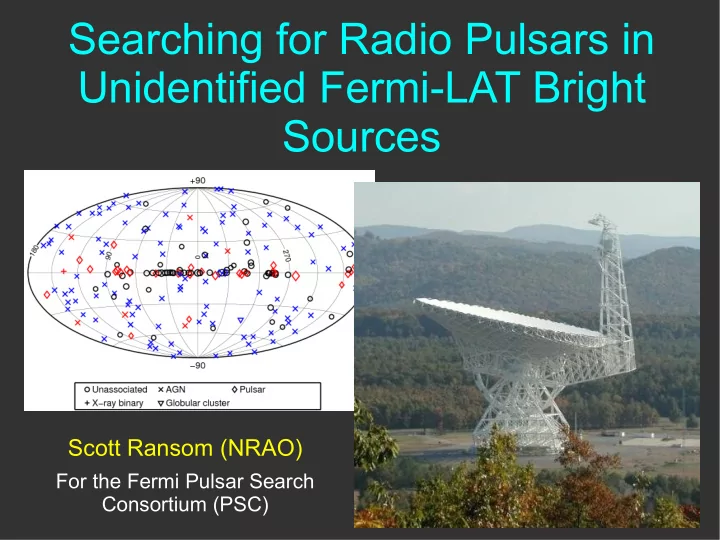
Searching for Radio Pulsars in Unidentified Fermi-LAT Bright Sources Scott Ransom (NRAO) For the Fermi Pulsar Search Consortium (PSC) Fermi Bright Source List Abdo et al, 2009, ApJS, 183, 46 205 sources after 3 months at >10

slide-1
SLIDE 1

Searching for Radio Pulsars in Unidentified Fermi-LAT Bright Sources

Scott Ransom (NRAO)

For the Fermi Pulsar Search Consortium (PSC)

slide-2
SLIDE 2

Fermi Bright Source List

  • 205 sources after 3

months at >10σ

  • Many with

associations

  • Many new pulsars
  • Many without

associations might be new pulsars

  • Blind searching in γ-

rays is getting much harder...

Abdo et al, 2009, ApJS, 183, 46

slide-3
SLIDE 3

Why search for pulsars?

  • Radio and γ-rays come

from different parts of magnetosphere

  • Constrain emission
  • See work by Romani,

Harding, Gonthier, etc

  • Dispersion Measure

gives a distance

  • Radio timing typically

much more accurate

  • Some pulsars we can't

find in γ-rays

Searches for γ-ray PSRs in EGRET srcs were not very successful. Exceptions: PSR J2229+6114 (Halpern et al 2001) PSR J2021+3651 (Roberts et al 2002)

slide-4
SLIDE 4

Which BSL Sources?

  • Chose 27 sources:
  • No associations
  • Not flagged as variable
  • Not already deeply

searched in radio

  • Dec > -40deg
  • 8 sources at high

galactic latitude

  • 30 hrs of GBT time
  • Used 9-month posns
  • Obs finished 2 wks ago

95% conf. regions well- matched to 820MHz GBT beam, 15' in diameter

100-m Green Bank Telescope

slide-5
SLIDE 5

Observations and Data Analysis

  • Each src obs ~1 hour
  • GBT+GUPPI @ 820MHz
  • 2048 freq channels
  • 61μs sampling
  • 200MHz of bandwidth
  • ~110 GB / src
  • ~3 TB total
  • Compute Intensive
  • Search over Dispersion Measure, frequency, and

potential orbital (linear) acceleration

  • Requires ~2 days on 50 CPUs per source
slide-6
SLIDE 6

Results so far....

  • 9 sources have been searched fully
slide-7
SLIDE 7

Results so far....

  • 9 sources have been searched fully
  • 5 of them are in the Galactic plane and nothing

was seen

slide-8
SLIDE 8

Results so far....

  • 9 sources have been searched fully
  • 5 of them are in the Galactic plane and nothing

was seen

  • 4 are high-Galactic latitude sources..
  • 0FGL J1311.9-3419 had nothing
slide-9
SLIDE 9

Results so far....

  • 9 sources have been searched fully
  • 5 of them are in the Galactic plane and nothing

was seen

  • 4 are high-Galactic latitude sources..
  • 0FGL J1311.9-3419 had nothing
  • 0FGLs J2214.8+3002, J1231.5-1410, and J0614.3-

3330 each have bright binary millisecond pulsars!

slide-10
SLIDE 10

0FGL J2214.8+3002 is PSR J2214+30

3.12 ms spin 10 hr orbit 13 Mjup min companion ~1.5 kpc (DM) X-ray point sources... Very bright Scintillation Arecibo visible! “Black-Widow”, NANOGrav MSP?

slide-11
SLIDE 11

3.12 ms spin 10 hr orbit 13 Mjup min companion ~1.5 kpc (DM) X-ray point sources... Very bright Scintillation Arecibo visible!

Chandra ACIS

0FGL J2214.8+3002 is PSR J2214+30

slide-12
SLIDE 12

0FGL J1231.5-1410 is PSR J1231-14

3.68 ms spin 1.86 day orbit 0.2 Msun min companion ~400 pc (DM) Good X-ray point source... (thanks to Michael Wolff) “Normal” Binary MSP (and close)

slide-13
SLIDE 13

3.68 ms spin 1.86 day orbit 0.2 Msun min companion ~400 pc (DM) Good X-ray point source... (thanks to Michael Wolff)

XMM-Newton (MOS)

0FGL J1231.5-1410 is PSR J1231-14

slide-14
SLIDE 14

0FGL J0614.3-3330 is PSR J0614-33

Unknown Binary MSP 3.15 ms spin unknown orbit ~2 kpc (DM) X-ray point sources... Very bright Scintillation

slide-15
SLIDE 15

3.15 ms spin unknown orbit ~2 kpc (DM) X-ray point sources... Very bright Scintillation

Swift XRT

0FGL J0614.3-3330 is PSR J0614-33

slide-16
SLIDE 16

Conclusions

  • 3 out of 4 high-Galactic latitude sources searched so far

have bright radio MSPs!

  • No γ-ray pulsations yet...(timing required)
  • A new way to find such valuable systems:
  • Basic physics tests (e.g. NS EoS)
  • Gravitational wave detection (e.g. NANOGrav)
  • Still 18 more sources to search (4 high-lat)
  • Many more in Mallory Robert's 350MHz survey and other

searches at Parkes, Arecibo and Effelsberg

  • γ-ray and radio luminosities of MSPs uncorrelated(?)
  • γ-ray and radio both likely have wide fan-beams