Screening-level Assessment of Uncapped Landfills in the Pinelands - - PowerPoint PPT Presentation

screening level assessment of uncapped landfills in the
SMART_READER_LITE
LIVE PREVIEW

Screening-level Assessment of Uncapped Landfills in the Pinelands - - PowerPoint PPT Presentation

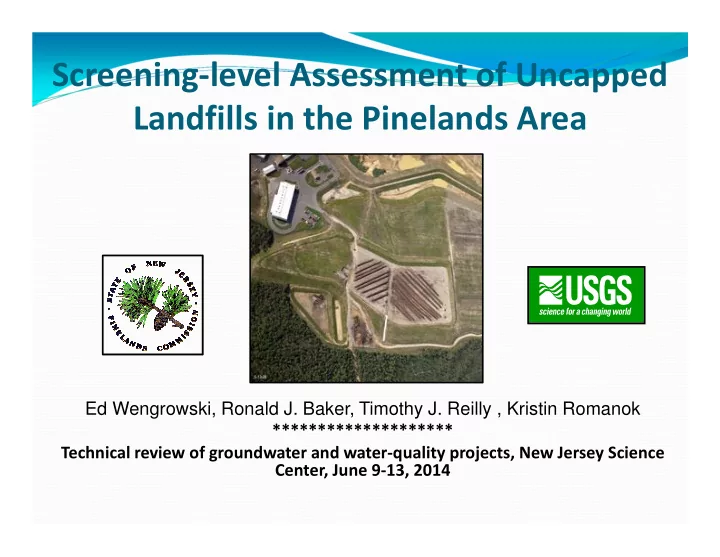
Screening-level Assessment of Uncapped Landfills in the Pinelands Area Ed Wengrowski, Ronald J. Baker, Timothy J. Reilly , Kristin Romanok ******************** Technical review of groundwater and water-quality projects, New Jersey Science


slide-1
SLIDE 1

Screening-level Assessment of Uncapped Landfills in the Pinelands Area

Ed Wengrowski, Ronald J. Baker, Timothy J. Reilly , Kristin Romanok ******************** Technical review of groundwater and water-quality projects, New Jersey Science Center, June 9-13, 2014

slide-2
SLIDE 2

Project Background

  • Purpose: There are at least 60

closed, uncapped landfills in the New Jersey Pinelands. The question posed by the Pinelands Commission was “Which of these pose environmental or health concerns, based on down- gradient water quality? Which need more monitoring or remediation before redevelopment?”

  • Study area: The New Jersey

Pinelands Reserve

slide-3
SLIDE 3

Landfill Selection Criteria

Within the New Jersey Pinelands Area Not solely vegetation or construction waste Permitted by NJDEP Ceased Operation after 9/23/1980 (if in

Preservation Area after 1/14/81)

No current Remediation effort underway 48 landfills meet these criteria

30 of those had monitoring well data

slide-4
SLIDE 4

Project objectives

Develop a screening tool for assigning levels of

concern for closed, uncapped landfills

Based on a simplified a solute-transport model Uses monitoring-well data, hydraulic parameters, contaminant

chemical properties, and distances from the landfill to receptors (water, wetlands, urban areas) t0 landfills

Level of concern is based on steady-state concentrations of

contaminants at receptors relative to regulatory concentrations

Apply screening tool to landfills in the New Jersey Pinelands Assemble and quality-assure water-quality data Assemble hydrologic, landfill, contaminant reactivity and

  • ther data

Predict contaminant concentrations reaching receptors

slide-5
SLIDE 5

Sources of Information

Well Permits, Well Records, Drillers’ Logs Monitoring Well Lab Results Permit Applications and Site descriptions GIS data (NJDEP and USGS) State and Federal Water-Quality Standards Published chemical property data for

contaminants

Solute transport model developed by PA DEP

(Quick Domenico)

slide-6
SLIDE 6

QA of water-quality data

Monitoring-well data were received as paper files from

NJDEP

Data were manually digitized by USGS 10%-100% of entries were checked for errors

Original data-entry errors by NJDEP Transcription errors by USGS Error rate was low, typically >>1%

An Access database was populated with water-quality and

all other relevant data

Additional quality checking was conducted whenever data

were accessed

Data acquisition, managing and QA was a major effort

in this investigation

slide-7
SLIDE 7

Domenico approach to groundwater-transport model

Based on widely used transport equations Supported by the USEPA.

USEPS Center for Subsurface Modeling Support

BIOSCREEN, BIOCHLOR, FOOTPRINT, and

REMChlor

Spreadsheet version developed by PA DEP

“Quick Domenico”

Estimates contaminant concentration

downgradient from a source

slide-8
SLIDE 8

Generic solute transport equation and Dominico transport model

Generic model of three-dimensional (3D) non-steady-state solute transport of a dissolved solute through porous media Domenico solute transport model. Important point: this equation can be Solved algebraically, e.g. on a spreadsheet

slide-9
SLIDE 9

Receptors were defined as:

Nearest stream to landfill Nearest wetlands to landfill Nearest residential area to landfill

slide-10
SLIDE 10

Wetlands 1000 ft residential buffer 500 ft residential buffer

Geographical Information System (GIS) Map showing a Landfill in the Pinelands and Receptors

Landfill

slide-11
SLIDE 11

Quick Domenico model spreadsheet

Limitations: Only one scenario per worksheet, no provision for archiving scenarios, several input parameters could be calculated automatically (dispersivities, time to steady-state), graphics of limited value

slide-12
SLIDE 12
  • !"

!" !" !"

##$

%

slide-13
SLIDE 13

Quick Domenico Multi-scenario (QDM)

Project: Password: Date: 5/23/2014 Prepared by: Simulation Steady-State Concentraton (ug/L) 254.13 Number: Regulatory Value (ug/L) 320.00 79.42 Source Time to reach ConcentratAx Ay Az Lambda Width Thickness Steady State (µg/L) (ft) (ft) (ft) >=.001 day-1 (ft) (ft) (days) x(ft) y(ft) z(ft) 500.000 15.44 1.54 0.001 0.001266 868 10 1319 757 Hydraulic Hydraulic Soil Bulk Fraction ConductivitGradient Porosity Density KOC Organic Retardation Velocity Peclet (ft/day) (ft/ft) (dec. frac.) (g/cm3) (dec. frac.) Carbon (dec. frac.) (ft/day) Length (ft) Width (ft) Number 50 0.01 0.358 1.7 0.0 0.001 1.00 1.40 1136 868 68 Lateral 113.55 227.1 340.65 454.2 567.75 681.3 794.85 908.4 1021.95 1135.5 Distance (ft 868 0.000 0.000 0.000 0.000 0.000 0.000 0.000 0.000 0.000 0.000 434 225.868 204.065 184.37 166.57 150.49 135.96 122.84 110.98 100.26 90.52 451.735 408.129 368.73 333.14 300.98 271.93 245.68 221.96 200.51 181.04

  • 434

225.868 204.065 184.37 166.57 150.49 135.96 122.84 110.98 100.26 90.52

  • 868

0.000 0.000 0.000 0.000 0.000 0.000 0.000 0.000 0.000 0.000 Optional Field Data for model calibration: enter centerline concentrations from well sample data and distances from source to receptor Concentra Distance (ft

Quick Domenico Multi-scenario (QDM) Spreadsheet

South Toms River RJB

  • ------------------------------------------------------------Concentration of Contaminant-------------------------------------------------------------

7 Contaminant: rogen, Nitrate, Disso Receptor: Stream Percent of Regulatory Value Dispersivity Receptor Distance from Source Model Domain Simulated Concentrations Downgradient from Source

  • ---------------------------------------------------------------Distance from source--------------------------------------------------------------------------

0.0 50.0 100.0 150.0 200.0 250.0 300.0 350.0 400.0 450.0 500.0 200 400 600 800 1000 1200 Concentraton (µg/L) Distance (feet)

Contaminant Concentrations at Plume Centerline

Plume Center Line steady-state concentration at receptor

A simulation (from numbers 1-50 is selected, and all parameters and results for that simulation are shown in the spreadsheet. Results as a percent of a regulatory value also are shown.
slide-14
SLIDE 14

QDM: User-input parameters

Source Decay constant Source Source Hydraulic Hydraulic Soil Bulk Fraction

Regulatory

Simulation Concentration Lambda Width Thickness Conductivity Gradient Porosity Density KOC Organic Value Number Receptor Contaminant (ug/L) (days-1) (ft) (ft) (ft/day) (ft/ft) (dimensionless) (g/cm3) Carbon x(ft) y(ft) z(ft) (ug/L) 1 Stream Chloride 40666.7 868 10 50 0.010 0.358 1.70 0.0 0.001 757 0 230000.00 2 Wetlands and Hydric SoiChloride 40666.7 868 10 50 0.010 0.358 1.70 0.0 0.001 7 0 230000.00 3 Residential Chloride 40666.7 868 10 50 0.010 0.358 1.70 0.0 0.001 250 0 250000.00 4 Stream Nitrogen, Ammo 17100.0 0.1 868 10 50 0.010 0.358 1.70 3.1 0.001 757 200.00 5 Wetlands and Hydric SoiNitrogen, Ammo 17100.0 0.1 868 10 50 0.010 0.358 1.70 3.1 0.001 7 200.00 6 Residential Nitrogen, Ammo 17100.0 0.1 868 10 50 0.010 0.358 1.70 3.1 0.001 250 3000.00 7 Stream Nitrogen, Nitrate 500.0 0.001265753 868 10 50 0.010 0.358 1.70 0.0 0.001 757 320.00 8 Wetlands and Hydric SoiNitrogen, Nitrate 500.0 0.001265753 868 10 50 0.010 0.358 1.70 0.0 0.001 7 320.00 9 Residential Nitrogen, Nitrate 500.0 0.001265753 868 10 50 0.010 0.358 1.70 0.0 0.001 250 10000.00 10 11 12 13 14 15 16 17 18 19 20 ←−Distance to Receptor−→

  • Up to 50 scenarios are entered and archived per landfill
  • Regulatory values are input
slide-15
SLIDE 15

QDM: Automatically-calculated input parameters

  • Conc. At

% of Simulation Ax Ay Az Time Time Model Model Steady Velocity Regulatory Number (ft) (ft) (ft) (days) (years) Length (ft) Width (ft) State (V) Value 1 15.44 1.5 0.001 1355 3.7 1136 868 1.40 2 0.00 0.0 0.001 13 0.0 11 868 1.40 3 8.13 0.8 0.001 448 1.2 375 868 1.40 4 15.44 1.5 0.001 587 1.6 1136 868 1.38 5 0.00 0.0 0.001 13 0.0 11 868 1.38 6 8.13 0.8 0.001 248 0.7 375 868 1.38 7 15.44 1.5 0.001 1319 3.6 1136 868 254.13 1.40 79.4 8 0.00 0.0 0.001 13 0.0 11 868 1.40 9 8.13 0.8 0.001 441 1.2 375 868 1.40 10 11 12 13 14 15 16 17 18 19 20 ←−−Dispersivity−−→ ←Simula;on Time→

  • Dispersivities, time to steady-state and model dimensions are calcualted
  • Contaminant concentration and % 0f regulatory value are calcualted for the

selected simulation number (in this case 7).

slide-16
SLIDE 16

Applying QDM to Pinelands landfills

Identify distance from landfill to nearest

receptors:

Stream Wetlands Residential

Simulate concentration of Cl- at each

receptor:

Most conservative, “worst case” scenario

Select other contaminants to be simulated

Based on concentration and detection frequency

slide-17
SLIDE 17

Criteria for Selecting contaminants to simulate

Frequently detected High concentration relative to regulatory

standards

Informed judgment

slide-18
SLIDE 18

Concentrations of contaminants used in models

Highest average daily concentration among

all monitoring wells samples

Contaminants analyzed for but not detected

are assigned the detection limit

  • e. g. if benzene is not detected in a well-water

sample, but the detection limit is 0.1 ppb, benzene concentration for that well is assigned as 0.1 ppb.

slide-19
SLIDE 19

Assessing Vulnerability of Groundwater to Contaminants of Concern (COCs) from Landfills

Level of Concern = Unknown

Data are insufficient to characterize the presence of COCs.

Level of Concern = Low

COCs do not reach receptors at concentrations greater than the

Practical Quantitation Limit (PQL).

Level of Concern = Moderate

COCs reach receptors at concentrations greater than the PQL but

less than 50% of any relevant regulatory standard.

Level of Concern = High

COCs reach receptors, which may be coincident with the landfill, at

concentrations greater than or equal to 50% of one or more relevant regulatory standards.

slide-20
SLIDE 20

Vulnerability assessment

Chloride Ammonia as N Nitrate as N Total P Stream High (A), but not a COC Low High (A) Low Wetland or Hydric Soil High (A), but not a COC High (A) High (A) Low Residential High (A), but not a COC Low Moderate Low

Level of Concern Meets criteria?

Unknown No Low Yes (non- nutrients) Moderate No High (A) Yes (nutrients) High (B) No

Domenico simulation indicates that the level of concern for this landfill is of low for non-nutrients and high for nutrients.

Level of Concern for Specific Analytes and Receptors

Organics and Inorganics Excluding Nutrients Nutrients Summary of Domenico Results: Level of Concern (Excluding Nutrients) Criteria

Data are insufficient to characterize the presence of COCs. COCs do not reach receptors at concentrations greater than the practical quantitation limit (PQ). COCs reach receptors at concentrations greater than the PQL but less than 50% of any relevant regulatory standard. COCs reach receptors at concentrations greater than or equal to 50% of

  • ne or more relevant regulatory standards.

Receptor coincides with landfill location, where COC concentration is greater than or equal to 50% of one or more relevant regulatory standards

slide-21
SLIDE 21

Summary of Model Results: Number of Landfills for Each Level of Concern

*******************************************************************************************************

Unknown level of concern (insufficient data): 18 Low level of concern: 12 Moderate level of concern: High level of concern: 18

Total landfills studied: 48

slide-22
SLIDE 22

Summary of Model Results (continued)

Contaminants responsible for high level

  • f concern

Arsenic

(2 landfills)

Barium

(3 landfills)

Benzene

(1 landfills)

Cyanide

(1 landfill)

Lead

(8 landfills)

Mercury

(2 landfills)

Selenium

(1 landfill)

slide-23
SLIDE 23

Results of This Study

Groundwater quality under 30 landfills

Based on historical water-quality data

Modeling tool to assess down-gradient threat

levels

Screening-level Microsoft Excel application

Results of modeling for 30 landfills

Water quality at down-gradient receptors

Levels of concern at 30 landfills

Based on regulatory contaminant concentration

and modeling results

slide-24
SLIDE 24

Next steps

Journal article (Waste Management Journal)

Draft received supervisory review Comments addressed, preparing for submission to

journal

Pinelands Commission application of results

Will assist in deciding what additional monitoring or

remediation is needed before a landfill site can be redeveloped

Proposal to NJDEP to apply method widely to landfills

in New Jersey

slide-25
SLIDE 25

Determining time required to reach steady state conditions

Domenico model can be solved for time required to

achieve 50% of the steady-state concentration at a specified distance from the source:

  • t1/2 = Rx/(Vs(1+4αxλR/Vs)0.5)

A simulation for time = t1/2 gives ½ x C(steady state) Determine the factor F which, when multiplied by t1/2 , is

the simulation time needed to achieve C(steady state)

F x t1/2 = time to reach steady-state conditions

slide-26
SLIDE 26

Determining time required to reach steady state conditions

slide-27
SLIDE 27

Model sensitivity to longitudinal dispersivity

Model (contaminant concentration) is relatively insensitive to longitudinal dispersivity for conservative contaminants at distances of 200-4000 ft from source

slide-28
SLIDE 28

Model sensitivity to contaminant first-order reaction rate constant (λ)

Model (contaminant concentration) is highly sensitive to contaminant reaction rate (λ), which varies widely among environments and is an important source of uncertainty in this and other reactive transport models.

slide-29
SLIDE 29

Model sensitivity to KOC

Simulated concentration is highly sensitive to KOC when the contaminant is not conservative (λ>0)