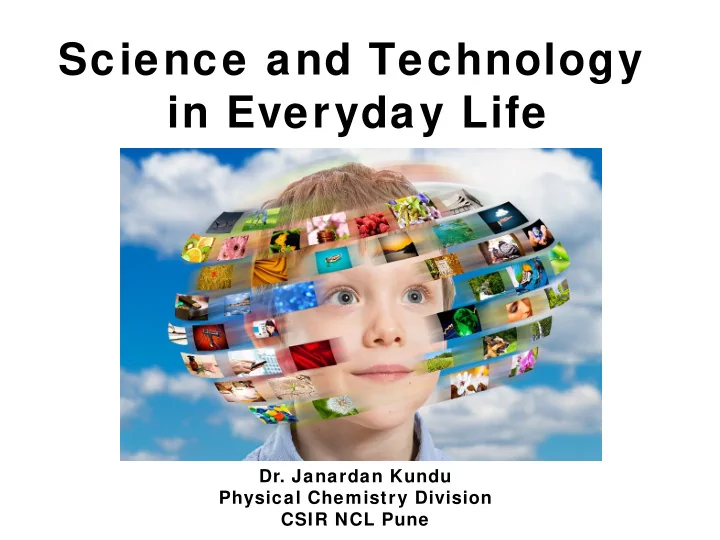
SLIDE 1 Science and Technology in Everyday Life
Physical Chemistry Division CSIR NCL Pune
SLIDE 2
What is Science and Technology?
SCARY?
SLIDE 3
Science & Technology is Anyw here & Everyw here
SLIDE 4
Do not be afraid of Science
Science is Fun
SLIDE 5
Scientists are not all serious
They are fun too
SLIDE 6
Name the Scientists
Isaac Newton, C. N. R. Rao, C. V. Raman, Albert Einstein
SLIDE 7
Science is about making observations and ask the follow ing questions:
Why and How
Logic & Reasoning are heavily utilized in Science
SLIDE 8
Consider some daily life encounters w ith science
Pow er and Limitations of Science
Science can explain many things that w e see around us. Yet there are things that science can not explain Keeping an open mind is the most important aspect of modern Science
SLIDE 9 Water
Our planet Earth &
consists of w ater
H H O
(H 2O)
SLIDE 10
Water commonly exists in the follow ing inter-convertible forms:
Solid (ice), Liquid (w ater), gas (steam)
SLIDE 11
What is this process?
Ice melting into liquid w ater
SLIDE 12
Inter-conversion of forms of w ater
Heating/cooling is required for these inter-conversions
SLIDE 13
Science behind these inter-conversions
SLIDE 14
Evaporation
SLIDE 15
Drying clothes in winter is faster than in rainy days Evaporation in action: Drying Clothes Humidity present in the air matters
SLIDE 16
Why Evaporation causes Cooling
SLIDE 17
Why do w e Perspire (sw eat)?
Thermoregulation (maintaining body temperature) needs sw eating Evaporative cooling in action
SLIDE 18
Boiling
Water boils at 100 ⁰C
Water at 1 atmosphere Pressure boils at 100 ⁰C Water at 0.33 atmosphere Pressure (Mount Everest) boils at 71 ⁰C
SLIDE 19
Boiling w ater at 1 Atm.
SLIDE 20 Boiling temperature & Pressure acting on the liquid are connected
Higher the surrounding pressure, higher is the boiling temperature
SLIDE 21
Pressure cooker
SLIDE 22
Let’s go inside a kitchen
Common Indian Kitchens
Everyday Cooking involves Science
SLIDE 23
Tips for Cooking
When boiling potato/eggs in Water, add some salt to cook it faster How do you boil potato/egg in w ater?
Elevation of boiling point
SLIDE 24 Why is Salt Used on Icy Roads? To melt the slippery ice
Working principle: Freezing point Depression
SLIDE 25
Elevation of Boiling Point
SLIDE 26
Light: What it does for us
SLIDE 27
Let’s SEE
“Let there be light”
SLIDE 28
What is a common theme In these two images?
SLIDE 29
What is a common theme In these two images?
ACTION REFR
SLIDE 30
What is this process called?
SLIDE 31
Refraction in Action
Common encounters w ith Refraction: Occurrence of mirage effect in deserts in summer Pencil partially dipped in glass filled w ith w ater seems to be bent at point of immersion Tw inkling of star- light reaching to us has gone several refraction because of mediums A clear pool of w ater alw ays appears to be shallow er than it actually is Formation of a RAINBOW
SLIDE 32
Refraction
SLIDE 33
Refraction and it’s extension
SLIDE 34
Rainbow
SLIDE 35
Mirages
SLIDE 36
Float or Sink?
Density and Buoyancy are important
SLIDE 37
Will an Orange Sink in w ater?
Answ er: Depends on the nature of the orange
SLIDE 38
Why does it not hurt to cut your nails/hair?
SLIDE 39
Dead vs. Alive Cells
SLIDE 40
Beauty of a Lotus Leaf
Self-cleaning surface Rolling off of w ater from lotus leaves
SLIDE 41 Lotus Effect
micron sized pointed structures in Lotus leaf
SLIDE 42
Emulating Lotus Effect in the Lab
Self-cleaning surface
SLIDE 43
Cricket
“The sultan of sw ing bow ling”
Insw ing and outsw ing balls
SLIDE 44
Sw ing Bow ling in Action
SLIDE 45
Sw ing Bow ling: Art
Cricket Academy teaches how to sw ing ball
SLIDE 46 Low pressure High pressure
Batsman (Right handed) Slip Bowler
Outsw inging ball
Fine leg Laminar flow Turbulent flow
Sw ing Bow ling: Science
SLIDE 47 Insw inging ball
rough smooth Laminar flow Turbulent flow
Low pressure High pressure
Swing direction
Batsman (Right handed) Slip Fine leg Bowler Ball flight direction
SLIDE 48
SEASONS
Summer, Winter, Fall, Spring
Axis of Rotation of Earth
SLIDE 49
SEASONS
SLIDE 50
Instances of Science in Everyday life is countless You have to keep looking and Think how Science operates You may see the working of the science and sometimes you may not Science is pow erful but has it’s limitation and hence it is evolving
SLIDE 51
Unsolved Mysteries of Science
Scientists simply don't know for sure. In broad terms, researchers believe it is to enable our bodies and especially our brains to recover
1) Why do w e need sleep?
SLIDE 52
2) How do animals Migrate?
Different animals use different navigational tools, including some w ho are able to tap into the Earth’s magnetic field and use themselves like a compass. How ever, scientists still don’t know how this trait evolved or how untrained animals know exactly w here to go season after season.
SLIDE 53
3) Does intelligent life exist elsew here?
Why haven’t w e connected w ith anyone else yet? This is know n as the Fermi Paradox. There are two (at least) possible explanations: One, there have been no messages from Aliens. Two, the messages are there, but nobody know s how to detect or recognize them.
SLIDE 54
4) Why and How Gravity works?
While scientists do understand a great deal about how gravity acts, they aren’t really sure w hy it exists. Why are atoms mostly empty space? Why is the force that holds atoms together different from gravity? Is gravity actually a particle (gravitons) or is it a w ave (Gravitational w aves)?
SLIDE 55 5) What is the nature of TIME?
What’s the nature of duration and the flow of time — is it illusory
- r “real” in some elusive w ay?
What about the direction of time — does it alw ays go forw ard? Why? Is time travel possible, or can messages at least be sent backw ard in time?
Terminator series is a classic example w here time travel has been implicated
SLIDE 56
Instances of Science in Everyday life is countless You have to keep looking and Think how Science operates You may see the working of the science and sometimes you may not Science is pow erful but has it’s limitation and hence it is evolving
SLIDE 57 Contact details:
Physical Chemistry Division CSIR‐NCL Pune, Maharashtra, India Telephone: 02025903049 E‐mail: j.kundu@ncl.res.in