Scene Understanding Tasks Krishna Kumar Singh Kayvon Fatahalian - - PowerPoint PPT Presentation

scene understanding tasks
SMART_READER_LITE
LIVE PREVIEW

Scene Understanding Tasks Krishna Kumar Singh Kayvon Fatahalian - - PowerPoint PPT Presentation

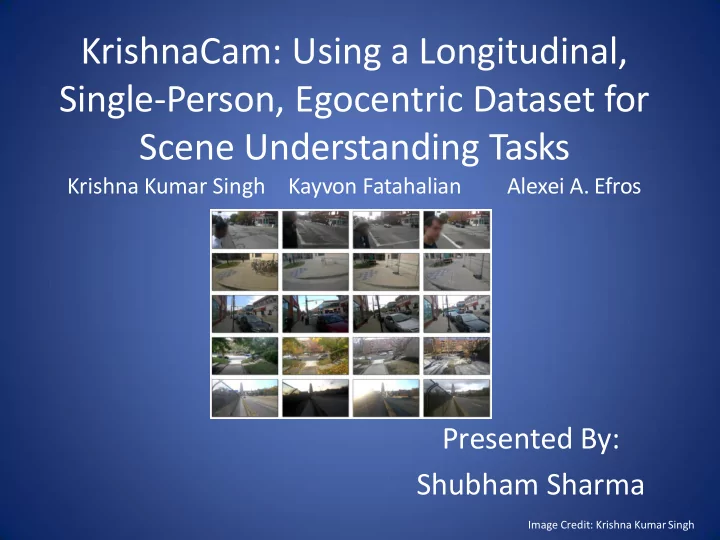
KrishnaCam: Using a Longitudinal, Single-Person, Egocentric Dataset for Scene Understanding Tasks Krishna Kumar Singh Kayvon Fatahalian Alexei A. Efros Presented By: Shubham Sharma Image Credit: Krishna KumarSingh Objective Organize a

slide-1
SLIDE 1

KrishnaCam: Using a Longitudinal, Single-Person, Egocentric Dataset for Scene Understanding Tasks

Krishna Kumar Singh Kayvon Fatahalian Alexei A. Efros

Presented By: Shubham Sharma

Image Credit: Krishna KumarSingh

slide-2
SLIDE 2

Objective

Organize a large egocentric video collection of real-world data from a single individual into a richly annotated database How much novel visual information does an individual see each day? Can we predict where the individual might walk next?

slide-3
SLIDE 3

Motivation

  • “A baby has brains, but it doesn’t know much. Experience is

the only thing that brings knowledge, and the longer you are

  • n earth the more experience you are sure to get.” —L. Frank

Baum, The Wonderful Wizard of Oz

  • The goal is to extract value from life events.

Image credits: Krishna Kumar Singh et al.

slide-4
SLIDE 4

Agenda

Creation of the KrishnaCam new dataset Quantification of novel visual data Trajectory estimation and motion class prediction Experimental evaluation Applications Strengths and Weaknesses

slide-5
SLIDE 5

The KrishnaCam dataset

  • Over a period of 9 months, collect and record

the events in the life of a graduate student

  • Data still being recorded.

Heat map of locations visited

Image Credit: Krishna Kumar Singh et al.

slide-6
SLIDE 6

The KrishnaCam dataset

Image Credit: Krishna Kumar Singh et al.

slide-7
SLIDE 7

How much novel visual data is present?

Lot’s of redundant data! Identify top-5 nearest neighbors

  • f frame in prior

recordings. NN frames constrained to be separated by at least 10 minutes Novel if the average similarity

  • f its top-5

nearest neighbors is below threshold or if no neighbor.

slide-8
SLIDE 8

Results of Novel Visual Data Growth

Image Credit: Krishna Kumar Singh et al.

slide-9
SLIDE 9

Results of Novel Visual Data Growth

Image Credit: Krishna Kumar Singh et al.

slide-10
SLIDE 10

Motion Prediction

  • Given a single image, can we predict where

the student would walk next in the scene?

Image Credit:http://paragonroad.com/krishna-pendyala-legacy-by-design-not-by-default/

slide-11
SLIDE 11

Motion Prediction: Ground-Truth data

How do we get ground-truth trajectories in this huge dataset? Manual annotation?

I am not labeling that!

Image Credit: https://beinspiredchannel.com/frustrated-frustration/

slide-12
SLIDE 12

Motion Prediction: Ground-Truth

  • Estimating ground-truth motion trajectories:

GPS is inaccurate for location prediction.

Image Credit: Krishna Kumar Singh et al.

slide-13
SLIDE 13

Motion Prediction: Ground Truth

  • A multi-class SVM is trained with

accelerometer and orientation sensor readings.

  • 4 classes of velocity: stationary, slow, regular

and fast.

  • Using this velocity and orientation, find 7

second trajectories.

slide-14
SLIDE 14

Ground truth 7-second motion trajectories obtained from accelerometer and

  • rientation measurements. The red dots represent stationary behavior.

Image credits: Krishna Kumar Singh etal.

slide-15
SLIDE 15

Motion Class prediction

  • Ground partitioning. C(fi) is the final position
  • To learn C(fi), modify the final softmax layer of the MIT Places-Hybrid

Network to predict nine motion classes

  • Training: 38 hours (681,565 frames, September 18 to March 2)
  • Testing: 252,209 frames (collected between 38 and 52 hours)

Image Credit: Krishna Kumar Singh et al.

slide-16
SLIDE 16

Results

  • The dataset is heavily biased towards instances of

walking straight.

  • To remove bias, for each training frame, scale the

gradient used for back-propagation by the size of the frame’s motion category

Image Credit: Krishna Kumar Singh et al.

slide-17
SLIDE 17

Results: weighted model

Image Credits: Krishna Kumar Singh et al.

Per-class motion prediction accuracy

slide-18
SLIDE 18

Image credits: Krishna Kumar Singh et al.

slide-19
SLIDE 19

Predicting Trajectories

  • Future trajectory as average of the frame

trajectories of top-10 nearest neighbors separated by 10 minutes.

  • Training: First 38 hours of recording (681,565

frames after temporal subsampling)

  • Testing: 40,000 test frames (20,000 unvisited,

20,000 visited) randomly chosen from 38 and 52 hours.

slide-20
SLIDE 20

RESULTS

slide-21
SLIDE 21

Image credits: Krishna Kumar Singh et al.

slide-22
SLIDE 22

Image credits: Krishna Kumar Singh et al.

slide-23
SLIDE 23

RESULTS

Error measure: Distance (in meters) between the predicted position and the measured position seven seconds into the future.

Image Credit: Krishna Kumar Singh et al.

slide-24
SLIDE 24

RESULTS

Results on the SUN database

Image Credit: Krishna Kumar Singh et al.

slide-25
SLIDE 25

Value of longer recordings

Image Credit: Krishna Kumar Singh et al.

slide-26
SLIDE 26

APPLICATIONS OF THE DATASET

VIRTUAL WEBCAM

Image Credit: Krishna Kumar Singh et al.

slide-27
SLIDE 27

APPLICATIONS OF THE DATASET

  • Finding popular places: Correlate pedestrian

detection with GPS location.

Image Credit: Krishna Kumar Singh et al.

slide-28
SLIDE 28
  • Creation of a huge

egocentric dataset

  • Using simple methods like NN
  • New analyses that shed light on

the nature of an individual’s daily visual environment

  • No manual annotations required
  • Single person only!
  • Failure in trajectory prediction

in fast movement.

  • Low prediction accuracy in

per- class motion prediction.

  • No novel algorithms created

OPEN ISSUE: IS SUCH A DATASET USEFUL FOR MANY APPLICATIONS, AS IT IS EXTREMELY BIASED TO THE LIFE OF A PARTICULAR INDIVIDUAL?

slide-29
SLIDE 29

POSSIBLE EXTENSIONS/FUTURE WORK

Motion prediction based on recent video history. Using advanced techniques to enhance accuracy. Application of dataset: giving good trajectory predictions to intoxicated individuals. Analyzing motion of other individuals.

slide-30
SLIDE 30

SUMMARY

Collected a large-scale, motion annotated, egocentric video stream Solve scene understanding tasks Opinion: Great dataset, huge scope for improvement in algorithms