
SLIDE 1
SCAMS & OLDER PEOPLE
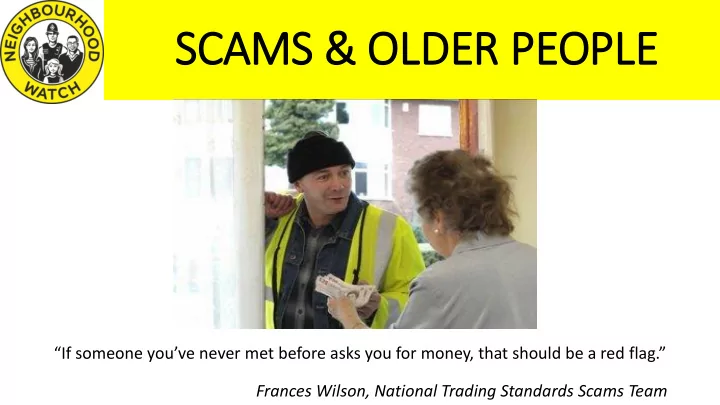
“If someone you’ve never met before asks you for money, that should be a red flag.” Frances Wilson, National Trading Standards Scams Team
SCAMS & OLDER PEOPLE If someone youve never met before asks you - - PowerPoint PPT Presentation
SCAMS & OLDER PEOPLE If someone youve never met before asks you for money, that should be a red flag. Frances Wilson, National Trading Standards Scams Team WHAT IS IS A SCAM? Scams are crimes where the perpetrator tries to swindle
“If someone you’ve never met before asks you for money, that should be a red flag.” Frances Wilson, National Trading Standards Scams Team
Scams are crimes where the perpetrator tries to swindle the victim out of money, or personal information so they can steal their money later. Scam is a slang term for personal fraud. All scams are frauds. Scams can be committed over the phone, through the post, on the internet or face-to- face, often on your doorstep. Once a person falls victim to one con artist, their personal details are often added to so-called ‘suckers lists’ and sold on to other criminals, so they are targeted again and again. £10 billion is lost in the UK each year to scammers.
Because older people are more likely to live alone, and are often lonely, they become targets for fraudsters. Those with dementia are at particular risk.
and over say they have been targeted by scammers – that’s almost 5 million people
People who have been defrauded in their own homes are 2.5 times more likely to die or go into residential care within a year
The average age
mass-market postal fraud is
There are some basic rules that should stop you falling victim to almost any scam. Here they are:
don’t respond – it’s a scam!
post or on your doorstep. Instead, contact the company yourself using a known phone number or email address
responding
contain a virus or harmful software that can steal your information
them often
your PIN number or passwords
computer
PROBABLY RIGHT!
some work on your property
photo)
items you don’t need, or are poor value for money
you later
keeps you at the front door while the other burgles your home from the back 65% of doorstep scam victims are 75 and over! Doorstep fraud is where fraudsters try to scam you after knocking on your door. They can include:
Trading Standards advise all householders to NEVER BUY GOODS AND SERVICES ON THE DOORSTEP Keep your front and back doors locked even when at home Install a spyhole or keychain in your door The safest thing to do is not to answer the door if you’re not expecting anyone. But if you do answer, and you don’t know the person, JUST SAY NO. It’s not rude to ask people to leave. Here’s some things you can say:
“I never deal with cold callers at the door, please would you leave” “I don’t know who you are so please can you just leave” “I have a neighbour who helps me so please go and knock on their door first”
Some people receive hundreds of scam letters each
mail scams include:
£100,000!! Now just send us your bank details/passport/£100 handling fee and we’ll send you your prize!” 2 in 5 of all postal scams are prize or lottery draws and the UK public loses £60million to these every year.
value.
can predict your future – for a fee. Bereaved people can be especially susceptible.
Nigerian criminal code”)
REMEMBER: IF IT SEEMS TOO GOOD TO BE TRUE, IT USUALLY IS! If you’ve been told you’ve won something in a raffle, prize draw or competition, think about whether you actually
If you are asked to pay a fee up-front in order to receive your money, it’s a scam. Have you received a letter or catalogue out of the blue from a company or person you’ve never had contact with before? Chances are it’s a scam. Are they asking you for money? Any request for money is suspicious until proven otherwise. DON’T SEND ANY MONEY! If you receive anything in the post that has any of these attributes, put it here:
People aged 65 and over are the most likely to be targeted by telephone scammers, who call you to try to obtain your personal details
common telephone scams are:
Someone posing as an official from your bank, saying your bank account has been fraudulently accessed and so a new ‘safe’ account has been opened for you to transfer your money into Courier scams – where scammers will call and pretend to be from your bank or utility company, and ask for your PIN number, and then send a ‘courier’ to your house to collect your bank card Investment scams – where scammers cold-call you and try to sell you shares in ‘once-in-a-lifetime’ opportunities, often in exotic-sounding assets like wine, hotels or diamonds – which don’t exist or are worthless. Computer scams – where a caller tells you there’s a problem with your computer and offers to help fix it. After you’ve logged in and followed their instructions, the scammers install programs on your computer that steal your personal data.
Buy a telephone with a display and subscribe to caller display. Ignore International and Withheld numbers BT offer a free Nuisance Call service called ‘BT Call Protect’ Set up a blacklist You set up a “junk” voicemail that unwanted calls get redirected to Report these calls to the Nuisance Call Advice Line - 0800 661 441 Subscribe to the Telephone Preference Service: www.tpsonline.org.uk or by calling 0345 070 0707 BT gives good advice: http://home.bt.com/tech-gadgets/bt-devices/what-are-nuisance-calls-how-to-stop- them-11364055573542
Any one of these probably means it’s a scam call….
your telephone keypad, it’s still a fraud.
insistent and makes you uncomfortable
cash, PIN, payment card or cheque book
second payment (which needs bank/pin details)
Never agree to anything over the phone. Just hang up if you feel at all wary of a caller. Don’t assume a caller or texter is genuine just because they already have some details about you, such as your name. Criminals will often already have some basic information about you. Remember: Your bank or building society will NEVER contact you out of the blue to ask for your PIN, full password or to move money to another account. If you receive a call from your bank requesting any of these, hang up immediately. Never give out any personal information over the phone, such as bank account or credit card details, unless you made the call. Never give control of your computer remotely to a third party over the phone. If you’re at all wary….
Investment or pension scams can
post, and usually involve offers of worthless or non-existent shares in unregulated products like wine
Over-55s are at greatest risk
The average loss to an investment scam is over £32,000
75% of victims are men, with an average age of 65
Those with savings of over £10,000 are most likely to fall victim
You are due to make a large payment, say: Transfer pension pot to an investment company Pay a solicitor the balance of a house purchase At the last moment the payee contacts you (phone, letter, email) with updated bank account details (looks like a different account number for same company) You pay to that account, but the account is owned by a fraudster You made the payment and so the payee is innocent – it’s your fault The FSA are introducing checks and processes to reduce the risk and increase the chances of the payer get reimbursed. But you may not get any back.
There are some more preventative measures you can take to help protect yourself from scams:
number you can also download TPS Protect, which will send you messages about new scams and nuisance calls).
so you know the caller is genuine.
If you do fall victim to a scam, don’t be embarrassed. It’s not your fault – scammers are professional criminals and very good at what they do. Thousands of older people are victims of scammers every year. Contact your bank/credit card supplier immediately. They will instantly block your account or card. This gives you both time to work on a solution. You should report it immediately to the police by calling 101, and to Action Fraud on 0300 123 2040, or via their
Action Fraud is the national fraud reporting database, which exists to build an accurate picture of frauds and scams, in
The quicker you act, the sooner you might prevent someone else becoming a victim. You may even be able to get your money back – though this is highly unusual. Which? has a guide online that might help you get your money back. Victim Support can provide further help and advice if you need it.