SBI Equity Savings Fund NFO Opens: 11 th May 2015 NFO Closes: 25 th - - PowerPoint PPT Presentation

sbi equity savings fund
SMART_READER_LITE
LIVE PREVIEW

SBI Equity Savings Fund NFO Opens: 11 th May 2015 NFO Closes: 25 th - - PowerPoint PPT Presentation

SBI Equity Savings Fund NFO Opens: 11 th May 2015 NFO Closes: 25 th May 2015 Scheme Re-Opens: On or before 08 th June 2015 This product is suitable for investors who are seeking*: Regular Income & Capital appreciation To generate


slide-1
SLIDE 1

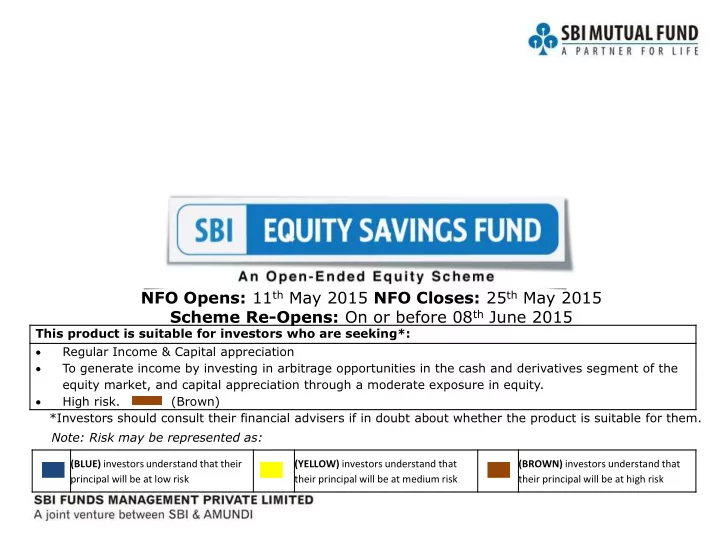
NFO Opens: 11th May 2015 NFO Closes: 25th May 2015 Scheme Re-Opens: On or before 08th June 2015

This product is suitable for investors who are seeking*:  Regular Income & Capital appreciation  To generate income by investing in arbitrage opportunities in the cash and derivatives segment of the equity market, and capital appreciation through a moderate exposure in equity.  High risk. (Brown) *Investors should consult their financial advisers if in doubt about whether the product is suitable for them.

(BLUE) investors understand that their principal will be at low risk (YELLOW) investors understand that their principal will be at medium risk (BROWN) investors understand that their principal will be at high risk

Note: Risk may be represented as:

SBI Equity Savings Fund

slide-2
SLIDE 2

Index

  • Predicament of low risk hybrid strategies
  • Presenting SBI Equity Savings Fund
  • The Arbitrage Component
  • Tax Efficiency
  • Key Features
  • Why Invest?
  • Investment Team
slide-3
SLIDE 3

Predicament of Low Risk Hybrid Strategies

slide-4
SLIDE 4

Difficulty of Low Risk Hybrid Strategies

Equity (Less than 35%) Fixed Income (More than 65%) Capital Appreciation High Risk Regular Income Low Risk

Problem: Tax Inefficiency Low risk Hybrid Strategies - Two for One Benefits Taxation: Non Equity Scheme

slide-5
SLIDE 5

Presenting: SBI Equity Savings Fund

slide-6
SLIDE 6

Connecting the Strategies

0% 10% 20% 30% 40% 50% 60% 70% 80% 90% 100%

Net Long Equity Exposure

0% 10% 20% 30% 40% 50% 60% 70% 80% 90% 100%

Cash- future arbitrage

0% 10% 20% 30% 40% 50% 60% 70% 80% 90% 100%

Debt & Money Market

SBI Equity Savings Fund

Bringing Tax Efficiency

slide-7
SLIDE 7

A 3 Pronged Strategy

Equity Arbitrage Debt

  • Generates capital appreciation by taking limited equity

exposure

  • Stock selection is focused on 3 factors

1. Growth potential relative to peers 2. Valuations 3. Value add i.e., excess RoCE > WaCC

  • Generates income by exploiting the arbitrage
  • pportunities in the market
  • Invests into equity stocks in the cash market & takes an

equivalent short position in futures market

  • Captures spread between spot & futures market
  • Generates regular income by investing in debt & money

market instruments

  • Provides liquidity to the fund & also margin for

derivatives

  • Maturity profile of debt instruments is based on interest

rate outlook & current market conditions

RoCE = Return on Capital Employed; WaCC = Weighted Average Cost of Capital

slide-8
SLIDE 8

SBI Equity Savings Fund: Positioning

Returns Risk

Liquid Funds Arbitrage Funds Debt Funds Hybrid Debt Funds SBI Equity Savings Fund Balanced Funds Multi Cap Equity Funds Mid Cap Equity Funds

slide-9
SLIDE 9

A Stable Hybrid Strategy

Equity Savings Strategy reduces volatility leading to relative stability in performance

Past performance may or may not be sustained in future. Source: Bloomberg, CRISIL Fund Analyzer. *Equity Savings Strategy refers to 30% CNX Nifty + 70% Crisil Liquid Fund Index rebalanced on a daily basis. The above is only for illustration of the way this strategy works in various scenarios and in no way should be construed as any indication

  • f future returns of any of the schemes. The above chart depicts the high-average-low 2 year return (CAGR) of the

specified index.

14% 11% 8%

  • 20%
  • 10%

0% 10% 20% 30% 40% 50% Crisil Balanced Fund Index Equity Savings Strategy* Crisil MIP Blended Index

Rolling 2 year returns (Mar 2004 - Mar 2005)

slide-10
SLIDE 10

Performs across market cycles

Past performance may or may not be sustained in future. Source: Bloomberg, CRISIL Fund Analyzer. *Equity Savings Strategy refers to 30% CNX Nifty + 70% Crisil Liquid Fund Index rebalanced on a daily basis. The above is

  • nly for illustration of the way this strategy works in various scenarios and in no way should be construed as any

indication of future returns of any of the schemes.

Equity Savings Strategy helps to reduce the downside while providing opportunity to participate in rising markets

  • 34.3%

6.0% 48.6%

  • 13.2%

8.7% 23.9%

  • 2.3%

4.4% 13.0%

  • 40%
  • 30%
  • 20%
  • 10%

0% 10% 20% 30% 40% 50% 60% Falling Market (CY 2008) Sideways Market (CY 2013) Rising Market (CY 2009) Crisil Balanced Fund Index Equity Savings Strategy* Crisil MIP Blended Index

slide-11
SLIDE 11

How does the Arbitrage Strategy work?

Working of a Cash Future Arbitrage Strategy Price of Company A in Cash Market - Rs .200.30 Price of Company A in Futures Market - Rs. 203.35 Start Date On Expiry Price in Cash & Futures Market

  • Rs. 210

Profit in Cash Market: Rs.9.70 Loss in Future Market: Rs.6.65 Price in Cash & Futures Market

  • Rs. 200.30

Profit /Loss in Cash Market: Rs.0 Profit in Future Market: Rs.3.05 Price in Cash & Futures Market

  • Rs. 190

Loss in Cash Market: Rs.10.30 Profit in Future Market: Rs.13.35 Net Gain

  • Rs. 3.05

The above is only to explain the concept of cash future arbitrage and should not be construed as any indication

  • f future returns. The above illustration does not take costs into consideration.

1 2 3

slide-12
SLIDE 12

How different is this fund from other strategies?

Debt Hybrid Funds Balanced Funds Arbitrage Funds Equity Savings Funds

Type of Scheme Debt Balanced Equity Equity Typical Equity Allocation Range (including equity derivatives) <=35% >=50% >=65% >=65% Cash – Future Arbitrage Strategies followed

X X  

Volatility Medium High Low Medium Equity Taxation* No May have Yes Yes *Please consult your tax advisor for details

slide-13
SLIDE 13

Tax Efficiency

Non-Equity Taxation Equity Taxation

Amount of Investment 1,00,000 1,00,000 Assumed Pre-tax annualized return 9% 9% Gains/Interest Earned after 1 year 9,000 9,000 Amount at the end of 1 year 1,09,000 1,09,000 Taxable Gains/ Income 9,000 9,000 Applicable Tax Rate* 34.61% 0% Tax Liability 3,115 Post Tax Gains/ Income 5,885 9,000 Post Tax Annualised Yield 5.89% 9.00%

*Assuming highest tax bracket & including surcharge & cess. The above table is only to illustrate the tax treatment of different types of funds and in no way should be construed as any indication of returns. Past performance may or may not be sustained in future. This calculation is based on prevailing tax laws and is applicable only in case of resident investors. Please consult your tax advisor for details & before taking any decision of investment.

Gain required in non- equity tax product

1,00,000 14% 13,763 1,13,763 13,763 34.61% 4,763 9,000 9.00% To reproduce similar gains

Illustration

slide-14
SLIDE 14

Fund Philosophy

  • Investment objective is to generate income by investing in arbitrage opportunities in the

cash and derivatives segment of the equity market, and capital appreciation through a moderate exposure in equity. However there is no guarantee or assurance that the investment objective of the scheme will be achieved.

  • Invests across equity, debt & equity derivatives
  • Suitable for investors looking for optimum risk adjusted returns over the medium term
slide-15
SLIDE 15

Asset Allocation

  • Indicative Asset Allocation under normal circumstances:
  • Asset Allocation when adequate arbitrage opportunities are not available in the Derivative and Equity

markets, the alternate asset allocation# on defensive considerations would be in as per the allocation given below

#The above alternate asset allocation will be for temporary period and would be rebalanced by the AMC within 30 days. The cumulative gross exposure through Equity and Equity related Instruments including derivatives position, debt, Money Market Instruments /Units of debt & liquid mutual funds will not exceed 100% of the net assets of the scheme. *Exposure to domestic securitized debt may be to the extent of 20% of the net assets. The Scheme shall not invest in ADR/ GDR/ Foreign Securities / foreign securitized debt. The Scheme shall invest in repo in corporate debt. The Scheme shall not engage in Stock lending. The Scheme shall not engage in short selling

Instruments Indicative allocations (% of total assets) Risk Profile Minimum Maximum Equity and Equity related Instruments including derivatives Out of which: 65% 90% Medium to High

  • Cash-future arbitrage:

15% 70%

  • Net long equity exposure:

20% 50% Debt* and Money Market Instruments (including margin for derivatives) 10% 35% Low to Medium Instruments Indicative allocations (% of total assets) Risk Profile Minimum Maximum Equity and Equity related Instruments including derivatives Out of which: 30% 70% Medium to High

  • Cash-future arbitrage:

0% 45%

  • Net long equity exposure:

20% 50% Debt* and Money Market Instruments (including margin for derivatives) 30% 70% Low to Medium

slide-16
SLIDE 16

Key Features

Plans/ Options The Scheme has two plans viz. Regular plan & Direct plan. Both plans would offer Growth & Dividend options. Dividend

  • ption will have the facility of Reinvestment, Payout &

Transfer Benchmark 30% CNX Nifty + 70% Crisil Liquid Fund Index Fund Manager

  • Mr. Neeraj Kumar & Mr. Ruchit Mehta

Load Structure Entry Load: Not Applicable Exit Load: For exit within 1 year from the date of allotment -1% For exit after 1 year from the date of allotment - Nil Minimum Application Amount

  • Rs. 5,000/- and in multiples of Re. 1 thereafter

Additional Purchase Amount

  • Rs. 1,000/- and in multiples of Re. 1 thereafter
slide-17
SLIDE 17

Why Invest?

Medium Volatility

Net long equity exposure in the range of 20 – 50%; Limited directional equity exposure reduces the volatility compared to equity funds

Potential for capital appreciation

Moderate exposure to equity allows the fund to participate in the long term growth

  • f equity markets

1 2

Regular Rebalancing

Directional equity exposure in the range of 20%- 50% ensures disciplined rebalancing

3

Tax Efficiency

Fund is an equity fund for tax purposes

4

*Investors are advised to consult their Tax/ Financial Advisor before taking decision of Investment.

slide-18
SLIDE 18

SBI Funds Management Private Limited

63% 37%

  • India’s premier and largest bank with
  • ver 200 years experience (Estd: 1806)
  • Asset base of USD 399 bn*
  • Pan-India network of ~22,972 branches

and ~ 50,000 ATM’s as at end of Dec 2014

  • Servicing over 256 million customers
  • Global leader in asset management
  • Backed

by Credit Agricole and Société Générale

  • More than 2,000 institutional clients and

distributors in 30 countries

  • Over 100 million retail clients via its partner

networks

  • € 866 bn AuM as at end of December 2014#

*Source: SBI Analyst Presentation as on end December 2014 # Source : Amundi website as on end December 2014

slide-19
SLIDE 19

SBI Funds Management: India’s First Bank Sponsored Funds

Source: SBI Funds Management Private Limited, AMFI; Average AUM (AAUM) for the quarter ending on March 31, 2015

Established in 1987: A leading asset manager in India

  • Expertise in managing assets across mutual funds,

segregated managed accounts, domestic advisory and

  • ffshore advisory business
  • Multiple asset classes ranging from equities and debt,

money market to ETFs and structured funds

  • Investment team of 33 professionals with strong track

record

  • Broad customer base with ~ 4.09 million folios related to

individual, corporate and institutional investors

Broad Investor Base AUM USD 14.09 bn Wide Distribution Network Experienced Investment Team Extensive Product Range Broad Investor Base AAUM

  • Rs. 74942 crs

Wide Distribution Network Experienced Investment Team Extensive Product Range

slide-20
SLIDE 20

Annexure

slide-21
SLIDE 21
  • Mr. Navneet Munot
  • Mr. Navneet Munot joined SBI Funds Management Pvt. Ltd. as Chief Investment Officer in Dec. 2008. Prior to

SBIFM he was the Head of Multi Strategies fund at Morgan Stanley Investment Management before which he worked as the Chief Investment Officer (Fixed Income and Hybrid Funds) of Birla Sun Life Asset Management Company Ltd. Navneet has been associated with the financial services business of the Birla group for over 13 years and worked in various areas such as fixed income, equities and foreign exchange. His articles on matters related to financial markets have widely been published. Navneet holds a Masters in Commerce and is also a Chartered Accountant. He is a charter holder of Chartered Financial Analyst Institute, US and Chartered Alternative Analyst Institute, US. He has also done Financial Risk Management, FRM from Global Association of Risk Professionals (GARP).

  • Mr. Ruchit Mehta

Ruchit joined SBIFM in 2010, Ruchit joined us from HSBC Asset Management where he was an analyst and assistant portfolio manager for four years. Prior to HSBC, Ruchit was as a sell side analyst with leading broking firms like ASK Raymond James and Prabhudas Liladhar for two years. Ruchit is a commerce graduate from Mumbai University and holds masters degree in finance from Lancaster University, UK. He is also a charter holder of the CFA Institute, USA

  • Mr. Neeraj Kumar

Neeraj joined SBIFM in 2006. Prior to joining SBIFM Neeraj was associated with Life Insurance Corporation of India (LIC) for 10 years. He started his career as an administrative officer in finance and accounts department of

  • LIC. Thereafter he worked as an equity analyst for five years and subsequently as a dealer for three years.

Neeraj is a commerce graduate and chartered accountant from ICAI.

Investment Team

slide-22
SLIDE 22

SBIFM: A Complete Framework

Expertise

Highly experienced team Strong industry relations Complete in-house research

Processes

Structured & Disciplined Rigorous investment templates Agility with Flexibility

Risk Management

Six member independent team International standards Coherent monitoring

Group Advantage

25 years of experience Both domestic and international strengths Investors trust

slide-23
SLIDE 23

Disclaimer

Mutual Fund investments are subject to market risks, read all scheme related documents carefully. This presentation is for information purposes only and is not an offer to sell or a solicitation to buy any mutual fund units/securities. The views expressed herein are based on the basis of internal data, publicly available information &

  • ther sources believed to be reliable. Any calculations made are approximations meant as guidelines only, which need to

be confirmed before relying on them. These views alone are not sufficient and should not be used for the development

  • r implementation of an investment strategy. It should not be construed as investment advice to any party. All opinions

and estimates included here constitute our view as of this date and are subject to change without notice. Neither SBI Funds Management Private Limited, SBI Mutual Fund nor any person connected with it, accepts any liability arising from the use of this information. The recipient of this material should rely on their investigations and take their own professional advice