Sauk County Well Water Monitoring Program 2020 Year 1 of 5 - - PowerPoint PPT Presentation

sauk county well water
SMART_READER_LITE
LIVE PREVIEW

Sauk County Well Water Monitoring Program 2020 Year 1 of 5 - - PowerPoint PPT Presentation

Sauk County Well Water Monitoring Program 2020 Year 1 of 5 Through Extension, all Wisconsin people can access University resources and engage in lifelong learning, wherever they live and work. The Center is a partnership between the University


slide-1
SLIDE 1

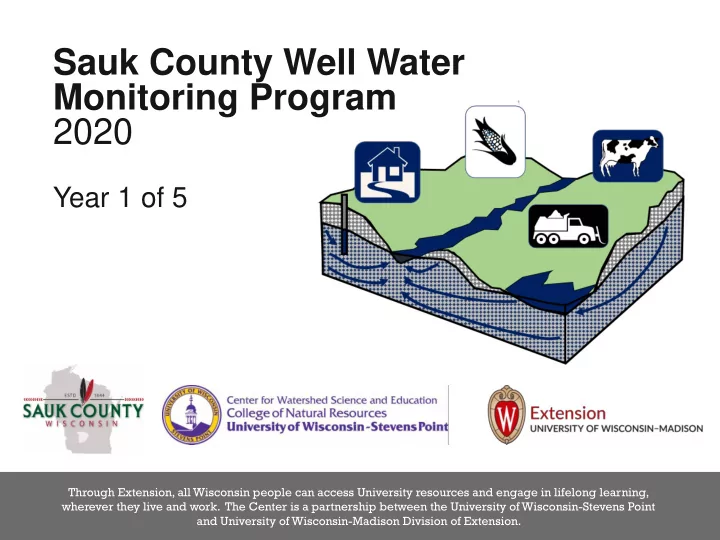
Sauk County Well Water Monitoring Program 2020

Year 1 of 5

Through Extension, all Wisconsin people can access University resources and engage in lifelong learning, wherever they live and work. The Center is a partnership between the University of Wisconsin-Stevens Point and University of Wisconsin-Madison Division of Extension.

slide-2
SLIDE 2

Today’s presentation

  • Basics of groundwater in Sauk County
  • Overview of the project goals/process
  • What do my individual test results

mean?

  • What we’ve learned so far about

groundwater quality in Sauk County

  • Looking forward…what comes next?
  • Q&A
slide-3
SLIDE 3

Groundwater Movement

slide-4
SLIDE 4

Sauk County Water Table Elevation

slide-5
SLIDE 5

water basics

➢“Universal Solvent” ➢Naturally has “stuff” dissolved in it.

⚫ Impurities depend on rocks, minerals, land-use, plumbing, packaging, and other materials that water comes in contact with.

➢Can also treat water to take “stuff” out

p + p -

H H

O

slide-6
SLIDE 6

Aquifers: Our groundwater storage units

Water and contaminants can move quickly through cracks and fractures.

Aquifers are geologic formations that store and transmit groundwater. The aquifer properties determine how quickly groundwater flows, how much water an aquifer can hold and how easily groundwater can become contaminated. Some aquifers may also contain naturally occurring elements that make water unsafe.

Wisconsin’s geology is like a layered

  • cake. Underneath all of Wisconsin lies

the Crystalline bedrock which does not hold much water. Think of this layer like the foundation of your

  • house. All groundwater sits on top of

this foundation. Groundwater is stored in the various sandstone, dolomite and sand/gravel aquifers above the crystalline bedrock layer. The layers are arranged in the order which they formed, oldest on the bottom and youngest on top.

Diagram courtesy of WGNHS

N

Oldest Youngest

Sand and gravel

Sandstones and dolomite Crystalline bedrock

Eastern Dolomite

Learn more about Wisconsin’s geologic past by clicking the aquifer names

Water moving through tiny spaces in between sand particles or sandstone moves slower and allows for filtration

  • f some contaminants.

Who to contact if I need additional assistance How does your water quality compare? Look for data in your area Interpret my water test results How to improve my water quality Learn about well construction What is Groundwater? Watersheds of Wisconsin Aquifers: Our groundwater storage units Factors that affect groundwater quality Better Homes and Groundwater Groundwater Basics: Where does my water come from?
slide-7
SLIDE 7

Sauk County Geology

slide-8
SLIDE 8

Depth to Bedrock in Sauk County

slide-9
SLIDE 9

Surficial Deposits in Sauk County

slide-10
SLIDE 10
slide-11
SLIDE 11

The role of well depth and well casing in determining water quality

slide-12
SLIDE 12

WHY were you selected?

Our Recruitment Strategy

❑ Mostly wells drilled after 1988

Wisconsin Unique Well Numbers that links to a Well Construction Report (ex. SP123)

Information on well depth, casing depth, depth to water, and geology.

❑ Attempted to find one well per section that

met the criteria above and could be matched to an individual parcel with a high degree of confidence

Spatially distributed

Account for wide variety of soils, geology, and land use

❑ All things being equal, preference was given

to those landowners that participated in previous Extension well testing efforts.

slide-13
SLIDE 13

WHERE and HOW many wells?

Total of 802 landowners were sent recruitment materials asking whether or not they wanted to participate Total of 438 landowners indicated their interest and were mailed sample materials, with 394 actual samples submitted

slide-14
SLIDE 14

GOAL: To learn how well water quality changes over time

Is well water quality getting better, worse, or staying the same. If changing, what can we learn about where and why This project works best when:

  • Wells are representative of

diverse geology and land use

  • The same wells are sampled

every year

slide-15
SLIDE 15

Year 1 - Overview

January Mailed sample kits February-March Participants collected samples and mailed back to lab March-April Lab analyzed samples May Mailed out results

slide-16
SLIDE 16

WHAT tests were performed?

Nitrate / Chloride

  • Useful for understanding land-use impacts on groundwater

Total Hardness / Alkalinity / pH

  • Help us understand how rocks and soils impact groundwater

Conductivity

  • Overall water

quality, combination of both land-use, rocks, and soils

slide-17
SLIDE 17
  • Natural (rocks and soils)
  • Primarily calcium and

magnesium

  • Problems: scaling, scum,

use more detergent, decrease water heater efficiency Less than 150 Greater than 200 150-200 “SOFT WATER” “HARD WATER” IDEAL

Interpreting your Total Hardness test

slide-18
SLIDE 18

Water Softening

Water softeners remove calcium and magnesium which cause scaling and exchange it for sodium (or potassium).

  • Considerations:
  • Increase sodium content of water
  • Discharge chloride to groundwater
  • Suggestions:
  • Bypass your drinking water faucet.
  • Do not soften water for outdoor

faucets

  • Regenerate based on volume rather

than set time period

  • If you are concerned about sodium

levels – use potassium chloride softener salt.

slide-19
SLIDE 19

Interpreting tests for Alkalinity and pH

  • Alkalinity – ability to neutralize acid, helps

determine how corrosive water is likely to be

  • Less than 150 mg/L water is more likely be corrosive
  • Greater than 200 water will be more likely to form scale
  • pH – Indicates water’s acidity and helps

determine if water will corrode plumbing

7 14

Acidic Basic

slide-20
SLIDE 20

2020 Sauk County Results for: Alkalinity, Total Hardness, and pH

Averages: Total Hardness– 237 mg/L as CaCO3 Alkalinity – 209 mg/L as CaCO3 pH – 7.55

slide-21
SLIDE 21

Total Hardness / Alkalinity / pH

  • Help us understand how rocks and soils

impact groundwater

slide-22
SLIDE 22
  • Greater than 250 mg/l
  • No direct effects on health
  • Salty taste
  • Exceeds recommended level
  • Greater than 10 mg/l may indicate

human impact

  • Less than 10 mg/l considered

“natural” in much of WI Sources: Fertilizers / Septic Systems / Road Salt

Interpreting your chloride test

slide-23
SLIDE 23

2020 Sauk County Chloride Results

Summary

  • 2% of wells tested greater

than 100 mg/L

  • 58% of wells tested less than

10 mg/L

  • Average Chloride:

16.6 mg/L

  • Maximum Chloride:

545 mg/L

slide-24
SLIDE 24

➢ Greater than 10 mg/L

Exceeds State and Federal Limits for Drinking Water

➢ Between 2 and 10 mg/L

Some Human Impact

➢ Less than 2.0 mg/L

“Transitional”

➢ Less than 0.2 mg/L

“Natural”

10 2 “NATURAL”

UNSAFE - for infants and pregnant women; everyone should avoid long term consumption.

Interpreting your nitrate-nitrogen test

slide-25
SLIDE 25

Nitrate-Nitrogen

Health Effects:

  • Infants Less than 6 months:
  • Methemoglobinemia (blue

baby disease)

  • Women who are or may

become pregnant:

  • Possible links to birth defects and

miscarriages (humans and livestock)

  • Everyone:
  • Thyroid disease
  • Increase risk of certain types of

cancers

Sources:

Agricultural fertilizer / Animal Waste or other bio-solids / Septic Systems / Lawn fertilizer

slide-26
SLIDE 26

2020 Sauk County Nitrate Results

Summary

  • 9% of wells tested greater

than 10 mg/L

  • 43% of wells tested less than

2 mg/L

  • Average Nitrate-Nitrogen:

4.2 mg/L

  • Maximum Nitrate-Nitrogen:

41.4 mg/L

slide-27
SLIDE 27

What can I do to reduce my nitrate levels?

Solution:

  • Eliminate contamination source or

reduce nitrogen inputs Short term:

  • Change well depth or relocate well
  • Carry or buy water
  • Water treatment devices
  • Reverse osmosis
  • Distillation
  • Anion exchange
slide-28
SLIDE 28

Nitrate / Chloride

  • Useful for understanding land-use impacts
  • n groundwater
slide-29
SLIDE 29

Conductivity

  • Overall water quality, combination of both land-use, rocks, and soils
  • Measure of total ions
  • Generally twice the hardness, if much greater may signify land-use impacts
slide-30
SLIDE 30

What’s next for the project?

  • Test kits for Year 2 will be sent sometime in

November

  • Coming in Year 2:
  • Will work to investigate relationships between land-use,

soils, geology, well depth, etc. on water quality results

  • Develop statistical models to better predict water quality risk for

wells that are not part of the project

  • Integrate temporal component to data analysis for

understanding changes over time

  • Trends
  • Better understand which wells fluctuate and why
  • How does weather impact well quality from year to year
  • Working on website to communicate project results
slide-31
SLIDE 31

Questions?

Kevin Masarik 800 Reserve St. Stevens Point, WI 54481 715-346-4276 kmasarik@uwsp.edu

www.uwsp.edu/cnr/watersheds

Thanks to you and the following for helping sponsor this program:

  • Sauk County
  • Ho-Chunk
  • University of Wisconsin-Madison,

Division of Extension – Sauk County

  • Sauk County Health Department
  • Sauk County Land Resources and

Environment