SANJEEV MEHTA 774.5 800 - - PowerPoint PPT Presentation

sanjeev mehta
SMART_READER_LITE
LIVE PREVIEW

SANJEEV MEHTA 774.5 800 - - PowerPoint PPT Presentation

Identify factors responsible for the 1. slowdown of food grain production in Bhutan since 1990. 2. Explore possible means to accelerate the growth rate of food grain production growth rate of food grain production SANJEEV MEHTA


slide-1
SLIDE 1

SANJEEV MEHTA

1.

Identify factors responsible for the slowdown

  • f

food grain production in Bhutan since 1990.

  • 2. Explore possible means to accelerate the

growth rate of food grain production growth rate of food grain production

  • 600

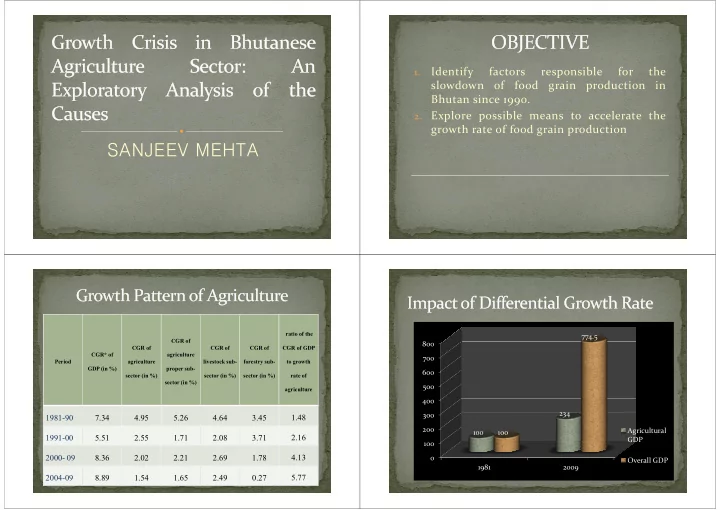
700 800 774.5 100 200 300 400 500 1981 2009 100 234 100 Agricultural GDP Overall GDP

slide-2
SLIDE 2
  • !"#$"$

"$%% $%%%%"

  • &

'(% '() !(* Dzongkhags Growth rate

  • f Paddy

(in %) share in paddy production (in %) Growth rate Maize (in %) Share in maize production (in %) Bumthang 19.7 0.02 Chukha 1.0 2.8 19.6 2.4 Dagana 1.3 5.5

  • 5.5

11.7 Dagana 1.3 5.5

  • 5.5

11.7 Gasa 11.0 0.2 Haa

  • 7.8

0.3 10.2 0.2 Lhuntse 18.5 2.6 4.5 4.3 Monggar 1.9 2.8 13.7 11.3 Paro 13.1 9.0 59.3 0.0 Pemagatshel

  • 7.3

0.3 18.7 2.6 Punakha 13.5 12.7 24.6 0.3 Dzongkhags Growth rate

  • f Paddy

(in %) share in paddy production (in %) Growth rate Maize (in %) Share in maize production (in %) S/J 23.8 2.5

  • 3.3

9.5 Samtse

  • 1.2

12.2

  • 1.1

16.9 Samtse

  • 1.2

12.2

  • 1.1

16.9 Sarpang

  • 15.7

18.0

  • 7.2

9.2 Thimphu

  • 11.7

3.6

  • 26.0

0.0 T/gang 20.0 2.3 42.3 2.2 T/Yangtse

  • 15.8

7.2

  • 23.0

15.3 Trongsa 7.9 2.7 15.6 1.7 Tsirang 11.1 4.6

  • 1.4

7.6 Wangdue 3.6 9.0 23.8 0.2 Zhemgang 3.2 1.8 4.2 4.6

All crops Paddy Maize 1982-92 Area 1.46 4.88

  • 0.24

Yield 0.99 1.56 19.22 Area 2.70 0.61 4.17 1992-00 Area 2.70 0.61 4.17 Yield

  • 6.20
  • 6.07
  • 3.70

00-09 Area

  • 0.13

2.41

  • 0.95

Yield

  • 1.10
  • 2.80
  • 1.63
slide-3
SLIDE 3

+ ,

  • %%%-
  • %%%-.&
  • /0

12 $# $) "))

  • !-)3$

!-3#! "%$

  • '-"4)

'-!4' )")

  • '-"4)

'-!4' )")

  • !44

!") !-!#3 ") "$ "*3 5 $-$!4 '-$#) !-*#' . !-*$% !-4*" !-!4!

  • *-4#4

"-%$) !-"$4 2 !$3 "4 )4# + ,

  • %%%-
  • %%%-.&
  • /0
  • #-3!#

!$-"#! !-3$* 6/7 *-!)' *-%$* "4* 62 )-3*) 4-$44 #'% 6 3-!%# *-!3) #!* &2 43% !-%3* !-4$! & $-!"# '-!$* !-*$$ &/8 !-*)) !-434 !-!$! + ,

  • %%%-
  • %%%-.&
  • /0

& $-!'3 $-!)4 !-%!" & 3-4*% *-$33 )3* 9 3-*') 3-#') !-%)* :2 !-$4) !-!!) ##$ ; 3#-4%" 43-)4' !-!$$

Paddy : 1172 kg Maize: 1123 kg

Impact: if these gaps are bridged, Impact: if these gaps are bridged, maize output would grow by 96% and paddy by 73%.

slide-4
SLIDE 4

22.5 18 18.3 14.4 9.5 10 15 20 25 6.9 9.5 5 10 1981-86 1987-92 1992-97 1998-02 2002-07 2008-13

6 3.6 4.4 4 5 6 7 3.6 3 1.9 1.4 1 2 3 4 1986 1990 1994 2001 2006 2009

  • !"#$%&'()"'(*"

*+(,*#-.

  • /0

%"

  • %"
  • 1
  • 2

1

  • 1

2 1

  • $%&
  • (*"
  • ()"
slide-5
SLIDE 5

The model suggests that public investment (pvtgdcf) and the private investment (pvtgdcf) tends to stimulate the growth rate

  • f

the agriculture, the growth rate

  • f

the agriculture, though the impact

  • f

the private investment is not large enough.

1) The external economies, that are created by the public investment and that tend to make the private investment more effective, are at present not substantial. 2) The declining share of the agriculture in 2) The declining share of the agriculture in public investment has constrained the rural infrastructure in general and agricultural infrastructure in particular. Also, the ability

  • f the farmers to benefit more from private

investment is determined by size of land holdings. 3) The low impact of private investment on agriculture growth suggests that the share

  • f agriculture in private investment is

probably declining due to limits imposed by probably declining due to limits imposed by the profitability of such investment. 4) There is, apparently, a vicious cycle

  • perating that prevents faster growth of the

agriculture due to low levels of private investment and unless the private investment itself becomes more profitable it will remain lower.