San Diego Mesa College Presidents Cabinet Retreat Meeting Notes - - PDF document

san diego mesa college president s cabinet retreat
SMART_READER_LITE
LIVE PREVIEW

San Diego Mesa College Presidents Cabinet Retreat Meeting Notes - - PDF document

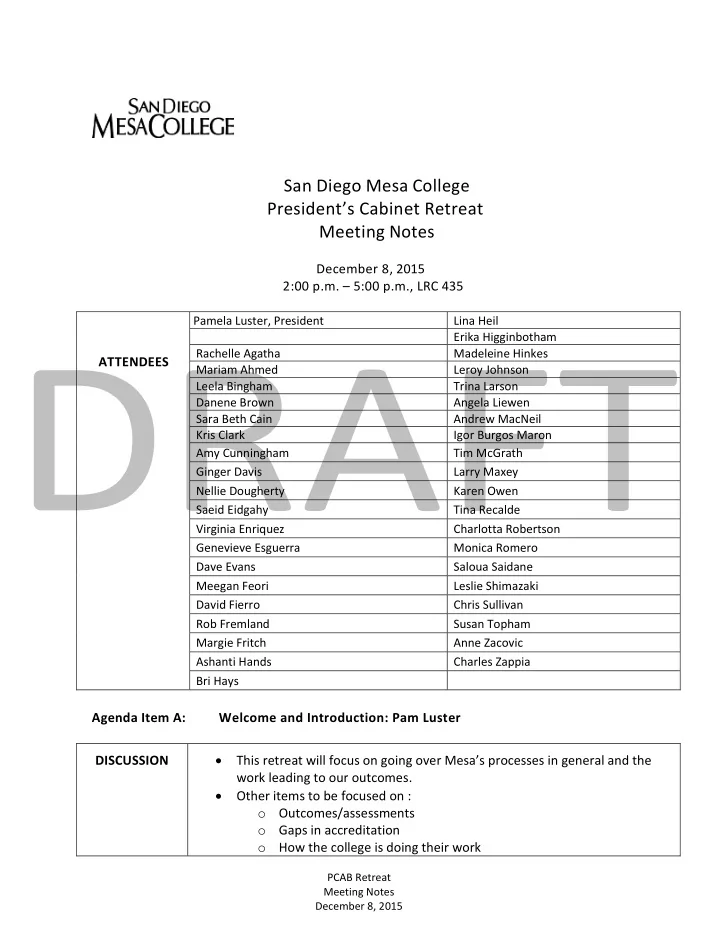
San Diego Mesa College Presidents Cabinet Retreat Meeting Notes December 8, 2015 2:00 p.m. 5:00 p.m., LRC 435 Pamela Luster, President Lina Heil Erika Higginbotham Rachelle Agatha Madeleine Hinkes ATTENDEES Mariam Ahmed Leroy Johnson


slide-1
SLIDE 1

PCAB Retreat Meeting Notes December 8, 2015

San Diego Mesa College President’s Cabinet Retreat Meeting Notes

December 8, 2015 2:00 p.m. – 5:00 p.m., LRC 435 ATTENDEES

Pamela Luster, President Lina Heil Erika Higginbotham Rachelle Agatha Madeleine Hinkes Mariam Ahmed Leroy Johnson Leela Bingham Trina Larson Danene Brown Angela Liewen Sara Beth Cain Andrew MacNeil Kris Clark Igor Burgos Maron Amy Cunningham Tim McGrath Ginger Davis Larry Maxey Nellie Dougherty Karen Owen Saeid Eidgahy Tina Recalde Virginia Enriquez Charlotta Robertson Genevieve Esguerra Monica Romero Dave Evans Saloua Saidane Meegan Feori Leslie Shimazaki David Fierro Chris Sullivan Rob Fremland Susan Topham Margie Fritch Anne Zacovic Ashanti Hands Charles Zappia Bri Hays

Agenda Item A: Welcome and Introduction: Pam Luster DISCUSSION  This retreat will focus on going over Mesa’s processes in general and the work leading to our outcomes.  Other items to be focused on :

  • Outcomes/assessments
  • Gaps in accreditation
  • How the college is doing their work
slide-2
SLIDE 2

PCAB Retreat Meeting Notes December 8, 2015

 President Luster introduced Mariam Ahmed(ASG Senator) and Igor Burgos Maron (ASG President).  The overall goal of the retreat is to be able to find ways to provide evidence

  • n how the college delivers student success.

Agenda Item B: Outcomes/Assessments DISCUSSION Kris Clark & Madeleine Hinkes  Kris Clark reported on COA and focus group (Think-Ins) results/feedbacks. There were 57 participants in the focus groups.  Clark presented “Where Are We in the Process of Outcomes Assessments?”

  • Snapshot Report: a year ago 75.5% of all outcomes assigned to

courses have been assessed; now 82.3% of all outcomes assigned to courses have been assessed

  • What we’ve learned?
  • “Think In” Focus Groups: During the Spring 2015 and Fall

2015 semesters Clark visited schools/departments to go over best practices and what needs improvement.

  • Why do you assess SLO’s in your classroom?
  • Compliance
  • Tangible data of evidenced outcomes
  • Linking the subject being taught to life outcomes/life skills,

not just the course objectives

  • What types of outcomes assessments do you use in your classroom?
  • Surveys, rubrics, exam questions
  • Few faculty reported use of outcomes assessment to

improve teaching.

  • Do you think outcomes assessments provide meaningful data?
  • Faculty found there was a lack of appropriate scientific

evaluation available in a two year college, and do not see students’ success until they’re gone.

  • How are decisions made as to where time, energy, and money

should be repurposed within your discipline? Is SLO assessment data used for this purpose?

  • Chairs and Deans make the decisions
  • Departmental decisions
  • SLO data is most helpful in resource allocation when looking

at the weaknesses in a program

  • What changes would you like to see in the next learning outcomes

assessment cycle?

  • Ability to share data more easily between departments
  • Long term tracking of student success by the College
  • Better access to better report
  • Link from Program Review to SLO data

 What’s next?

  • Revising ILOs and working definitions
slide-3
SLIDE 3

PCAB Retreat Meeting Notes December 8, 2015

  • Ethical citizenry, information competency, communication,

critical thinking

  • ILOS condensed from 6 to 4
  • There will be COA-sponsored flex workshops in Spring 2016 on

assessments/outcomes. Best Practices  Leela Bingham and Karen Owen presented their assessment methods.  Karen Owen, SLO Coordinator for GISG, CBTE, MULT, WEBD

  • CBTE department: timeline, organized, documentation, team work
  • Timelines: do work and get SLOs and findings in on time
  • Organization:
  • Documentation: shared online documents (using spreadsheets

reflecting timeline)

  • Team Work: Department breaks up into groups by program and

have discussions over findings. Use findings in program review and Perkins Grant and decide on SLOs and assessment measurements together as a group. The groups divide the work for inputting on the findings or new SLOs.

  • The department has regular meetings and the groups provide

feedback to each other on findings.

  • Venues for SLO meetings: school meetings, department meetings,
  • nline documents/discussions
  • Adjuncts and full time faculty participate in process; faculty buy in.

 Leela Bingham, SLO Coordinator for Languages Department

  • Started working on SLOs in 2005; direct and indirect assessment.

Received support from campus researcher for creating surveys.

  • The department works with the National Standards of Foreign

Language for their assessments.

  • SLOs are discussed at school meetings each semester where full

time and adjunct faculty provide input. There is also communication via email regarding SLOs.

  • The department has asked students to self-assess, worked with

campus researcher to help with assessments and provides department based surveys on assessment.

  • Workshop on “We Speak Training“:
  • Multimedia technology designed to get students to speaking

target

  • There will be a Best Practices workshop in Spring 2016.
  • Recommendation to work with campus researcher (Bri Hays).

PRT visit  President Luster received the visiting team’s report on December 7th. The results of the report will go to COA.  There will be a total of 3 visits from team. After the visits the college will be eligible for $150k for funding to receive training and help with improving assessments.

slide-4
SLIDE 4

PCAB Retreat Meeting Notes December 8, 2015

Agenda Item C: Accreditation DISCUSSION Accreditation- Danene Brown & Chris Sullivan  Attendees participated in an activity centered on the Accreditation Standard Areas that are not being met and finding the gaps.  Feedback from the activity will provide an update and guidance on what is being done.  Please refer to attachment A for the results of the activity. Report out:  FOR NEW ACCREDITATION STANDARDS:

  • Quality focused essay that is focused on highlighting 2-3 issues and

providing the steps on how we are going to work on improving meeting the standard

  • The visiting team will return to college in 18 months to follow up on

meeting the standard.

  • Reminder: meeting the accreditation standards is different from

complying with eligibility.  President Luster will be attending accreditation training at East Los Angeles Community College.  President’s Cabinet will receive standing reports from college committees to provide the statuses of what they’re working on and cross report over committees- to keep people in the loop. Submitted by: Virginia Enriquez, Senior Clerical Assistant Approved on: ________________________