Leaning in to Facilitate Difficult Conversations Friday, June 21, - - PowerPoint PPT Presentation

leaning in to facilitate difficult conversations
SMART_READER_LITE
LIVE PREVIEW

Leaning in to Facilitate Difficult Conversations Friday, June 21, - - PowerPoint PPT Presentation

Leaning in to Facilitate Difficult Conversations Friday, June 21, 2019 | 1:10 pm Sheraton Hotel, Raleigh NC Justine Hollingshead, Chief of Staff and Assistant Vice Chancellor, NC State Barry Olson, Associate Vice Chancellor, NC State Today we


slide-1
SLIDE 1

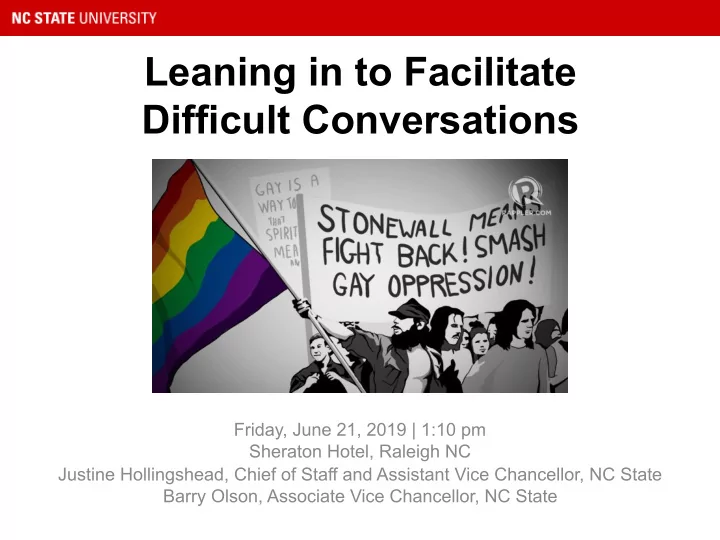
Leaning in to Facilitate Difficult Conversations

Friday, June 21, 2019 | 1:10 pm Sheraton Hotel, Raleigh NC Justine Hollingshead, Chief of Staff and Assistant Vice Chancellor, NC State Barry Olson, Associate Vice Chancellor, NC State
slide-2
SLIDE 2

Today we will cover

  • Introductions
  • Safe Spaces v Brave Spaces

conversation – what should we be doing?

  • Some training and facilitation

suggestions

  • Understanding your role and

privilege

  • Positive actions to take
  • Resources
slide-3
SLIDE 3

Who am I? Justine

  • Over 30 years in higher

education.

  • Wife, sister, friend, mom to other

people's kids, and four-legged fur babies.

  • Former director of the NC State

GLBT Center and served on the board for the LGBT Center of Raleigh.

  • Passionate about advocacy and

inclusion.

  • I have privilege.
slide-4
SLIDE 4

Who am I? Barry

  • 23 years in higher

education.

  • Husband, father, mentor,

professor, administrator.

  • Out and proud ally!
  • My dissertation focused on

how white male graduate students in SA prep programs make meaning of whiteness, white privilege, and multiculturalism.

  • I have privilege.
slide-5
SLIDE 5

Safe Spaces vs Brave Spaces

slide-6
SLIDE 6

From Safe Spaces to Brave Spaces

  • Arao and Clemens (2013)From Safe Spaces to Brave Spaces:

a new way to frame dialogue around diversity and social justice.

  • A good place to start with a conversation.
  • Are we nurturing engagement in ideas that may be counter to
  • ur own beliefs?
  • Ground Rules:

– “Agree to disagree” restated as controversy with civility. – “Don’t take things personally” restated as own your intentions and your impact. – Challenge by choice restated as consider the impact of your participation. – Consider what respect looks like culturally and with regard to bravery. – Consider what no attacks looks like culturally and with regard to bravery.

slide-7
SLIDE 7

Why are we here?

  • Challenging conversations are

inevitable...and scary to many.

  • Our nation is divided.
  • Most people are often ill-equipped to

engage in authentic dialogue.

  • It is NOT the job or role of people of color or

those who identify as LGBTQ to lead the way - we need to teach the majority how to engage, and not just through questioning.

  • We need to confront privilege. In an authentic
  • way. AND this includes within the LGBTQ

community!

slide-8
SLIDE 8

Reasons for Dialogue

slide-9
SLIDE 9

What does a courageous conversation look like?

  • Stay engaged
  • Speak your truth
  • Expect to experience discomfort
  • Expect AND accept a lack of closure

Glenn Singleton and Curtis Linton (2005)

slide-10
SLIDE 10

P – A – I – R – S

  • P: PAN (Pay Attention Now) the

environment

  • A: Ask specifics about comment
  • r behavior
  • I: Interrupt the dynamics
  • R: Relate to the person or the

comment/behavior

  • S: Share about yourself

Taken from Foundations of Equity, Inclusion, and Social Justice, by Dr. Kathy Obear

slide-11
SLIDE 11

What can we do BEFORE issues arise?

  • Know the issues that people face.
  • Be knowledgeable about laws and policies.
  • Use of social media
  • Awareness of current events
  • Free speech versus hateful speech
  • Resources on and off campus
  • Expectations for sharing information
  • Focus on emotions,

feelings, and fears

Taken from Informed Discussions Guide: A Staff Guide by Paperclip Communications

slide-12
SLIDE 12

The Mechanics

slide-13
SLIDE 13

Articulating and Arguing Opinions

➢Groupthink ➢Thinking versus Feeling ➢Perceptions of arguments

Taken from Informed Discussions Guide: A Staff Guide by Paperclip Communications

slide-14
SLIDE 14

What is your opinion?

slide-15
SLIDE 15

Confronting Inappropriate Comments

  • Do not laugh and remain calm.
  • Public versus private?
  • Avoid abstract – state how you feel.
  • Do not censor or inhibit free speech.
  • Ask open-ended questions.
  • Be aware of policies AND resources.
  • Document what happened.
  • Debrief and process with someone

you trust.

Taken from Informed Discussions Guide: A Staff Guide by Paperclip Communications

slide-16
SLIDE 16
slide-17
SLIDE 17

What is Privilege?

“No one is asking you to apologize for being privileged; people want you to stop using your privilege in ways that require an apology.”

  • Ilana Alazzeh
slide-18
SLIDE 18

HOMEWORK What have YOU

  • bserved or personally

experienced?

slide-19
SLIDE 19

Role of a Facilitator

➢Use inclusive language. ➢Think about people you may be leaving out. ➢Address any missteps.

Taken from Informed Discussions Guide: A Staff Guide by Paperclip Communications

slide-20
SLIDE 20

Handling Someone Who Is Aggressive

✓ get into a shouting or challenging exchange. ✓ become hostile or demanding. ✓ physically try to restrain the person. ✓ press for an explanation. ✓ ignore the situation. ✓ put your own needs or rights aside.

Taken from Informed Discussions Guide: A Staff Guide by Paperclip Communications

Do NOT

slide-21
SLIDE 21

Think AND Do

  • Demonstrate leadership
  • Infuse equity and inclusion into all

relationships

  • Deepen multicultural competencies
  • Assess and analyze
  • A personal and environmental scan

Taken from Foundations of Equity, Inclusion, and Social Justice, by Dr. Kathy Obear

slide-22
SLIDE 22
slide-23
SLIDE 23
  • Understand one’s identity.
  • Acknowledge and be open to biases.
  • Be comfortable and open to discussions.
  • Understand emotions.
  • Validate and facilitate discussion of feelings.
  • Control the process NOT the content.
  • Unmask dialogue through observations and

interventions.

  • Do not allow difficult dialogue to be brewed in silence.
  • Understand differences in communication styles.
  • Forewarn, plan, and purposefully instigate conversation.
  • Validate, encourage, and express admiration and

appreciation to participants who speak when it is unsafe for them to do so.

Positive Actions

Taken from Race Talk and the Conspiracy of Silence, by

  • Dr. Derald Wing Sue
slide-24
SLIDE 24

Preparing for Dialogue

  • The Challenge - Engage in

difficult dialogues and courageous conversations.

  • Create spaces that are brave.
  • Remember that the best way

to address voices is through more dialogue.

  • Know the issues in your community -

regionally, nationally, and internationally.

  • Give voice to the voiceless.
  • Find comfort in the uncomfortable!
slide-25
SLIDE 25

#ProudtoBe

slide-26
SLIDE 26
slide-27
SLIDE 27

Thanks and Good Luck!

  • Ms. Justine Hollingshead

Chief of Staff and Assistant Vice Chancellor for Academic and Student Affairs jrhollin@ncsu.edu, 919-434-4167 Twitter: @Jholli99

  • Dr. Barry Olson

Associate Vice Chancellor for Academic and Student Affairs Professor of the Practice, College of Education baolson@ncsu.edu, 919-513-3402 Twitter: @BarryOlson1