SAN DIEGO COUNTY 1. Understand the foundaDonal theory and process of - - PDF document

san diego county
SMART_READER_LITE
LIVE PREVIEW

SAN DIEGO COUNTY 1. Understand the foundaDonal theory and process of - - PDF document

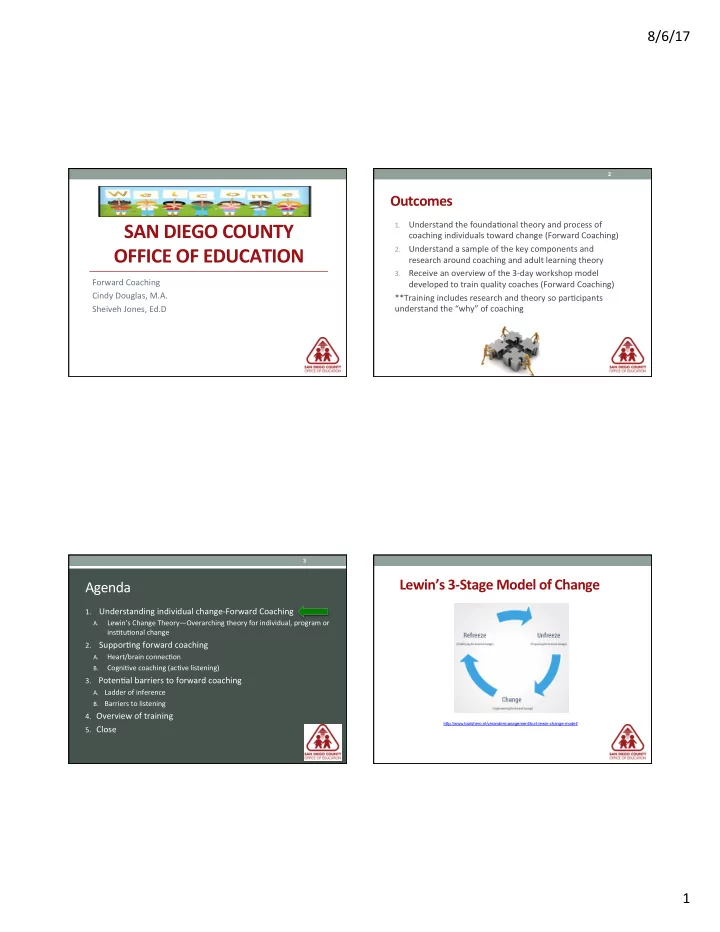
8/6/17 2 Outcomes SAN DIEGO COUNTY 1. Understand the foundaDonal theory and process of coaching individuals toward change (Forward Coaching) OFFICE OF EDUCATION 2. Understand a sample of the key components and research around coaching and


slide-1
SLIDE 1

8/6/17 1

SAN DIEGO COUNTY OFFICE OF EDUCATION

Forward Coaching Cindy Douglas, M.A. Sheiveh Jones, Ed.D

Outcomes

  • 1. Understand the foundaDonal theory and process of

coaching individuals toward change (Forward Coaching)

  • 2. Understand a sample of the key components and

research around coaching and adult learning theory

  • 3. Receive an overview of the 3-day workshop model

developed to train quality coaches (Forward Coaching) **Training includes research and theory so parDcipants understand the “why” of coaching

2

Agenda

  • 1. Understanding individual change-Forward Coaching

A.

Lewin’s Change Theory—Overarching theory for individual, program or insDtuDonal change

  • 2. SupporDng forward coaching

A.

Heart/brain connecDon

B.

CogniDve coaching (acDve listening)

  • 3. PotenDal barriers to forward coaching
  • A. Ladder of inference
  • B. Barriers to listening
  • 4. Overview of training
  • 5. Close

3

Lewin’s 3-Stage Model of Change

http://www.toolshero.nl/verandermanagement/kurt-lewin-change-model/

slide-2
SLIDE 2

8/6/17 2 Unfreezing

  • Ge^ng people ready to change. Involves ge^ng to a point of

understanding that change is necessary, and ge^ng ready to move away from our current comfort zone.

  • Unfreezing and ge^ng moDvated for the change is all about

weighing the 'pro's' and 'con's' and deciding if the 'pro's'

  • utnumber the 'con's' before you take any acDon.
  • This is the basis of what Kurt Lewin called the "Force Field

Analysis"

  • There are lots of different factors (forces) for and against making change

that we need to be aware of (analysis). If the factors for change outweigh the factors against change we'll make the change. If not, then there's low moDvaDon to change - and if we feel pushed to change we're likely to get grumpy and dig in our heels.

5

Personal Constructs

6

H a p p y Sad Angry F r i g h t e n e d Frustrated Ecstatic Playful A f f e c t i

  • n

a t e Protective S u r p r i s e d

Changing

  • Kurt Lewin: Change is not an event, but rather a process. . . a

transiDon

  • This stage is ofen the hardest as people are unsure or even fearful.

Imagine bungee jumping or parachuDng. You may have convinced yourself that there is a great benefit for you to make the jump, but now you find yourself on the edge looking down.

  • TransiDon is a process that occurs within each of us. There's no set

Dme limit as each of us is different.

  • Support is really important here and can be in the form of training,

coaching, and expecDng mistakes as part of the process.

7

ReFreeze

  • Establishing stability once the changes have been made.
  • The changes are accepted and become the new norm.
  • People form new relaDonships and become comfortable with

their rouDnes. This can take Dme...

  • Lewin's concern is about reinforcing the change and ensuring

that the desired change is accepted and maintained into the

  • future. Without this people tend to go back to doing what they

are used to doing.

  • SomeDmes called "freezing like a milkshake" and not a block of

ice . . . to be prepared for the next change!

8

slide-3
SLIDE 3

8/6/17 3 Agenda

  • 1. Understanding individual change-Forward Coaching

A.

Lewin’s Change Theory—Overarching theory for individual, program or insDtuDonal change

  • 2. SupporDng forward coaching

A.

Heart/brain connecDon

B.

CogniDve coaching (acDve listening)

  • 3. PotenDal barriers to forward coaching
  • A. Ladder of inference
  • B. Barriers to listening
  • 4. Overview of training
  • 5. Close

9

THE HEART-BRAIN CONNECTION Heart and Brain Signals

Stress and NegaDve EmoDons

  • Anger
  • FrustraDon
  • Anxiety
  • Heart rhythm: erraDc

Positive Emotions

  • AppreciaDon
  • Joy
  • Care
  • Love
  • Heart rhythm: highly
  • rdered

11 12

slide-4
SLIDE 4

8/6/17 4

TacJcal Breathing

  • 1. Breathe in through the nose for a slow four count

(1, 2, 3, 4). NoDce your belly expanding.

  • 2. Hold the breath for a four count (1, 2, 3, 4).
  • 3. Slowly exhale through pursed lips for a four count

(1, 2, 3, 4).

  • 4. Hold empty for a four count (1, 2, 3, 4)
  • 5. Repeat two more Dmes.

Grossman, D., & Christensen, L.W. (2008). On combat: The psychology an physiology of deadly conflict in war and in peace. Millstadt, IL: Warrior Science Pub. HeartMath Institute: https://www.heartmath.org

13

Agenda

  • 1. Understanding individual change-Forward Coaching

A.

Lewin’s Change Theory—Overarching theory for individual, program or insDtuDonal change

  • 2. SupporDng forward coaching

A.

Heart/brain connecDon

B.

CogniDve coaching (acDve listening)

  • 3. PotenDal barriers to forward coaching
  • A. Ladder of inference
  • B. Barriers to listening
  • 4. Overview of training
  • 5. Close

14

AcJve Listening Strategies

  • 1. Paraphrase: Express the meaning of the speaker using

different words, especially to achieve greater clarity.

  • 2. Clarify: Make a statement or situaDon less confused and

more clearly comprehensible (ask quesDons, pause)

  • 3. Mediate: Once you are clear on what the issue is, suggest

soluDons, opDons, or ideas to help create a bridge from problem to soluDon..

Listening to Understand

  • 10% of our communicaDon is represented by the words we say
  • 30% is represented by our sounds
  • 60% is represented by our body language

16

slide-5
SLIDE 5

8/6/17 5 CreaJng Space

“Coaching is a luxury service where we give people space and 6me that they wouldn’t have elsewhere.”

– Alain Cardon

17

AcJve Listening: What it Does (and Doesn’t) Look Like

Agenda

  • 1. Understanding individual change-Forward Coaching

A.

Lewin’s Change Theory—Overarching theory for individual, program or insDtuDonal change

  • 2. SupporDng forward coaching

A.

Heart/brain connecDon

B.

CogniDve coaching (acDve listening)

  • 3. PotenDal barriers to forward coaching
  • A. Ladder of inference
  • B. Barriers to listening
  • 4. Overview of training
  • 5. Close

19

How PercepJons Impact our Beliefs

20

Brown, Y. F. (n.d.). The ladder of inference: How assumptions can cause miscommunication [PDF]. JAD Communications International.

slide-6
SLIDE 6

8/6/17 6

Ladder of Inference

21

Brown, Y. F. (n.d.). The ladder of inference: How assumptions can cause miscommunication [PDF]. JAD Communications International.

22

We can’t count on John. He’s Unreliable. John always comes in late. John knew exactly when the meeting was to start. He deliberately came in late. The meeting was called for 9 am and John came in at 9:30. He didn’t say why. EXAMPLE

Brown, Y. F. (n.d.). The ladder of inference: How assumptions can cause miscommunication [PDF]. JAD Communications International.

23

This boss shouldn’t be supervising women. He picks on Jane because she’s a woman. The boss thinks Jane’s work is unacceptable. “Jane, your performance is not up to standard,” says the boss. The boss is chewing Jane out. EXAMPLE

Brown, Y. F. (n.d.). The ladder of inference: How assumptions can cause miscommunication [PDF]. JAD Communications International.

24

I’m not going to bother to vote anymore. Every politician lies and cheats. Once again he shows he has no integrity. A politician just made a statement which seems to contradict a campaign promise. It’s another political sell-out. EXAMPLE

Brown, Y. F. (n.d.). The ladder of inference: How assumptions can cause miscommunication [PDF]. JAD Communications International.

slide-7
SLIDE 7

8/6/17 7

25

Mary can’t keep up the pace, and so she’s willing to have us lose our competitive edge. She can’t compete very well. Mary doesn’t like competition. “We need to be less competitive,” Mary says. “We need to find a way to reward people for the contribution they make to the whole.” EXAMPLE

Brown, Y. F. (n.d.). The ladder of inference: How assumptions can cause miscommunication [PDF]. JAD Communications International.

Stop the Cycle

  • 1. IdenDfy where you are on the ladder
  • 2. Analyze your reasoning (facts)
  • 3. Work back down the ladder from current rung and trace

the facts

  • 4. Consider:
  • Why have I/you chosen this acDon?
  • Are there other acDons I/you should have considered?
  • What beliefs led to the acDon and were they well-founded?
  • What path have I/you chosen and why?
  • Are there other facts I/you should have considered?

**DISRUPTIVE THINKING**

26

Agenda

  • 1. Understanding individual change-Forward Coaching

A.

Lewin’s Change Theory—Overarching theory for individual, program or insDtuDonal change

  • 2. SupporDng forward coaching

A.

Heart/brain connecDon

B.

CogniDve coaching (acDve listening)

  • 3. PotenDal barriers to forward coaching
  • A. Ladder of inference
  • B. Barriers to listening
  • 4. Overview of training
  • 5. Close

27

Barriers to Listening

  • One-up listening
  • Irrelevant detail listening
  • No need for all the facts

listening

slide-8
SLIDE 8

8/6/17 8 What not to do! Agenda

  • 1. Understanding individual change-Forward Coaching

A.

Lewin’s Change Theory—Overarching theory for individual, program or insDtuDonal change

  • 2. SupporDng forward coaching

A.

Heart/brain connecDon

B.

CogniDve coaching (acDve listening)

  • 3. PotenDal barriers to forward coaching
  • A. Ladder of inference
  • B. Barriers to listening
  • 4. Overview of training
  • 5. Close

30

Overview of "Forward Coaching" Training

  • 1. Understanding change theory
  • 2. Se^ng the tone and establishing connecDons for an effecDve

coaching conversaDon

  • 3. Neuroscience and brain research for developing a coaching

conversaDon

  • 4. EffecDve quesDoning strategies
  • 5. IdenDfying and moving beyond the barriers to forward

change

  • 6. DirecDve conversaDons
  • 7. Four points of communicaDon
  • 8. Modeling effecDve coaching and pracDce/consultaDon Dme

31

Agenda

  • 1. Understanding individual change-Forward Coaching

A.

Lewin’s Change Theory—Overarching theory for individual, program or insDtuDonal change

  • 2. SupporDng forward coaching

A.

Heart/brain connecDon

B.

CogniDve coaching (acDve listening)

  • 3. PotenDal barriers to forward coaching
  • A. Ladder of inference
  • B. Barriers to listening
  • 4. Overview of training
  • 5. Close

32

slide-9
SLIDE 9

8/6/17 9 QuesJons

Cindy Douglas cdouglas@guhsd.net 619-644-8040 Sheiveh Jones snjones@sdcoe.net 760-761-5182

33