
SLIDE 1
Take part in the greatest microfinance event in Africa!
SAM
African Microfinance Week 2017
Addis Ababa, ETHIOPIA 9-13 October, 2017
SAM - African Microfinance Week
www.microfinance-africa.org
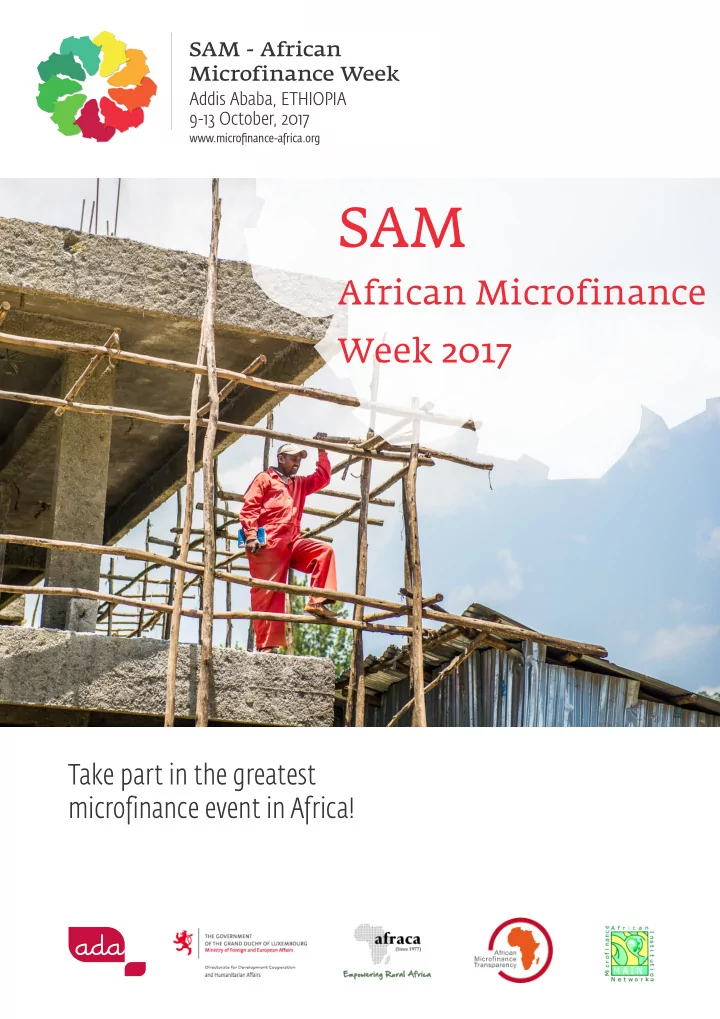
SAM African Microfinance Week 2017 Take part in the greatest - - PDF document
SAM - African Microfinance Week Addis Ababa, ETHIOPIA 9-13 October, 2017 www.microfinance-africa.org SAM African Microfinance Week 2017 Take part in the greatest microfinance event in Africa! Summary What is the African Microfinance Week?
Addis Ababa, ETHIOPIA 9-13 October, 2017
SAM - African Microfinance Week
www.microfinance-africa.org
Summary
What is the African Microfinance Week? 3 Back to the SAM 2015 4 The 3rd edition of the SAM 2017 8 About the organisers
11
Practical detail
13
ADA’s contact
14
Open to all microfjnance practitioners and related sectors, the SAM aims to become a common African platform that offers a true framework for discussion between all stake- holders in the sector, in order to accelerate the fjnancial inclusion and the economic growth of the continent. This common platform eases peer-to-peer exchanges and the search of synergies at regional and international level.
The African Microfinance Week (SAM - Semaine Africaine de la Microfinance) is a biennal conference dedicated to the development of financial inclusion in Africa.
African Microfinance Week 2017 - 3
SAM’s main target audience
and decision-makers
and other relevant development issues
Accelerating innovative rural finance in Africa
In 2015, the 2nd edition of the SAM took place in Dakar, Senegal, on the theme ‘Accelerating innovative rural fjnance in Africa’. It brought together over 550 participants from 49 countries, including 36 African ones.
36 African countries represented in the SAM
80
microfinance institutions
75
NGOs
50
investors
53
public institutions
57
private companies
4
research and academic institutes
More than 300 organizations represented:
4 - African Microfinance Week 2017
Governments committed to microfinance
The SAM 2015 was supported by the Government of the Grand Duchy of Luxembourg, through its Ministry of Foreign and European Affairs, and specifjcally its Directorate for Development Cooperation and Humanitarian Affairs, and by the Government
Ministry Delegate in charge of Microfjnance and Solidarity Economy. The event also benefjted from the High Patronage of His Excellency Macky Sall, President of the Republic of Senegal. The 2015 Opening Ceremony was chaired by:
Women, Family and Children, in charge
economy of Senegal;
Affairs of Luxembourg;
Development of the Democratic Republic
The ceremony was attended by several ministerial delegations including that of Benin, Burkina Faso, Cameroon, Cabo Verde, Dji- bouti, Mauritania, Niger, DRC, Senegal, Chad and Togo. Ethiopia
Moustapha Diop, Minister, Ministry of Women, Family and Children, in charge of microfinance and solidarity-based economy of Senegal Lamine Gueye, President of APSFD Senegal (on the left) and Romain Schneider, Minister for Development Cooperation and Humanitarian Affairs of Luxembourg (on the right) Eugène Serufuli, Minister for Rural Development of the Democratic Republic of Congo African Microfinance Week 2017 - 5
Expert institutions in financial inclusion
The conference programme was structured around three plenary sessions, each declined in four parallel sessions around the theme Innovating to accelerate rural fjnance in Africa. These sessions were presented and moderated by experts from international organisations active in the fjeld of fjnancial inclusion:
ment
Not only a conference, but also numerous side events
The SAM 2015, on the sidelines of the two-day conference, hosted the general meetings of the organisers networks as well as workshops and training courses organised by our various partners. In total, over 20 events were offered to participants. Among the highlights of these additional activities, we can mention:
The Investor’s Fair
Previously dedicated to rated MFIs, the 7th Investor’s Fair is now opened to all African MFIs (Tiers 1, 2 and 3) of the continent. In 2015, the Fair hosted 17 microfjnance investors, 2 rating agencies and over 60 MFIs. A total of 197 speed-dating meetings were held throughout the day. During the edition 2017, the morning will be devoted to speed-dating sessions between MFIs and investors. These sessions are scheduled in advance by organizers, based on requests received by investors and MFIs registered in the event. Each meeting lasts 25 minutes. The agenda of the afternoon will be free, and participants will have the opportunity to take private meetings with investors.
The Proparco meeting table during the Investor’s Fair in 2015
197
speed-dating sessions
60
IMF
17
investors
6 - African Microfinance Week 2017
The Innovation Fair
The fjrst Innovation Fair welcomed 20 new technology suppliers who presented their innovative solutions to accelerate access to basic services for the rural population. The most relevant innovations were the subject of a presentation followed by a discussion with the
the MasterCard Foundation. This year, the Innovation Fair will invite MSME service providers. Exhibitors will present their successful initiatives of funding and support for African small business.
Research Meets Africa
PhD students, researchers and international experts were invited to participate in the symposium Research Meets Africa, a UMM (University Meets Microfjnance) research workshop jointly organised by ADA and Positive Planet on ‘Promote research on innovation to accelerate rural fjnancial inclusion in Africa’. At the workshop, ten research papers were selected and presented to a hundred of
prize of € 6,000 each, awarded by MFW4A. Once again, the 2017 edition will allow the authors of accepted articles to present the main results of their research.
Exhibition stands for innovators at the Innovation Fair in 2015.
Sponsors and partners of the SAM 2015
African Microfinance Week 2017 - 7
Workshops and trainings Numerous workshops and trainings will be organized on the days before and after the conference, so that participants can benefjt from their presence at the SAM. During the SAM 2015, more than 20 events were proposed to the participants. The Salon will be a wonderful meeting place for business services providers and actors able to promote (policy makers, fjnancial institutions, land development actors, donors and investors).
Creating value for SMEs: a new frontier for inclusive finance
This year, the conference will take place from 9th to 13th October, 2017, in Addis Ababa, Ethiopia, on the following topic: ‘Creating value for SMEs: a new frontier for inclusive fjnance’. The theme will focus on the subject of mesofjnance and therefore the development of micro, small and medium-sized enterprises (MSMEs). The term mesofjnance refers to a segment of the provision of fjnancing to enterprises which, generally speaking, is barely or not at all developed by microfj- nance institutions or banks. This segment may be defjned as being between the upper limit of loans covered by microfjnance and the lower limit for bank loans. There is a missing middle between these two limits in which micro, small and medium-sized enterprises struggle to fjnd funding and, therefore, to develop. Particular focus will be placed on the question of the impact this has in terms
micro, small and medium-sized enterprises. Youth employment is indeed an important issue for the continent since, according to the World Bank, eleven million youth are expected to enter Africa’s labour market every year for the next decade1. In many ways, there will be a need to look beyond con- ventional microfjnance and fjnancial inclusion in order to focus upon economic inclusion and job creation in Africa. Both in the North and in the South, the MSME seg- ment represents one of the main drivers of economic growth and of the development of employment. In Africa, the formal sector is mainly constituted of larg- er companies that work in the commodities market, without there being much processing taking place. While there exists a huge potential, only limited added value is being produced on the continent
with agriculture being the main sector. The informal sector provides indeed 80 to 90% of all employment in Africa.
1 Filmer, Deon and Louise Fox. 2014. Youth Employment in Sub-Saharan Africa. Africa Development Series. Washington, DC: World Bank.
« In countries with low and middle income, more than 50% of employees work in companies with fewer than 100 employees. »
Source : Thorsten Beck et Robert Cull
« Only 25% of formal SMEs have access to formal credit in sub-Saharan Africa and that this lack of formal credit for SMEs was estimated to represent a figure of $100 billion in 2010. »
Source : IFC
8 - African Microfinance Week 2017
From a quantitative point of view, the major ab- sent player within this sector, is the micro, small and medium-sized enterprise (MSME), which is a key element in the creation of both added value and employment. In fact, in the majority of the countries in the South and particularly in the least developed countries, MSMEs rarely have access to bank funding, even though this is fundamental for their development. This lack of access is identifjed as the missing middle. According to the AFD, this missing middle represents credits that lie within a fairly wide bracket since they may range from € 2,000 to € 100,000 as shown in the diagram hereafter:
Funding the missing middle
This issue of accessing funding stems from the fact that the banks, many of which are not well acquainted with this sector, consider these institutions to represent too great a risk: there is a lack of visibility regarding the projects to be funded, the absence of a business plan, insuffjcient equity and guarantees, limited evidence of the entrepreneur’s experience, etc. Added to this is the argument always used by the conventional bank- ing sector regarding the management and monitoring of low amounts of credits, which is very expensive for the banks. At the lower limit, most MFIs are not particularly well equipped to fjnance this segment of clients. With the exception of just a handful of successful initiatives, it is recognised today that investments in micro-enterprises are generally focussed on ac- tivities that barely enable the enterprises to survive (small-scale trade and processing activities), which provide precious few possibilities for expansion or job creation. The concept of mesofjnance has therefore been introduced in
which, nevertheless, still continue to be an important vector of growth and job creation. Mesofjnance covers all of the initiatives that make it possible to fjnance the missing middle of funding, namely the clients and organisations which fjnd themselves in the gap between being the benefjciaries of microfjnance and being conventional bank clients. The clear aim and intention is to develop forms of funding for these clients who are served neither by banks nor by microfjnance institutions. Here, we are talking about downscaling in the case of banks that wish to con- quer this market and therefore to accord funding which is lower than the average level they traditionally offer, or upscaling if this is carried out by microfjnance institutions that wish to respond to the expectations of MSMEs. Tracks of reflexion
What are the characteristics of this fjnancing, the diffjculties, the market shares conquered, the operational arrangements deployed?
donors and international fjnancial institutions in creating an environment and a fmexible institutional framework for the fjnancing of MSMEs?
fjnancing initiatives that have prove to be successful?
African Microfinance Week 2017 - 9
Source: AFD website http://www.afd.fr/home/projets_afd/appui-secteur-prive/accessibilite-fjnanciere2/mesofjnance
Technical assistance for the development of MSMEs
Another major challenge for MSMEs is that of improving their organisation, governance and management so as to gain the trust of fjnancers. Indeed, it is vitally importantly that these struc- tures demonstrate their capacity to develop and to ensure their long-term future by presenting tools and monitoring systems which go well beyond the business plan and its projections. Acquiring know-how in terms of management and marketing techniques, networking and the capacity to mobilise quality technical support are as important as gaining access to funding. In this sense, it may henceforward be acknowl- edged that credit or funding is not the only factor that may limit the success of an enterprise and rather that professional and commercial support are important elements of success. Funding and technical assistance are now combined by the majority of operators with support provisions aimed at the development of MSMEs. In this context, the SAM 2017 program will focus
ment of MSMEs and will try to provide concrete answers. Tracks of reflexion
and support services for MSMEs’ development? Which devices to implement and at what cost? How to envisage sustainable solutions by International Financial Institutions, donors (dedicated lines
incubators, etc.)?
necessary and essential formalization of companies, which is the bearer of rights, protection, sustainability and quality?
innovative approaches have been deployed to support the strategic development of high-performing and sustainable MSMEs? Whether at the level of MFIs or companies, equity intervention is an innovative approach to small business fjnancing in Africa, as it allows a long-term fjnancing and the guidance of the institutions development strategy. Two additional subjects could be dealt with in plenary or in a parallel session, considering their importance: Entrepreneurship development and youth employment: What lessons can be learned from current experiences? Rural MSMEs: How to accelerate their development for the benefit of small farmers?
10 - African Microfinance Week 2017
ADA – with the support of the Directorate for Development Cooperation and Humanitarian Affairs For 20 years ADA has been a leading player in the fjeld of microfjnance in Luxembourg and
convinced that access to fjnancial services can bring about a lasting improvement in the living conditions of poor populations. ADA pursues its goals with the backing of the Luxembourg Development Cooperation, which has extended its mandate by fjve more years. www.ada-microfjnance.org Luxembourg’s Directorate for Development Cooperation and Humanitarian Affairs Luxembourg’s Development Cooperation has been committed for nearly 20 years to the development of microfjnance and inclusive fjnance. The Directorate works with civil society stakeholders specialised in microfjnance. Luxembourg supports the evolution of the sector through its contribution, conceptualisation, support for research and development of new tools, political action in many national and international fora, exchanges with multilateral and bilateral partners, both public and private, or CSOs and through its fjnancial commitment to a multitude
www.gouvernement.lu/cooperation AFRACA The African Rural and Agricultural Credit Association is a regional association of Sub-Saharan fjnancial and non-fjnancial institutions involved in promoting rural and agricultural fjnance. AFRACA was established in 1977 alongside similar institutions across the globe as a lead advocate and coordinator of rural and agricultural fjnance in their respective regions. The AFRACA secretariat is based in Nairobi, Kenya where it was registered under the NGOs Coordination act in 1981 and received diplomatic status from the government of Kenya in 2003. www.afraca.org AMT – African Microfjnance Transparency forum Created in 2003, the African Microfjnance Transparency forum aims to promote transparency and strengthen performance of Africa MFIs in order to improve the effjciency of their actions and activities in terms of poverty alleviation. www.amt-forum.org
African Microfinance Week 2017 - 11
MAIN - Microfjnance African Institution Network MAIN (Microfjnance African Institutions Network) is an international nonprofjt association established in 1995 in Abidjan. It began as an initiative spearheaded by several insitutitions with experience in microfjnance and/or promoting microenterprises in Africa. The mission of MAIN is to reinforce the social and economic role of African microfjnance institutions through an African programme to promote microfjnance in the context of African economic development. As at December 31st 2017, MAIN has 77 members from 21 countries in Africa and Europe. MAIN is composed of microfjnance institutions, national networks, NGOs working in the fjeld of microfjnance, banks, cooperatives and “resource” organisations (universities, social investors). MAIN member institutions have reached 3.2 million customers with an outstanding loan and savings portfolio of more than 1.26 billion USD. www.mainnetwork.org AEMFI - Association of Ethiopian Microfjnance Institutions The Association of Ethiopian Microfjnance Institutions is a non-for-profjt, non-governmental association of the Ethiopian microfjnance institutions. Since its establishment in 1999, AEMFI has been providing several capacity building activities through technical assistance, networking, advocating, research and training aimed at enhancing the capacity of practitioners in the microfjnance sector. With the vision to become an innovative network that provides value added services in building an inclusive fjnancial system in Ethiopia, it recently established its own training and research institute- Ethiopian Inclusive Finance Training and Research institute (EIFTRI). Its mission is to support the inclusive fjnance sector in Ethiopia with all the required knowledge and skills through training, research, MIS and knowledge management activities. Currently, AEMFI has 34 member microfjnance institutions. www.aemfj-ethiopia.org AMFI - Association for Microfjnance Institutions The Association for Microfjnance Institutions (AMFI) is a member based organization with the aim to build the capacity of the Kenyan Microfjnance Industry. In its 17 years of existence, AMFI supports the Kenyan microfjnance industry by providing services based on 4 pillars: policy advocacy, capacity building, networking and linkages, research and knowledge
focus on microfjnance, Credit Only Microfjnance Institutions, Wholesale Microfjnance lenders, Developmental Institutions and Sacco’s. www.amfjkenya.com
12 - African Microfinance Week 2017
African Microfinance Week 2017 - 13
Event
African Microfjnance Week (3rd edition)
Date
Fom 9th to 13th October 2017
Location
Sheraton Hotel – Conference center Taitu Street Addis Ababa, Ethiopia
SAM website
www.microfjnance-africa.org
For more information on the SAM - African Microfjnance Week -, please do not hesitate to contact our representatives: Luc VANDEWEERD SAM Steering Committee Executive Adviser - ADA l.vandeweerd@ada-microfjnance.lu +352 45 68 68 20 Frédéric RUAZ Communication Manager - ADA f.ruaz@ada-microfjnance.lu +352 45 68 68 27
14 - African Microfinance Week 2017
Organisers: Sponsors: Media partners: Innovation Fair sponsors: Investor’s Fair sponsors: Supporters: Research Meets Africa sponsors: Research Meets Africa co-organiser: With the support of:
M O S S
I C TMaking Finance Work for Africa