Sales and Use Tax Implications of M&A: Avoiding Costly Mistakes - - PowerPoint PPT Presentation

sales and use tax implications of m a avoiding costly
SMART_READER_LITE
LIVE PREVIEW

Sales and Use Tax Implications of M&A: Avoiding Costly Mistakes - - PowerPoint PPT Presentation

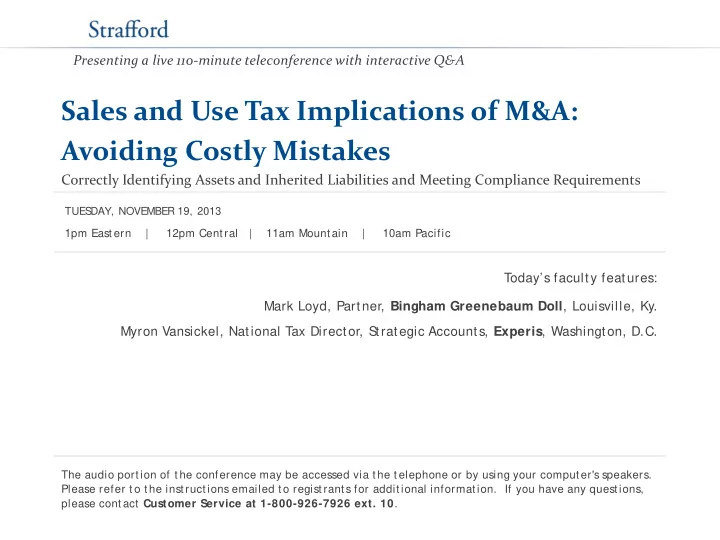
Presenting a live 110-minute teleconference with interactive Q&A Sales and Use Tax Implications of M&A: Avoiding Costly Mistakes Correctly Identifying Assets and Inherited Liabilities and Meeting Compliance Requirements TUES DAY,


slide-1
SLIDE 1

Sales and Use Tax Implications of M&A: Avoiding Costly Mistakes

Correctly Identifying Assets and Inherited Liabilities and Meeting Compliance Requirements

Today’s faculty features:

1pm East ern | 12pm Cent ral | 11am Mount ain | 10am Pacific The audio port ion of t he conference may be accessed via t he t elephone or by using your comput er's speakers. Please refer t o t he inst ruct ions emailed t o regist rant s for addit ional informat ion. If you have any quest ions, please cont act Customer Service at 1-800-926-7926 ext. 10. TUES DAY, NOVEMBER 19, 2013

Presenting a live 110-minute teleconference with interactive Q&A

Mark Loyd, Partner, Bingham Greenebaum Doll, Louisville, Ky. Myron Vansickel, National Tax Director, S trategic Accounts, Experis, Washington, D.C.

slide-2
SLIDE 2

Tips for Optimal Quality

S

  • und Qualit y

If you are listening via your computer speakers, please note that the quality

  • f your sound will vary depending on the speed and quality of your internet

connection. If the sound quality is not satisfactory, you may listen via the phone: dial 1-866-873-1442 and enter your PIN when prompted. Otherwise, please send us a chat or e-mail sound@ straffordpub.com immediately so we can address the problem. If you dialed in and have any difficulties during the call, press *0 for assistance. Viewing Qualit y To maximize your screen, press the F11 key on your keyboard. To exit full screen, press the F11 key again.

FOR LIVE EVENT ONLY

slide-3
SLIDE 3

Continuing Education Credits

Attendees must listen throughout the program, including the Q & A session, in

  • rder to qualify for full continuing education credits. S

trafford is required to monitor attendance. Record verification codes presented throughout the seminar. If you have not printed out the “ Official Record of Attendance,” please print it now (see “ Handouts” tab in “ Conference Materials” box on left -hand side of your computer screen). To earn Continuing Education credits, you must write down the verification codes in the corresponding spaces found on the Official Record of Attendance form. Please refer to the instructions emailed to the registrant for additional

  • information. If you have any questions, please contact Customer Service

at 1-800-926-7926 ext. 10.

FOR LIVE EVENT ONLY

slide-4
SLIDE 4

Program Materials

If you have not printed the conference materials for this program, please complete the following steps:

  • Click on the ^ symbol next to “ Conference Materials” in the middle of t he left-

hand column on your screen.

  • Click on the tab labeled “ Handouts” that appears, and there you will see a

PDF of the slides and the Official Record of Attendance for today's program.

  • Double-click on the PDF and a separate page will open.
  • Print the slides by clicking on the printer icon.

FOR LIVE EVENT ONLY

slide-5
SLIDE 5

Partnership Distributions: Avoiding Tax Traps of Mixing Bowl Transactions, Disguised Sales, and 751(b)

  • Nov. 19, 2013

Myron Vansickel, Experis myron.vansickel@ experis.com Mark Loyd, Bingham Greenebaum Doll MLoyd@ bgdlegal.com

slide-6
SLIDE 6

Today’s Program

Overview of Challenges Related to Mergers & Acquisitions [Myron Vansickel] Risk Management Opportunities [Myron Vansickel] Risk Management Opportunities: Nexus and Compliance Challenges [Mark Loyd] Due Diligence Best Pract ices [Mark Loyd] S lide 8 – S lide 10 S lide 11 – S lide 30 S lide 31 – S lide 38 S lide 39 - S lide 41

slide-7
SLIDE 7

Title of Presentation – Change in Master Slide Experis | Monday, November 18, 2013

7

Circular 230 Disclaimer

  • This presentation contains general educational information only and Experis

is not, by means of this presentation, rendering accounting, business, financial, investment, legal, tax, or other professional advice or services. This presentation is not a substitute for such professional advice or services, nor should it be used as a basis for any decisions or action that may affect your business. Before making any decisions or taking any action that may affect your business, you should consult a qualified professional advisor. Experis shall not be responsible for any loss stained by any person who relies on this presentation. This document was not intended or written to be used, and it cannot be used, for the purpose of avoiding tax penalties that may be imposed on the taxpayer.

slide-8
SLIDE 8

CHALLENGES RELATED TO MERGERS & ACQUISITIONS

Myron Vansickel, Experis

slide-9
SLIDE 9

Title of Presentation – Change in Master Slide Experis | Monday, November 18, 2013

9

Challenges Related to Mergers & Acquisitions

  • Acquisition of Ownership Interests

Ownership interests may include stock of a C corporation, S corporation or a partnership interest. Each of these types of acquisitions will likely include all unrecorded liabilities of the target. Therefore, a buyer may want to perform more due diligence review for this type of acquisition

slide-10
SLIDE 10

Title of Presentation – Change in Master Slide Experis | Monday, November 18, 2013

10

Challenges Related to Mergers & Acquisitions

  • Acquisitions of Assets

Tangible, intangible and real estate may represent the types of assets that may be purchased directly. The buyer may be potentially liable for unpaid sale sand use tax liability for the seller, up to the purchase price of the assets in most states.

slide-11
SLIDE 11

RISK MANAGEMENT OPPORTUNITIES

Myron Vansickel, Experis

slide-12
SLIDE 12

Title of Presentation – Change in Master Slide Experis | Monday, November 18, 2013

12

Risk Management

  • Asset Purchases

Here you may become liable up to the purchase price for the seller’s tax obligation if you do not protect yourself by filing “bulk sales” notifications in the states where assets are located. Generally, this relieves the purchaser form the assertions of successor’s liability for most states and the requirements for notification will vary form state to state.

slide-13
SLIDE 13

Slide Intentionally Left Blank

slide-14
SLIDE 14

Title of Presentation – Change in Master Slide Experis | Monday, November 18, 2013

14

Managing Sales Tax on Acquisitive Transactions

  • Identification of Non-Taxable & Exempt Items

Cash, marketable securities, real estate and other intangibles are not subject to sales tax. The sales tax is applied to the tangible personal property based on the sales price allocated to this property. There may be sales tax exemptions on various property on a state by state basis, e.g., manufacturing equipment.

slide-15
SLIDE 15

Title of Presentation – Change in Master Slide Experis | Monday, November 18, 2013

15

Managing Sales Tax on Acquisitive Transactions

  • Allocation of Purchase Price

The allocation of purchase price is very important in determining the sales price for the tangible personal property purchased. Valuations may need to be performed to determine the Fair Market Value of the assets purchased. Book value may not be indicative of the true FMV! Book value is based on useful life and depreciation methods that may not reflect the true value of assets if sold between a willing buyer and seller.

slide-16
SLIDE 16

Title of Presentation – Change in Master Slide Experis | Monday, November 18, 2013

16

Managing Sales Tax on Acquisitive Transactions

  • Allocation of Purchase Price Methodology

IRC Reg. §1.338-6 and Reg. §1.338.7 provide the residual methodology for allocating purchase price. The Regulations provide seven classes of property.

  • Class I: Cash and cash equivalent;.
  • Class II: Actively traded personal property as certificates
  • f deposit and foreign currency;
slide-17
SLIDE 17

Title of Presentation – Change in Master Slide Experis | Monday, November 18, 2013

17

Managing Sales Tax on Acquisitive Transactions

  • Allocation of Purchas Price Continued

Class III: Accounts Receivable, mortgages, and credit card receivables arising from the ordinary course of business. Class IV: Stock in Trade (inventory) Class V: All assets not in Classes I, II, III and IV. (furniture and fixtures; equipment)

slide-18
SLIDE 18

Title of Presentation – Change in Master Slide Experis | Monday, November 18, 2013

18

Managing Sales Tax on Acquisitive Transactions

  • Allocation of Purchase Price Continued

Class VI: All IRC Code Sec. 197 intangibles, except good will and going concern value. Class VII: Goodwill and going concern Goodwill is not valued separate, but is the remainder of the purchase price after other class has been identified and valued.

slide-19
SLIDE 19

Title of Presentation – Change in Master Slide Experis | Monday, November 18, 2013

19

Transactions Structuring Using Entities

  • Asset Purchase: An acquisition of all of most of the

assets and liabilities of a company or a line of business. Generally, do not inherit tax liabilities except for sales taxes under successor liability rules. Remember that the states are going to look at the Fair Market Value of the assets purchased in computing sales tax due.

slide-20
SLIDE 20

Title of Presentation – Change in Master Slide Experis | Monday, November 18, 2013

20

Transactions Structuring Using Entities

  • Stock Purchase: A business transfer where either the

corporation stock or partnership ownership interest is transferred. The sales tax treatment of a merger or acquisition generally depends on its form. State sales and use tax apply only to transfers of the tangible personal property, so transfers of corporate stock and securities are not subject to sales tax.

slide-21
SLIDE 21

Title of Presentation – Change in Master Slide Experis | Monday, November 18, 2013

21

Transactions Structuring Using Entities

Structure of the Deal – Sales/Use Tax

  • A Reorganizations: Many states provide specific

exemptions for transfers pursuant to a statutory merger or consolidation

  • B Reorganizations: Stock-for-stock reorganizations

should not have any sales or use tax implications, since the property transferred is intangible property

  • C Reorganizations: An acquisition of corporate assets for

stock requires careful examination since the corporation is acquiring tangible property, unless some exemption applies

slide-22
SLIDE 22

Title of Presentation – Change in Master Slide Experis | Monday, November 18, 2013

22

Transactions Structuring Using Entities

  • D Reorganizations: Typically involve transfers of property

to a corporation, for stock in that corporation. The property transfer is potentially subject to sales tax, however many states have exemptions for transfers to newly-formed corporations in exchange for stock

  • Recapitalization on E: Does not trigger sales or use

taxes since recapitalization involved transfers of intangibles.

  • F Reorganizations: Transactions that are a “mere change

in identity, form or place of organization” generally are not subject to sales tax.

slide-23
SLIDE 23

Title of Presentation – Change in Master Slide Experis | Monday, November 18, 2013

23

Transactions Structuring Using Entities

  • Triangular Mergers: The federal income tax rules provide

tax-free reorganization treatment, however depending on the transaction – Forward triangular merger – typically subject to sales tax unless a specific exemption exists – Reverse triangular merger – no sales tax on the target’s assets

slide-24
SLIDE 24

Title of Presentation – Change in Master Slide Experis | Monday, November 18, 2013

24

Transactions Structuring Using Entities

Different tax outcomes by two different states regarding tax- free reorganizations subject to sales tax.

  • New York exempts the transfer of property to a

corporation in a statutory merger or consolidation, but

  • nly if the transfer is in exchange for the acquiring

corporation’s stock. N.Y. Regs. §526.6(d)(7)

  • Maryland apparently exemption applies to transfers in

exchange for stock of the parent of the acquiring corporation as well as to transfers in exchange for stock

  • f the acquiring corporation itself. MD. Code Ann. Tax-
  • Gen. 11-209(c)(1)(i)
slide-25
SLIDE 25

Title of Presentation – Change in Master Slide Experis | Monday, November 18, 2013

25

Transactions Structuring Using Entities

  • The New York exemption may apply when the parent

corporation can form a new subsidiary and merge it into the target with the target surviving the merger and the target shareholders receiving parent stock in the transaction.

  • Where the merger of the target into the parent’s

subsidiary which the subsidiary survives and the target corporation receives stock of the parent is not exempt from New York Sales tax.

slide-26
SLIDE 26

Title of Presentation – Change in Master Slide Experis | Monday, November 18, 2013

26

Transactions Structuring Using Entities

  • Maryland takes a broader approach and their exemption

for all transfers of property in transactions that qualify as tax free reorganizations under IRC §368. (see prior citation)

slide-27
SLIDE 27

Title of Presentation – Change in Master Slide Experis | Monday, November 18, 2013

27

Occasional Sale Exemption

“ Occasional or casual sale” refers to an isolated transaction is which tangible personal property or taxable services is sold other than in the ordinary course of repeated and successive transactions. Otherwise not a “retail” sale. Some states provide an exemption for “occasional or casual sales” that my be applicable to asset transactions when all

  • f most of a biusness assets are purchased.
slide-28
SLIDE 28

Title of Presentation – Change in Master Slide Experis | Monday, November 18, 2013

28

Liability of Purchaser for Seller’s Tax Obligations

“Bulk sale” notification. Some states will require written notification within 10 days prior to a sale of business assets and/or the buyer must withhold taxes owed by the seller until the seller can clear its tax obligations. The asset sale that may qualify for this is one where the entire assets of the business are sold or a substantial portion of a business line.

slide-29
SLIDE 29

Title of Presentation – Change in Master Slide Experis | Monday, November 18, 2013

29

Liability of Purchaser for Seller’s Tax Obligations

It is imperative to do your due diligence when acquiring a business and especially when it come to sales and use tax. It can add cost to the acquisition that was not anticipated. Many buyers will ask for “tax clearance” certificates to be delivered a the time of closing to prove that the seller has paid all taxes due at that time.

slide-30
SLIDE 30

Slide Intentionally Left Blank

slide-31
SLIDE 31

www.bgdlegal.com

RISK MANAGEMENT OPPORTUNITIES: NEXUS AND COMPLIANCE CHALLENGES

slide-32
SLIDE 32

www.bgdlegal.com

Nexus

  • A. Ne w Fi l i n g Ob l i ga t i o n s Re su l t i n g f r o m

Ac q u i si t i o n

  • B. I m p a c t o n Cu r r e n t Ne x u s Po si t i o n s
  • C. Op p o r t u n i t i e s f o r Re so l u t i o n ( VDA, e t c . )

32

slide-33
SLIDE 33

www.bgdlegal.com

Nexus: New Filing Obligations Resulting from

Acquisition

  • Physi cal Locat i ons of Tar get Com p any
  • Headquarters
  • Manufacturing Facilities
  • Distribution Facilities
  • S

ales Offices

  • Retail Locations
  • Pr esence of Tar get ’ s Em p l oyees
  • Tar get ’ s Econom i c Act i vi t i es

33

slide-34
SLIDE 34

www.bgdlegal.com

Nexus: New Filing Obligations Resulting from

Acquisition

34

slide-35
SLIDE 35

www.bgdlegal.com

Nexus: Impact on Current Nexus Positions

Jurisdictions in which Target Filing Sales Tax Returns Jurisdictions in which Acquirer Filing Sales Tax Returns Target Nexus- Issue Jurisdictions Acquirer Nexus- Issue Jurisdictions

Manage

35

slide-36
SLIDE 36

www.bgdlegal.com

Nexus: Opportunities for Mitigation or

Resolution (VDA, etc.)

  • Am nest y
  • Vol unt ar y Di scl osur e Agr eem ent s
  • “ Op p or t uni t y” t o Begi n Fi l i ng
  • Ot her St r at egi es
  • Not Acquire Aspect of Target?
  • Other S

tructural Opportunities?

36

slide-37
SLIDE 37

Slide Intentionally Left Blank

slide-38
SLIDE 38

www.bgdlegal.com

Compliance Challenges

  • Nexus – Fi l i ng Ob l i gat i ons
  • Tax Base Det er m i nat i ons
  • Application of Exemptions
  • Audit Experience
  • Resal e & Exem p t i on Cer t i f i cat es ( Sur vi vor
  • f M& A Tr ansact i on?)
  • Aud i t s: Pr i or ; Ongoi ng; Fut ur e

38

slide-39
SLIDE 39

www.bgdlegal.com

DUE DILIGENCE BEST PRACTICES

39

slide-40
SLIDE 40

www.bgdlegal.com

Documents to Obtain and Review

  • Li c e n se s
  • Tax Cal e n d ar
  • Tax Re t u r n s
  • Tax Re t u r n Wo r k

Pap e r s & Re l at e d Do c u m e n t s

  • G/ L Ac c o u n t s
  • Re sal e & Ex e m p t i o n

Ce r t i f i c at e s

  • Sal e s & Use Tax

Han d b o o k ( s)

  • Pl an n i n g Me m o r an d a
  • Pr i o r Au d i t s
  • Ot h e r Re l e v an t

Do c u m e n t s

40

slide-41
SLIDE 41

www.bgdlegal.com

Anticipate Post-Acquisition Issues

  • Ne x u s Po si t i o n s
  • S

ales Tax “ Footprint”

  • Tax Filings
  • Tax Base Po si t i o n s: Ex e m p t i o n s, Cr e d i t s, Et c .
  • Do c u m e n t at i o n & Su b st an t i at i o n I ssu e s
  • Pr i o r Au d i t Ef f e c t o n Cu r r e n t Au d i t s
  • Fi n an c i al St at e m e n t I m p ac t

41