Sales and Use Tax Challenges With Highly Skilled Temporary Workers: - - PowerPoint PPT Presentation

sales and use tax challenges with highly skilled
SMART_READER_LITE
LIVE PREVIEW

Sales and Use Tax Challenges With Highly Skilled Temporary Workers: - - PowerPoint PPT Presentation

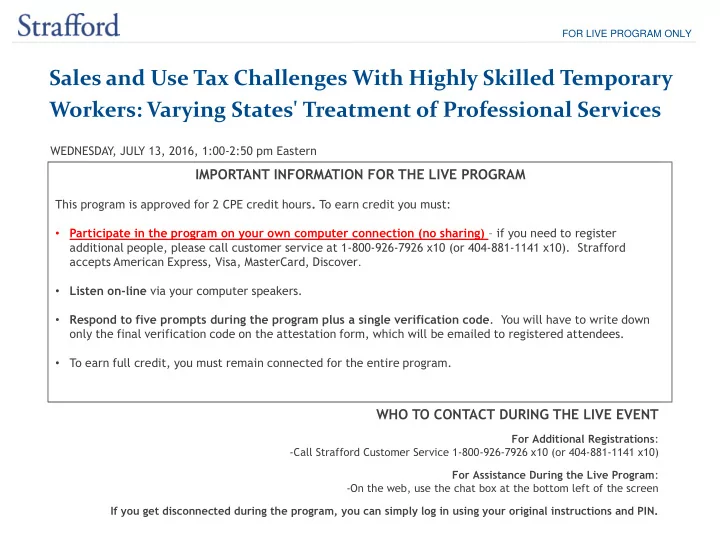
FOR LIVE PROGRAM ONLY Sales and Use Tax Challenges With Highly Skilled Temporary Workers: Varying States' Treatment of Professional Services WEDNESDAY , JULY 13, 2016, 1:00-2:50 pm Eastern IMPORTANT INFORMATION FOR THE LIVE PROGRAM This program


slide-1
SLIDE 1

WHO TO CONTACT DURING THE LIVE EVENT

For Additional Registrations:

  • Call Strafford Customer Service 1-800-926-7926 x10 (or 404-881-1141 x10)

For Assistance During the Live Program:

  • On the web, use the chat box at the bottom left of the screen

If you get disconnected during the program, you can simply log in using your original instructions and PIN.

IMPORTANT INFORMATION FOR THE LIVE PROGRAM

This program is approved for 2 CPE credit hours. To earn credit you must:

  • Participate in the program on your own computer connection (no sharing) – if you need to register

additional people, please call customer service at 1-800-926-7926 x10 (or 404-881-1141 x10). Strafford accepts American Express, Visa, MasterCard, Discover.

  • Listen on-line via your computer speakers.
  • Respond to five prompts during the program plus a single verification code. You will have to write down
  • nly the final verification code on the attestation form, which will be emailed to registered attendees.
  • To earn full credit, you must remain connected for the entire program.

Sales and Use Tax Challenges With Highly Skilled Temporary Workers: Varying States' Treatment of Professional Services

WEDNESDAY , JULY 13, 2016, 1:00-2:50 pm Eastern

FOR LIVE PROGRAM ONLY

slide-2
SLIDE 2

Tips for Optimal Quality

Sound Quality When listening via your computer speakers, please note that the quality

  • f your sound will vary depending on the speed and quality of your internet

connection. If the sound quality is not satisfactory, please e-mail sound@straffordpub.com immediately so we can address the problem.

FOR LIVE PROGRAM ONLY

2

slide-3
SLIDE 3

July 13, 2016

Sales and Use Tax Challenges With Highly Skilled Temporary Workers

Katherine Gauntt, Engagement Manager Experis, Atlanta katherine.gauntt@experis.com Chandra Ford, Tax Manager Allegis Group, Hanover, Md. chaford@allegisgroup.com

slide-4
SLIDE 4

The information contained herein is general in nature and based on authorities that are subject to change. Applicability to specific situations is to be determined through consultation with your tax adviser.

4

slide-5
SLIDE 5

AGENDA

  • 1. Evolution of Temporary Work
  • 2. Types of Employment Services
  • 3. Nexus and Sales/Use Tax Basics
  • 4. Application of Sales Tax to Employment Services
  • 5. Audit Defense

5

slide-6
SLIDE 6

EVOLUTION OF WORK 1990s to present

6

slide-7
SLIDE 7

SOURCE: https://americanstaffing.net/staffing-research-data/2015-asa-staffing-industry-economic-analysis/charts-figures/

Temporary work become commonplace in the 2000s…..

7

slide-8
SLIDE 8

Manufacturing jobs declined and the service economy grew…

8

slide-9
SLIDE 9

SOURCE: http://www.pewresearch.org/fact-tank/2015/05/11/millennials-surpass-gen-xers-as-the-largest-generation-in-u-s-labor-force/

…the Gen Xers and millennial workforce grew…

9

slide-10
SLIDE 10

…while remote work became possible through advances in technology…

10

slide-11
SLIDE 11

TYPES OF EMPLOYMENT SERVICES

11

slide-12
SLIDE 12

PERMANENT PLACEMENT OF WORKERS

IN HOUSE RECRUITMENT PROFESSIONAL EMPLOYMENT ORGANIZATIONS (PEO) EMPLOYMENT SEARCH FIRMS RECRUITMENT OUTSOURCED PROVIDERS (RPO)

Permanent placement services offered by employment firms has evolved.

1990s 2000s Present

12

slide-13
SLIDE 13

TEMPORARY WORKERS

Labor pools have evolved to highly skilled temporary workers on demand.

LABOR POOLS (MANUFACTURING)

STAFF AUGMENTATION TEMPORARY STAFFING MANAGED SERVICE PROVIDERS (MSP)

1990s 2000s Present

13

slide-14
SLIDE 14

1980s-1990s

Low Skill Labor Pools

>Factory Workers > Secretarial

2000s

Low Skill Labor Pools to Skilled Workers

> Licensed Trades

> Technology Workers > Supervisory

2010s

Skilled Workers to Professional Workers >Technology > Finance > Engineering > Medicine

Companies have outsourced human resources functions to concentrate on core

  • competencies. The labor needs of the employer have changed

from physical and low skilled labor to highly skilled knowledge based

  • labor. The skills level of the worker has evolved to meet this

demand while newer technologies facilitate efficient delivery of labor and services. Companies can now engage the best talent available for specific needs to create greater efficiencies.

14

slide-15
SLIDE 15

NEXUS AND SALES TAX BASICS

15

slide-16
SLIDE 16

Fundamental Concepts of Sales Tax

FIRST RULE – There is an exception to everything.

16

slide-17
SLIDE 17

Fundamental Concepts of Sales Tax

Nexus

  • Sufficient presence in a tax jurisdiction to create a legal requirement to collect

sales tax. Application of Tax

  • Tangible Personal Property (TPP) is taxable unless a specifically excluded by law.
  • Services are nontaxable unless specifically identified as taxable by law.

Tax Base

  • Sales price or tax base includes any product or service integral to a sale unless

excluded by law. (e.g. Freight) Exemptions or Exclusions from Sales Tax By State

  • An exclusion is based upon the legal status of the buyer and excludes tax from

sales of taxable or nontaxable goods to that entity. e.g. non-profit organizations

  • An exemption is granted to specific products if criteria based upon the nature of

the sale (e.g. resale) or the nature of the product (e.g. prescription drugs) is met

17

slide-18
SLIDE 18

Quill is still law

Quill Corp. v. North Dakota (1992) Supreme Court found sufficient physical presence to establish nexus if: the temporary or permanent presence of a single resident employee in the state (Standard Pressed Steel Co. v. Department of Revenue of Washington (1975) 419 US 560); the use of independent brokers, who were residents of the state, to solicit sales (Scripto, Inc. v. Carson (1960) 362 US 207); and the presence of advertising sales offices in the state, with activities unrelated to the mail order business (National Geographic Society v. California Board of Equalization (1977) 430 US 551).

18

slide-19
SLIDE 19

NEXUS-Now versus Then

Twentieth Century Sales Tax Nexus equaled PHYSICAL NEXUS New Millennium Sales Tax Nexus equals PHYSICAL NEXUS or “CLICK-THROUGH” NEXUS or ECONOMIC NEXUS or AFFILIATE NEXUS

19

slide-20
SLIDE 20

But…the states have enacted other types of nexus

Click Through Nexus Legislation or Policies

  • AZ, AR, CA, CT

, DC, GA, HI, IA, KS, LA, MD, ME, MI, MN, MO, ND, NJ, NM, NV, NY , NC, PA, RI, SD, TN, UT , VT , WA

Affiliate Nexus

  • MI (eff. 10/1/2015) Seller is presumed to be engaged in business if it or any
  • ther entity (i) sells a similar line of products under similar business

name;(ii) uses trademarks, service marks are trade names substantially similar; (iii) shares management , business systems, business practices, or employees; (iv) engages in intercompany transactions to establish or maintain a marketplace. Rebuttal presumption available.

  • 2016 Affiliate Nexus Legislation passed in ID, MN, OK (expanded), and RI.

20

slide-21
SLIDE 21

Economic Nexus - – Alabama challenges Quill

  • Ala. Reg. 810-6-2-.90.03, eff. January 1, 2016 - ( for sales of $250k or more)

Remote seller is presumed to have nexus if (1) Maintains, occupies, or uses an

  • ffice, place of distribution, …. or other place of business in Alabama; (2) Qualifies

to do business or registers with Alabama to collect the tax levied by the regulation; (3) Employs or contracts any representative, agent, ….or installer operating in Alabama; (4) Benefits from (i) banking, financing, debt collection...or from authorized installation, servicing, or repair facilities, (ii) Catalogs or advertising resulting in sale; (iii) Franchisees; or,(5) Solicits orders..by means of a telecommunication or television shopping system.

21

slide-22
SLIDE 22

APPLICATION OF THE TAX

22

slide-23
SLIDE 23

Temporary Services vs. Services

  • Temporary Services are defined by the service recipient’s right to direct,

supervise, and control the work the worker does as well as how the work is done.

  • Consulting Services are defined by a predetermined task or project where the

service provider controls the employee’s means and methods of providing that service. Generally, there are deliverables or outcomes the service provider must meet.

  • Permanent Placement Services is defined as a staffing firm bringing together

job seekers and potential employers for the purpose of establishing a permanent employment relationship. (ASA)

  • Professional Services are generally performed by individuals with specials skills

and knowledge requiring specialized training, education and/or accreditation

23

slide-24
SLIDE 24

Temporary Services vs. Professional Services

26 CFR 31.3401(c)-1 – Employee

§ 31.3401(c)-1 Employee. (b) Generally the relationship of employer and employee exists when the person for whom services are performed has the right to control and direct the individual who performs the services, not only as to the result to be accomplished by the work but also as to the details and means by which that result is accomplished. That is, an employee is subject to the will and control of the employer not only as to what shall be done but how it shall be done. In this connection, it is not necessary that the employer actually direct or control the manner in which the services are performed; it is sufficient if he has the right to do so. The right to discharge is also an important factor indicating that the person possessing that right is an employer. Other factors characteristic of an employer, but not necessarily present in every case, are the furnishing of tools and the furnishing of a place to work to the individual who performs the

  • services. In general, if an individual is subject to the control or direction of another merely as

to the result to be accomplished by the work and not as to the means and methods for accomplishing the result, he is not an employee.

24

slide-25
SLIDE 25

Bright Line Tests to Determine Service What are you buying/selling?

True object of the underlying transaction

  • a service recipient who wishes to receive the services of a temporary or part-

time employee

  • a service recipient who wishes to receive a specific service

Means and Methods test (Darling v. Burrone Bros., Inc., 162 Conn. 187 (Conn. 1972)) What is to be done How it is to be done When a project is complete, are the workers reassigned to a new project or task?

25

slide-26
SLIDE 26

APPLICATION OF THE TAX Taxation of Employment Services

NOTE: We will focus on “temporary services” going forward.

26

slide-27
SLIDE 27

Criteria for Taxation of Temporary Workers

  • 1. Source of Compensation for the Worker

Objective measure based on who pays worker. By definition, employer does not pay worker if worker is “temporary worker.”

  • 2. Client Supervision and Control

Subjective measure based on limited state specific criteria. Generally dependent upon state code, rulings and administrative guidance if available.

27

slide-28
SLIDE 28

DEFINITION OF “CONTROL” – FEDERAL LAW

Under federal law, “control” is determined by the “totality of the circumstances … the focus [is] on who has the right—the employer or the employee—to control the work process.” Tests for “control”:

  • Common law test is based upon who has the right to control the work process

and is generally applied under federal tax law associated with wages and retirement.

  • Economic realities test is based upon whether an individual is economically

dependent upon a business for continued employment and is applied under federal law associated with discriminatory practices. Factors such as supervision, method of payment (hourly versus fixed fee), skill level, duration of the work, who supplies tools and the extent to which the work is incorporated into the business may also be considered in evaluating a worker relationship and the degree of control.

28

slide-29
SLIDE 29

Basis of Tax States Taxing Employment Services

Citation

  • 1. Employment Services

are Taxable Services CT, IA (permanent placement only) PA, OH

  • Conn. Gen Stat. §.12-

407(a)(37)(C); Iowa Code §423.2.6.a ;. 5739.01(B)(3)(k)-(l), Ohio R.C.; 72 PS §7202

  • 2. Sales of all services

taxable without specified exemption SD, WV

§10-45-4, SDCL; § 10-45-12.1, SDCL; WV Reg. §. 110-15-8; W.Va. Reg. Sec. 110-15-33.

  • 3. Employment Services

subject to Gross Receipts Tax DE (for receipts >$1mm/mo), HI, NM,

DE Publication-Basic License and Gross Receipts Information (Sept. 20, 2000); Haw Rev Stat §. 237-13(6); 3.2.1.18 NMAC;

  • 4. Service performed by

temporary worker is a taxable service. (Underlying Service) Depends on state law. Generally involves actions upon TPP (e.g. installation, repair, maintenance)

State Specific Citations.

  • 5. Employment Services

subject to Excise Tax Based upon Business Activity (Underlying Service) Classification AZ, WA

  • Sec. 42-5061(A)(1),(2),

A.R.S., RCW 82.04.290

Understanding the Basis of Taxing Employment Services

29

slide-30
SLIDE 30

States that Specifically Tax Employment Services CONNECTICUT PENNSYLVANIA OHIO

30

slide-31
SLIDE 31

CONNECTICUT- Definition of “Employment Services”

Connecticut places more emphasis on provider type when taxing employment services. “Employment services” provide permanent placement services, whereas “personnel services” employ and pay temporary or part- time workers to perform temporary work. Both are taxable services in

  • Connecticut. Conn. Gen. Stat. §12-407(a)(37). Connecticut Reg. Sec 12-426-27(b).

31

slide-32
SLIDE 32

CONNECTICUT-Taxation of Highly Skilled Workers Providing Professional Services

Definition of “professional services” as services:

  • rendered by a member of a generally acknowledged professional occupation

requiring a degree, license or specialized training, including, but not limited to, the medical, legal, accounting and actuarial professions;

  • acting in such member’s professional capacity, and
  • that are commonly associated with such profession. Conn. Gen. Stat. §12-

407(2)(i)(J)-1(c)(3).

However, Connecticut’s definition of “sale” includes management advisory services and human resource management services and specifically excludes these services from the “professional services” definition when rendered by accountants or actuaries.

32

slide-33
SLIDE 33

PENNSYLVANIA - Definition of “Employment Services”

Pennsylvania defines taxable “help supply” services (Pennsylvania’s term for “employment services”) as the “providing of an individual by a vendor to a purchaser whereby the individual is an employee of the vendor and the work performed by the individual is under the supervision of the purchaser.” An “employee” is defined as a “person who is paid for his work or services by a vendor, including persons on the payroll or independent contractors.” In both instances, the service of providing temporary workers itself is the target of the taxation as long as control is exerted over the worker by the client company and wages are paid by the employment services firm. Pennsylvania,

  • Reg. Sec. 60.4 (a).

33

slide-34
SLIDE 34

PENNSYLVANIA – Determining the Tax Base

Pennsylvania provides three options with which to determine tax base for employment services. 1. Gross Fee Method: Total Fee 2. Service Fee Method: Gross Margin by Transaction, or 3. Average Employee Cost or Average Service Fee Method :Average Gross Margin

PA Reg. §60.4(c)(2)

This scheme can create considerable conflict between the employment services provider and the client company. Essentially, Pennsylvania puts the provider in the position of 1. minimizing its audit risk by imposing tax on the highest possible amount, 2. assuming audit risk by having to defend an “average fee,” or 3. charging the minimal amount of sales tax by disclosing its profit margin and worker pay to the client company and any competitors with access to invoice data. Sellers of other TPP or taxable services do not face similar customer service dilemmas.

34

slide-35
SLIDE 35

OHIO - Definition of “Employment Services”

Ohio defines an “employment service” as “the providing or supplying of personnel, on a temporary or long-term basis, to perform work under another’s supervision or control, when the personnel receive their wages, salary, or other compensation from the supplier or provider of the employment service or from a third party that provided or supplied the personnel to the provider or supplier.” Sec. 5739.01(JJ), Ohio R.C.; Sales and Use Tax Information Release ST 1993-08, Ohio Department of Taxation, revised Feb. 2007.

35

slide-36
SLIDE 36

OHIO – Resale of of “Employment Services

Ohio only recognizes the “resale of services” exemption if the temporary services are sold by one employment services firm to another. If the “temporary services” are resold to any firm other than another employment services firm, the nature of the service is deemed to have changed from an “employment service” to another taxable or non-taxable service type regardless of whether the benefit of the service or the utilization of the temporary worker’s skills does not change. Ohio’s position is based upon Crew 4 You, Inc. v. Wilkins, where a temporary services firm provided workers to perform taxable underlying services. In this case, the taxable temporary service provided by Crew 4 You was deemed to have been consumed by the client who then performed another underlying taxable service for its client. Under this scenario, the courts ruled that the resale exemption did not apply Crew 4 You, Inc. v. Wilkins, 105 Ohio St3d 356, 2005-

Ohio-2167 (May 18, 2005).

36

slide-37
SLIDE 37

States Taxing Receipts from All Services South Dakota West Virginia

37

slide-38
SLIDE 38

SOUTH DAKOTA

South Dakota imposes “a tax at the same rate as that imposed upon sales of tangible personal property ..upon the gross receipts of any person from the engaging or continuing in the practice of any business in which a service is

  • rendered. ‘Service’ means all activities engaged in for other persons for a

fee, retainer, commission, or other monetary charge,…….In determining what is a service, the intended use, principal objective or ultimate objective of the contracting parties shall not be controlling. (Sec. 10-45-4, SDCL Sec. 10-45-4,

SDCL)

38

slide-39
SLIDE 39

WEST VIRGINIA

West Virginia 11-15-2(b)(18) imposes a tax upon “the furnishing of all services, except professional and personal services, …”"Service" or "selected service" includes all nonprofessional activities engaged in for other persons for a consideration, which involve the rendering of a service as distinguished from the sale of tangible personal property or custom software, but does not include contracting [i.e. construction services], personal services or the services rendered by an employee to his or her employer or any service rendered for resale. W.Va. Code Sec. 11-15-2(b)(17) ; W.Va. Code Sec. 11-15-8

39

slide-40
SLIDE 40

States Taxing Receipts from Employment Services Delaware Hawaii New Mexico

40

slide-41
SLIDE 41

DELAWARE- Tax is on the Seller

Delaware applies its gross receipts tax to gross receipts greater than $1 million per month without deduction for wages, benefits, state or federal taxes or any other expenses associated with the provision of employment services. NOTE: This is a tax on the Seller. It cannot be passed through to the Purchaser.

Delaware Department of Finance, Division of Revenue, Basic License and Gross Receipts Information (Sept. 20, 2000).

41

slide-42
SLIDE 42

HAWAII – Tax can be Passed to Buyer

Hawaii 237-13(6)(A) applies an excise tax upon “every person engaging …in any service business or calling including professional services not otherwise specifically taxed ……is likewise hereby levied and shall be assessed and collected a tax equal to four per cent of the gross income of the business.”

Haw Rev Stat §. 237-13(6)

42

slide-43
SLIDE 43

NEW MEXICO- Sales of Services to Government Entities are Taxable

New Mexico applies its gross receipts tax to all “Receipts derived from performing a service in New Mexico …unless a specific exemption or deduction provided for in the Gross Receipts and Compensating Tax Act applies.” 3.2.1.18 NMAC Receipts from the sale of a service to a governmental agency are not deductible pursuant to Section 7-9-54. Only the receipts from selling tangible personal property to a governmental agency are deductible. 3.2.212.9NMAC.A.

43

slide-44
SLIDE 44

States Taxing Receipts from Underlying Services

* Depends on Whether State Specifically Subjects Certain Services to Tax AND State Law Specific to the Sale of Services.

44

slide-45
SLIDE 45

Common Taxable Services Performed by Temporary Workers

  • 1. Computer Services Performed on Tangible Personal Property
  • 2. Installation, Repair and Maintenance Services Performed on Tangible Personal

Property

  • 3. General Services such as Cleaning, Landscaping, Security Services

45

slide-46
SLIDE 46

It’s important to note that there is very little guidance by the states on the taxation of underlying services when performed by a temporary

  • worker. Some states are more aggressive in this area than others and a

thorough reading of each state’s law should be conducted to ensure

  • compliance. Generally, the law is written for a situation where the Service

Provider is also the Seller of the TPP that is the object of the service, The following is a list of taxable services in specific states. The extent to which that same service is taxable when performed by a temporary worker is dependent upon the tax code and state policy.

46

slide-47
SLIDE 47

Taxable Computer Services

STATES WHERE SET-UP OF CUSTOM SOFTWARE IS TAXABLE WHEN VENDOR IS NOT THE SELLER OF THE SOFTWARE:

CT, DC, HI, IN, MS, NE, SD, TN, TX, WV, WY

(SOURCE: CCH Smart Charts™ - Exceptions Apply – Refer to specific Jurisdictional Tax Code)

47

slide-48
SLIDE 48

Taxable Repair of TPP

STATES WHERE LABOR TO REPAIR TPP IS TAXABLE

AR, CT, DC, FL, HI, IA, KS, LA, MS, NE, NJ, NM, OH, PA, SD, TN, TX, UT, WA, WV, WI, WY

(SOURCE: CCH Smart Charts™ - Exceptions Apply – Refer to specific Jurisdictional Tax Code)

48

slide-49
SLIDE 49

Taxable Cleaning, Landscaping, Security Services

(SOURCE: CCH Smart Charts™ - Exceptions Apply – Refer to specific Jurisdictional Tax Code)

CLEANING LANDSCAPING SECURITY

AR, DC, FL, HI, IA, LA, MD, MN, NE, NJ, NM, NY , OH, PA, SD, WV AZ, AR, CT , DC, HI, IA, MN, MS, NE, NJ, NM, NY ,OH, SD, TX, WA, WV, WI AR, CT , DC, FL, GA, HI, IA, MD, MN, MS, NE, NJ, NM, NY , OH, SD, TX, WA, WV

49

slide-50
SLIDE 50

NEW JERSEY- No Precedent-Just Policy

Labor Ready Northeast, Inc. v. Director, Division of Taxation. Labor Ready and the Division of Taxation settled a 2008 audit assessment after which the Division sent Labor Ready a letter stating:

“…if the services performed are taxable services, Labor Ready is required to collect … sales tax from its clients, based on the amount charged for the worker's services, regardless of how calculated.” It then went on to elaborate its conclusion by enumerating the circumstances pertaining to taxability of Labor Ready's activities, namely: (1) where an enumerated service is performed directly for Labor Ready's client, “tax must be charged” since there is no third-party involved; (2) where Labor Ready provides workers to a client, and the client uses the workers to perform a nontaxable or non-enumerated service, “tax is not due;” (3) where Labor Ready's client uses Labor Ready's worker to perform services “engaged in by Client's own employees” for resale to a third party, then “a resale exemption may be claimed;” and (4) if Labor Ready's worker performs taxable services for a contractor ( e.g., snow removal), the services are taxable, however, if the worker is “acting as a subcontractor” or performing nontaxable services ( e.g., assisting or helping a plumber), the “transactions are not subject to tax.” The Court denied both parties motion for Summary Judgment on technical grounds. However,, the guidance issued to Labor Ready based on the Division’s letter is indicative of how the Division will continue to treat underlying services until such time as the Court rules on its application to all temporary service providers. New Jersey Tax Court, No. 000359-2010, 25 N.J.Tax 607, January 6, 2011

50

slide-51
SLIDE 51

FLORIDA- The “Control” Issue Works Both Ways

Technical Assistance Advisement No. 97A-048, Florida Department of Revenue, July 11, 1997 Cleaning services performed by a person hired as a temporary employee, which are performed at the discretion and under the direction of the customer (i.e., temporary employer), would not be construed as taxable nonresidential cleaning services. Conversely, if a temporary staffing company provides the labor, on-site supervision and process “know-how”, and/or the implements (vacuums, mops, brooms, pails, sponges, soaps, etc.) necessary to accomplish the cleaning activities, the company is engaged in the business of providing a [taxable] cleaning service. This guidance underscores the key criteria of wages and control. However, the burden of proof is on the taxpayer to prove that “control” is exerted by the customer in this instance.

51

slide-52
SLIDE 52

Tennessee- A Lesson in “True Object”

Tennessee Department of Revenue, LTR 14-11 (Oct. 30, 2014)- Ruling was in favor of the taxpayer providing staff augmentation services but….….the department of revenue opined that “… when outsourcing operations to service providers … the question often arises as to whether characterization of the service should be limited to what the service provider claims to provide, or should be properly characterized according to the true object of the customer’s broader operation for which service is rendered…. Under Tennessee law, the provision of temporary workers is not a taxable service, but repairing tangible personal property is a taxable service. Accordingly, a court would have to determine the true object of the transaction to determine the sales tax consequences of the transaction [emphasis added] …. the taxpayer should determine whether ‘the true object of the transaction or any of the ‘crucial,’ ‘essential,’ ‘necessary,’ ‘consequential,’ or ‘integral’ elements thereof would be subject to sales tax. If so, the entire transaction is subject to sales tax.” Using this analysis, the characterization of the service provided by the staffing company is based on the “true object” of the totality of the service which may not be disclosed to the temporary services provider.

52

slide-53
SLIDE 53

States Assessing Excise Taxes Based on the Underlying Services AZ, WA

53

slide-54
SLIDE 54

ARIZONA- Type of Business Drive Taxation

Arizona imposes the transaction privilege tax upon sellers of services falling into the amusement, intrastate telecommunications and transportation services business classifications. Services that are not specifically included in the classifications, such employment services, are deemed nontaxable. However, if the underlying service falls into one of these business classifications and constitutes a separate business under the test put forth in State Tax Commission v. Holmes & Narver, Inc., (State Tax Commission v. Holmes

& Narver, Inc., 113 Ariz. 165, 548 P2d 1162 (1976). §42-5073 ARS; §42-5064 ARS; §42- 5062 ARS.)

54

slide-55
SLIDE 55

WASHINGTON- B&O Tax Rates Are Determined by Underlying Service Tax Status

Washington’s taxation of underlying services is based upon business activity classifications similar to Arizona. Unlike Arizona, however, its retail sales classification incorporates both the sale of TPP and the sale of certain

  • services. Employment services providers must collect and remit the retail

sales tax when they provide temporary workers that perform retail services. Only specified services are taxable in Washington and include canned software installation, TPP repair and hardware repair and maintenance. The business classification for sales tax purposes also impacts the allocation of Washington’s business and occupation tax where different rates may be

  • applied. (Wash. Rev. Code Sec. 82.04.290; Wash. Rev. Code Sec. 82.04.540; Wash.

Special Notice, Employment Services, Washington Department of Revenue, Aug. 11, 2009., Wash. Rev. Code Sec. 82.04.215; Wash. Rev. Code Sec. 82.04.050(3)., Wash. Rev. Code Sec. 82.04.290; Wash. Rev. Code Sec. 82.04.540)

55

slide-56
SLIDE 56

AUDIT DEFENSE CONSIDERATIONS

56

slide-57
SLIDE 57

Audit Support and Documentation Issues

  • High data volume and multiple data sources retain the data which drives

taxability

  • Inconsistent exemption certificate administration is required due to differing

rules on resale administration

  • Customized contracts and free form job descriptions may increase

administrative burden and have unintended consequences

  • Remote workers may impact sourcing
  • Multiple fee structures may create tax base issues

57

slide-58
SLIDE 58

MULTIPLE DATA SOURCES FOR TAX DETERMINATION

CLIENT DATA

  • WORKSITE
  • JOB TITLE
  • JOB DESC

STAFF CO DATA

  • PAY RATE
  • BILL RATE
  • WORKER

VENDOR MANAGEMENT SYSTEM (VMS) BILLING SYSTEM Job ID Code Worksite Bill Rate

Tax Decision

SOURCE Key Fields for Tax Calculations CLIENT DATA/ VMS SERVICE Job Description Provides Details of Underlying Service CLIENT DATA/ VMS SITUS Worksite Determines Tax Law and Tax Rates that Apply BILLING SYSTEM – TAX DETERMINATION TAXABLE –Y/N Manual or Automated – Generally associated with Billing System BILLING SYSTEM BILL RATE Basis for Calculating Tax Base STAFF CO/ VMS PAY RATE Basis for Offsets (Pennsylvania Only)

58

slide-59
SLIDE 59

Resale of Temporary Services

Acceptable Exemption Documentation State issued Direct Pay Permit Blanket exemption certificate Properly executed Resale

59

slide-60
SLIDE 60

Resale of Temporary Services

Tax law is written with assumption that service is sold with TPP. The code is limited or silent in most states on resale of services. However, some states have guidance: Connecticut has the most extensive guidance. the sale of a service [must] be “an integral and inseparable component of one of the enumerated services that the purchaser will subsequently sell to an ultimate consumer.” Examples are provided in the code to better determine what an “integral and inseparable” component may be. Reg. Sec. 12-410(5)-1; Reg. Sec. 12-411(14)-1.

60

slide-61
SLIDE 61

Resale of Temporary Services

Pennsylvania takes the position that the provision of “help supply service” is any service where the employee is paid by the employment services provider and is under the “control” of the client. The nature of the work and the business classification is irrelevant if these two criteria apply. As such, the resale exemption is applicable regardless of whether a provider in the business of providing temporary services sells to a provider of technology services as long as the technology services provider meets Pennsylvania’s definition for “help supply services.” 72 PS §7201(k)(8).

61

slide-62
SLIDE 62

Resale of Temporary Services

Ohio requires that for resale of services to apply, the service must be sold in the same form in which it was purchased. As such, employment service providers may only resell to other employment service providers for Ohio to recognize the exclusion. Ohio R.C. 5739.01 (JJ)(5)

62

slide-63
SLIDE 63

Resale of Temporary Services

New Mexico requires that for resale of services to apply, the buyer must resell the service in the ordinary course of business and the resale must be subject to the gross receipts tax. NMSA 1978, § 7-9-48

63

slide-64
SLIDE 64

Sourcing

Remote workers performing tasks providing benefit is certain states may be subject to tax. Ohio take the position that sales of taxable services will be sourced to the location where the consumer receives the service, no matter where the service provider is located. One could argue that the remote upgrade of a computer system might benefit the company in multiple locations both inside and outside Ohio. However, if the worker is sourced from an employment services provider, the total fee for that worker will be subject to Ohio tax under current law. Information Release ST 2009-03, Ohio Department of Taxation (Dec. 2009).

64

slide-65
SLIDE 65

Tax Base

Tax Base for fee structures other than hourly rates are difficult to administer:

  • Fixed Fee transactions will be taxed in their entirety on sales of taxable

services.

  • Fees based on percentage of compensation must be clearly and separately

stated.

  • Contingent fees are variable for the same service.

65

slide-66
SLIDE 66

FUTURE TRENDS

66

slide-67
SLIDE 67

Companies are Returning to Core Competencies

Companies are returning to Core Competencies and outsourcing or co-sourcing human resource functions.

  • BPO (Business Process Outsourcing) – Help Desks, Shared Services Centers,

Call Centers

  • RPO (Recruitment Process Outsourcing)- Attracting, selecting and engaging

candidates for temporary or permanent jobs

  • MSP (Managed Service Providers) – Provides the administration associated

with supplying temporary workers from preferred suppliers.

Assimilation of better communication and technologies into work administration

  • Increase in usage of ATS (Applicant Tracking Software)
  • Increase in usage of VMS (Vendor Management Software)
  • Scaling communication and technology into cloud
  • Increase in remote workers

67

slide-68
SLIDE 68

Work is Changing

  • Over time, demand has shifted from lower skilled manufacturing work to the so-

called white collar or knowledge worker. Manufacturers’ Outsourcing to Staffing Services, Upjohn

Institute Staff Working Paper No. 07-132, Dec. 2006.

  • 38% of the U.S. employers experience difficulty filling mission-critical positions.

ManpowerGroup 2015 Talent Shortage Survey www.manpowergroup.com/talentsurvey.

  • By 2020, there will be a world-wide shortage of skilled college-educated workers

representing 13 percent of demand. McKinsey Global Institute, THE WORLD AT WORK: JOBS, PAY, AND SKILLS

FOR 3.5 BILLION PEOPLE June 2012

  • A 2014 survey of business leaders at the Global Leadership Summit found that 34

percent indicated that more than half of their company’s full-time workforce would be working remotely by 2020. Laura Vanderkam, Will Half of People be Working Remotely by

2020?, FAST COMPANY (Aug. 2014). 68