s Guided: Students repeat process with their own writing. - - PDF document

s
SMART_READER_LITE
LIVE PREVIEW

s Guided: Students repeat process with their own writing. - - PDF document

Week Anchor Lesson: Getting to 1 Feelings and Emotions through Pre-Writing Model: Brainstorm, What does Conne Belonging mean to me? ct Guided: Students generate their own personal brainstorm. Model: Respond


slide-1
SLIDE 1

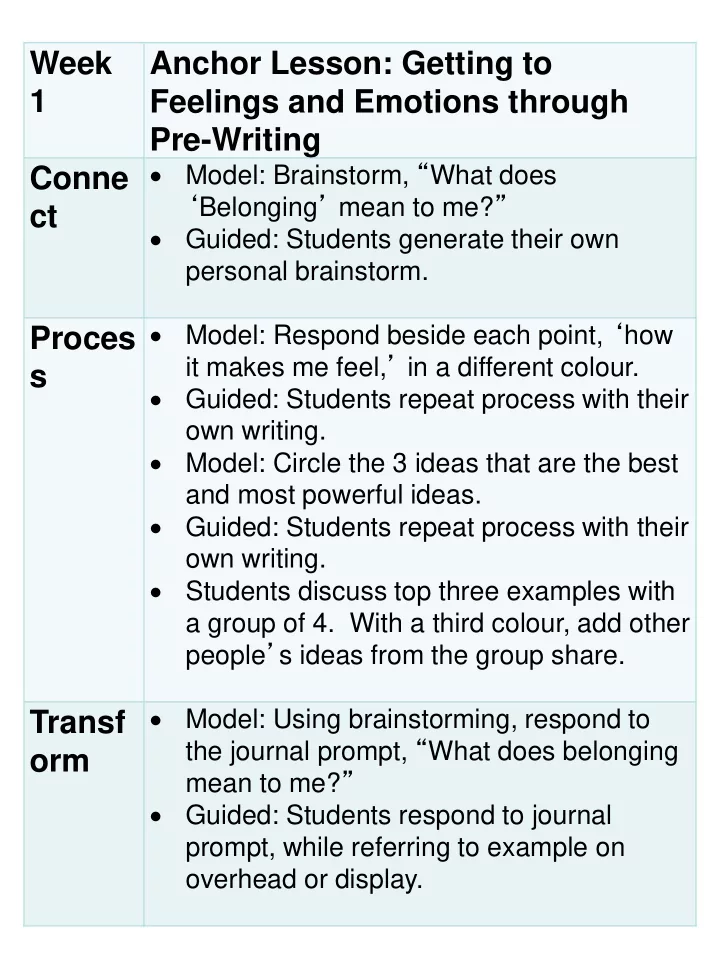
Week 1 Anchor Lesson: Getting to Feelings and Emotions through Pre-Writing Conne ct

 Model: Brainstorm, “What does ‘Belonging’ mean to me?”  Guided: Students generate their own personal brainstorm.

Proces s

 Model: Respond beside each point, ‘how it makes me feel,’ in a different colour.  Guided: Students repeat process with their

  • wn writing.

 Model: Circle the 3 ideas that are the best and most powerful ideas.  Guided: Students repeat process with their

  • wn writing.

 Students discuss top three examples with a group of 4. With a third colour, add other people’s ideas from the group share.

Transf

  • rm

 Model: Using brainstorming, respond to the journal prompt, “What does belonging mean to me?”  Guided: Students respond to journal prompt, while referring to example on

  • verhead or display.
slide-2
SLIDE 2
slide-3
SLIDE 3

Week 2 Anchor Lesson: Analyzing Peer Writing for Strengths Connect  Students look at 3 samples of journal entries (ranging in ability levels, but all having an area of strength) and generate what makes them powerful. Process  Using a graphic organizer (think- group-share) groups come up with 5 criteria to share with the class. These ideas are recorded on chart paper. Transform  After discussion, students brainstorm and respond to the journal entry, “What can belonging look like and feel like in our classroom?” Follow up lessons based on student need Examples: Continue to refer to student generated to criteria writing continued journal responses Writing organized paragraphs Carrying over writing skills to other content areas

slide-4
SLIDE 4
slide-5
SLIDE 5

What Makes a Powerful ? My Ideas…

  • _________
  • _________
  • _________
  • _________
  • _________
  • _________

Group Ideas

  • _________
  • _________
  • _________
  • _________
  • _________
  • _________

Class Ideas…

  • _________
  • _________
  • _________
  • _________
  • _________
  • _________

Schnellert, 2010

slide-6
SLIDE 6

Week 3 Anchor lesson: Sorting and Classifying Criteria

Connect 

In groups of 4, students are given an envelope with all the powerful journal entry criteria brainstormed in week 2, typed up in strips. Student group the ideas by concept or theme and come up with a title or reason for each group.

Process

 Grouped strips are attached to coloured paper with the category title.  The class analyzed each group’s proposal, and lists titles on overhead. They choose the criteria that represent the class the best.

Transfor m

 The groups then go back and regroup the remaining criteria using the same process. A vote can be taken if class consensus cannot be reached.

Follow up lessons based

  • n

student need

Examples: Brainstorming using specific examples and details Using highlighters to mark beginnings and endings

  • f paragraphs

Ongoing lessons on cooperative learning

slide-7
SLIDE 7
slide-8
SLIDE 8
slide-9
SLIDE 9
slide-10
SLIDE 10
slide-11
SLIDE 11
slide-12
SLIDE 12
slide-13
SLIDE 13
slide-14
SLIDE 14
slide-15
SLIDE 15

Week 4 Anchor lesson: The Art of Noticing Connect

 Students are asked to identify a piece of writing that they believe meet one of the criteria categories particularly well. This can be done in partners or small groups.

Process

 Model: Read aloud piece of writing.  Model: Refer to posted criteria and read piece again looking for example.  Guided: Students continue reading in partners and look for more examples of criteria.  Guided: Students in partners come up and underline examples they find and label it with criteria title.  Independent: Students bring out their own writing and underline phrases or sentences that demonstrate criteria, and labeled criteria beside it.

Transform

 Each student share a quote and the class guess which criteria it meets. Students choose one of the criteria discussed to focus

  • n in their next writing piece.

Follow up lessons based

  • n student

need

Examples: Looking for examples of criteria in their writing Setting goals related to criteria before writing

slide-16
SLIDE 16
slide-17
SLIDE 17

Our Journal Criteria

Good d Start rt Ev Even n Better ter WOW!

Thinking It Through

  • feelings, real

events, thoughts pictures, drawings

Sounds Great

  • exciting, good

explanations, interesting/ descriptive, detail, good use of words

Final Touch

  • Good

sentences,

  • rganized,

easy to read, neatness

slide-18
SLIDE 18

Week 5 Anchor lesson: Making Revisions in Your Writing Connect

 As a class, define ‘revision,’ by discussing, “how can I as a writer better get my message across?” Set the goal for the lesson: to look at our work and identify one criteria area to focus on to make

  • ur writing better.

Process

 Model: Choose one really good sentence from your piece that is descriptive or powerful.  Model: Using pre-prepared graphic organizer of titles and criteria created, write the phrase you found into the ‘Good Start’ section of the

  • rganizer.

 Guided: Using A/B partners, discuss what could be done to make the sentence more descriptive.  Discuss with the class and revise the sentence based on their advice.

Transform

 Repeat the process and have the students choose a sentence to write in their organizer and

  • revise. Finish the class by having students share

the first and the revised versions of their sentences.

Follow up lessons based on student need

Examples: Continuing to write and revise aspects of pieces Student- teacher conferences to take to ‘WOW’ stage Student- peer conferences to describe types of revisions made

slide-19
SLIDE 19

Week 6 Anchor lesson: Graffiti and Conversation Connect  Review generated criteria as a class Process  Students choose from 2 criteria categories to target while writing that day.  Class is divided in 6 groups. Each graffiti ‘palette’ had a content-based prompt in the center. Students have 10 minutes to write before rotating to the next topic.  Students examine results, taking turns reading quotes from palettes. Transform  Students choose one of the prompts to write about independently, including using a journal organizer which includes ‘thinking space’ for pre-writing. Follow up lessons based on student need Examples: Brainstorming powerful ideas and possible prompts for writing in other content areas

slide-20
SLIDE 20

Week 7 Anchor lesson: Cracking Open Your Topic: Getting Beyond Listing

Connect

 Look at a list of topics generated by the class and discuss in partners how to choose a topic that yields the best personal writing.

Process

 Model: Brainstorm initial ideas about a content concept.  Guided: Students choose a topic from the list to write about and brainstorm their initial ideas.  Model: Think aloud which ideas you have strong examples and details for and write down them down being sure to connect the topic and the idea with it. Repeat modeling process several times.  Guided: Students follow same process.  Model: Write an entry using brainstorm and details or examples.

Transform

 Students write their own entry following process.

Follow up lessons based on student need

Examples: Targeting specific aspects missing from writing Using background knowledge- choosing a topic you have a strong opinion on Stretching out moments in our writing Effective endings including opinions, questions and

  • bservations

Extending pieces with personal stories and examples

slide-21
SLIDE 21

Week 8 Anchor lesson: Getting Ready for Evaluation

Connect  Review class generated criteria and categories. Process  As a class, discuss if there is anything to add, based on mini lessons taught throughout the unit.  Talk about the column, which would clarify the ‘I’m There’ category in the 4 descriptors of: ‘Good Start,’ ‘Getting There,’ ‘I’m There’ and ‘WOW.’ Transfor m  Student look at their own work to find sentences that for the specific criteria. Evaluati

  • n

 Students chose 3 pieces of writing to take to the almost published form taken through the stages from a ‘Good Start’ to ‘WOW.’  An in-class ‘demand’ write combined with journal pieces were used to constitute their mark for the term.  Rubric reviewed with class and students were given a copy to refer to while taking pieces to final copy.

slide-22
SLIDE 22
slide-23
SLIDE 23

Our Journal Criteria

Good

  • d

Start art Even Bette ter I’m m Ther ere WOW! W!

Thinking It Through

  • feelings, real

events, thoughts Pictures, drawings

Sounds Great

  • exciting, good

explanations, interesting/ descriptive, detail, good use of words

Getting Up & Organized

  • -ideas well organized,

interesting beginning, well developed middle, powerful ending, one main idea in each paragraph

Final Touch

  • Good sentences,
  • rganized,

easy to read, neatness

slide-24
SLIDE 24

References

BC Performance Standards www.bced.gov.bc.ca/perf_stands Barton, M. & Heidema, C. (2002) Teaching Reading in Mathematics Mid-continent Research for Education and Learning. Barton, M & Jordan, D. (2001) Teaching Reading in Science ASCD. Bennett, B. & Rolheiser, C. (2001). Beyond Monet: The Artful Science of Instructional Integration. Bookation. Brown, A., Cocking, R., & Bransford, J., Eds. (2000). How People Learn: Brain, Mind, Experience, & School. National Academy Press. Brownlie, F. Feniak, C. & Schnellert, L. (2006). Student Diversity, 2nd ed., Pembroke. Buehl, D. (2001). Classroom Strategies for Interactive Learning,IRA. Butler, D. L., Schnellert, L., & Cartier, S. C. (2005). Adolescents' engagement in "reading to learn": Bridging from assessment to instruction. BC Educational Leadership Research, 2. Daniels, H. & Bizar, M. (2005).Teaching the best practice way: Methods that matter, K-12 Pembroke Publishers. Doty, J. Cameron, G. Barton, M. (2003) Teaching Reading in Social Studies Mid- continent Research for Education and Learning. Gregory, K., Cameron, C. & and Davies, A. (2000). Setting and Using Criteria: For Use in Middle and Secondary Classrooms, Connections Publishing, BC, Canada. Hourcade, J.J., & Bauwens, J. (2002). Cooperative Teaching: Rebuilding and Sharing the Schoolhouse. Austin, TX: ProEd Inc. Joyce, B., Hrycauk, M., & Calhoun, E. (2001 March). A Second Chance for Struggling Readers. Educational Leadership, 42-46. Lenz, B.K., Deschler, D.D. & Kissam, B.R. (2004). Teaching content to all: Evidence-based inclusive practices in middle and secondary schools. Boston: Allyn & Bacon. Marzano, R., Pickering, D., & Pollack, J. (2001). Classroom Instruction That Works: Research-Based Strategies for Increasing Student Achievement ASCD. Murawski, W.W., & Dieker, L.A. (2004). Tips and strategies for co-teaching at the secondary level. Teaching Exceptional Children, 36, 52-58. Schnellert, L. Butler, D. & Higginson, S. (2008). Co-constructors of data, co- constructors of meaning: Teacher professional development in an age of

  • accountability. Teaching and Teacher Education..

Throneburg, R.N., Calvery, L.K., Sturm, J. J., Paramboukas, A.A., & Paul, P.J. (2000). A comparison of service delivery models: Effects on curricular vocabulary skills in the school setting. American Journal of Speech- Language Pathology, 9, 10-20. Walsh, J.M., & Jones, B. (2004). New models of cooperative teaching. Teaching Exceptional Children, 36, 14-20.