S ENTENCES IN FOL Cube(a) xCube(x) a is a cube For any x, x is a - - PowerPoint PPT Presentation

s entences in fol
SMART_READER_LITE
LIVE PREVIEW

S ENTENCES IN FOL Cube(a) xCube(x) a is a cube For any x, x is a - - PowerPoint PPT Presentation

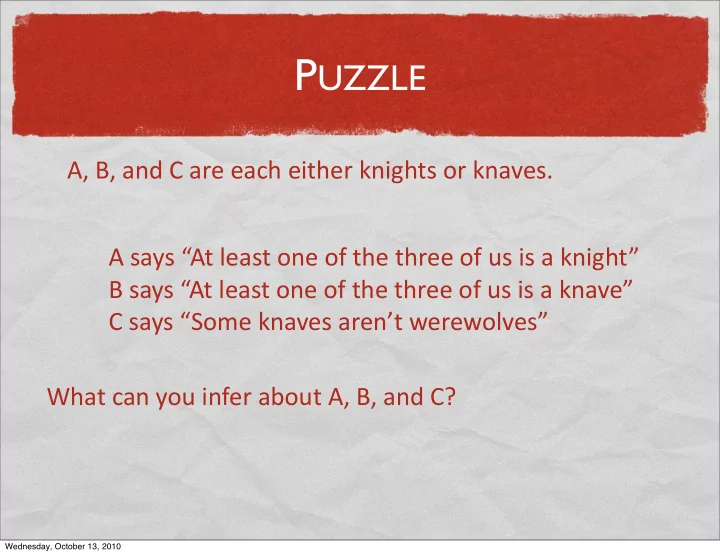
P UZZLE A, B, and C are each either knights or knaves. A says At least one of the three of us is a knight B says At least one


slide-1
SLIDE 1

PUZZLE

A, ¡B, ¡and ¡C ¡are ¡each ¡either ¡knights ¡or ¡knaves. ¡ ¡ What ¡can ¡you ¡infer ¡about ¡A, ¡B, ¡and ¡C? A ¡says ¡“At ¡least ¡one ¡of ¡the ¡three ¡of ¡us ¡is ¡a ¡knight” B ¡says ¡“At ¡least ¡one ¡of ¡the ¡three ¡of ¡us ¡is ¡a ¡knave” C ¡says ¡“Some ¡knaves ¡aren’t ¡werewolves”

Wednesday, October 13, 2010

slide-2
SLIDE 2

QUANTIFIERS

Wednesday, 13 October

Wednesday, October 13, 2010

slide-3
SLIDE 3

SENTENCES IN FOL

Cube(a) True in a world if a is a cube in that world a is a cube

∀xCube(x)

True in a world if every

  • bject in that world is a cube

For any x, x is a cube

Wednesday, October 13, 2010

slide-4
SLIDE 4

SENTENCES IN FOL

Cube(a) True in a world if a is a cube in that world a is a cube

∃xCube(x)

True in a world if at least one

  • bject in that world is a cube

For at least one x, x is a cube Cube(x) - Not true or false - not even a sentence

Wednesday, October 13, 2010

slide-5
SLIDE 5

WELL-FORMED FORMULAS

Both constants and variables are terms, as are functions applied to terms. An atomic well-formed formula (wff) is a predicate followed by the appropriate number of terms. If P is a wff, so is ¬P . If P and Q are wffs, so is (P ∧ Q). If P and Q are wffs, so is (P ∨ Q). If P and Q are wffs, so is (P → Q). If P and Q are wffs, so is (P ↔ Q).

Wednesday, October 13, 2010

slide-6
SLIDE 6

WELL-FORMED FORMULAS

If P is a wff and v is a variable, then ∀v P is a wff, and any occurrence of v in ∀v P is said to be bound. If P is a wff and v is a variable, then ∃v P is a wff, and any occurrence of v in ∃v P is said to be bound. Complex wffs are formed out of atomic wffs according to these rules. (Compare to complex and atomic sentences from propositional logic.) Wffs are not ambiguous.

Wednesday, October 13, 2010

slide-7
SLIDE 7

WELL-FORMED FORMULAS

wffs not wffs ∀x Cube(x) ∀ Cube(b) Taller(Claire, x) Taller(x ∧ Claire)

∀x∃y Smaller(y, x) Small(a) ∧ Cube(a) ∨ Small(b)

A variable is bound if it is under the scope of a quantifier;

a variable is free if it is not bound.

A wff is a sentence iff it has no free variables.

Wednesday, October 13, 2010

slide-8
SLIDE 8

WELL-FORMED FORMULAS

wffs with free variables sentences Home(u) ∀u Home(u)

∃v(Cube(v)∧Small(u)) ∃v(Cube(v)∧Small(v)) ∀uLarge(u)∧Dodec(u) ∀u∃v(Large(u)∧Dodec(v)) ∃v ¬Cube(u) ∃v Small(v)

A wff with free variables is neither true nor false; a sentence is either true or false in a particular world.

Parentheses are important to whether a wff is a sentence: ∃vCube(v)∧Small(v) vs. ∃v(Cube(v)∧Small(v))

Wednesday, October 13, 2010

slide-9
SLIDE 9

SATISFACTION

An object satisfies a wff with a free variable such as Cube(x) iff it is a cube; an object satisfies Dodec(y) ∧¬Small(y) iff it is a dodecahedron and not small, etc. Remember that a free variable is a placeholder. Suppose S(x) is a wff with x as its only free variable. An object satisfies S(x) iff the sentence S(b) is true, where b is a constant that names the object.

Wednesday, October 13, 2010

slide-10
SLIDE 10

SATISFACTION

Unnamed objects can also satisfy wffs. An object satisfies S(x) iff the sentence S(n1) is true, where n1 is a constant that names the object, possibly temporarily. We can use satisfaction to define truth values for sentences containing quantifiers: A sentence of the form ∀x S(x) is true iff the wff S(x) is satisfied by every object in the domain of discourse. A sentence of the form ∃x S(x) is true iff the wff S(x) is satisfied by some object in the domain of discourse.

Wednesday, October 13, 2010

slide-11
SLIDE 11

ARISTOTELIAN FORMS

Forms: Examples: All Ps are Qs. All mammals are animals. Some Ps are Qs. Some mammals live in water. No Ps are Qs. No humans have wings. Some Ps are not Qs. Some birds cannot fly.

Wednesday, October 13, 2010

slide-12
SLIDE 12

ARISTOTELIAN FORMS

Forms: QL sentence: All Ps are Qs. ∀x(P(x)→Q(x)) Some Ps are Qs. ∃x(P(x)∧Q(x)) No Ps are Qs. ∀x(P(x)→¬Q(x)) Some Ps are not Qs. ∃x(P(x)∧¬Q(x))

Wednesday, October 13, 2010

slide-13
SLIDE 13

SATISFACTION

F T T T F F T T

∀x Cube(x) ∃x Cube(x) ∀x(Cube(x)∨Tet(x)) ∃x(Cube(x)∨Dodec(x)) ∀x(Cube(x)→Small(x)) ∀x(Cube(x)→¬Medium(x)) ∀x(Dodec(x)→Cube(x)) ∃x(Cube(x)→Large(x))

Wednesday, October 13, 2010

slide-14
SLIDE 14

COMPLEX PREDICATES

Some Ps are Qs

∃x(P(x) ∧ Q(x))

Some Ps that are also Rs are Qs

∃x([P(x)∧R(x)] ∧ Q(x))

Some cubes are to the right of a

∃x(Cubes(x) ∧ RightOf(x,a))

Some small cubes are to the right of a

∃x([Small(x)∧Cube(x)] ∧

RightOf(x,a))

Wednesday, October 13, 2010

slide-15
SLIDE 15

COMPLEX PREDICATES

There is a large cube to the left of b

∃x(L(x)∧C(x)∧LO(x,b))

There is a cube to the left of b which is in the same row as c b is in the same row as a large cube

∃y(C(y)∧LO(y,b)∧SR(y,c)) ∃x(L(x)∧C(x)∧SR(b,x))

Wednesday, October 13, 2010

slide-16
SLIDE 16

COMPLEX PREDICATES

All Ps are Qs

∀x(P(x) → Q(x))

All Ps that are also Rs are Qs

∀x([P(x)∧R(x)] → Q(x))

All cubes are to the right of a

∀x(Cubes(x) → RightOf(x,a))

All small cubes are to the right of a

∀z([Small(z)∧Cube(z)] →

RightOf(z,a))

Wednesday, October 13, 2010

slide-17
SLIDE 17

COMPLEX PREDICATES

Every tall boy is a happy painter

∀x([T(x)∧B(x)]→ [H(x)∧P(x)])

Not every cube in the same row as b is medium No cubes in the same row as b are medium Every cube that is either small or medium is smaller than b

¬∀w([C(w)∧SR(w,b)] → M(w)) ∀x([C(x)∧SR(x,b)] → ¬M(x)) ∀x([C(x)∧(S(x)∨M(x))]

→ Sm(x,b))

Wednesday, October 13, 2010

slide-18
SLIDE 18

OTHER FORMS

If every block is a cube, then none are dodecs

∀xC(x)→ ∀y¬D(y)

Every cube is small if and

  • nly if it isn’t large

Every cube is either small or medium Either every cube is small

  • r every cube is medium

∀x(C(x) → (S(x) ↔ ¬L(x))) ∀x(C(x) → (S(x)∨M(x))) ∀x(C(x) → S(x)) ∨ ∀x(C(x) → M(x))

Wednesday, October 13, 2010

slide-19
SLIDE 19

SATISFACTION - AGAIN

T F T F T Not a sentence

∀x(x=a →Tet(x)) ∃x(x≠a∧Small(x)∧Tet(x)) ∀x((Small(x)∧Cube(x))→

RightOf(x,a))

∀x(Tet(x)→

(FrontOf(x,b)→Small(x))

∀x RightOf(x,a) ∃x SameSize(x,a) → x=b

Wednesday, October 13, 2010