S 0 = D can be rewritten S 0 = 0 D = 0 E [ S T ] , where E [ ] - - PowerPoint PPT Presentation

s 0 d
SMART_READER_LITE
LIVE PREVIEW

S 0 = D can be rewritten S 0 = 0 D = 0 E [ S T ] , where E [ ] - - PowerPoint PPT Presentation

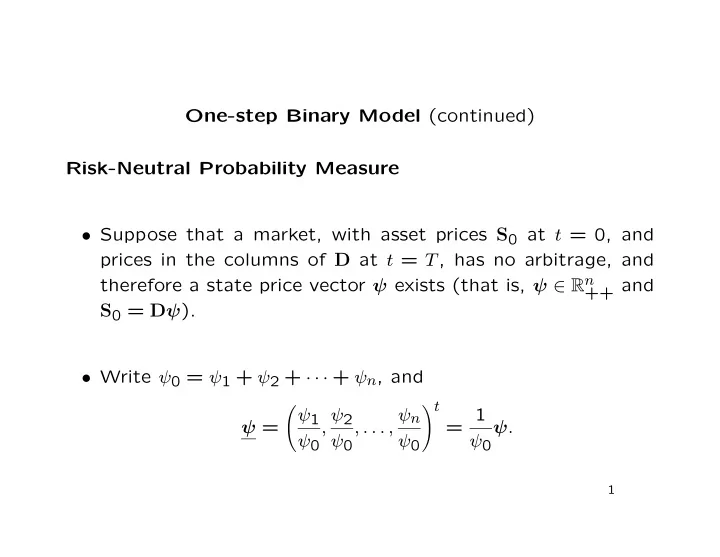
One-step Binary Model (continued) Risk-Neutral Probability Measure Suppose that a market, with asset prices S 0 at t = 0, and prices in the columns of D at t = T , has no arbitrage, and therefore a state price vector exists (that is,


slide-1
SLIDE 1

One-step Binary Model (continued) Risk-Neutral Probability Measure

  • Suppose that a market, with asset prices S0 at t = 0, and

prices in the columns of D at t = T, has no arbitrage, and therefore a state price vector ψ exists (that is, ψ ∈ Rn

++ and

S0 = Dψ).

  • Write ψ0 = ψ1 + ψ2 + · · · + ψn, and

ψ =

  • ψ1

ψ0 , ψ2 ψ0 , . . . , ψn ψ0

t

= 1 ψ0

ψ.

1

slide-2
SLIDE 2
  • The entries of ψ are strictly positive and sum to 1, and may

therefore be interpreted as probabilities associated with the various market states at t = T.

  • The equation

S0 = Dψ

can be rewritten

S0 = ψ0Dψ = ψ0E[ST] ,

where E[·] represents expectation with respect to this set of probabilities, and ST is the random vector of asset prices at t = T.

2

slide-3
SLIDE 3
  • We interpret ψ0 as a discount factor, and state this as

the price of an asset at t = 0 is its expected payoff at t = T, discounted to present value.

  • But note that these probabilities are derived from a set of

weights in a convexity argument, and not from a “view” about the likely state of the market at t = T.

3

slide-4
SLIDE 4
  • Risk-free borrowing: suppose that there is a portfolio θ whose

value is 1 in all states of the market; that is, Dtθ = 1.

  • The price of this portfolio at t = 0 is then ψ0; zero-coupon

Treasury securities play this rˆ

  • le, and their prices are used to

define the risk-free discount factors.

  • So if there is such a portfolio, the discount factor ψ0 is

unique, even if the state price vector is not.

  • The discount factor defines the risk-free interest rate through

ψ0 = e−rT.

4

slide-5
SLIDE 5
  • Attainable claim: a claim C (defined by a vector of payoffs

C = (C1, C2, . . . , Cn)t ∈ Rn) is attainable if it is replicated by

some portfolio. – That is, C = Dtφ for some φ ∈ RN.

  • In a market with no arbitrage and with riskless borrowing,

the price at t = 0 of an attainable claim C is ψ0EQ[C], where

EQ[·] denotes expected value with respect to a measure Q

derived from some state price vector.

  • Note that we did not need to construct the replicating port-

folio to price C, only an appropriate Q.

5

slide-6
SLIDE 6
  • Risk-neutral probabilities: every Q derived from some state

price vector is called a risk-neutral probability measure or an equivalent martingale measure.

  • A risk-neutral investor is one who prices any asset at its

discounted expected value, so a risk-neutral investor who believed that Q describes the true uncertainty in the market would use these prices.

  • Of course, no such investor exists, so no risk-neutral Q really

represents the true market uncertainty.

6

slide-7
SLIDE 7
  • Complete market:

a market is complete if every possible contingent claim C is attainable. – That is, for every C ∈ Rn, we can find a portfolio φ with

C = Dtφ.

– In other words, the column space of Dt is Rn.

  • Hence our market is complete if and only if D is of full rank

n. – This requires that N ≥ n: at least as many assets as states

  • f the market.

7

slide-8
SLIDE 8
  • In an arbitrage-free market, D is of full rank n if and only if

the state price vector ψ, and hence the risk-neutral measure

Q, is unique:

– If D is of full rank n, and ψ and ψ′ are two state price vectors, then

S0 = Dψ = Dψ′,

so D(ψ−ψ′) = 0, and because D is of full rank, ψ−ψ′ = 0. – Conversely, if D is not of full rank, Dδ = 0 for some

δ = 0. If ψ is a state price vector, then for small enough

ǫ, ψ + ǫδ = ψ is also a state price vector.

8

slide-9
SLIDE 9

Summary of Single Period Model

  • The market is arbitrage-free if and only if there exists a mar-

tingale measure Q.

  • An arbitrage-free market is complete if and only if Q is unique.
  • The no-arbitrage price of an attainable claim C is e−rTEQ[C].

9