Rural Society in Transition Planning for 21 st Century Rural - - PDF document

rural society in transition
SMART_READER_LITE
LIVE PREVIEW

Rural Society in Transition Planning for 21 st Century Rural - - PDF document

15/09/14 Rural Society in Transition Planning for 21 st Century Rural Potentials & Challenges 26 April 2018 Finding a Place for Community Planning in Ireland? Deborah Peel Emeritus Professor, University of Dundee Visiting Professor,


slide-1
SLIDE 1

15/09/14 1

Rural Society in Transition

Planning for 21st Century Rural Potentials & Challenges 26 April 2018

Finding a Place for Community Planning in Ireland?

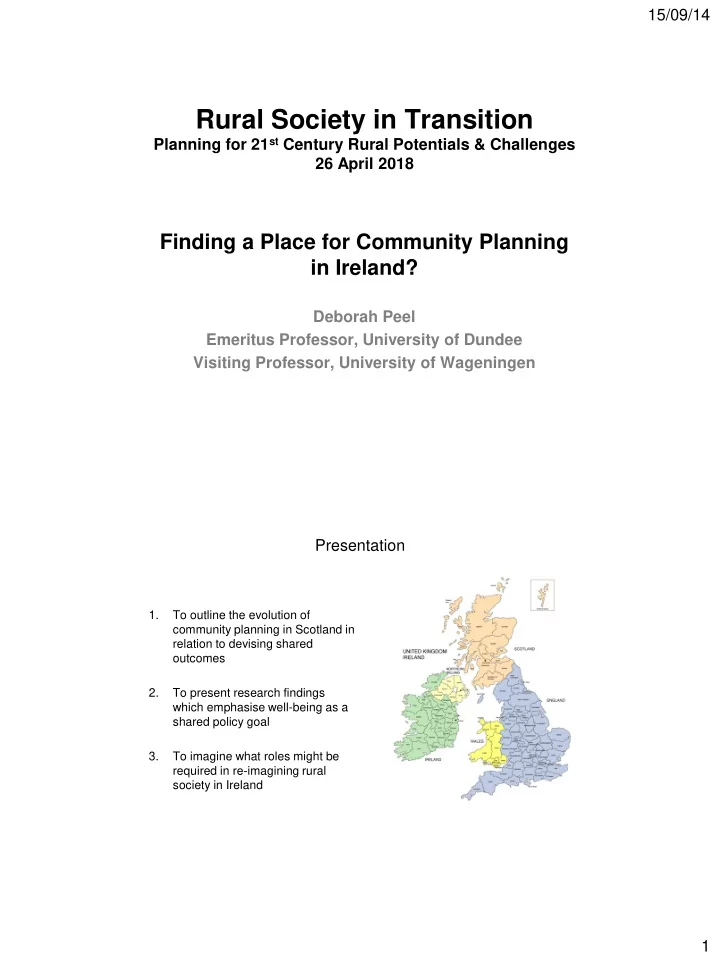
Deborah Peel Emeritus Professor, University of Dundee Visiting Professor, University of Wageningen Presentation

1. To outline the evolution of community planning in Scotland in relation to devising shared

  • utcomes

2. To present research findings which emphasise well-being as a shared policy goal 3. To imagine what roles might be required in re-imagining rural society in Ireland

slide-2
SLIDE 2

15/09/14 2 Project objectives

1. To identify and explain the legislative, policy and organisational arrangements for community-based planning across the devolved UK. 2. To identify how joint-working relations are designed, organised and managed. 3. To investigate issues of community engagement. 4. To examine the relationship between community planning and land use planning.

Exploring New Models of Community-based Planning in the Devolved UK

(with Professor Simon Pemberton; Keele University). Funded by the Planning Exchange Foundation

England Scotland Wales Northern Ireland

Central Government

Communities and Local Government (x2) Scottish Government Public Bodies & Public Service Reform Division Welsh Government Local Government Division Government of Northern Ireland Department of the Environment

Local government associations across the UK

Local Government Association Convention of Scottish Local Authorities Welsh Local Government Association Northern Ireland Local Government Association

Community body (national level)

Locality Planning Advisory Service PAS (formerly Planning Aid for Scotland)

  • Community Places

Strategic partner

Independent Steering Group member National Health Service National Health Service

  • Local authority

Strategic level Strategic level Strategic level x 3 Strategic level (x 2)

Local authority

Delivery level (neighbourhood planning) Community level (regeneration) Delivery level (sustainability) Land use planning
slide-3
SLIDE 3

15/09/14 3 Community planning: A (very) quick overview

  • 1. Rationalisation of services – “integrated service delivery”
  • 2. High quality public services & continuous improvement as part of a

long-term process

  • 3. Joint-working (co-production) – involving a range of actors,
  • rganisations, activities, values, cultures & behaviours
  • 4. Strong, cooperative leadership & citizen-centricity
  • 5. An emphasis on proactively engaging communities
  • 6. A focus on well-being in environmental, social & economic aspects
  • 7. Partnership, prevention, people, performance & prioritisation
  • 8. Not just new actors – and new roles – but a rescaling of
  • rganisations, relations & an ethos of shared societal goals
  • 9. New performance regimes

10.

Put simply

Strategic Local Service Board representative – Wales. (SURF, 2016)

It is about a group of people that come together to look at unblocking issues and talking about the really difficult stuff that is happening and which needs a group of people to work at a strategic level. There is a clear remit of breaking down barriers, but also working together. It is the kind of high-level, strategic collaboration that a thoughtful taxpayer would expect to happen anyway.

slide-4
SLIDE 4

15/09/14 4 Strengthening of statutory basis for community planning

Community Empowerment (Scotland) Act 2015

… a more intricate, sophisticated understanding of local circumstances and a more intense response from partners

Scottish Government representative Local authority strategic officer - Scotland

It gives a defined purpose for what community planning should achieve for the first time, which is very much about improving local outcomes and tackling inequality. It places a range of duties on a number of partners - not just the local authority, but also the health board, integrated joint board, etc., - to support community planning. And the involvement of communities is right at the heart of it.

Mutual learning & innovation

  • Local Government Act (Northern Ireland) 2014 sets out how the

eleven councils, as lead partners, will ‘work with statutory bodies and their communities to develop and implement a shared vision for promoting the well-being of an area, community cohesion and improving the quality of life of its citizens.’

… the only show in town….

Northern Ireland representative

slide-5
SLIDE 5

15/09/14 5 A transition to well-being

‘…the time is ripe for our measurement system to shift emphasis from measuring economic production to measuring people’s well-being. And measures of well- being should be put in a context of sustainability’ Scotland’s National Performance Framework is ‘an international leader in wellbeing measurement’ Well-being of Future Generations (Wales) Act 2015

2009 2013

New mind sets? Well-being & Joint working

  • Move away from silo / sectoral services to

more joined up working with an emphasis on the outcomes for individuals, families and communities

  • Emphasis on early intervention / prevention

and person-centred approaches

  • Community Empowerment (Scotland) Act

2015 – strengthens the status of the National Performance Framework highlighting identifying local outcomes for well-being that meet national priorities

slide-6
SLIDE 6

15/09/14 6 Relevance to rural communities?

Community Planning Partnerships are required to identify better outcomes for specific communities, reducing the gap in outcomes between the most & least deprived groups & improving long term sustainability of public service provision The [local] articulation of a shared overarching purpose requires the strategic alignment of different scalar actors – often with different priorities /statutory responsibilities Understanding place: – What are local people’s concerns, needs, priorities? – How can we re-solve issues? – How will we know if we’ve made a difference?

slide-7
SLIDE 7

15/09/14 7 Rural challenges?

  • Geography: A highly rural area with many small

communities (often separated by water)

  • Demographics: Ageing, population decline, population

density

  • Inequalities: Health, income, economic deprivation –

access to services (Scottish Index of Multiple Deprivation)

  • Mapping exercises: Digital connectivity, fuel poverty,

isolation, access to health services, recreation, affordable housing, size of schools, transport (including road safety)

“Major disadvantages: terrible transport links by road and rail...”“Poor bus service, no major shops...” ‘where I live, the buses are every two hours’ (p.17)

Rural challenges?

The biggest concerns that people in Girvan (South Ayrshire) relate to:

  • work and the local economy
  • public transport

Other issues include:

  • Child poverty
  • Less good outcomes for young

carers

  • Prevalence of dementia
  • Loneliness & social isolation

Place Standard Feedback Tool Collated Diagram

p.19

slide-8
SLIDE 8

15/09/14 8 Focus for improvement

Strategic Delivery Partnerships 1.Integrated children’s services 2.Community safety 3.Health & wellbeing 4.Economy, employment & sustainability Iterative process Strategic improvement themes 1.Closing the poverty-related outcomes gap for children & young people 2.Supporting older people to live in good health

Individual workshops Locality planning groups Community consultation Community conference

Implications for reimagining rural society in Ireland?

  • 1. Shifts attention away from a relatively narrow focus on individual service

providers' inputs & outputs towards making a qualitative difference in individuals’, families’ and communities’ lives – well-being outcomes Hierarchical – does central government want to take the lead? Is an outcomes / well-being / reducing inequalities focus appropriate?

  • 2. Demands iterative & collaborative processes involving blended data collection,

analysis & action across sectors To what extent might inputs, outputs and processes be shared? Is a cross-sectoral, cooperative working practice & culture in place?

  • 3. Ensures strong community engagement

Are there appropriate tools, spaces & mind sets for genuine listening? What mechanisms exist for prioritising the use of scarce resources?

slide-9
SLIDE 9

15/09/14 9 A place for community planning in Ireland: Your role?

Clarity of roles: local government (councillors/officers); partner organisations; voluntary sector; community groups; individual citizens… Alternative roles - planning for, resourcing & providing / securing the provision

  • f services may involve new service providers, new services, new forms of

service Leadership roles – championing integration & delivery Organisational roles – how best to organise roles and responsibilities - both in terms of organisational capacity but also spatially Research & analysis roles – open source; robust Evaluation roles - metrics and methods? Initiating role?

Full Report

Pemberton, S. and Peel, D. (2016) Exploring New Models of Community-based Planning in the Devolved UK, Glasgow: Planning Exchange Foundation. Available at: www.planningexchangefoundation.org.uk