Rule of Three (a language technique) - - PowerPoint PPT Presentation

rule of three a language technique
SMART_READER_LITE
LIVE PREVIEW

Rule of Three (a language technique) - - PowerPoint PPT Presentation

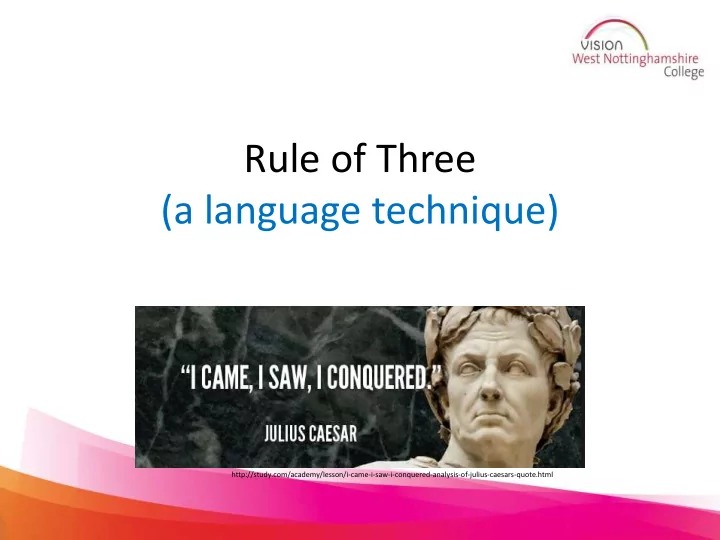
Rule of Three (a language technique) http://study.com/academy/lesson/i-came-i-saw-i-conquered-analysis-of-julius-caesars-quote.html Introduction The purpose of this PowerPoint is to introduce the use of the rule of three as a language

slide-1
SLIDE 1

Rule of Three (a language technique)

http://study.com/academy/lesson/i-came-i-saw-i-conquered-analysis-of-julius-caesars-quote.html

slide-2
SLIDE 2

Introduction

The purpose of this PowerPoint is to introduce the use

  • f the rule of three as a language technique.

By the end of this PowerPoint you will have the knowledge and understanding of how to identify the technique within a range of texts. When completing any form of writing activity for functional skills, try to apply the technique you’ve learned.

slide-3
SLIDE 3

Learning outcomes

  • To define the term ‘rule of three’
  • To develop knowledge and understanding of

the language technique

slide-4
SLIDE 4

Rule of Three

What is the rule of three? Write your thoughts

below.

slide-5
SLIDE 5

Rule of three

The rule of three is a mechanism by which three related words or points are presented in quick succession for literary effect, e.g. friends, romans, countrymen.

slide-6
SLIDE 6

Why do we use this technique?

  • Things that come in threes are more

persuasive.

  • We process information using patterns.
  • It helps make our content more memorable.

Do you remember the Heinz advert?

slide-7
SLIDE 7

Remember the Tony Blair speech?

The rule of three is based on the presentational technique that people tend to remember three

  • things. Good speeches are peppered with lists with

three items. For example, “Our priorities are Education, Education, Education” – Prime Minister, Tony Blair

http://news.bbc.co.uk/1/hi/6564933.stm

slide-8
SLIDE 8

Further examples include:

Stop, Look and Listen – a UK pedestrian safety

campaign

The Good, the Bad and the Ugly – a film title

The Olympic motto is Citius, Altius, Fortius, which is Latin for Faster, Higher, Stronger.

slide-9
SLIDE 9

Recognise the symbols?

Heat, Fuel, Oxygen – to stop a fire, remove one of the three.

Can you think

  • f any other

examples?

slide-10
SLIDE 10

Can you remember the Mars slogan?

slide-11
SLIDE 11

Exam example - Edexcel

Instructions

Refer to Edexcel Reading Level 2 practice test paper from February 2013. Question 6

From the text, give two ways the writer tries to influence the reader. Use Text A to help you find the example.

slide-12
SLIDE 12

Exam example - answer

Refer to paragraph 5 to find the answer.

This scientific evidence confirms what we already know from our personal experience. I am sure we have all had our weekend plans ruined by bad weather: barbecues abandoned, trips to the seaside spoilt and walks in the countryside cancelled!

The rule of three applies to the bold text in relation to bad weather and suggests three ways in which the weather can disrupt weekend plans.

slide-13
SLIDE 13

Further exam practice

Refer to SAM E202/01 (2015) for an example of a typical exam question.

In Text B, ‘Litter, vandalism and neglect’ is an example

  • f:
  • A direct address to the reader
  • B a rhetorical question
  • C the rule of three
  • D a slogan
slide-14
SLIDE 14

Exam answer Analyse the paragraph below

Residents are ashamed to live in communities with litter, dog-fouling, fly-tipping, graffiti and fly-posting. People do not want to visit shopping streets, parks or beaches covered in rubbish and

  • debris. Litter, vandalism and neglect are signs
  • f a community in decline.

What does the text imply?