Rufford Project Title: Assessment of Benefits and Evaluation of - - PowerPoint PPT Presentation

rufford project title assessment of benefits and
SMART_READER_LITE
LIVE PREVIEW

Rufford Project Title: Assessment of Benefits and Evaluation of - - PowerPoint PPT Presentation

Rufford Project Title: Assessment of Benefits and Evaluation of Ecosystem Services in Langtang National Park, Nepal Presentation Title: Measuring and Valuing Recreational Ecosystem Services in Langtang National Park, Nepal Rufford Small


slide-1
SLIDE 1

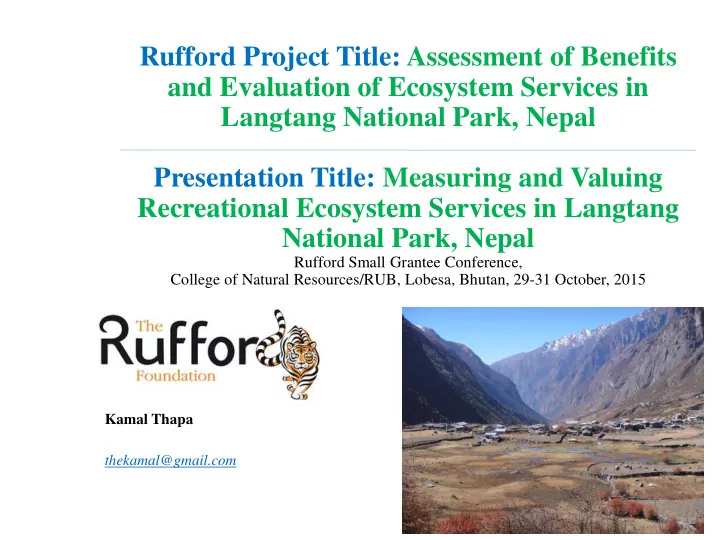
Rufford Project Title: Assessment of Benefits and Evaluation of Ecosystem Services in Langtang National Park, Nepal Presentation Title: Measuring and Valuing Recreational Ecosystem Services in Langtang National Park, Nepal

Rufford Small Grantee Conference, College of Natural Resources/RUB, Lobesa, Bhutan, 29-31 October, 2015

Kamal Thapa thekamal@gmail.com

slide-2
SLIDE 2

Introduction

  • Protected Area is defined as the, ‘‘ clearly

defined geographically space recognized, dedicated and managed through the legal

  • r effective means to achieve the long term

conservation of nature with associated ecosystem services and cultural values.’’ (Dudley 2008: 8)

  • Protected Areas (PAs) covers 23.23% of

Nepal’s territory (DNPWC, 2012)

  • PAs as a destination of nature based

tourism in Nepal

  • ES: Aspect of ecosystem producing human

welfare/well-being (Peh et.al., 2013)

slide-3
SLIDE 3

Rationale

  • (Non) market value of tourism in LNP
  • PA management: costly business, require sufficient fund
  • Fund drying, management cost increasing
  • conservation aims challeged by fund= Paper Parks
  • Tourism: source of revenue for PA management and local community

development

slide-4
SLIDE 4

Objectives

  • To identify and assess various ecosystem services (provisioning,

regulating, supporting, and cultural services) offered by LNP.

  • To carry out total economic valuation of LNP and its associated

ecosystem services.

  • To determine the maximum WTP for park entry fee in LNP.
  • To analyze recreational economic value of ecotourism in LNP.
  • To explore potential of entry fee in financing management cost of

LNP

slide-5
SLIDE 5

Materials and Methods

  • Study Area: Langtang National

Park, (part of Sacred Himalayan Landscape).

  • 3rd most visited mountain park

(5th in total) (DNPWC, 2010)

Research Methods:

  • TESSA Toolkit (Peh, et. al., 2013)
  • WTP - Contingent valuation
  • Payment Vehicle: Payment card
  • Market expenditure

Sampling:

  • Non-probability, Convenience

sampling

  • Sample size: 289 (only

international visitors)

slide-6
SLIDE 6

Results: Willingness to Pay Entry Fees

3 5 22 51 24 65 13 3 3 1 24 5 2 3

10 20 30 40 50 60 70 10 20 30 40 50 60 70 80 90 100 150 200 300

Frequency WTP bids of respondents for an admission fee to LNP (N=224)

Mean WTP (USD) = 53.57 Median (USD) = 50 WTP, YES= 63.83%

slide-7
SLIDE 7

Results: Visit demand at various entry fees

y = -8.2558x + 105.83 R² = 0.8924

  • 40
  • 20

20 40 60 80 100 120 % of Respondents willing to pay Hypothetical entry fee (USD)

slide-8
SLIDE 8

Visitors trend in LNP

y = 286.32x + 1782.7 R² = 0.6076

2000 4000 6000 8000 10000 12000 14000 16000

Visitors' number Fiscal Year

Visitors Number Linear (Visitors Number)

slide-9
SLIDE 9

WTP, respondents’ percentage, possible visitors’ number and revenue

(baseline scenario of 14,134 visitors)

WTP (USD) % of Respondents Possible visitors Nr. Possible revenue (USD)

100 14134 10 98.66 13945 139450 20 96.42 13628 272560 30 86.6 12240 367200 40 63.83 9022 360880 50 53.12 7508 375400 (business as usual 424020) 60 24.1 3406 204360 70 18.3 2587 181090 80 16.96 2397 191760 90 15.62 2208 198720 100 15.17 2144 214400 150 4.46 630 94500 200 2.23 315 63000 250 1.33 188 47000 300 1.33 188 56400 >300

slide-10
SLIDE 10

Increment in Entry Fee: Implication for Protected Area Management

Source: LNP, 2012, p. 90 (Langtang National Park and Buffer Zone Management Plan, 2012-2016)

Budget Gaps for Buffer Zone Development Program

2000000 4000000 6000000 8000000 10000000 12000000 14000000 1 2 3 4 5 Fiscal year in first phase program Budget (NRs.) Cost Estimated in BZMP Available Budget

slide-11
SLIDE 11

Recreational value of Ecotourism in LNP

(baseline scenario of 14,134 international visitors)

  • Independent tourists’ expenditure (53%) = 10.43 days X

35.44 USD/day X 7489 = USD 2,768,967

  • Group traveller/package tourist expenditure (47%) =

10.43 days X 46.4 USD/day X 6645 = USD 3,215,861

  • Revenue from TIMS card issued to FITs (38% of

visitors) = 20 USD X 5371 = USD 107,420

  • Revenue from TIMS card issue to group traveller (62%)

= 10 USD X 8763 = USD 87,630

  • Entry fee revenue = 14134 X 30 USD = USD 424,020
  • Gross regional economic activities = USD 6,603,898

(Nepalese per capita income, USD 721) (GoN/MoF 2013)

slide-12
SLIDE 12

Is Investment sufficient to secure the ES in Langtang NP?

  • 465110 USD allocated budget(FY

2013/14)

  • Gross regional economic impact

(only Ecotoursim) = USD 6,603,898

slide-13
SLIDE 13

Challenges/Gaps and Future work

  • (some) Tourist reluctant to participate in the survey.
  • (some) Local respondents have negative attitudes.
  • Local respondents reply(ied) with under/over

estimation Next Step

  • Detail econometric analysis of the WTP value.
  • Detail analysis of 5 key Ecosystem Services (global

climate regulation, water related services, cultivated goods, harvested wild goods and tourism)

  • Valuation of those key ES of LNP.
  • Peer reviewed paper submission.
slide-14
SLIDE 14

Conclusion

  • Tourists are WTP more than the current fee.
  • Economic value of tourism in LNP is not captured fully.
  • Substantial contribution in local development via park tourism.
  • Revenue generated from tourism must be invested into the local

community and park management activities.

  • No integration of ES concept in park management/decision making

process.

slide-15
SLIDE 15

Acknowledgements

  • The Rufford Foundation
  • Jigme Dorji and organizing committee/participants of RSG Bhutan

conference

  • DNPWC and LNP
  • Prof. Dr. Michael Getzner
  • Respondents and local hoteliers

THANK YOU !

Questions ?

slide-16
SLIDE 16

Hypothetical scenario eliciting WTP of visitors’ for an increase in entry fees to Langtang National Park

  • The lack of financial resources is a major challenge for protected area management in
  • NEPAL. At present, ecotourism seems to be a viable option to generate revenues through

tourist entry fees. Although ecotourism has high prospects in financing of Langtang National Park, it relies on government funding. Increment in the current entry fee means more budget for buffer zone development because 30% to 50% of the park income has to be channelized back to the conservation and development activities of buffer zone areas and local people. This can lead to reduction in poaching and illegal activities in Langtang NP, encourage local participation to achieve better nature conservation, increment in wildlife population so that chances of wildlife viewing also increases. Sufficient budget to government means it can manage Langtang NP in par with international standard to achieve sustainable PA management, helps in improving visitors‟ infrastructure and more. If the management authorities increase the current entry fee (NPR 3000 = abt US$ 30) in

  • rder to have more funds to enhance visitors' experience, conserve biodiversity and promote

economic development, how much would you be willing to pay (more or less) as a new entry fee for the experience you had? in US $ (please circle): Zero, 10, 20, 30, 40, 50, 60, 70, 80, 90, 100, 150, 200, 250, 300, >300