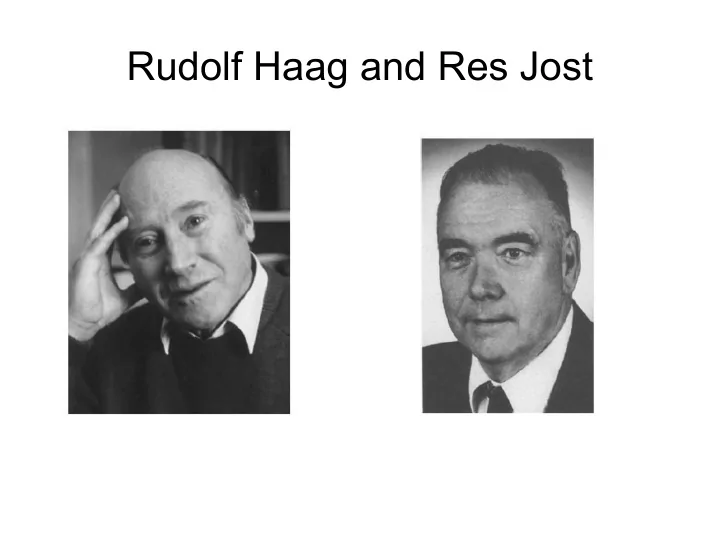
SLIDE 1
Rudolf Haag and Res Jost
SLIDE 2
SLIDE 3
Communications in Mathematical Physics
Chief Editors: R Haag (1965-1973), K Hepp (1973-1976), J Glimm (1976-1978), A Jaffe (1978-2000), M Aizenman (2000-2012), Horng- Tzer Yau (2012- ) 1995: 320 pages on mathematics and physics 2015: 11985 pages on mathematics or physics
SLIDE 4
SLIDE 5 The BOOKS
- R. Jost ‘The General Theory of Quantized Fields’,
American Mathematical Society’, 1965
- R. Haag ‘Local Quantum Physics, Fields, Particles
and Algebras’ 2nd Ed. Springer, 1996
SLIDE 6
- R. Jost ‘The General Theory of
Quantized Fields’, A M S, 1965
Contents:
- III. The axioms and the Wightman distributions
- IV. The Wightman functions
- V. The TCP-Theorem. Spin and statistics
- VI. The Haag-Ruelle theory of asymptotic fields
and particles
- VII. Things not treated
- 1. Models
- 3. Analytic properties in p-space
SLIDE 7
- R. Haag ‘Local Quantum Physics,
Fields, Particles, Algebras’ 2nd Ed. Springer, 1996
Contents:
- II. General Quantum Field Theory
- III. Algebras of Local Observables and Fields
- IV. Charges, Global Gauge Groups and Exchange
Symmetry
- V. Thermal States and Modular Automorphisms
- VI. Particles. Completeness of the Particle Picture
- VII. Principles and Lessons of Quantum Physics
SLIDE 8
R Haag ‘Quantum Field Theories with Composite Particles and Asymptotic Conditions’, Phys Rev 112:669 (1958)
The connection between the Nishijima- Zimmermann method and the Ekstein method of treating collision processes between composite particles in quantum field theory is given. Starting from the point of view that the field is a local observable, the ‘asymptotic conditions’ are proved and generalized.
SLIDE 9
D Ruelle ‘On the Asymptotic Condition in Quantum Field Theory’, Helv Phys Acta 32:147 (1962)
A ‘space-like asymptotic condition’ is proved which allows Haag’s approach to the asymptotic condition to be carried out rigorously in the framework of the Wightman axioms.
SLIDE 10
K Hepp ‘On the Connection between the LSZ and Wightman Quantum Field Theory’, CMP 1:95
The LSZ aymptotic condition and the Yang- Feldman equations are derived in a Wightman quantum field theory on a dense set of scattering states. The Green’s distributions are shown to be sufficiently regular around the energy shell to give well-defined reduction formulae for the scattering amplitudes.
SLIDE 11
H Epstein ‘CTP Invariance of the S- Matrix in a Theory of Local Observables’, J Math Phys 8:750
In a theory of local observables as proposed by Haag and Araki, the assumptions, which make possible a collision theory also guarantee the CTP invariace of the S-matrix.
SLIDE 12 The P(phi)2 quantum field model with small coupling constant satisfies the Wightman
- axioms. The spectrum of the mass operator
contains two isolated eigenvalues 0 and m>0. Hence the model describes the scattering of particles of mass m.
J Glimm, A Jaffe, T Spencer ‘The Wightman Axioms and Particle Structure in the P(phi)2 Quantum Field Model’, Ann Math, 100:585 (1974)
SLIDE 13
W Hunziker, IM Sigal ‘Time- dependent scattering of N-body quantum systems’, Rev Math Phys 12: 1033
SLIDE 14
R Haag ‘Fundamental Irreversibility and the Concept of Events’ CMP 132:245 (1990)
It is proposed that the transmutation from possibilities to facts should be introduced as an essential element in fundamental theory. This has no bearing on TCP-invariance. If indeterminism is accepted it leads to picture of an evolving history formed by individual events and causal ties. In the low density regime it can be compared with the treatment of multiple collisions in quantum field theory.
SLIDE 15 R Haag ‘On Quantum Theory’, arXiv: 1602.054v1, 17 Feb 2016
Abstract by R Seiler: A discussion of fundamental aspects of quantum theory is presented, stressing the essential role
SLIDE 16
K Hepp ‘Quantum Theory of Measurement and Macroscopic Observables’, H P A 45:237 (1972)
The generation of probabilities from probability amplitudes in a quantum mechanical measurement process is discussed in the framework of infinite quantum systems. In several explicitely solvable models, the measurement process leads to macroscopically different ‘pointer positions’ and a rigorous ‘reduction of the wave packet’ with respect to all local observables.
SLIDE 17
C Koch and K Hepp ‘Quantum Mechanics in the Brain’, Nature 440:611 (2006)
Does the enormous computing power of neurons mean consciousness can be explained in a purely neurobiological framework, or is there a scope for quantum computations in the brain?
SLIDE 18