Royal Pharmaceutical Society, London 19 June 2017 Dr Sarah Rodgers - - PowerPoint PPT Presentation

royal pharmaceutical society london 19 june 2017 dr sarah
SMART_READER_LITE
LIVE PREVIEW

Royal Pharmaceutical Society, London 19 June 2017 Dr Sarah Rodgers - - PowerPoint PPT Presentation

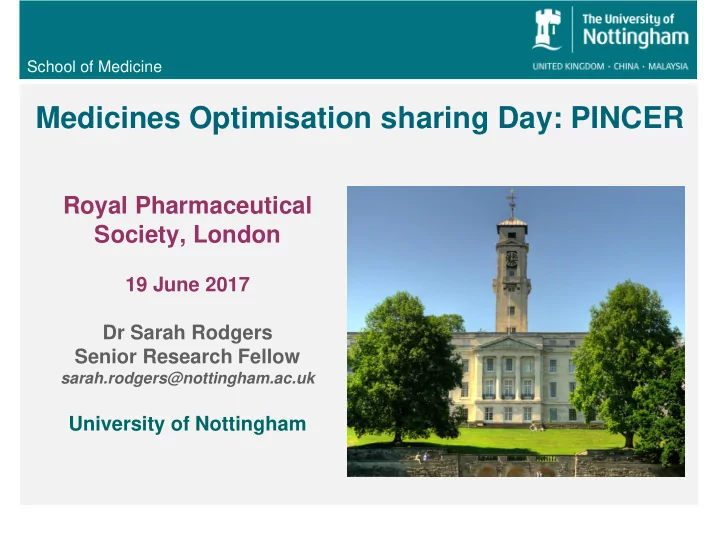
School of Medicine Medicines Optimisation sharing Day: PINCER Royal Pharmaceutical Society, London 19 June 2017 Dr Sarah Rodgers Senior Research Fellow sarah.rodgers@nottingham.ac.uk University of Nottingham School of Medicine Plan for

slide-1
SLIDE 1

School of Medicine

Medicines Optimisation sharing Day: PINCER

Royal Pharmaceutical Society, London

19 June 2017 Dr Sarah Rodgers Senior Research Fellow

sarah.rodgers@nottingham.ac.uk

University of Nottingham

slide-2
SLIDE 2

School of Medicine

Plan for presentation

  • Overview of PINCER intervention
  • Current work
  • What are our main research findings and how are we

implementing these findings into practice?

  • Plans for future work
slide-3
SLIDE 3

School of Medicine

Scale of the problem

  • Medication errors in primary and secondary care are an

important cause of morbidity and mortality

  • Prescribing errors
  • 1 in 20 items with an error – 1 in 550 with a serious error
  • Over 1 billion items dispensed in 2015 = 1.8 million serious prescribing

errors

  • Preventable medication-related admissions to hospital
  • These account for around 1 in 25 hospital admissions
  • Annual cost of £650m per year
  • 4 classes of drug account for over 50% of these admissions:
  • Anti-platelets, non-steroidal anti-inflammatory drugs (NSAIDs), diuretics

and anticoagulants

Big implications in terms of patient safety and costs

slide-4
SLIDE 4

School of Medicine

The PINCER Intervention

Pharmacist-led IT-based intervention to reduce rates of clinically important errors in medicines management in general practices

1. Conducting searches on GP clinical systems to identify patients at risk from common and important prescribing and drug monitoring errors 2. Pharmacists (trained in the PINCER approach) working with general practices to develop an action plan to correct and prevent potentially hazardous prescribing 3. Pharmacists (and pharmacy technicians) working with and supporting general practice staff to implement the action plan

slide-5
SLIDE 5

School of Medicine

The PINCER Trial

A cluster randomised trial comparing the effectiveness of a pharmacist-led IT-based intervention with simple feedback in reducing rates of clinically important errors in medicines management in general practices

The Lancet, 2012;379:1310 – 1319 doi:10.1016/S0140-6736(11)61817-5

slide-6
SLIDE 6

School of Medicine

Overview

  • The study involved at-risk patients in 72 general practices who

were being prescribed drugs that are commonly and consistently associated with medication errors

  • These included the prescription
  • f NSAIDs and beta blockers, and

the monitoring of ACE inhibitors or loop diuretics, methotrexate, lithium, warfarin, and amiodarone

slide-7
SLIDE 7

School of Medicine

Cluster randomised trial

72 General Practices consented into the study Simple feedback

Computer-generated feedback

  • n patients at potential risk

from hazardous prescribing (n=36)

Pharmacist-led intervention (PINCER)

Simple feedback plus educational

  • utreach and dedicated support

to correct and prevent potentially hazardous prescribing (n=36)

slide-8
SLIDE 8

School of Medicine

PINCER Trial

  • PINCER intervention is an effective

method for reducing a range of clinically important and commonly made medication errors in primary care

  • At 6-months follow-up patients in the

PINCER group had significantly fewer prescribing errors than those in the control group

  • There was evidence that the

intervention was cost-effective

  • Could be rolled out across NHS at low

cost to reduce medication errors

slide-9
SLIDE 9

School of Medicine

Roll out of PINCER Approach

  • We have worked with PRIMIS to

launch a new PINCER Query Library tool

  • Extension of the PRIMIS suite of

audit tools

  • Consists of eight Rx safety

indicators used in the trial

  • The aim is to identify patients at risk
  • f medication error so that corrective

action can be taken http://www.nottingham.ac.uk/primis/index.aspx

slide-10
SLIDE 10

School of Medicine

PINCER Query Library

Query 1: Patients with a history of peptic ulcer who have been prescribed a non-selective non-steroidal anti-inflammatory drug (NSAID) without co-prescription of a proton-pump inhibitor (PPI) Query 2: Patients with a history of asthma who have been prescribed a beta-blocker Query 3: Patients aged 75 years and older who have been prescribed an angiotensin converting enzyme (ACE) inhibitor or a loop diuretic long term who have not had a computer-recorded check of their renal function and electrolytes in the previous 15 months Query 4: Women with a past medical history of venous or arterial thrombosis who have been prescribed combined hormonal contraceptives (CHC) Query 5: Patients receiving methotrexate for at least 3 months who have not had a recorded full blood count (FBC) or liver function test (LFT) within the previous 3 months Query 6: Patients receiving warfarin for at least 3 months who have not had a recorded check of their international normalised ratio (INR) within the previous 12 weeks Query 7: Patients receiving lithium for at least 3 months who have not had a recorded check of their lithium concentrations in the previous 3 months Query 8: Patients receiving amiodarone for at least 6 months who have not had a thyroid function test (TFT) within the previous 6 months

slide-11
SLIDE 11

School of Medicine

Overview of the PINCER Query Library Tool

1. CHART software installed on GP practice computer

http://www.nottingham.ac.uk/primis/tools-software/chart/chart.aspx

2. CHART software used to download the PINCER Query Library

http://www.nottingham.ac.uk/primis/tools-audits/list-of-audit- tools/pincer.aspx

3. PINCER Queries run on GP clinical system using MIQUEST software 4. Data provided to GP practices at individual patient level, with those patients ‘at risk’ highlighted

slide-12
SLIDE 12

School of Medicine

General practice view

slide-13
SLIDE 13

School of Medicine

General practice comparative views

  • We have worked with PRIMIS to develop

aggregated views of anonymised patient data using CHART Online

  • This allows practices to view their results

in relation to other practices within their CCG and see improvements over time

slide-14
SLIDE 14

School of Medicine

CHART Online

Various views of data:

  • Compare all practices
  • ne indicator
  • Compare one practice

all indicators

  • Compare practice

progress time trend

slide-15
SLIDE 15

School of Medicine

Evidence-Based Summaries

slide-16
SLIDE 16

School of Medicine

Key impacts

‘Organisations and health professionals should consider applying the

principles of the PINCER intervention to reduce the number of medicines- related patient safety incidents, taking account of existing systems and resource implications.’

  • The PINCER Query Library Tool is available to all GP practices in

England and has been accessed by >2,000 GP practices across 196 CCGs

  • Rolled out to GP practices in Wessex AHSN
  • Piloted in 20 GP practices in Northern Ireland with potential for rollout to

all practices

  • The intervention has now been supported by NICE in its ‘Medicines

Optimisation Clinical Guideline’ published 04/03/15 and available at: http://www.nice.org.uk/guidance/ng5/evidence

slide-17
SLIDE 17

School of Medicine

Recent work

slide-18
SLIDE 18

School of Medicine

PINCER 3: Prescribing Safety Indicators

We have focused on indicators associated with significant harm:

  • Gastrointestinal bleed (6 indicators + composite outcome)
  • Acute exacerbation of asthma (2 indicators)
  • Heart failure (1 indicator)
  • Stroke in dementia (1 indicator)
  • Acute kidney injury (1 indicator)
slide-19
SLIDE 19

School of Medicine

PINCER Query Library

OUTCOME: GI BLEED Query A: Prescription of an oral NSAID, without co-prescription of an ulcer healing drug, to a patient aged ≥65 years Query B: Prescription of an oral NSAID, without co-prescription of an ulcer healing drug, to a patient with a history of peptic ulceration Query C: Prescription of an antiplatelet drug without co-prescription of an ulcer-healing drug, to a patient with a history of peptic ulceration. Query D: Prescription of warfarin or NOAC in combination with an oral NSAID Query E: Prescription of warfarin or NOAC and an antiplatelet drug in combination without co-prescription of an ulcer- healing drug Query F: Prescription of aspirin in combination with another antiplatelet drug without co-prescription of an ulcer-healing drug OUTCOME: EXACERBATION OF ASTHMA Query G: Prescription of a non-selective beta-blocker to a patient with a history of asthma Query H: Prescription of a long-acting beta-2 agonist inhaler (excluding combination products with inhaled corticosteroid) to a patient with asthma who is not also prescribed an inhaled corticosteroid OUTCOME: HEART FAILURE Query I: Prescription of an oral NSAID to a patient with heart failure OUTCOME: STROKE Query J: Prescription of antipsychotics for >6weeks in a patient aged ≥65 years with dementia but not psychosis OUTCOME: KIDNEY INJURY Query K: Prescription of an oral NSAID to a patient with eGFR <45

slide-20
SLIDE 20

School of Medicine

General practice/CCG summary view

slide-21
SLIDE 21

School of Medicine

CCG comparative view

slide-22
SLIDE 22

School of Medicine

CCG composite indicators view

slide-23
SLIDE 23

School of Medicine

Current work: HF Scaling Up PINCER

Findings to date:

  • 361 general practices in 12 CCGs

(>94%)

  • 279 TPP; 82 EMIS Web
  • >2.9 million patient records searched
  • 21,617 cases of potentially hazardous

prescribing identified

  • Funnel plots and Statistical Process

Control charts fed back to CCGs

slide-24
SLIDE 24

School of Medicine

Current work: HF Scaling Up PINCER

Control chart

Funnel plot

Funnel Plots Statistical Process Control Charts

slide-25
SLIDE 25

School of Medicine

Indicator A: Prescription of an oral NSAID, without co-prescription of an ulcer healing drug, to a patient aged ≥65 years

2 2.5 3 3.5 4 4.5

30/11/2013 28/02/2014 31/05/2014 31/08/2014 30/11/2014 28/02/2015 31/05/2015 31/08/2015 30/11/2015 29/02/2016 31/05/2016 31/08/2016

CCG 1

1.4 1.6 1.8 2 2.2 2.4 2.6 2.8

30/11/2013 28/02/2014 31/05/2014 31/08/2014 30/11/2014 28/02/2015 31/05/2015 31/08/2015 30/11/2015 29/02/2016 31/05/2016 31/08/2016

CCG 2

1.8 2 2.2 2.4 2.6 2.8 3 3.2

30/11/2013 28/02/2014 31/05/2014 31/08/2014 30/11/2014 28/02/2015 31/05/2015 31/08/2015 30/11/2015 29/02/2016 31/05/2016 31/08/2016

CCG 3

1.4 1.6 1.8 2 2.2 2.4 2.6

30/11/2013 28/02/2014 31/05/2014 31/08/2014 30/11/2014 28/02/2015 31/05/2015 31/08/2015 30/11/2015 29/02/2016 31/05/2016 31/08/2016

CCG 4

2.2 2.4 2.6 2.8 3 3.2 3.4

30/11/2013 28/02/2014 31/05/2014 31/08/2014 30/11/2014 28/02/2015 31/05/2015 31/08/2015 30/11/2015 29/02/2016

CCG 5

1.6 1.8 2 2.2 2.4 2.6 2.8 3 3.2

30/11/2013 28/02/2014 31/05/2014 31/08/2014 30/11/2014 28/02/2015 31/05/2015 31/08/2015 30/11/2015 29/02/2016

CCG 6

slide-26
SLIDE 26

School of Medicine

Future work

NIHR PRoTeCT: Avoiding patient harm through the application of prescribing safety indicators in English general practices. Aim: To evaluate the application of ‘prescribing safety indicators’ in English general practices to reduce hazardous prescribing and avoidable harm to patients. This will include the introduction of prescribing safety indicators to computerised decision support software, and a pharmacist-led IT-based intervention (PINCER).

Start date: 01 March 2017 End date: 29 August 2021

slide-27
SLIDE 27

School of Medicine

NIHR PRoTeCT

Avoiding patient harm through the application of prescribing safety indicators in English general practices

CPRD studies to explore risk of serious harm Process evaluation to generate policy recommendations Evaluation of PINCER when rolled out at scale Economic impact

  • f hazardous

prescribing 10 and 20 care data linkage to investigate morbidity

slide-28
SLIDE 28

School of Medicine

WHO’s Third Global Patient safety Challenge

“Now the Third Global Patient Safety Challenge seeks the commitment of health ministers, health-system leaders, and a range of stakeholders, including educational institutions, experts……and professional organisations. Its goal will be to reduce the level of severe, avoidable harm related to medications by 50% over 5 years, globally.”

slide-29
SLIDE 29

School of Medicine

Could PINCER be rolled out in your AHSN?

  • Consider who pays for the pharmacists time i.e. CCG/practice
  • Include PINCER into a work plan/incentive scheme and find a

GP advocate

  • Long term view
  • Communication plan for practices

Obtain stakeholder backing for PINCER

  • Change to previous working, each practice is different
  • Name a lead to drive the project forward and be the link person

Commitment from the prescribing team Consider IT skills and access rights Consider how to evidence the changes

  • Consider how to keep PINCER a focus
  • Barriers/facilitators

Cost pressures change priorities frequently

slide-30
SLIDE 30

School of Medicine

Thank you for listening

Any comments/question?

Further information available from: sarah.rodgers@nottingham.ac.uk