Round Table Organizing research on LICSs at the global level Helena - - PowerPoint PPT Presentation

round table organizing research on licss at the global
SMART_READER_LITE
LIVE PREVIEW

Round Table Organizing research on LICSs at the global level Helena - - PowerPoint PPT Presentation

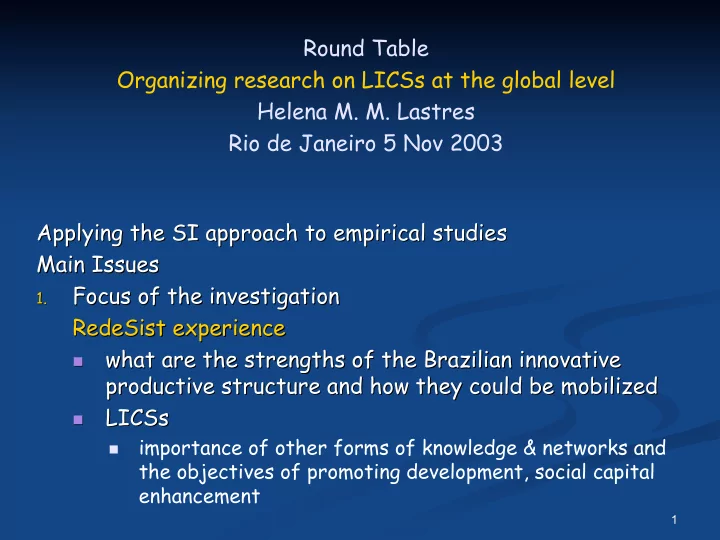
Round Table Organizing research on LICSs at the global level Helena M. M. Lastres Rio de Janeiro 5 Nov 2003 Applying the SI approach to empirical studies Applying the SI approach to empirical studies Main Issues Main Issues Focus of the


slide-1
SLIDE 1

1

Round Table Organizing research on LICSs at the global level Helena M. M. Lastres Rio de Janeiro 5 Nov 2003 Applying the SI approach to empirical studies Applying the SI approach to empirical studies Main Issues Main Issues

1. 1.

Focus of the investigation Focus of the investigation RedeSist experience RedeSist experience

  • what are the strengths of the Brazilian innovative

what are the strengths of the Brazilian innovative productive structure and how they could be mobilized productive structure and how they could be mobilized

  • LICSs

LICSs

  • importance of other forms of knowledge & networks and

the objectives of promoting development, social capital enhancement

slide-2
SLIDE 2

2

2. 2.

Concepts of system and innovation Concepts of system and innovation

  • SI

SI -

  • useful focusing device

useful focusing device

  • RedeSist development:

RedeSist development: local productive and local productive and innovative systems and arrangements innovative systems and arrangements -

  • LPISAs

LPISAs

  • elaboration of a glossary –

– GASPIL GASPIL: :

  • definition of LPISAs + innovation, cooperation,

knowledge, social capital, etc.

  • differences with other concepts, etc …
  • www.ie.ufrj.br/redesist
slide-3
SLIDE 3

3

3. 3.

Selection of cases Selection of cases

3.

criteria: social, economic, technological, political

4.

indicators: employment, level of education, sales, taxes, imports & exports of goods and services (including tech), patterns of specialization, infrastructure including (knowledge), regional and national relevance + IPR, etc.

4.

Identification of IS

  • problems:
  • systems are open; cognitive space goes beyond usual focus and

indicators on sectors, individual organizations and space (municipalities and micro-regions) – investigation of the importance of proximity, etc.

  • bjectives:
  • to capture and assess the processes of knowledge creation,

acquisition, use and diffusion

  • processes of learning and competence building
  • information and knowledge fluxes
slide-4
SLIDE 4

4

5.

Empirical investigation

  • methodology for direct empirical surveys - in refinement
  • questionnaires, sample and tabular plans targeting

different agents - firms and other organizations dealing with education, training, R&D, promotion, financing, etc.

  • elaboration of technical notes
  • general structure for the reports (role of the LPISA in

the international, national and local economies, analysis of the case, policy recommendations + IPR regimes,

6. 6.

Recuperation and analysis Recuperation and analysis

  • specific conclusions and policy implications

detailed information and local participation in the planning and implementation processes

  • conception of a geo-referenced system of information on

local productive and innovative systems and arrangements - Sinal - www.sinal.redesist.ie.ufrj.br www.sinal.redesist.ie.ufrj.br

  • secondary + primary information
  • elaboration of a panel summarizing the different types,

forms, location and dynamics of these arrangements, indicating strengths and weaknesses, as well as specific needs

slide-5
SLIDE 5

5

Concept of Local Productive and Innovative Systems and Arrangements - LPISAs

www.ie.ufrj.br/redesist

LPISAs comprise

➮ ➮ firms producers of final goods and services, suppliers of

firms producers of final goods and services, suppliers of inputs and equipment, service providers, etc.) and their inputs and equipment, service providers, etc.) and their different forms of representation and association different forms of representation and association

➮ ➮ other public and private institutions and organizations

  • ther public and private institutions and organizations

specialized in educating and training, R&D, engineering, specialized in educating and training, R&D, engineering, promotion, financing, etc. promotion, financing, etc. Local system Local system are defined as any productive agglomeration involving economic, political and social agents localized in the same area, performing related economic activities and presenting consistent articulation, interaction, co-operation and learning processes Local arrangement Local arrangements s include productive agglomerations, in which there is no (or almost no) articulation among the agents