Robotics Robotics 8.1 8.1 What are Robots Good For? What are - - PDF document

robotics robotics
SMART_READER_LITE
LIVE PREVIEW

Robotics Robotics 8.1 8.1 What are Robots Good For? What are - - PDF document

Chapter 8 8 Chapter 8. 8. Robotics Robotics Introduction Introduction Robotics Robotics 8.1 8.1 What are Robots Good For? What are Robots Good For?


slide-1
SLIDE 1

Christian Jacob Christian Jacob

jacob@cpsc.ucalgary.ca

Department of Computer Science University of Calgary

Chapter Chapter 8 8

Robotics Robotics

—————————————— —————————————— 8. 8. Robotics Robotics

Introduction Introduction 8.1 8.1 What are Robots Good For? What are Robots Good For? 8.2 8.2 What are Robots Made Of? What are Robots Made Of? 8.3 8.3 Architectures Architectures

Classic Architecture Classic Architecture Situated Automata Situated Automata

8.4 8.4 Configuration Spaces Configuration Spaces 8.5 8.5 Navigation and Motion Planning Navigation and Motion Planning 8.6 8.6 More Robot Examples More Robot Examples

Introduction Introduction

  • Robot Institute of America defines a robot as a

reprogrammable, multifunction manipulator designed to move material, parts, tools or specific devices through variable programmed motions for the performance of a variety of tasks.

  • Russell and Norvig: an active, artificial agent

whose environment is the physical world.

  • Robots differ from Softbots whose environment

consists of computer systems, databases and networks.

The Physical World The Physical World

  • The physical world is very demanding, it is:
  • inaccessible - sensors are imperfect, only stimuli that

are near the agent can be perceived.

  • nondeterministic - a robot needs to deal with

uncertainty

  • nonepisodic - effects of an action change over time
  • dynamic - robot needs to decide when to think and

when to act immediately

  • continuous - states and actions are drawn from a

continuum of physical configurations and motions

8. 8. Robotics Robotics

Introduction Introduction 8.1 8.1 What are Robots Good For? What are Robots Good For? 8.2 8.2 What are Robots Made Of? What are Robots Made Of? 8.3 8.3 Architectures Architectures

Classic Architecture Classic Architecture Situated Automata Situated Automata

8.4 8.4 Configuration Spaces Configuration Spaces 8.5 8.5 Navigation and Motion Planning Navigation and Motion Planning 8.6 8.6 More Robot Examples More Robot Examples

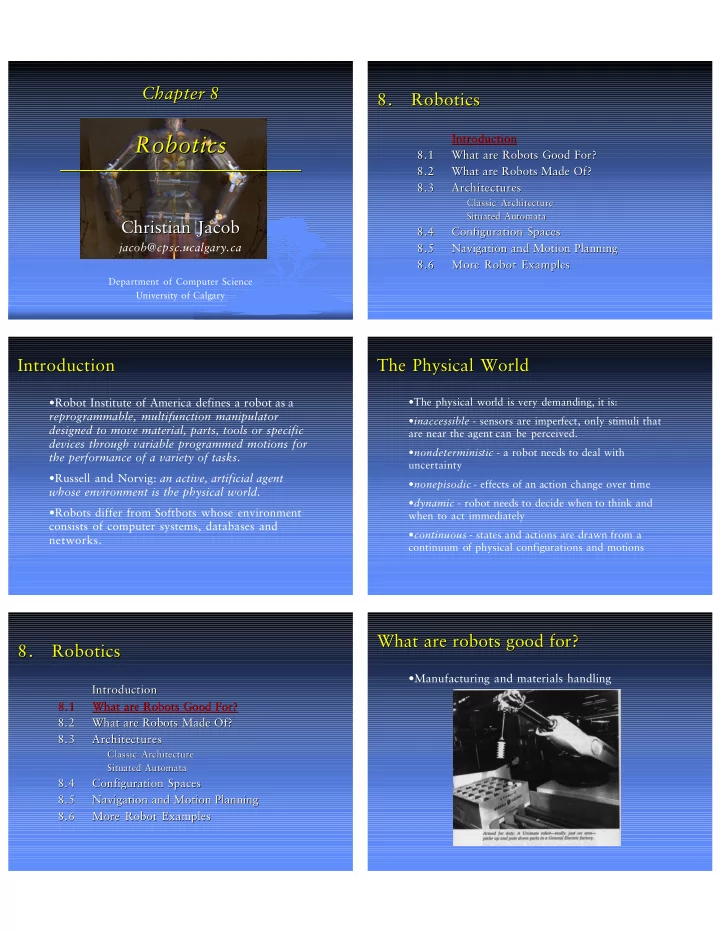
What are robots good for? What are robots good for?

  • Manufacturing and materials handling
slide-2
SLIDE 2

What are robots good for? What are robots good for?

  • Gofer robots

Bell & Howell Mailmobile

What are robots good for? What are robots good for?

  • Gofer robots

Carnegie Mellon’s Nomad

What are robots good for? What are robots good for?

  • Hazardous environments

Lunokhod Moon Robot

What are robots good for? What are robots good for?

  • Hazardous environments

Dante II Frame Walking Robot

What are robots good for? What are robots good for?

  • Telepresence and virtual reality

The Wheelbarrow, a bomb disposal robot

What are robots good for? What are robots good for?

  • Telepresence and virtual reality

Advanced Tethered Vehicle (ATV)

slide-3
SLIDE 3

What are robots good for? What are robots good for?

  • Telepresence and virtual reality

Advanced Robot and Telemanipulator System for Minimal Invasive Surgery (ARTEMIS)

What are robots good for? What are robots good for?

  • Augmentation of human abilities

Sigourney Weaver in the movie Aliens

What are robots good for? What are robots good for?

  • Augmentation of human abilities

General Electric’s Walking Truck

8. 8. Robotics Robotics

Introduction Introduction 8.1 8.1 What are Robots Good For? What are Robots Good For? 8.2 8.2 What are Robots Made Of? What are Robots Made Of? 8.3 8.3 Architectures Architectures

Classic Architecture Classic Architecture Situated Automata Situated Automata

8.4 8.4 Configuration Spaces Configuration Spaces 8.5 8.5 Navigation and Motion Planning Navigation and Motion Planning 8.6 8.6 More Robot Examples More Robot Examples

What are robots made of? What are robots made of?

  • Effectors: Tools for Action
  • Locomotion
  • Manipulation
  • Sensors: Tools for perception
  • Proprioception
  • Force Sensing
  • Tactile Sensing
  • Sonar
  • Camera Data

What are robots made of? What are robots made of?

  • Effectors: Locomotion

Carnegie Mellon’s Ambler

slide-4
SLIDE 4

What are robots made of? What are robots made of?

  • Effectors: Locomotion

MIT’s 3D Hopper

What are robots made of? What are robots made of?

  • Effectors: Manipulation

Degrees of Freedom

What are robots made of? What are robots made of?

  • Sensors: Proprioception

MIT’s Spring Flamingo

Haptics Haptics

❏ ❏ MIT Touch Lab

MIT Touch Lab

What are robots made of? What are robots made of?

  • Sensors: Force Sensing

MIT’s Phantom

What are robots made of? What are robots made of?

  • Sensors: Tactile Sensing

MIT’s Planar Grasper

slide-5
SLIDE 5

What are robots made of? What are robots made of?

  • Sensors: Sonar

ActivMedia’s Peoplebot

What are robots made of? What are robots made of?

  • Sensors: Light Sensors

Grey Walter’s Tortoise: Machina Speculatrix

What are robots made of? What are robots made of?

  • Sensors: Camera Data

The Beast: Johns Hopkins University

What are robots made of? What are robots made of?

  • Sensors: Camera Data

MIT’s Fast Eye Gimbals

8. 8. Robotics Robotics

Introduction Introduction 8.1 8.1 What are Robots Good For? What are Robots Good For? 8.2 8.2 What are Robots Made Of? What are Robots Made Of? 8.3 8.3 Architectures Architectures

Classic Architecture Classic Architecture Situated Automata Situated Automata

8.4 8.4 Configuration Spaces Configuration Spaces 8.5 8.5 Navigation and Motion Planning Navigation and Motion Planning 8.6 8.6 More Robot Examples More Robot Examples

Architectures Architectures

The architecture of a robot defines how the job of generating actions from percepts is organized. It is basically the control mechanism of the robot.

  • Classical Architecture
  • Situated Automata
slide-6
SLIDE 6

Architectures: Classical Architecture Architectures: Classical Architecture

  • A robot with classical architecture is given a

number of low-level actions (LLAs). It then uses these LLAs to reason about the effects of performing a sequence of these LLAs. The problem with this is that due to things like wheel slippage and measurement errors any lengthy sequence of actions is prone to fail.

Architectures Architectures

  • Classical Architecture

SRI’s Shakey

Architectures: Situated Automata Architectures: Situated Automata

  • The process of deliberating is often too expensive

to generate real-time behavior. Situated automata do not explicitly reason, they operate by reflex. A situated automata has two parts:

  • The first collects sensor inputs and updates the

state register accordingly.

  • The second looks at the state register and

calculates output (actions). Thus a situated automata does not plan, it just does whatever it knows to do given the state it is in.

Architectures Architectures

  • Situated Automata

SRI’s Flakey

8. 8. Robotics Robotics

Introduction Introduction 8.1 8.1 What are Robots Good For? What are Robots Good For? 8.2 8.2 What are Robots Made Of? What are Robots Made Of? 8.3 8.3 Architectures Architectures

Classic Architecture Classic Architecture Situated Automata Situated Automata

8.4 8.4 Configuration Spaces Configuration Spaces 8.5 8.5 Navigation and Motion Planning Navigation and Motion Planning 8.6 8.6 More Robot Examples More Robot Examples

Configuration Spaces Configuration Spaces

Configuration Space is the path where a robot can move from one position to another.

  • Generalized configuration space
  • Recognizable sets
slide-7
SLIDE 7

Generalized configuration space

Configuration Spaces Configuration Spaces

❏ ❏

Generalized configuration space Generalized configuration space includes other objects as part of the includes other objects as part of the configuration, which could be movable, variable in shapes (i.e. configuration, which could be movable, variable in shapes (i.e. scissors or staples), or deformable (i.e., string or paper). scissors or staples), or deformable (i.e., string or paper).

Recognizable Sets

Configuration Spaces Configuration Spaces

❏ ❏

Includes envelope of possible configurations Includes envelope of possible configurations

8. 8. Robotics Robotics

Introduction Introduction 8.1 8.1 What are Robots Good For? What are Robots Good For? 8.2 8.2 What are Robots Made Of? What are Robots Made Of? 8.3 8.3 Architectures Architectures

Classic Architecture Classic Architecture Situated Automata Situated Automata

8.4 8.4 Configuration Spaces Configuration Spaces 8.5 8.5 Navigation and Motion Planning Navigation and Motion Planning 8.6 8.6 More Robot Examples More Robot Examples

Navigation and Motion Planning Navigation and Motion Planning

  • Cell decomposition
  • Skeletonization
  • Fine-motion (bounder-error) planning
  • Landmark-based navigation
  • Online algorithms

Navigation and Motion Planning Navigation and Motion Planning

  • Cell decomposition
  • Breaks continuous space into a finite number of

discrete search problems

Bell & Howell Mailmobile

Navigation and Motion Planning Navigation and Motion Planning

  • Skeletonization methods
  • Computes a one-directional “skeleton” (subset) of

the configuration space, yielding an equivalent graph search problem

slide-8
SLIDE 8

Navigation and Motion Planning Navigation and Motion Planning

  • Fine-motion (Bounded-error) Planning
  • This methods assume bounds on sensor and actuator

uncertainty, and in some cases can compute plans that are guaranteed to succeed even in the face of severe actuator errors

  • partial knowledge of the environment is known to the system
  • most of the planning is done offline
  • used for planning small, precise motions of assembly robots

Navigation and Motion Planning Navigation and Motion Planning

  • Landmark-based navigation
  • This method assumes that some regions exist in which the

robot location can be pinpointed using landmarks, whereas

  • utside those regions it may have only orientation

information.

  • This method is both sound and complete
  • The plan has at most n steps if there are n landmarks

Navigation and Motion Planning Navigation and Motion Planning

  • Online algorithm
  • The robot makes decisions at run time (no need for offline

planning

  • This method assumes that the environment is completely

unknown

  • The robot cannot see anything. It can only sense a boundary
  • The robot is equipped with a position sensor and knows the

location of its goal.

Mars Pathfinder Sojourner Mars Exploration Rovers

8. 8. Robotics Robotics

Introduction Introduction 8.1 8.1 What are Robots Good For? What are Robots Good For? 8.2 8.2 What are Robots Made Of? What are Robots Made Of? 8.3 8.3 Architectures Architectures

Classic Architecture Classic Architecture Situated Automata Situated Automata

8.4 8.4 Configuration Spaces Configuration Spaces 8.5 8.5 Navigation and Motion Planning Navigation and Motion Planning 8.6 8.6 Robo Robo sapiens? sapiens?

Robo Robo Sapiens? Sapiens?

[Kurzweil, 1990]

Seymour Papert

LOGO Robot

Robo Robo Sapiens? Sapiens?

[Menzel and D’Aluisio, 2000]

KISMET MIT

slide-9
SLIDE 9

Robo Robo Sapiens? Sapiens?

[Kurzweil, 1990]

WABOT, theOrgan Player

Ichiro Kato, Waseda-University, Tokyo

References References

  • P.
  • P. Menzel

Menzel and F. and F. D’Aluisio D’Aluisio (2000). (2000). Robo Robo sapiens — sapiens — Evolution of a New Species Evolution of a New Species. Cambridge, MA, MIT Press. . Cambridge, MA, MIT Press.

  • Kurzweil

Kurzweil, R. (1990). , R. (1990). The Age of Intelligent Machines The Age of Intelligent Machines. . Cambridge, MA, MIT Press. Cambridge, MA, MIT Press.